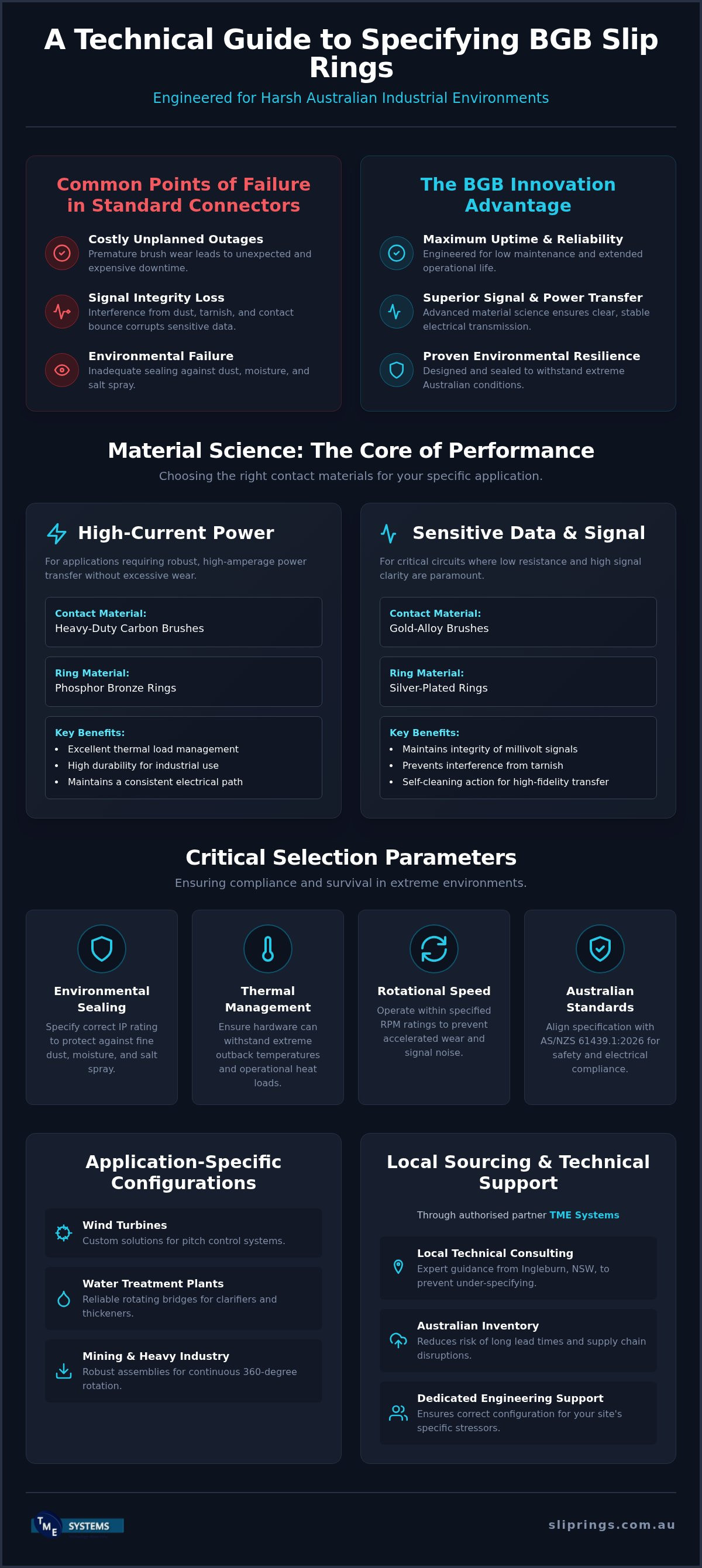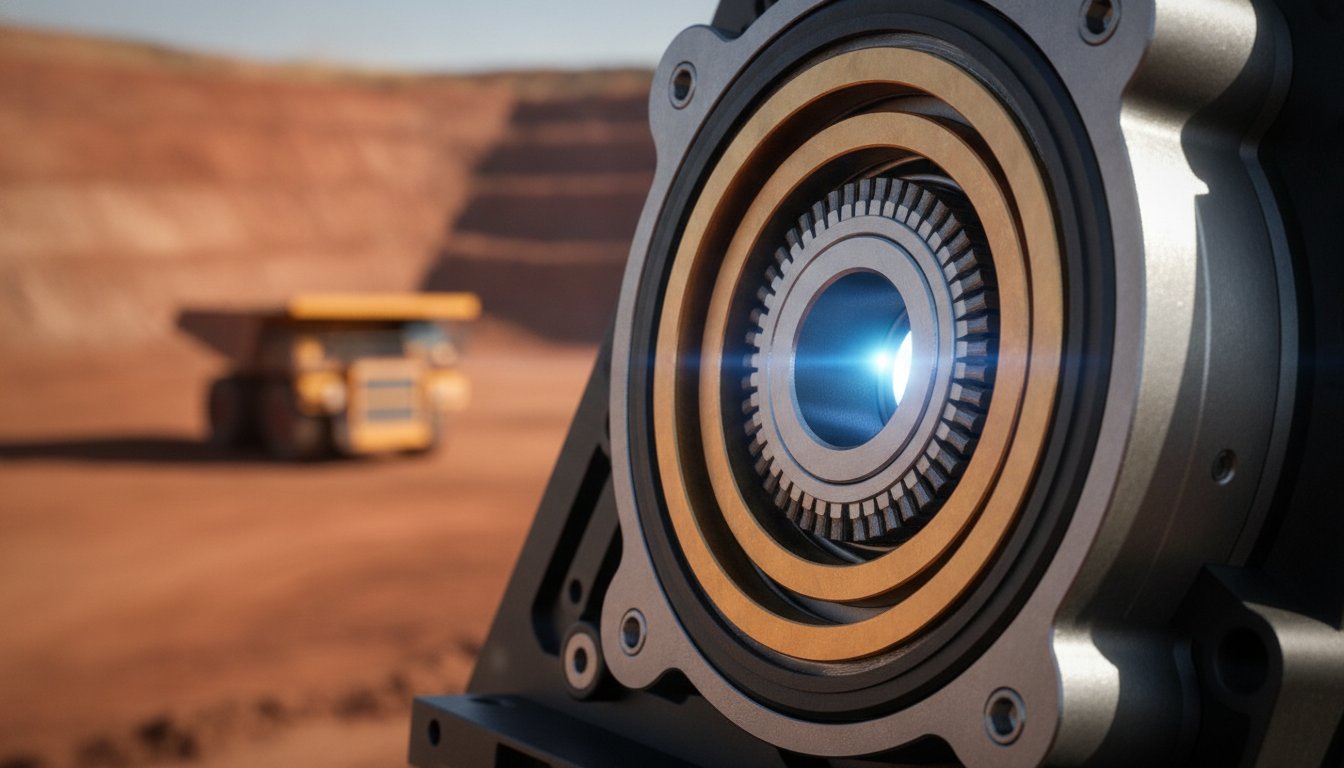
In the unforgiving conditions of an Australian mining site or wastewater facility, a single millimetre of premature brush wear can be the difference between peak operational efficiency and a costly, unplanned outage. You likely understand that standard rotary connectors often struggle when exposed to the relentless dust and thermal stress typical of local industrial environments. Maintaining clear signal integrity while transferring high-current power through rotating machinery is a persistent challenge for electrical engineers and procurement officers alike.
This technical guide explains how to accurately specify BGB Innovation slip rings Australia to eliminate these common points of failure and ensure your hardware remains compliant with AS/NZS 61439.1:2026 standards. We'll explore the material science behind BGB's phosphor bronze rings, the advantages of silver-to-silver contacts for sensitive data, and how a local supply chain through TME Systems reduces the risk of long lead times. By following this methodical approach to hardware selection, you can protect your uptime and streamline your maintenance cycles for even the most demanding rotary applications.
Key Takeaways
- Evaluate the material science of contact systems to determine whether precious metal or carbon brushes are required for your specific signal and power needs.
- Identify the necessary environmental sealing and thermal management parameters to ensure BGB Innovation slip rings Australia survive extreme outback temperatures.
- Explore custom configuration options for specialised sectors, including pitch control for wind turbines and rotating bridges for water treatment plants.
- Learn how to navigate the technical selection process to ensure compliance with the latest Australian safety and electrical standards.
- Maximise operational efficiency by utilising local technical consulting to prevent under-specifying hardware in data-sensitive applications.
Engineering Reliability: Why BGB Innovation Slip Rings Lead the Australian Market
BGB Innovation slip rings are specialised rotary interfaces engineered for continuous power and signal transfer. At its core, a slip ring is an electromechanical device that allows the transmission of power and electrical signals from a stationary to a rotating structure. In the Australian heavy industry sector, these components are critical for machinery that requires 360-degree rotation without the risk of cable tangling or mechanical fatigue. Many local engineering teams are moving away from generic collector rings in favour of BGB Innovation slip rings Australia because they offer a higher threshold for environmental resilience and mechanical precision.
The 'BGB Advantage' centres on a design philosophy that prioritises low maintenance and maximum uptime. Generic alternatives often fail prematurely due to poor brush-to-ring contact or inadequate sealing against the fine iron ore dust and salt spray common in local operations. TME Systems acts as the authorised technical partner for BGB Innovation in Australia, providing the necessary engineering oversight to ensure these units are configured for the specific stressors of your site. This partnership ensures that Australian projects receive the same level of technical support as those in the UK or Europe, backed by local inventory and application consulting based in Ingleburn, NSW.
The Role of Rotary Electrical Connectors in Modern Industry
Modern industrial applications have evolved beyond simple power transfer to include complex data and signal transmission. BGB hardware supports this transition by enabling 360-degree continuous rotation without inducing cable strain or signal attenuation. By integrating power and data into a single, robust assembly, these slip rings reduce the total cost of ownership. You aren't just buying a component; you're investing in a system that minimises unplanned downtime through superior material science and mechanical alignment.
Compliance with Australian Standards
Ensuring your rotary assemblies meet national safety requirements is a non-negotiable aspect of procurement. BGB's manufacturing processes are designed to align with AS/NZS 61439.1:2026, which is the current benchmark for low-voltage switchgear and controlgear assemblies in Australia. When specifying BGB Innovation slip rings Australia, engineering teams must consider the full operational profile, including peak current loads and environmental ingress protection. Sourcing through an authorised distributor ensures your hardware meets these rigorous site-specific regulations. This compliance is essential for maintaining safety protocols and ensuring your equipment remains operational under the scrutiny of national electrical audits.
Technical Specifications: Material Science and Signal Integrity
The operational life of a rotary interface is determined by the material science at the point of contact. When selecting BGB Innovation slip rings Australia, the choice of contact materials must align with the specific electrical requirements of the application. For high-power circuits, heavy-duty carbon brushes provide the necessary durability to handle high-amp transfer without excessive wear. In contrast, signal-critical circuits rely on precious metal technology to maintain low electrical resistance and high signal clarity. BGB utilises silver-plated rings paired with gold-alloy brushes to ensure that even millivolt signals remain free from the interference caused by contact bounce or surface tarnish.
Contact Materials and Brush Technology
The interaction between the brush and the ring is a dynamic process. BGB assemblies are engineered so the mechanical contact facilitates a self-cleaning action that prevents the build-up of non-conductive oxidation on the ring surface. While silver-plated systems excel in high-fidelity data transfer, high-current industrial power applications typically require the robustness of carbon-based brushes. These materials are selected for their ability to manage thermal loads while maintaining a consistent electrical path. Component longevity is also heavily influenced by the RPM rating; operating BGB Innovation slip rings Australia beyond their specified rotational speed can lead to accelerated brush wear and heat-induced signal noise. In demanding wind turbine designs, these units must balance high rotational speeds with the need for low-maintenance intervals over several years.
Data Transfer and IoT Compatibility
As Australian industrial sites transition toward Industry 4.0, the demand for IoT-compatible hardware has increased. BGB Innovation has addressed this by developing slip rings capable of handling high-speed data protocols such as Ethernet and Profinet alongside traditional power channels. To prevent electromagnetic interference (EMI) in these mixed-signal units, BGB employs sophisticated shielding techniques that isolate sensitive data circuits from high-voltage lines. This ensures that sensor data and control signals remain uncorrupted during rotation. If you're designing a system that requires integrated data and power, you can consult the technical specifications for BGB hardware to ensure your chosen unit provides the necessary shielding for your network architecture.
Application-Specific Configurations: From Wind Turbines to Water Treatment
Selecting the correct rotary solution requires a deep understanding of the mechanical and environmental variables unique to each sector. While the previous section detailed the material science of contacts, the physical configuration of the housing and mounting system is equally vital. BGB Innovation slip rings Australia are frequently deployed in environments where standard hardware would fail within months. Whether managing the high-vibration loads of a primary crusher in a Pilbara mine or the constant humidity of a metropolitan clarifier, the hardware must be tailored to the specific mechanical stressors of the site.
Renewable Energy: BGB's Global Wind Legacy
BGB Innovation has established itself as a preferred original equipment manufacturer (OEM) for the global wind industry. In these applications, slip rings facilitate pitch control and nacelle rotation, tasks that require absolute reliability in remote onshore and offshore locations. The engineering challenge involves managing high-current power transfer alongside sensitive data while protecting the assembly from lightning strikes. This level of complexity is why material and mechanical engineers prioritise BGB hardware for turbines where maintenance access is both difficult and expensive. For Australian wind farms, this means specifying units that can withstand high UV exposure and extreme thermal cycling without compromising signal integrity.
Geometry Constraints: Standard vs. Pancake Designs
Space limitations often dictate the form factor of a slip ring assembly. While standard cylindrical units are the default for most industrial shafts, 'Pancake' slip rings are engineered for height-restricted machinery where a vertical stack is not feasible. These flat, disc-like configurations provide a low-profile solution without sacrificing the number of available circuits. In contrast, through-bore designs allow for the passage of hydraulic or pneumatic lines through the centre of the assembly, which is common in automated packaging and heavy plant equipment. If your application requires a specific mounting footprint that falls outside the standard BGB range, you might learn more about Prosper Rotation's versatile mounting options to see if a different geometry better suits your shaft requirements.
Beyond these standard types, TME Systems assists Australian engineers in organising bespoke circuit counts and hybrid units. These custom configurations can combine high-power channels with fibre optic rotary joints or fluid swivels in a single housing. By acting as the technical intermediary, TME ensures that the final assembly is not only fit for purpose but also scalable for future system upgrades in water treatment bridges or mining conveyors.
Critical Selection Parameters for Harsh Australian Environments
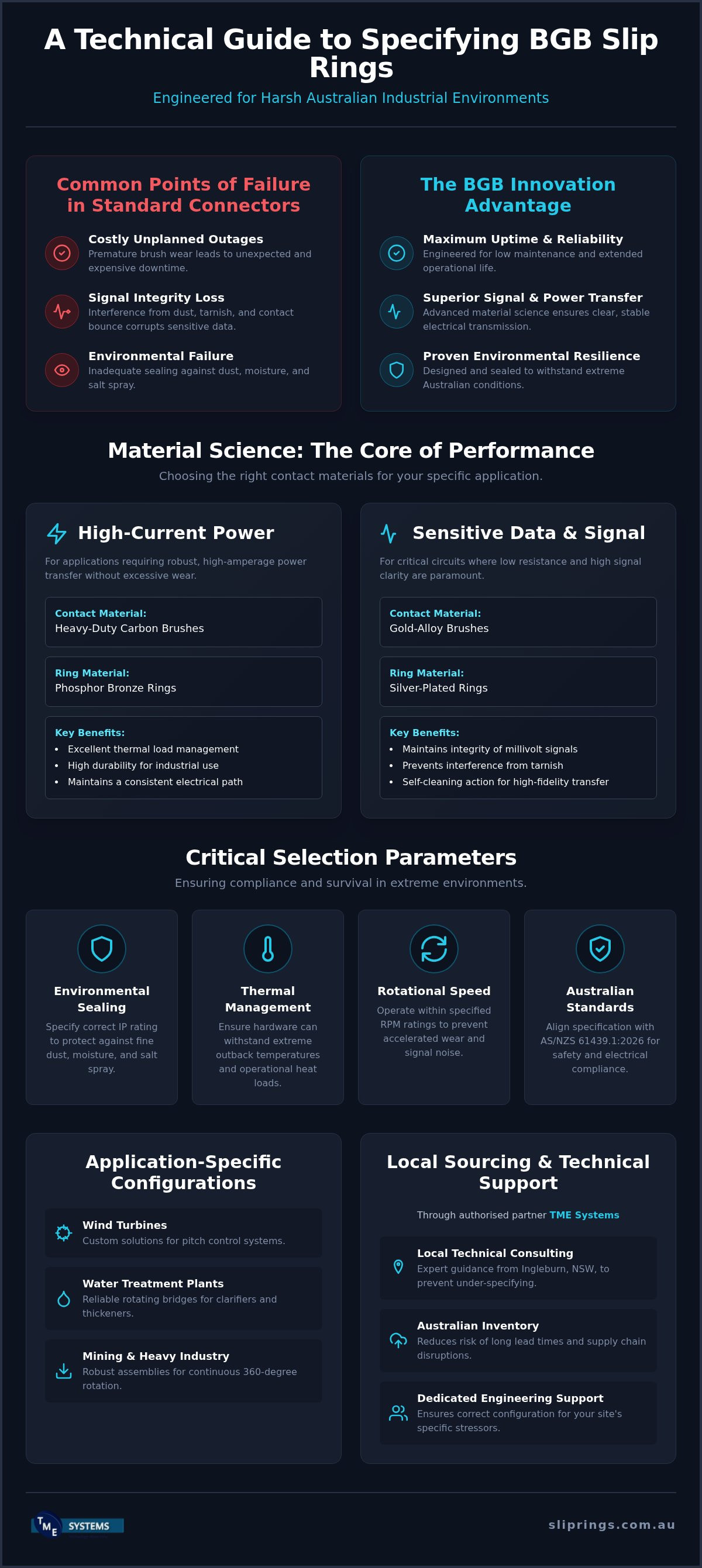
Environmental variables in Australia are often more extreme than those found in Northern Hemisphere manufacturing hubs. When specifying BGB Innovation slip rings Australia, engineers must account for high ambient temperatures and the abrasive nature of iron ore and coal dust. Selecting a standard unit without considering these factors leads to premature brush failure and increased electrical noise. Survival in these conditions depends on matching the hardware's ingress protection and thermal ratings to the specific mechanical stressors of the site.
The 'Australian Factor': Dust and Heat
Ingress protection is your first line of defence against component failure. While IP65 ratings are sufficient for most indoor industrial plants, outdoor mining or water treatment sites often require IP67 or IP68 protection to prevent moisture and fine particulates from entering the housing. Material choice is equally critical. Anodised aluminium provides a lightweight, cost-effective housing for many applications, whereas 316 stainless steel is preferred for coastal installations or chemical processing where corrosion resistance is paramount. Ambient temperature significantly impacts the maximum current capacity of the assembly; as the temperature rises, the electrical resistance of the contacts increases, necessitating a derating of the unit's power handling to prevent thermal damage.
A Professional Selection Checklist
To ensure the longevity of your rotary interface, follow this prioritised selection sequence during the procurement phase:
- Step 1: Define circuit count. Separate your high-current power requirements from low-voltage signal needs to determine the internal layout and required shielding.
- Step 2: Identify mounting constraints. Confirm the bore size for through-shaft mounting and the maximum overall diameter to ensure clearance within the machinery housing.
- Step 3: Evaluate environmental threats. Assess the likelihood of UV exposure, salt spray, or chemical contact to select the appropriate housing material and seal type.
Predicting maintenance intervals is a function of the duty cycle and the cleanliness of the operating environment. While BGB brushes are designed for extended service life, high-vibration sites or those with significant abrasive dust will require more frequent inspections. Monitoring the brush wear indicators allows maintenance teams to plan replacements during scheduled shutdowns rather than reacting to a catastrophic failure. If you are unsure which environmental rating is required for your specific site, you can request a technical application review from TME Systems to ensure your hardware is correctly specified for the task.
Sourcing BGB Innovation Hardware through TME Systems
Sourcing specialised industrial hardware from overseas often introduces risks related to logistics, currency fluctuations, and technical miscommunication. By procuring BGB Innovation slip rings Australia through TME Systems, you gain access to a local supply chain that understands the specific regulatory and environmental requirements of the region. TME Systems operates as an authorised distributor, providing a direct link between BGB's global engineering capabilities and the Australian and New Zealand industrial sectors. This local presence significantly reduces lead times compared to direct international shipping and ensures that technical support is available within your time zone.
Technical Application Consulting
To avoid costly specification errors, TME Systems provides technical application consulting as a core part of the procurement process. Professional consultation is necessary for non-standard rotary connections where circuit count, mounting geometry, or environmental sealing requirements fall outside the standard catalogue range. Our role as a technical intermediary ensures that you don't over-specify hardware, which saves on capital expenditure, or under-specify, which leads to premature failure. When requesting a quote, you should provide specific data points including the maximum operating current, voltage requirements, and peak RPM. This information allows our technical team to recommend the most resilient configuration for your machine. While BGB hardware is the benchmark for heavy-duty applications, you might also read our guide on Mercotac liquid metal rotary connectors if your project involves high-speed data transfer with zero maintenance requirements.
Partnering for Long-Term Performance
The relationship with TME Systems extends beyond the initial delivery of hardware. We provide post-purchase support and troubleshooting to ensure your rotating assemblies continue to meet performance benchmarks over their entire life cycle. For critical infrastructure, such as water treatment plants or renewable energy installations, ensuring the availability of spare parts is essential for minimising unplanned downtime. Our technical support team assists with site-specific challenges and helps maintenance managers predict brush replacement cycles based on real-world duty data. By partnering with a local specialist, you ensure that your procurement strategy is backed by engineering expertise rather than just a vendor relationship. You can contact TME Systems for a technical review of your slip ring application to begin the specification process for your next project.
Optimising Rotary Performance for Your Local Site
Achieving maximum uptime in rotating machinery requires more than just high-quality hardware; it demands a precise alignment between component specifications and environmental realities. By prioritising material science and proper ingress protection, you can eliminate the signal noise and brush wear that frequently plague heavy-duty operations. Integrating BGB Innovation slip rings Australia into your systems ensures your project aligns with current Australian industrial standards while benefiting from a robust local supply chain.
TME Systems, as the authorised Australian distributor, provides the expert application engineering support necessary to navigate these technical variables. Whether you're managing a remote wind farm or a metropolitan water treatment plant, our team is ready to assist with custom circuit configurations and site-specific hardware selection. This methodical approach ensures your rotary solutions are both reliable and compliant with local regulations from the outset.
Request a Technical Consultation for BGB Innovation Slip Rings
We look forward to helping you solve your most complex rotary engineering challenges with precision and reliability.
Frequently Asked Questions
What are the main advantages of BGB Innovation slip rings for Australian industry?
BGB Innovation slip rings Australia provide high environmental resilience and superior signal integrity in harsh conditions. These units are engineered to withstand the abrasive dust and extreme thermal cycles common in local mining and renewable energy sites. Their modular design allows for the precise customisation of power and data channels, ensuring they don't require unnecessary over-specification. It's a design approach that prioritises mechanical requirements while protecting sensitive signals from interference.
How do I determine the correct IP rating for a slip ring in a mining environment?
Determining the correct IP rating requires assessing the exposure to fine particulates and high-pressure water on-site. For most Australian mining applications involving iron ore or coal dust, an IP65 rating is the minimum requirement for indoor plants, while IP67 or IP68 is necessary for outdoor equipment to prevent abrasive ingress. Consult with a technical engineer to evaluate your specific site stressors and thermal variables before finalising the enclosure specification for your hardware.
Can BGB slip rings handle both high-power and sensitive data signals in one unit?
Yes, BGB slip rings can integrate high-amp power channels with sensitive data protocols like Ethernet or Profinet in a single assembly. This is achieved through advanced shielding techniques that isolate data circuits from electromagnetic interference generated by power lines. Using silver-to-silver contacts for data channels ensures high-speed transmission is maintained without signal corruption during 360-degree rotation. This integrated approach simplifies machine design and reduces the total footprint of the rotary interface.
What is the typical maintenance interval for a BGB heavy-duty slip ring?
Maintenance intervals depend on the duty cycle, rotational speed, and environmental cleanliness of the installation. While BGB units are designed for long-term reliability, a standard inspection every six to twelve months is recommended for heavy-duty industrial applications. Monitoring brush wear indicators allows your team to schedule maintenance during planned shutdowns, preventing the risk of unplanned downtime in critical infrastructure. In dusty environments, more frequent checks may be required to clear debris and ensure optimal contact.
Are BGB Innovation slip rings compliant with AS/NZS 61439 standards?
BGB Innovation hardware is designed to support compliance with AS/NZS 61439.1:2026 for low-voltage switchgear and controlgear assemblies. TME Systems provides technical consulting to ensure that the specified slip ring meets the necessary current-carrying capacity and safety requirements for Australian industrial sites. Ensuring your rotary components align with these national standards is essential for passing electrical audits and maintaining site safety. Correct specification prevents the legal and operational risks associated with using non-compliant rotary electrical connectors.
How does RPM affect the choice of a BGB slip ring assembly?
Rotational speed directly influences the rate of brush wear and the amount of frictional heat generated within the assembly. Higher RPM ratings require specific material choices, such as silver-plated rings and gold-alloy brushes, to maintain signal integrity and manage thermal loads. Exceeding the rated RPM of a standard unit can lead to accelerated component fatigue and increased electrical noise, which compromises data accuracy. Engineers must specify the maximum operating RPM to ensure the internal geometry is balanced correctly.
What is the difference between a standard slip ring and a collector ring?
A standard slip ring is typically a complete electromechanical assembly designed to transfer both power and complex signals through continuous rotation. Collector rings are often simpler components used primarily for power transfer in applications like AC motors. BGB's solutions are engineered as integrated systems that handle mixed-signal requirements, providing much higher precision than a basic collector ring. This distinction is critical when your machinery requires the transmission of sensitive sensor data or high-speed communication protocols.
How can I source BGB Innovation slip rings in Australia?
You can source the full range of BGB Innovation slip rings Australia through TME Systems, the authorised distributor for Australia and New Zealand. Our team based in Ingleburn, NSW, provides technical application consulting to help you select and configure the correct hardware for your project. Sourcing locally ensures you receive technical support in your time zone and reduced lead times. It's a reliable supply chain for both replacement units and new custom assemblies.