Could a missing operating detail lead to the wrong rotary connector being selected? Matching a BGB slip ring to equipment involves more than identifying circuit count. Electrical, mechanical and environmental requirements all shape the choice. When searching for a BGB slip ring distributor Australia-wide, look for support that helps clarify those requirements before the final engineering review.
If you’re unsure whether a slip ring, collector ring or another rotary connection technology suits your equipment, start by defining what must cross the rotating interface. TME Systems supplies BGB Innovation slip rings to customers across Australia and provides technical application consulting to help assess product selection against the application.
This guide explains what to include in a technical brief, from current, voltage and rotational speed to mounting and operating conditions. It also compares slip rings with other rotary electrical joint options, helping your team prepare clear requirements for the final engineering review.
Key Takeaways
- Assess electrical, mechanical and environmental requirements together when matching a rotary connector to machine duty.
- Compare connector types by transfer needs, signal sensitivity, current demand and mounting requirements.
- Prepare a selection brief with circuit count, current, voltage, rotational speed rating, signal type, mounting and operating conditions.
- TME Systems supplies BGB Innovation slip rings and supports selection for applications across Australia.
- A clear application brief gives the final engineering review practical information to assess product fit.
What does a BGB slip ring distributor in Australia help you solve?
A slip ring provides an electrical connection between stationary and rotating parts, allowing power or signals to pass across a rotating interface. The assembly must suit the equipment’s duty, not just its brand. For a basic explanation of the device and its general applications, see What is a slip ring?
Selection involves more than electrical requirements. Current, voltage and circuit count need to be considered alongside rotation, mounting space and operating conditions. A product that meets the electrical brief may still be unsuitable for the machine’s layout or environment. A brand name alone does not establish product fit.
When is a BGB slip ring relevant to industrial equipment?
A slip ring may suit equipment that needs an electrical connection across a rotating interface. BGB’s published application sectors include wind power, construction and water treatment. Equipment and operating duties vary across these sectors, so these examples provide context rather than proving that one assembly suits every machine. Depending on the design, the interface may need to transfer power, control signals or other signals during rotation.
What does an Australian distributor contribute?
TME Systems supplies BGB Innovation slip rings to customers across Australia and provides technical application consulting for product selection. The selection process considers electrical, mechanical and environmental requirements together, so the final engineering review can assess product fit against the information provided.
A distributor helps translate an application’s operating requirements into a more informed rotary connector selection. This support can help engineering and procurement teams work from the same specification. TME Systems supplies BGB Innovation slip rings, with selection guided by the application rather than assumptions about a standard configuration.
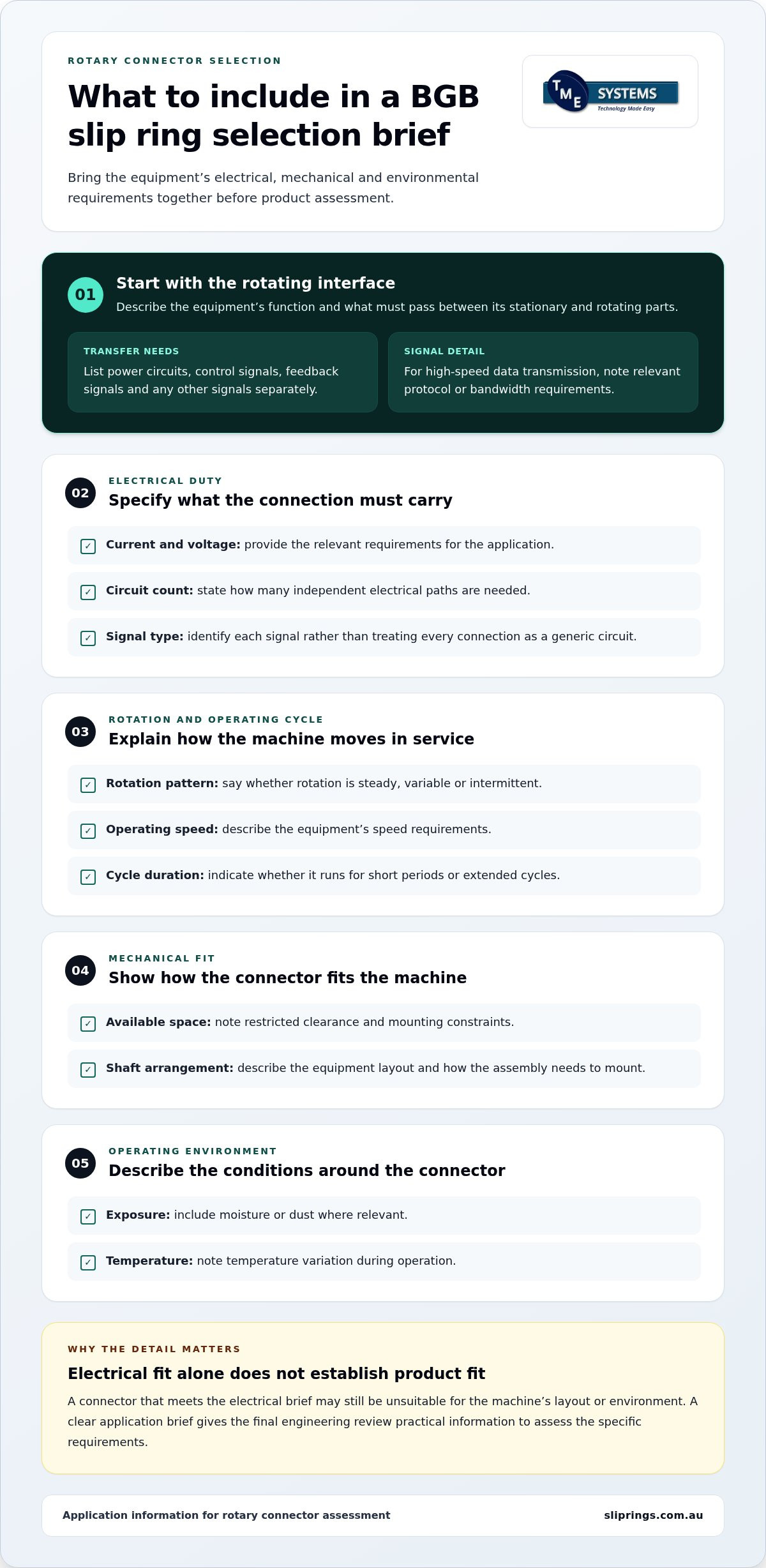
To make the discussion useful, describe the equipment’s function and what must cross the rotating interface. Then outline the conditions that affect selection:
- Electrical duty: Identify the power or signals to be transferred, with the relevant current and voltage.
- Rotation: Describe how the machine moves and its operating speed.
- Mechanical fit: Note available space, shaft arrangement and mounting constraints.
- Environment: Describe the conditions around the connector during operation.
These details help frame selection without assuming that equipment in the same industry needs the same solution. TME Systems uses application information to guide BGB product selection and support the final engineering review. The next step is to relate the machine’s specific demands to the connector requirements.
How BGB slip rings relate to application demands
Two machines with similar functions can place different demands on their rotary electrical joint. For example, an intermittently moving rotating table has a different operating pattern from a continuously rotating shaft. Describe how the equipment behaves in service, not just its general purpose. That context helps relate transfer needs and operating conditions to product selection.
Consider how the operating cycle affects the electrical interface. Rotation may be steady or variable, and the equipment may run for short periods or extended cycles. The installation matters too: restricted clearance, exposure to moisture or dust, and temperature variation can affect the requirements to assess. Include these details in the application brief.
Map the equipment duty to the rotary interface
Describe each transfer need separately. Power circuits, control signals and feedback signals have different functions, while high‑speed data transmission may have specific protocol or bandwidth requirements. Identifying each need helps focus the technical discussion on signal type and operating conditions instead of treating every connection as a generic circuit.
Define the machine’s operating duty before comparing product configurations. Include the rotation pattern, expected operating cycle, mounting constraints and conditions that could affect the assembly. For background on rotating electrical connections and their applications, this overview of rotating electrical slip ring connectors offers additional context. Use general information to shape the brief, then assess the specific application on its own requirements.
Separate slip rings from related rotary technologies
Choose the connection technology according to what must cross the rotating boundary. An electrical slip ring transfers electrical circuits; a rotary union transfers fluid. An optical rotary joint is relevant when the application requires an optical signal path. If a machine has more than one transfer requirement, identify each separately rather than assuming one device can meet them all.
Contact method and form factor are separate considerations. A conventional electrical slip ring and liquid metal rotary connectors use different contact approaches, while a through-bore design describes a mounting form with a hollow centre. These terms describe different selection criteria; none alone establishes suitability for a particular duty.
Once the transfer needs and operating conditions are clear, the BGB Innovation slip ring range provides manufacturer context for selection. TME Systems’ application consulting uses the brief to guide product assessment, keeping the discussion focused on the machine’s requirements.
BGB slip ring or another rotary connector: compare the requirements
Connector categories address different transfer needs. Comparing them by function helps narrow the options, but does not establish whether a particular assembly suits the machine. A BGB slip ring distributor Australia-wide can use the application brief to relate these distinctions to product selection and the equipment’s duty.
Compare connector categories by function
Use this table to identify which requirements matter for the application. It describes technology categories, not specifications or ratings for a particular BGB product.
| Connector type | Transfer medium | Current and signal considerations | Mounting and environment |
|---|---|---|---|
| Electrical slip ring | Electrical power and signal circuits | Assess current, voltage, circuit count and signal sensitivity separately. | Form and mounting must suit available space and the machine layout. |
| Collector ring | Electrical power, typically for demanding current duties | Collector ring vs slip ring: collector rings are heavy-duty rotary connectors designed for high current capacity, whereas standard slip rings are typically optimized for signal integrity and lower currents. | Assess the installation and operating environment against the specific assembly. |
| Liquid metal rotary connectors | Electrical continuity through liquid metal contacts | Brushless rotary connectors that use a pool of conductive liquid metal to maintain electrical continuity, eliminating wear and reducing noise. This is a separate contact approach, not an assumed feature of BGB slip rings. | Review mounting and environmental conditions for the specific technology and application. |
| Rotary union | Fluid transfer across a rotating interface | Its transfer function is fluid, not electrical circuit transmission. | Consider the fluid connection and mechanical arrangement required by the equipment. |
Mounting is separate from contact method. A through-bore slip ring has a hollow centre for shaft integration or to accommodate auxiliary components such as hydraulic lines. This describes a form factor, not a specific BGB configuration or a substitute for assessing the required transfer medium.
Compare operating conditions before selecting a category
Keep operating parameters distinct in the selection brief. The rotational speed rating concerns permissible operating speed; current and voltage describe electrical load; circuit count identifies the independent paths required. Signal sensitivity matters too, since power transfer and low-level signals can place different demands on an electrical interface.
- Speed and load: Record operating speed alongside current and voltage, rather than treating them as one capacity question.
- Circuits and signals: State the required circuit count and identify signal types, especially where signal integrity or high‑speed data transmission matters.
- Environment and heat: An IP rating defines protection against dust and water ingress. Thermal management covers techniques used to control temperature rise during operation.
- Fit: Note mounting space and shaft arrangement before comparing form factors.
These comparisons guide assessment; they do not replace a product-specific engineering review. TME Systems supplies BGB Innovation slip rings and provides technical application consulting to relate requirements to selection. Compare connector categories against the same machine duty, operating conditions and transfer needs before deciding which option merits engineering review.
How to prepare a BGB slip ring selection brief
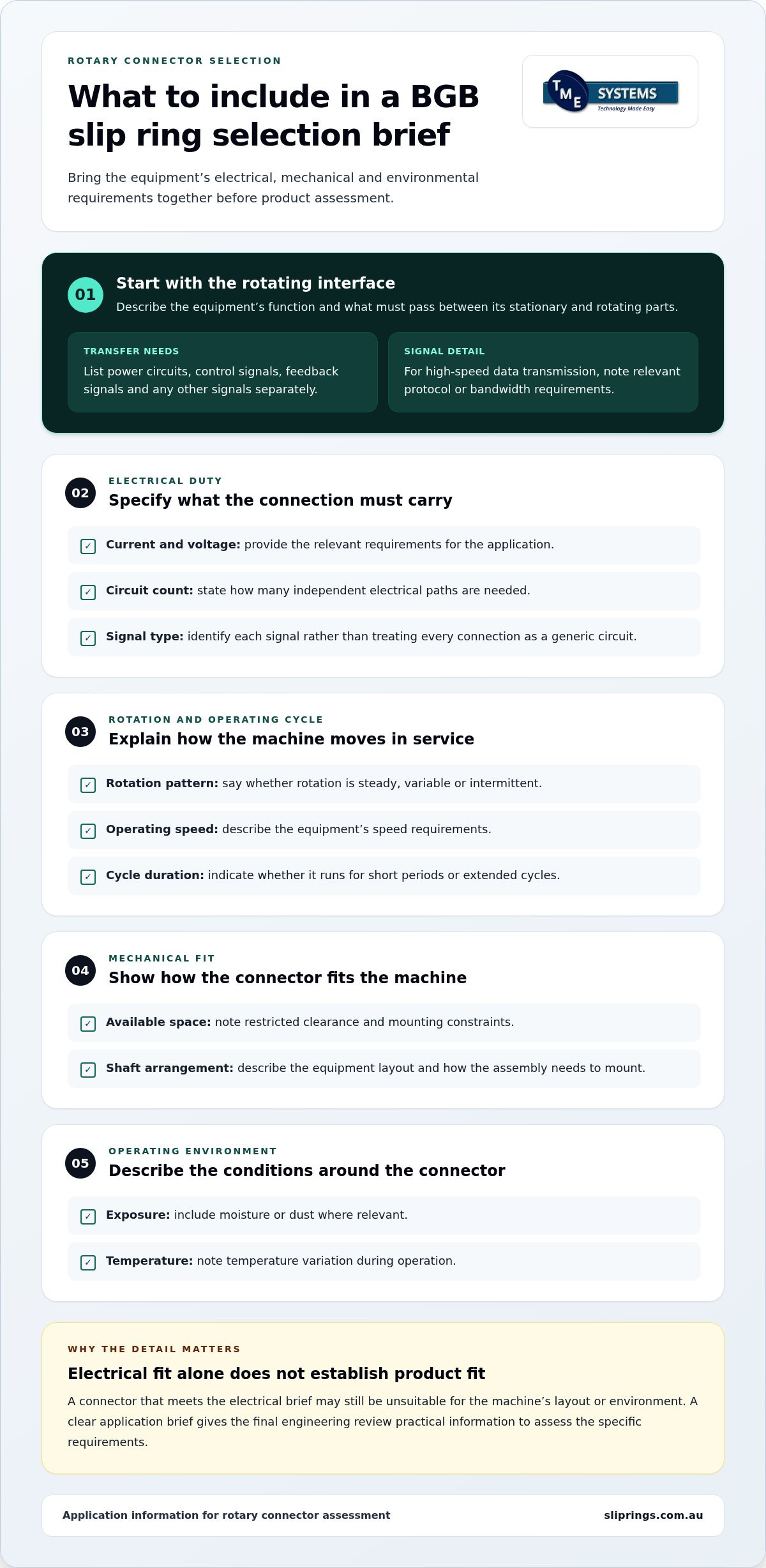
A useful brief gives TME Systems the application detail needed to guide BGB slip ring selection and support a final engineering review. Record measured requirements where available, and distinguish confirmed values from estimates or design targets. A broad description such as “industrial use” is not enough to establish which assembly suits the machine.
Organise the information so the equipment duty and connector requirements are easy to assess:
- Equipment function: Describe the machine, what it does and what the rotary interface must enable during operation.
- Rotation: State whether rotation is continuous or intermittent, the operating speed and the expected duty cycle.
- Electrical circuits: List each power, control and signal requirement, including circuit count, operating current and voltage.
- Mounting: Record available space, shaft arrangement, orientation and physical constraints around the assembly.
- Environment: Describe exposure to dust, water, temperature variation or other conditions that could affect operation.
Record electrical and signal requirements
Keep electrical values separate. Provide operating current and voltage for the relevant circuits, and specify whether each carries power, control or a signal. For signals, include the type and any sensitivity requirements. If high‑speed data transmission is needed, identify the protocol or bandwidth requirement rather than describing it only as “data”. This helps the review assess different circuit functions without assuming a default configuration.
Record mechanical and environmental conditions
Include the mounting arrangement, available clearance, rotational speed rating and how the equipment operates across a normal cycle. Describe exposure conditions and state the required IP rating, if applicable. If temperature may affect performance, provide the expected operating range and note any thermal management needs. Thermal derating is the reduction of allowable current based on increased ambient temperature to prevent overheating; thermal expansion can also affect fit as materials warm during operation.
Attach a drawing or layout if it helps explain shaft position, cable routing and clearance. Flag uncertainties, such as speed that varies by operating mode or an environment with changing exposure. A well-organised brief lets the application review focus on points that need engineering judgement.
TME Systems’ technical application consulting uses details such as circuit count, current, voltage, speed, mounting and environment to inform selection. For further preparation, consult the slip ring application engineering guide alongside the BGB Innovation slip ring information. The guide can help structure the technical discussion, while the final engineering review assesses product fit against the specific application.
Review BGB slip ring selection information as you prepare your application details.
Source BGB Innovation slip rings in Australia with TME Systems
Moving from an application brief to a product decision means resolving uncertainties before settling on a configuration. A final engineering review considers whether the documented operating conditions and connection needs align with the product information. It can also highlight assumptions that need clarification, keeping the selection tied to the equipment’s actual duty.
Use the review to distinguish confirmed design requirements from open questions. Missing signal details, uncertain operating conditions or an incomplete mechanical drawing may affect how product fit can be assessed. Identify these gaps early to give the discussion a clear technical basis.
What the technical review should resolve
The review should establish whether the available information is sufficient to assess fit and identify outstanding points that could affect the decision. Check that the application brief reflects the machine’s intended operation, not only its nominal design conditions.
- Requirement status: Which values are confirmed, estimated or still undecided?
- Design constraints: Are there physical or operating limits that could affect the configuration?
- Supporting details: Would drawings or interface information clarify the proposed arrangement?
These questions help focus the engineering assessment. For manufacturer context, the BGB Innovation slip ring range relates to the product under consideration. Product information should be assessed against the application, not treated as a substitute for the review.
Move from requirements to a supply discussion
Bring the equipment purpose, connection needs, installation constraints and operating conditions together in a concise brief. Include relevant drawings and mark estimated values clearly. This gives the discussion a defined starting point and helps separate technical questions from procurement decisions.
Once unresolved requirements are visible, the project team can focus on the engineering decisions and information needed to progress. A well-prepared brief also makes it easier to discuss how the intended operating conditions relate to a BGB product option without presuming a configuration before assessment.
Share the application brief and relevant drawings with TME Systems to discuss the requirements that matter to your equipment and assess product fit.
Turn your application brief into a clear next step
Engineering and procurement decisions are connected, but distinct. Use the final review to clarify what the project needs to resolve before carrying a product choice into design documentation. This gives engineers and procurement teams a shared basis for progressing the decision.
For a BGB slip ring distributor Australia project, the practical focus is not simply choosing a product category. It is making sure the decision reflects the equipment’s intended role and the design priorities that matter to the project. Keep the rationale with the brief so future reviewers can understand the basis for the selection.
Explore slip ring selection information as you plan the next engineering step. A clear record of the decision helps your team move forward with the relevant requirements in view.
Frequently Asked Questions
Is BGB Innovation a slip ring manufacturer?
Yes. BGB Innovation manufactures slip rings and rotary connection products. TME Systems distributes BGB Innovation slip rings to Australian customers and supports product selection; it is not the manufacturer. Keeping the roles clear helps during procurement: BGB is the product manufacturer, while TME Systems can relate application information to a selection discussion. For a specific assembly, use its product information and the application requirements rather than assuming all BGB products share the same capabilities.
Can a BGB slip ring transfer power and signals at the same time?
An assembly may be able to carry power and signals together, but suitability depends on its circuit design and the requirements of each circuit. For example, a machine may need power for a drive and separate control or feedback signals. Include the signal type, electrical values and any signal-integrity requirements in the application brief. Confirm suitability through a product-specific engineering review.
What information should I provide when requesting a BGB slip ring recommendation?
Provide the equipment function, rotation pattern, speed, mounting arrangement and operating environment, then describe each electrical circuit group. State the circuit count, operating current and voltage, and identify signal types or protocol and bandwidth needs for data. A BGB slip ring selection review is more useful when the brief distinguishes measured values from estimates. Include a drawing or layout if it clarifies shaft fit, clearances or cable routing.
Is a rotary union the same as an electrical slip ring?
No. A rotary union transfers fluid across a rotating interface, while an electrical slip ring carries electrical circuits. They address different transfer functions, so one should not be specified as a substitute for the other. If equipment needs both electrical and fluid connections across rotation, describe each requirement separately in the system brief. This helps the engineering review consider how the interfaces fit the machine’s design and operating conditions.
Does a through-bore slip ring fit directly over a rotating shaft?
It can be mounted over a shaft because its central bore provides space for shaft integration. Whether a particular unit fits depends on the shaft dimensions, available clearance, mounting arrangement and specified bore size. Include a drawing or measured dimensions with the application details so the fit can be assessed. The term describes the form factor; it does not establish the dimensions or compatibility of a particular slip ring.
What does AS/NZS 5368:2025 mean for selecting a BGB slip ring?
AS/NZS 5368:2025 addresses electrical equipment in mines and quarries. If the equipment will operate in one of these environments, identify that context in the application brief so its relevance can be considered during engineering review. The standard’s mention alone does not show that a particular BGB slip ring complies with it or is suitable for the application. Any compliance statement needs product-specific evidence and assessment against the project requirements. Include the operating context in your brief and discuss the application with TME Systems.