Standard rotary brush assemblies cannot preserve the 100-ohm differential impedance required for real-time industrial Ethernet protocols. If your rotating machinery suffers from intermittent packet drops, fieldbus watchdog timeouts, or electrical noise, you know how quickly dynamic contact resistance spikes disrupt production. When specifying an Ethernet slip ring Australia engineering teams can depend on, you must look beyond basic circuit counts and resolve dynamic electrical noise, shielding, and environmental factors directly.
This guide shows you how to specify the correct rotary joint for high-speed industrial data transmission across demanding Australian operating environments. We examine how to evaluate contact technologies for Profinet and EtherCAT, match through-bore or capsule form factors to equipment geometry, and isolate mixed power channels to ensure compliance with AS/NZS 3000:2018 without sacrificing signal integrity.
Key Takeaways
- Determine whether your network demands a 4-ring 100BASE-TX or an 8-ring Gigabit configuration to sustain uninterrupted transmission across rotating joints.
- Prevent electromagnetic interference in hybrid units by specifying grounded barrier shielding between high-voltage power lines and sensitive data pairs.
- Compare through-bore vs capsule slip rings to align connector geometry with central drive shafts or compact end-of-shaft spaces.
- When selecting an Ethernet slip ring Australia industrial sites require, verify the IP rating and apply thermal derating for severe dust and ambient heat.
- Minimise integration risks by validating operational speed, duty cycle, and circuit counts through technical application consulting before procurement.
Technical Criteria for Selecting an Ethernet Slip Ring in Australia
Hobby-grade rotary connectors fail under the physical rigours of factory automation, while heavy crane reels often overlook precision data requirements. Specifying an Ethernet slip ring Australia engineering projects require means balancing rotational stability with signal preservation. A rotary electrical joint must maintain uniform contact resistance through continuous 360-degree rotation. Any transient drop in conductivity corrupts digital packets, resulting in fieldbus dropouts and halted machinery.
Defining Bandwidth and Transmission Speed Requirements
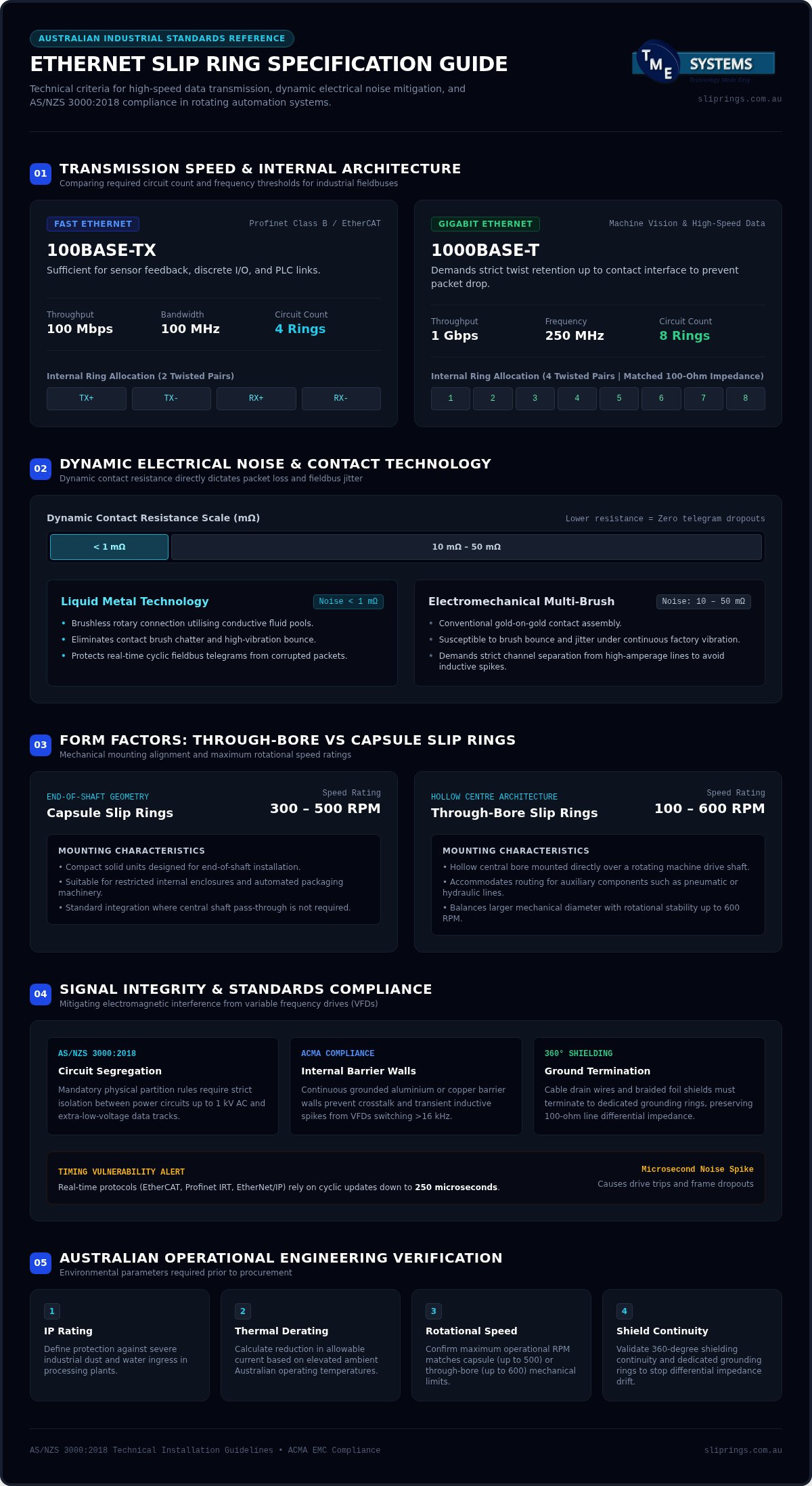
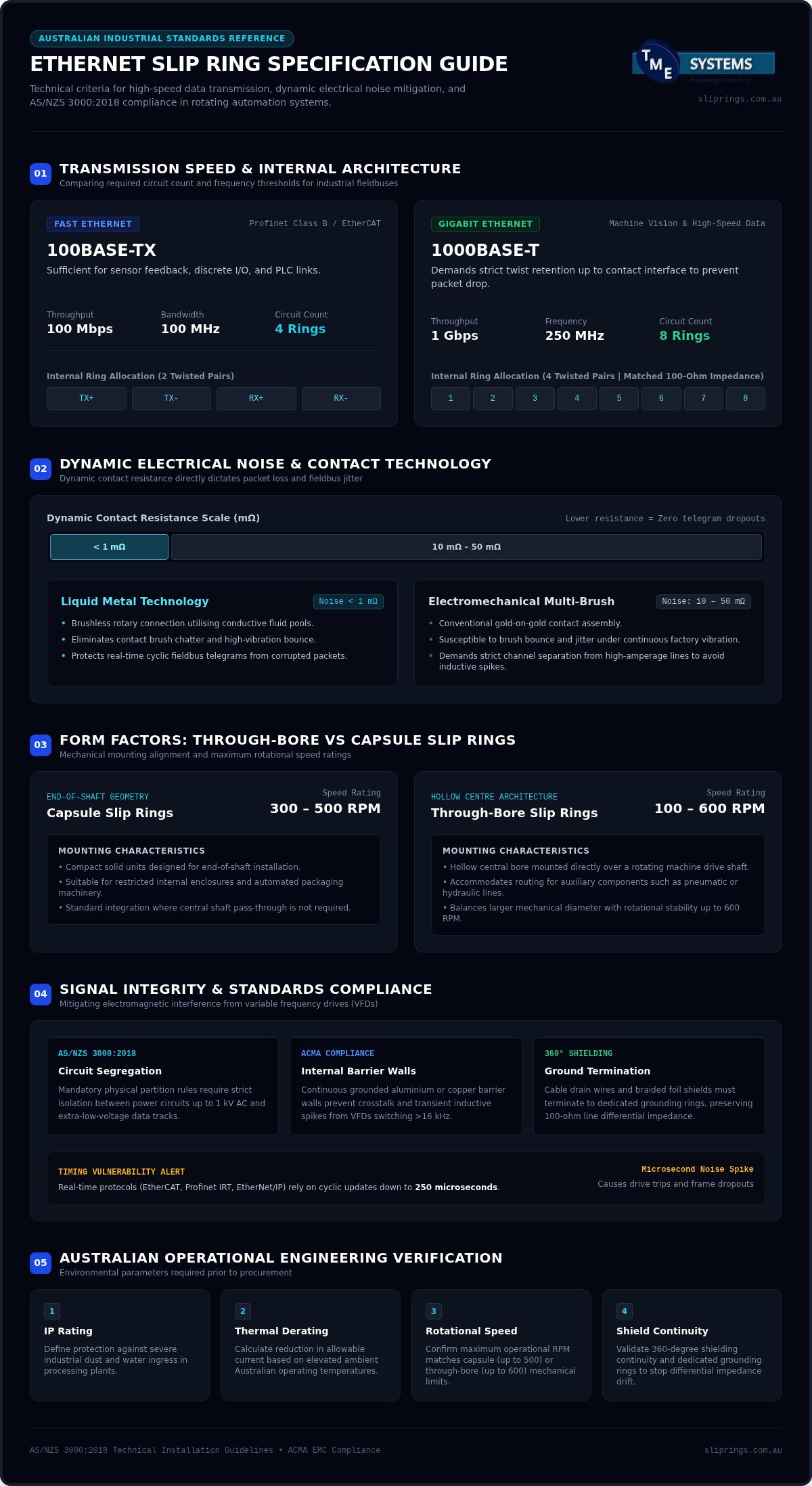
Selecting the right internal architecture starts with your network protocol. Standard 100BASE-TX fast Ethernet, widely used in Profinet Class B and EtherCAT networks, operates over two twisted pairs and requires four dedicated contact rings. In contrast, 1000BASE-T Gigabit systems transmit over four pairs across eight rings, running at frequencies up to 250 MHz.
- 100BASE-TX (100 Mbps): Uses 4 circuits across a 100 MHz bandwidth, sufficient for basic sensor feedback and programmable logic controller (PLC) links.
- 1000BASE-T (1 Gbps): Demands 8 circuits, matched 100-ohm differential impedance, and strict twist retention up to the contact interface to stop packet loss.
- Mechanical limits: Standard capsule assemblies handle rotational speed ratings up to 300 to 500 RPM, whereas hollow through-bore designs generally operate between 100 and 600 RPM.
Managing Electrical Noise and Contact Resistance
Dynamic contact resistance introduces jitter and phase errors across high-speed data transmission lines. While conventional electromechanical slip rings use gold-on-gold multi-brush contacts to limit electrical noise between 10 mΩ and 50 mΩ, high-vibration equipment can still cause brush bounce. Separating data tracks from high-amperage lines prevents inductive spikes from distorting sensitive digital edges.
Where dynamic electrical noise must remain under 1 mΩ, liquid metal technology offers a brushless alternative. Units such as Mercotac slip rings use a pool of conductive fluid to create an uninterrupted molecular connection. This eliminates contact brush chatter, protects real-time industrial fieldbuses from packet corruption, and delivers noise-free signals without ongoing contact maintenance.
Signal Integrity: Mitigating Interference in Mixed Power and Data Assemblies
Combining three-phase motor lines and sensitive fieldbus cabling inside a single housing creates severe electromagnetic coupling risks. Variable frequency drives switch high currents at frequencies exceeding 16 kHz, inducing high-voltage transient spikes across nearby channels. When integrating an Ethernet slip ring Australia installations require physical separation and tailored shielding architectures to prevent packet destruction and fieldbus dropouts.
Internal Shielding and Channel Isolation Techniques
Standard brush assemblies route data and power tracks along adjacent copper paths, creating parasitic capacitance. Reliable hybrid units eliminate this crosstalk by incorporating continuous grounded aluminium or copper barrier walls between the power stack and the digital channels. This arrangement aligns your machine design with mandatory ACMA electromagnetic compatibility compliance standards.
- Shield continuity: Cable drain wires and braided foil shields must terminate directly to dedicated grounding rings, preserving 360-degree shielding through the interface.
- Lead wire geometry: Differential data pairs must retain their uniform twist up to the contact termination points to preserve 100-ohm line impedance.
- Segregation compliance: Clear physical isolation between circuits up to 1 kV AC and extra-low-voltage data paths satisfies the mandatory physical partition rules of AS/NZS 3000:2018.
Compatibility with Industrial Ethernet Protocols
Real-time motion control demands continuous deterministic communication. Industrial protocols like EtherCAT, Profinet IRT, and EtherNet/IP rely on cyclic updates down to 250 microseconds. An electrical noise burst lasting only several microseconds will corrupt a cyclic telegram, tripping safety drives or freezing automated indexing tables. High-resolution machine vision systems experience frame drops if return loss spikes across the dynamic rotating contact interface.
Deploying hybrid equipment calls for careful channel planning. If your application combines servomotor circuits, 24 V DC safety signals, and Gigabit camera lines, review your layout against experienced technical application consulting before finalising fabrication specs. Custom multi-channel assemblies from Prosper Rotation slip rings provide isolated Ethernet modules configured with factory-tested near-end crosstalk attenuation to isolate vulnerable communication loops completely.
Form Factors: Through-Bore vs Capsule Slip Rings for Data Transfer
Selecting an Ethernet slip ring Australia operations can rely on requires balancing mechanical packaging against electrical isolation. Choosing between through-bore vs capsule slip rings determines how your assembly integrates with existing drive systems, cooling conduits, or pneumatic lines. Machine builders must examine mechanical runout, shaft concentricity, and thermal expansion to ensure high-speed data transmission remains stable across long operating cycles.
Through-Bore Slip Ring Configurations
A through-bore slip ring features a hollow centre designed to slide directly over a rotating machinery shaft, hydraulic swivel, or pneumatic feeder. Concentric mounting avoids offset loads, but it demands careful planning around internal clearances:
- Clearance allowances: Bore diameters range from 12 mm up to several hundred millimetres. The internal sleeve must accommodate drive-shaft thermal expansion during continuous running.
- Heat dissipation: Locating Ethernet channels on the outer circumference keeps sensitive twisted pairs isolated from conductive heat generated by drive motors and journal bearings.
- Rotational speed caps: Due to larger track circumferences and higher surface speeds, through-bore units typically run between 100 and 600 RPM.
Compact Capsule Units for Tight Enclosures
Capsule slip rings package brush contacts and slip rings inside a compact, solid-end casing designed for end-of-shaft installation. These self-contained units suit robotics, automated turntables, and vision inspection platforms where radial space is restricted. Because the outer diameter remains small, capsule units manage rotational speed ratings up to 300 to 500 RPM with minimal brush friction. Factory-fitted flying leads or standard RJ45 connections eliminate terminal-block terminations within cramped junction enclosures, preserving original impedance.
Custom Modular Systems for Hybrid Services
Complex automated equipment frequently requires fluid lines, motor power, and data lines inside one rotating envelope. A modular system lets designers combine high-current circuits, Ethernet paths, and optical or fluid joints without compromising signal integrity.
Engineers can specify modular platforms from Prosper Rotation slip rings to match precise circuit counts and mixed electrical loads. For heavier industrial machinery such as bulk stackers or slip ring systems with large power demands, hardware from BGB Innovation slip rings delivers rugged utility. Aligning your structural layout with the Safe Work Australia model code of practice for electrical risks ensures that multi-service rotary joints maintain mechanical and electrical safety across heavy-duty environments.
Environmental Protection and Australian Operating Conditions
Operating an Ethernet slip ring Australia industrial sites deploy means confronting extreme environmental stressors. Red dust across mining corridors, salty spray along coastal ports, and unshaded manufacturing plants regularly subject rotating equipment to temperatures above 45 °C. Without correct ingress sealing and thermal planning, fine airborne particles contaminate internal contact tracks, creating microscopic contact bounce that corrupts network packets.
Ingress Protection: IP65 and IP67 Enclosure Standards
Factory washdown zones and exposed extraction plants require verified enclosure integrity under AS 60529:2025. Standard IP51 or IP54 enclosures don't prevent airborne silica or direct moisture from entering internal tracks. Specifying an IP65 or IP67 IP rating ensures dynamic shaft seals block fine particulate ingress without binding the shaft or increasing rotational friction. For coastal processing facilities or washdown environments, selecting marine-grade 316 stainless steel or hard-anodised aluminium housings stops exterior corrosion from compromising internal contact assemblies.
Thermal Management in High Ambient Facilities
Electrical resistance from adjacent power channels combined with brush friction creates rapid heat build-up inside enclosed housings. In unconditioned sheds during Australian summer peaks, slip ring internal temperatures can exceed safe operating limits. To protect high-frequency signal transmission in an Ethernet slip ring Australia facilities rely on, engineers must apply thermal derating, reducing maximum current allowances by 20% to 40% when operating near the rotational speed rating.
- Heat dissipation: Arrange external heat sinking or select housings with increased surface area to dissipate internal thermal loads.
- Installation compliance: Follow AS/NZS 3000:2018 wiring rules to ensure conductor sizing accounts for elevated ambient temperatures inside junction boxes.
- Extraction sites: For surface or underground mining apparatus, verify your equipment assembly meets the mandatory criteria set out in AS/NZS 5368:2025.
Before installing rotary equipment under severe ambient loads, review your thermal and ingress requirements with engineering specialists. Speak with our technical team to specify a factory-sealed rotary joint configured for Australian operating conditions.
Procuring Industrial Ethernet Slip Rings from an Australian Supplier
Ordering rotary hardware without detailed operational profiling invites project delays and electrical faults. When procuring an Ethernet slip ring Australia machine builders must balance mechanical boundaries with strict digital transmission parameters. A structured procurement workflow avoids component mismatch, ensuring the assembled unit integrates cleanly into plant infrastructure and maintains network uptime.
Step 1: Document Operational Parameters and Protocol Requirements
Begin by defining your exact network protocol and physical environment. Engineers need to specify whether the channel runs 100BASE-TX Fast Ethernet or Gigabit 1000BASE-T, as this determines the required circuit count and internal shield separation. Collect all operational data before requesting a quotation:
- Electrical parameters: Record continuous operating voltages, peak current draws on adjacent power lines, and required isolation between signal types.
- Mechanical limits: Note maximum operating RPM, continuous duty cycles, envelope space, and shaft dimensions for through-bore mounting.
- Cabling and connectors: Specify flying lead lengths and preferred industrial terminations, such as M12 D-coded or RJ45 connections, to avoid difficult re-terminations inside local control cubicles.
Step 2: Technical Application Review and Brand Selection
Once you compile operational data, engage specialist technical application consulting to confirm that contact dynamics match machine expectations. Reviewing engineering drawings verifies brush contact metallurgy, dynamic resistance limits, and ingress protection against actual site demands.
Australian operations can select purpose-engineered assemblies from established manufacturers. For flexible hybrid layouts combining high-amperage feeds with industrial fieldbuses, look to Prosper Rotation slip rings. For ultra-low electrical noise and maintenance-free signal transmission, evaluate high-precision units from Meridian Laboratory slip rings. An upfront engineering review confirms that dynamic contact noise remains low, preventing costly communication dropouts once the host machine is commissioned.
Secure Seamless Rotary Data Transmission
Selecting the right Ethernet slip ring Australia operations demand means matching mechanical packaging with strict high-frequency data integrity. Whether your machinery runs deterministic EtherCAT lines, Gigabit vision systems, or hybrid circuits combining motor power with data, fieldbus reliability hinges on proper shielding, verified IP ratings, and low dynamic contact resistance. Accounting for thermal derating under harsh plant conditions protects your communication channels from dropped packets and unscheduled downtime.
As the authorised Australian distributor for premier manufacturers including Prosper Rotation and Mercotac, TME Systems Pty Ltd delivers field-proven rotary solutions across processing, mining, robotics, and industrial automation. Our specialists provide technical application consulting tailored to Australian installation standards, helping you confirm bore dimensions, circuit counts, and protocol compliance before hardware assembly. Discuss your Ethernet slip ring specifications with our Australian engineering team today to safeguard your network performance.
Frequently Asked Questions
Can an Ethernet slip ring transmit Gigabit data without packet loss?
Yes, provided the internal assembly maintains matched 100-ohm differential impedance across all four pairs and limits dynamic resistance variations. Standard 1000BASE-T Gigabit protocols operate at frequencies up to 250 MHz across eight contact channels. Preserving continuous shielding and using low-noise contact brushes or liquid metal rotary connectors prevents transient bit errors, frame drops, and communication timeouts during continuous rotation.
How does an Ethernet slip ring differ from a standard electrical collector ring?
In comparing a collector ring vs slip ring, collector rings are heavy-duty components built to conduct high current, whereas Ethernet slip rings are precision-engineered to preserve high-frequency digital signals. Standard collector rings tolerate dynamic contact resistance spikes that instantly corrupt digital communication. A dedicated Ethernet slip ring incorporates internal shielding barriers, precision wire twisting, and low-noise metallurgy to eliminate cross-talk and maintain packet integrity.
Can I combine 415V power circuits and Cat6 data lines in one slip ring?
Yes, you can combine 415 V three-phase power and Cat6 lines within a single hybrid modular system, provided the unit meets strict isolation standards. Compliance with AS/NZS 3000:2018 requires physical barrier partitioning or dielectric insulation between low-voltage power conductors and extra-low-voltage data paths. Internal shielding channels prevent electromagnetic interference from variable frequency drive surges from leaking into sensitive data pairs.
What IP rating is required for an Ethernet slip ring in an outdoor Australian facility?
Outdoor installations across Australia generally require a minimum IP rating of IP65, with IP66 or IP67 recommended for heavy weather and coastal exposure. When choosing an Ethernet slip ring Australia industrial sites expose to rain and airborne dust, enclosure seals must comply with AS 60529:2025. Washdown areas in food plants or chemical facilities often demand IP69K stainless steel housings to prevent moisture ingress during high-pressure cleaning.
What causes signal degradation in an industrial rotary Ethernet joint?
Signal degradation stems primarily from dynamic contact resistance variations, untwisted lead wires, and electromagnetic coupling from adjacent motor lines. As brush blocks wear or encounter mechanical vibration, dynamic resistance fluctuations generate jitter and packet loss. Untwisting cable pairs inside the housing upsets characteristic impedance, while poor shield termination allows external electrical noise to distort high-speed digital fieldbuses like Profinet and EtherCAT.
How do I choose between a through-bore slip ring and a capsule configuration?
Choose based on host equipment geometry and shaft mounting requirements. A through-bore slip ring has an open centre that slips directly over drive shafts or accommodates pneumatic lines. A capsule slip ring provides a compact, fully enclosed solid unit ideal for end-of-shaft installation where radial space is confined. Reviewing equipment envelope dimensions, clearance allowances, and rotational speed ratings determines the appropriate format.
Are pre-wired RJ45 connectors available on industrial Ethernet slip rings?
Yes, many industrial units come factory-fitted with pre-wired RJ45 or ruggedised M12 D-coded and X-coded connectors. When procuring an Ethernet slip ring Australia engineers often prefer factory-terminated cables because manual field terminations risk unravelling pair twists. Pre-wired assemblies preserve 100-ohm impedance up to the connection terminals, simplifying installation into stationary control panels and rotating junction enclosures.