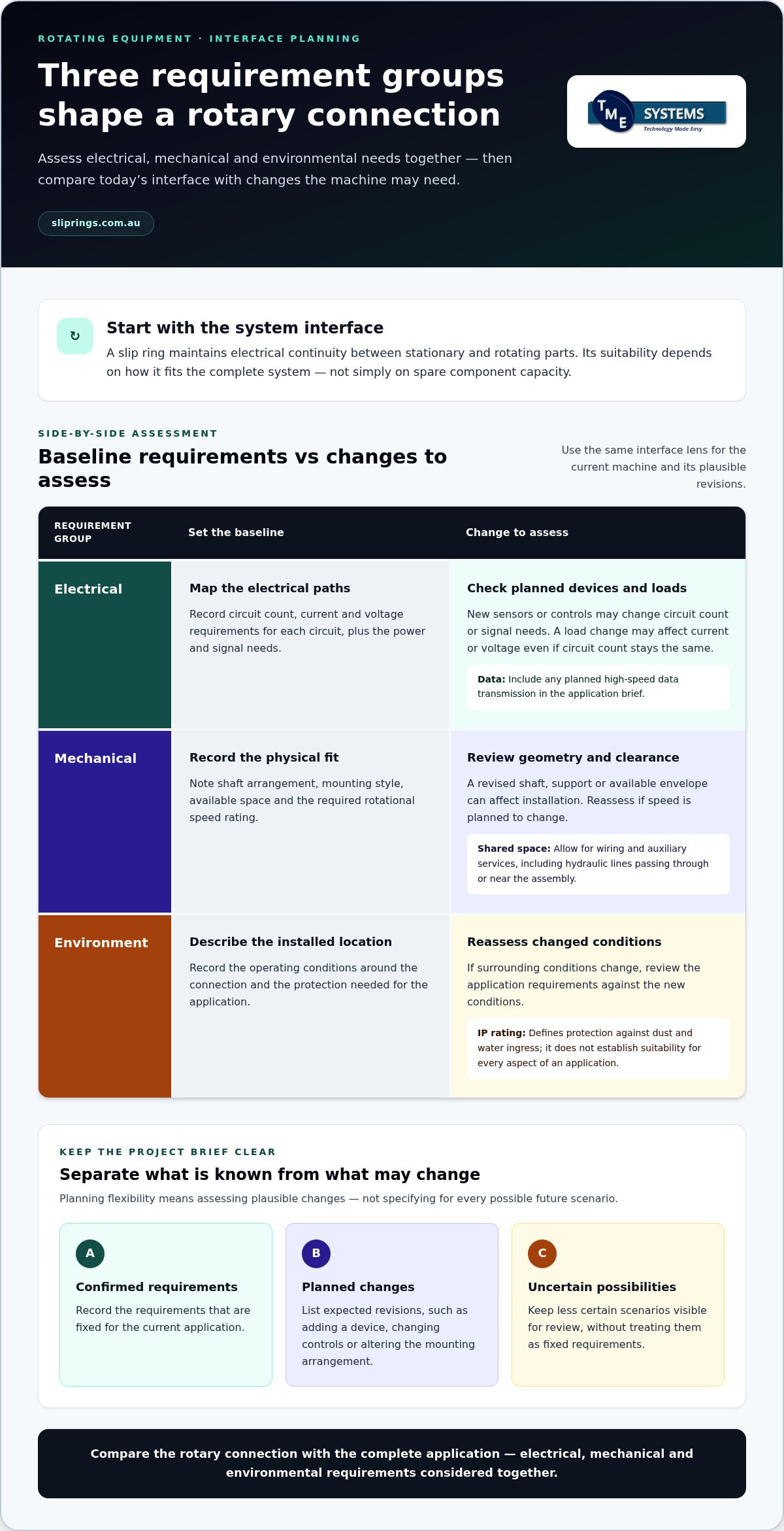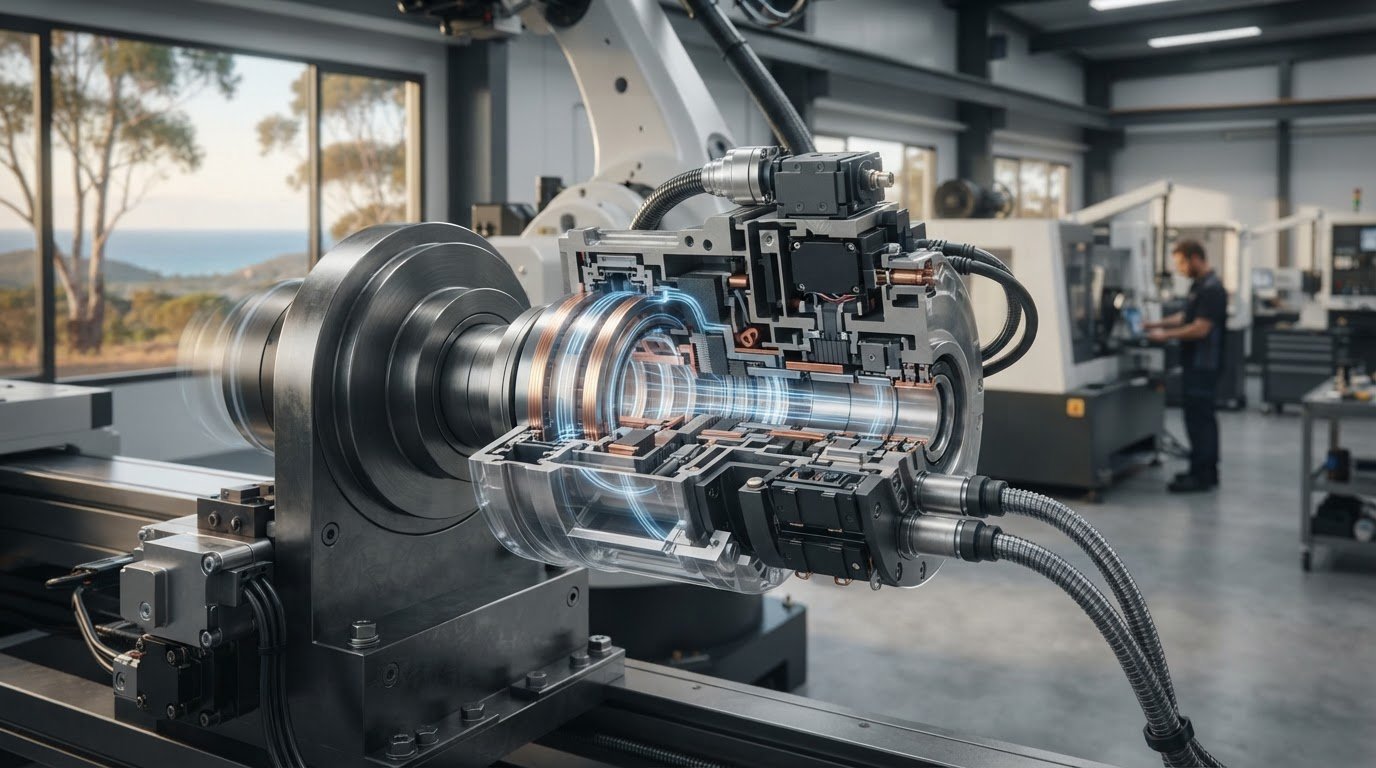
What if the rotary connection specified for today’s machine becomes a constraint during tomorrow’s upgrade? Future-proofing rotating equipment connections starts with the system interface, not simply choosing a component with spare capacity. A change in circuit count, current, voltage, rotational speed, mounting arrangement or operating environment can change what the connection needs to do. Assessing electrical, mechanical and environmental requirements together helps identify those dependencies before they limit a machine change.
Planning for flexibility does not mean specifying for every possible future scenario. That can add unnecessary complexity, while a narrow selection may become unsuitable too soon. This guide explains how to identify likely equipment and operating changes, compare rotary electrical joint approaches against the application, and prepare an engineering brief for technical review and component selection. It also covers mounting options, including Prosper Rotation slip rings, and how application engineering can turn system requirements into a clear connection specification.
Key Takeaways
- Plan for plausible changes to the machine interface rather than trying to predict every future requirement.
- Assess electrical, mechanical and environmental requirements together, including circuit count, current, voltage, speed and mounting style.
- Compare rotary connection approaches against the application and the information available for engineering review, not a generic feature list.
- For future-proofing rotating equipment connections, separate confirmed requirements, planned changes and assumptions in the project brief.
- Technical application consulting can help translate system requirements into a rotary connector specification suited to the application.
Why future-proofing rotating equipment connections starts at the interface
Future-proofing a rotating equipment connection means planning for plausible changes where stationary systems meet moving machinery, without trying to predict every future requirement. The interface must transfer the required electrical power or signals while fitting the machine’s physical arrangement and operating conditions. A slip ring is one way to maintain electrical continuity between stationary and rotating parts, but its suitability depends on how it fits the complete system.
Digitalisation and the energy transition may influence equipment upgrades, but they do not specify a rotary connection by themselves. Translate each relevant change into an interface question. Will new sensors or control devices affect circuit count or signal needs? Could a machine revision change speed, load or available mounting space? This turns broad equipment trends into requirements that can be assessed and recorded.
Design life alone does not establish future suitability. A connection may remain in service while the machine around it changes, or operating conditions may move beyond the original assumptions. The relevant question is whether the complete application, including electrical, mechanical and environmental conditions, remains compatible with the selected connection. Future-proofing rotating equipment connections is a planning discipline, not a promise of indefinite service life.
Which parts of a rotating equipment interface can change?
Separate planned revisions from uncertain possibilities. Record expected changes such as adding a device, revising controls or changing the mounting arrangement. List less certain scenarios separately, so they inform review without being mistaken for fixed requirements.
- Circuit requirements: changes to connected devices may affect circuit count, current, voltage or signal requirements.
- Mounting geometry: a revised shaft, support or available envelope can affect how the connection is installed.
- Operating conditions: changes in speed, duty or surrounding conditions may alter the application requirements.
Auxiliary services matter too. Hydraulic lines passing through or near a rotating assembly can affect shaft clearance and the space available for the electrical connection. Plan these interfaces together, while specifying fluid transfer separately from electrical transmission.
Why a component-only view can create constraints
A connector can meet the present specification yet leave too little space for a planned shaft change, an additional circuit or auxiliary services. Choosing the largest unit or the option with the most features does not automatically solve the problem. Extra capacity helps only when it matches the application and fits the mechanical arrangement.
Record the assumptions behind the selection alongside the component specification: what is fixed, what is planned to change and what remains uncertain. This gives engineers a basis for reviewing later revisions and identifying which requirements need reassessment, rather than relying on undocumented expectations.
How electrical, mechanical and environmental changes affect rotary connections
A change elsewhere in a machine can alter what its rotary connection must carry, how it is installed or what conditions it must withstand. Future changes become useful design inputs only when they are translated into measurable interface requirements. Assess electrical, mechanical and environmental factors together, then record which changes are planned and which remain possibilities.
Electrical changes: circuits, power and data
Circuit count is the number of independent electrical paths a slip ring provides for power and signal transmission. If new sensors, controls or other devices are planned, identify the paths they need and whether they must operate independently. This distinguishes a genuine circuit requirement from a general expectation that the machine may become more automated.
Current and voltage requirements come from the connected system and its loads. Record the requirements for each circuit, including any expected change to the equipment it serves. A future load change may affect the connection specification even if circuit count stays the same.
Give data needs separate attention. A planned shift to high‑speed data transmission may change what the interface needs to carry, but naming a data format alone does not establish that a particular rotary connection will support it. Include the signal requirements in the application brief so they can be assessed alongside power circuits.
Mechanical and environmental changes
Mechanical fit depends on the shaft arrangement, mounting style and space around the rotating assembly. A revised support or shaft can change where the connector sits or how it is secured. The rotational speed rating also needs to suit the operating requirement, including any planned change in speed. Note clearances for wiring and auxiliary services, as these can compete for the same space.
Environmental assessment starts with the conditions at the installed location. An IP rating defines the level of protection against dust and water ingress for electrical equipment. It does not, by itself, establish suitability for every aspect of an application. Consider other relevant exposures and operating conditions as part of the complete review.
Temperature affects both the connector and its surrounding structure. Thermal management covers techniques used to control temperature rise in a slip ring during operation. Ambient temperature and operating load can inform thermal derating, the reduction of allowable current as ambient temperature increases. Thermal expansion, the increase in material size due to heat, may also affect clearances and fit. Assess these factors against the actual operating profile rather than relying on a single nominal condition.
For planned equipment changes, include the revised requirements in the application brief and label uncertain scenarios clearly. Technical application consulting can help translate these electrical, mechanical and environmental inputs into a connection specification for review.
Comparing rotary connection approaches for changing equipment requirements
Compare connection approaches against the machine’s actual requirements, not a general ranking of features. The contact method, electrical duty, mounting arrangement and scope for later changes all matter. A useful review records what each approach must satisfy and which details need assessment for the specific application.
| Approach | Decision factors and application fit | Information needed for review |
|---|---|---|
| Brush-based contact | Consider where a conventional contact arrangement fits the circuit and operating requirements. Suitability depends on the complete application, not the contact method alone. | Circuit count, current, voltage, signals, speed, mounting and operating environment. |
| Liquid metal technology | Liquid metal technology uses a pool of conductive liquid metal to provide a low‑resistance electrical path. Liquid metal rotary connectors are brushless rotary connectors that use a pool of conductive liquid metal to maintain electrical continuity, eliminating wear and reducing noise. Their suitability depends on the application and exact product configuration. | Electrical requirements, operating conditions, installation constraints and applicable product information. |
| Collector ring | Collector ring vs slip ring is a useful distinction: collector rings are heavy-duty rotary connectors designed for high current capacity, whereas standard slip rings are typically optimized for signal integrity and lower currents. | Load requirements, signal needs, operating conditions and physical arrangement. |
| Modular system | A modular system is a slip ring architecture that allows stacking or combining multiple functional modules in a single assembly, where the design permits. It can support configuration changes, but does not establish suitability for every application. | Required functions, planned additions, module arrangement, space and interface requirements. |
When to assess liquid metal and brush-based approaches
Compare these contact approaches when the requirements call for a decision about how electrical continuity will be maintained. Assess circuit duties and signals alongside mounting, operating conditions and product-specific information. Do not assume a brushless approach is automatically the better choice, or infer service life, noise levels or maintenance needs without application-specific evidence.
Mercury‑free liquid metal uses gallium-based alloys instead of mercury. Treat this as a material and product consideration, not a blanket specification. The precise product and its application information must support its relevance to the project.
When collector rings or modular systems enter the discussion
Consider a collector ring where the application’s current capacity requirements make that architecture relevant, and compare it with standard slip rings where signal integrity and lower currents are central. A modular design may help accommodate a planned configuration change if its architecture allows the required functions to be combined. Neither approach is a universal fit.
Keep architecture separate from brand selection. Brand names do not replace matching electrical, mechanical and environmental requirements. For projects where configuration is a key consideration, Prosper Rotation slip rings can be included in an application-led review, with the configuration assessed against the project requirements.
For future-proofing rotating equipment connections, compare what each approach must do now with the changes it may need to accommodate. Base the decision on documented requirements and product information, then carry unresolved assumptions into engineering review.
A practical engineering process for future-proofing a rotary connection
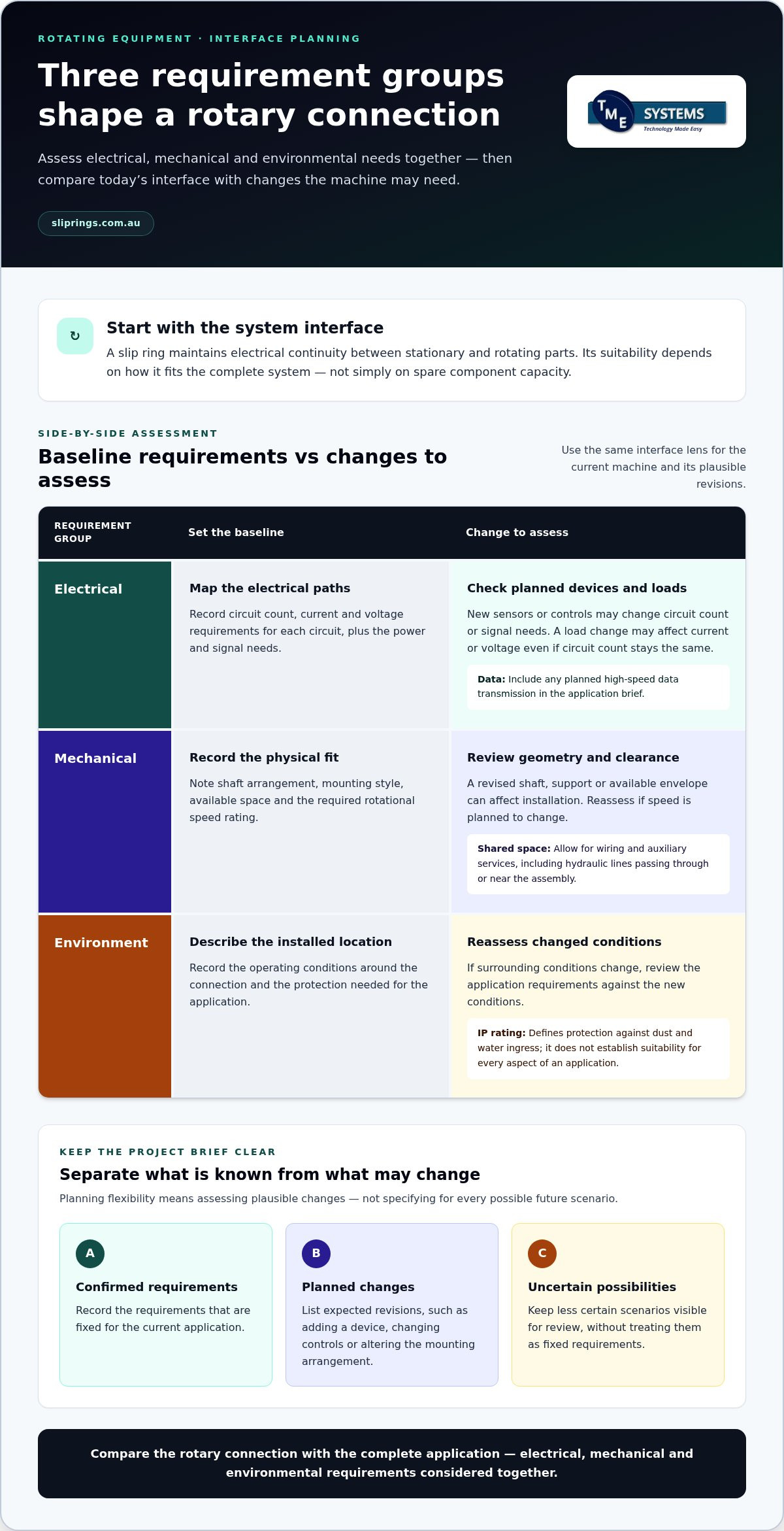
A structured review turns possible machine changes into a connection specification that engineers can assess. For future-proofing rotating equipment connections, keep three categories distinct throughout the process: confirmed requirements, planned changes and assumptions. This prevents a possibility from being mistaken for a fixed design condition.
Build a change-aware application brief
Start with the installed system and record its interface as it operates now. Add foreseeable revisions separately, such as a changed load, additional device or new data requirement. If information is unavailable, label it as an unknown and assign it for review rather than entering an assumed value as a specification.
- Document the existing connection. Record circuit count, current, voltage and signal requirements, plus the connected equipment and how the electrical paths are used.
- Describe the mechanical arrangement. Note rotational speed, shaft configuration, available space, mounting style and the position of wiring or auxiliary services.
- Describe operating conditions. Capture relevant temperature, dust or water exposure and other environmental conditions. Include the information needed to assess thermal management.
- Separate future inputs. List planned machine revisions and expected changes to connected loads or data needs. Keep uncertain possibilities in an assumptions section, not among confirmed requirements.
- Review the assembled specification. Compare electrical, mechanical, mounting and environmental needs as one interface. Record outstanding questions and identify what must be resolved before component selection.
Review the specification before selecting hardware
Check the complete assembly, not just the connector’s headline ratings. A circuit requirement can be electrically suitable while the proposed mounting arrangement conflicts with shaft space or auxiliary services. Review the mechanical layout alongside the electrical schedule, and check that planned changes do not create a mismatch between the connection and the equipment it serves.
Assess thermal management, thermal derating and the rotational speed rating against the application’s operating conditions. Keep inputs and assumptions visible so the engineering review can test the selection against the same conditions used to define the brief. TME Systems’ technical application consulting considers electrical, mechanical and environmental requirements as part of component selection.
Standards references also need a defined purpose. AS/NZS 5368:2025 sets out requirements for electrical equipment in mines and quarries. Where that context applies, document the equipment and standard reference for engineering review. Do not treat the standard as a general specification for every rotating machine. A clear scope helps prevent irrelevant references from entering the component decision.
Close the review by confirming that the selected connection, mounting arrangement and system interfaces align with the documented application. For a project considering Prosper Rotation slip rings, prepare the application details to support a focused technical selection review.
How TME Systems supports future-ready rotating equipment connections
Future-proofing rotating equipment connections depends on translating the machine’s requirements into a rotary connector specification that can be reviewed as the system changes. TME Systems supplies industrial slip rings and rotary electrical connectors to Australian customers, with technical application consulting to support application-led component selection.
What technical application consulting contributes
Bring the application brief to the selection discussion, including which requirements are confirmed, which changes are planned and which details remain assumptions. This gives the review a clear basis. Rather than choosing from a generic list of features, the task is to match the connector to the connected system and the machine’s operating conditions.
Technical application consulting considers circuit count, current, voltage, speed, mounting style and environmental requirements. These inputs help define the electrical and physical interface. For example, a planned change to connected equipment may affect circuit requirements, while a revised shaft arrangement may affect mounting. Include both in the selection discussion, even though they involve different engineering considerations.
Technical review helps assess how a proposed component fits the documented application. The assessment can consider the connector and its interfaces with the rotating assembly, associated services and surrounding equipment. Recommendations are tied to the supplied requirements and product information, so the selection is based on the intended application rather than an assumption that one component suits every future configuration.
Turning future requirements into a selection discussion
Current requirements establish the starting point. Foreseeable changes then help identify which parts of the specification may need flexibility, further assessment or a later review. Keep these categories separate. A planned additional device is a useful selection input; an uncertain possibility should be recorded as an assumption, not treated as a fixed electrical or mechanical requirement.
TME Systems distributes slip rings from Mercotac, Meridian Laboratory, BGB Innovation and Prosper Rotation. These brands form part of an application-led selection discussion, not a ranking. The relevant choice depends on how the available component configuration aligns with the project’s documented requirements. Where configuration is central to the design, Prosper Rotation slip rings can be considered against the application brief.
A useful review also considers the broader rotary electrical connector selection context: how the electrical specification, mechanical fit and operating environment work together. The engineering discussion can then focus on the complete interface, identify unresolved inputs and assess component suitability against the intended operating conditions.
If you are planning a new machine or reviewing an existing rotary connection, share the application requirements with TME Systems to discuss technical selection support.
Keep the connection specification useful as the machine evolves
A rotary connection decision can remain useful beyond initial selection when its assumptions stay visible. Keep the application brief with the equipment documentation, and revisit it when a machine revision, changed duty or new connected device alters the interface. This gives future engineering reviews a clear starting point and helps distinguish a genuine requirement change from an outdated assumption.
Future-proofing rotating equipment connections is not about choosing hardware for every scenario that might arise. It is about making a considered selection for the defined application and preserving the information needed to reassess it as the application changes. A clear brief supports better technical decisions at commissioning and during later upgrades.
For a considered next step, discuss your rotary connection application with TME Systems. Bring the current requirements and any planned changes so the selection discussion can focus on the machine’s actual interface. A well-documented starting point makes future decisions clearer.
Frequently Asked Questions
Can a rotary electrical connection be future-proofed?
Not completely, because no selection can guarantee compatibility with every later change. Future-proofing rotating equipment connections is a design discipline: document the application, identify credible changes and select a connection against those needs. For example, if a machine may gain an instrument, record that as a planned change and assess its interface requirements. Keep uncertain possibilities separate so they inform future review without inflating the present specification.
What information should I provide for a rotary connector engineering review?
Provide the available electrical and mechanical documentation, not just a product name or a general description of the machine. A circuit schedule, connection drawings, shaft or mounting details, operating profile and notes on environmental exposure can help clarify the application. Identify which values come from equipment documentation or measurement, and which are estimates. Add planned changes to connected devices or signals so the review can consider their effect without treating assumptions as fixed requirements.
Can an existing rotary connection be upgraded when equipment changes?
It may be possible, but assess a replacement against the revised assembly rather than treating it as a like-for-like upgrade. For example, a new device may need different signal paths even if it fits the existing mounting location. Compare the revised electrical schedule and mechanical arrangement with the existing connection details. If drawings or operating records are incomplete, identify those gaps before selection so the review does not rely on an assumed match.
Does a modular system make rotating equipment connections future-proof?
No. A modular system can make it possible to combine functional modules in one assembly, but the architecture still needs to suit the intended changes. For example, adding a function may affect the available space, wiring arrangement or interfaces between modules. Before relying on modularity, describe the change it is meant to support and assess the proposed assembly against that requirement. The term alone does not establish that later additions will be compatible.
How does digitalisation affect rotary connection requirements?
Digitalisation can introduce new signals or data paths across the rotating interface, but the specific requirements depend on the machine’s controls and connected equipment. Describe the signals, transmission method and relevant system interface information in the project documentation. For instance, consider a planned monitoring device as part of the system design rather than assuming it will work through any rotary connector. Assess its needs alongside the power circuits and mechanical installation.
What does AS/NZS 5368:2025 mean for a rotary connection project?
AS/NZS 5368:2025 sets out requirements for electrical equipment in mines and quarries. Its relevance to a particular rotary connection depends on the equipment and project context, so citing the standard alone does not establish that a component complies or that the standard applies to the complete installation. Identify the project’s applicable documentation and assess the standard’s relevance as part of the engineering review before making a compliance statement.
When should I seek technical application consulting for a rotary connector?
Consider technical application consulting if an equipment revision affects more than one part of the interface, or if available drawings and specifications leave open questions. It can also help when comparing connection approaches for a new machine design. Prepare the information available, including existing component details and the purpose of the proposed change. TME Systems can use the documented application requirements to support component selection and a focused technical discussion.