What if a signal that works reliably while stationary becomes noisy or intermittent once it passes through a rotating interface? High fidelity signal transfer for rotary joints depends on more than a headline bandwidth figure. The signal type, connector design and operating conditions all need to work together.
That uncertainty is familiar when specifying a rotary electrical joint. Signal requirements vary, and a choice that suits one application may not suit another. Assess the full operating context, including circuit count, current and voltage, rotational speed, mounting style, nearby power circuits and environmental conditions.
This guide explains the main factors that affect signal fidelity and how to turn application details into useful selection requirements. It covers the information to gather, questions to ask when comparing slip-ring designs, and when an engineering review can help resolve uncertainty before hardware is selected. TME Systems supplies industrial slip rings to customers across Australia and offers technical application consulting to help assess application requirements against suitable rotary connector options.
Key Takeaways
- High fidelity signal transfer for rotary joints depends on matching the signal, connector design and operating conditions, not just maintaining electrical continuity.
- Assess circuit configuration, contact method, speed, mounting and environmental conditions against the signal’s required performance.
- Compare conventional slip-ring and liquid metal options using application-specific evidence. Don’t assume one approach suits every signal.
- Set clear acceptance criteria, then document signal type, circuit count, voltage, current, rotational speed, mounting and environment.
- Technical application consulting can help review these requirements and assess suitable industrial rotary electrical connector options.
What high-fidelity signal transfer means in a rotary joint
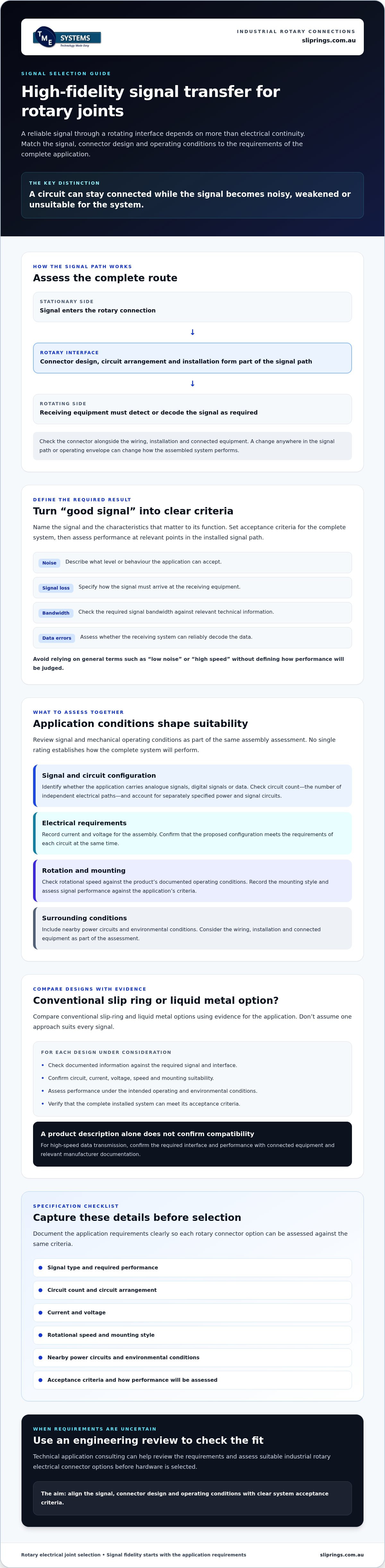
High-fidelity signal transfer in a rotary joint means preserving the signal characteristics required by the application as electrical paths cross a rotating interface. The goal isn’t simply to keep a circuit connected. A contact can maintain electrical continuity while the signal reaching the receiving equipment is noisy, weakened or otherwise unsuitable for the system.
A Slip ring provides a path for electrical power or signals between stationary and rotating parts. Whether that path suits a particular signal depends on the requirements of the complete application. There’s no universal threshold for acceptable fidelity. The system’s engineers need to define the required performance and how they’ll assess it.
Which signal characteristics should remain within specification?
Start by naming the signal and the characteristics that matter to its function. Depending on the application, these may include noise, signal loss, bandwidth or data errors. Describe each measure in clear engineering terms, then set acceptance criteria for the complete system. Avoid relying on general descriptions such as “low noise” or “high speed” without defining how the design team will judge whether performance is acceptable.
A control signal and a data link, for example, may need different checks. Identify what the receiving equipment must detect or decode reliably, then assess the signal at the relevant points in the installed system. Don’t assume that a connector’s continuity rating demonstrates signal quality.
Why a rotating interface changes the signal path
The rotary joint and its electrical contacts form part of the path between the stationary and rotating sides. The connector design, circuit arrangement and installation can all affect how the signal passes through that path. Rotational speed and the surrounding electrical environment also belong in the assessment. Their specific effects depend on the equipment, so check them against relevant technical information rather than inferring performance from a general product description.
Assess the connector alongside the wiring, installation and connected equipment. A signal that performs as required in one arrangement may behave differently if any part of the signal path or operating envelope changes. For high fidelity signal transfer for rotary joints, define the application’s required performance first, then confirm that the assembled system can meet its acceptance criteria under the intended conditions.
How rotary-joint design and operating conditions affect signal fidelity
Assess signal and mechanical operating conditions together because the rotary joint transfers signals as part of an assembly operating in its actual installation. Suitability depends on the signal requirements, circuit arrangement, contact method, rotational speed and mounting, as well as electrical and environmental conditions. Reviewing one rating in isolation won’t establish how the complete system will perform.
Signal type, bandwidth and circuit configuration
First identify whether the application carries analogue signals, digital signals or data. These categories have different performance requirements. Don’t treat a connector as suitable simply because it maintains continuity or has enough electrical paths.
Circuit count is the number of independent electrical paths available for power and signal transmission. Check that the arrangement provides the paths the application needs, including any separately specified power and signal circuits. For high-speed data transmission, confirm the required interface and performance with the connected equipment, then check bandwidth or data-rate claims against the relevant manufacturer documentation. A general description of a slip ring doesn’t establish compatibility with a particular protocol or system.
Record the electrical requirements for the complete assembly too. Current and voltage matter alongside signal performance, especially when the rotary joint carries more than one type of circuit. Confirm that the proposed configuration meets the requirements for each circuit at the same time.
Rotation, mounting and the installation environment
Use the rotational speed rating as a selection parameter, not as a guarantee of signal quality. Confirm that the expected speed falls within the product’s documented operating conditions, then assess signal performance against the application’s acceptance criteria. Consider the contact method in relation to the signal and verify it against product information rather than assuming it will suit a particular data requirement.
Mounting affects how the connector fits into the rotating assembly. A through-bore slip ring may suit an arrangement built around a shaft, while an end-of-shaft mounting may suit a different layout. Choose the form that meets the mechanical integration requirements and check that the installation doesn’t conflict with the circuit arrangement or operating envelope.
Document the conditions the unit will experience, including temperature, contamination, vibration and other relevant environmental factors. Compare these with the connector’s specified limits. Assess the joint, installation and connected equipment as one signal path.
If you’re comparing options, TME Systems’ Prosper Rotation slip rings are one product category to assess against your documented requirements. Confirm the relevant specifications for the intended application before selection.
Comparing rotary-joint approaches for signal transfer
Compare connector technologies against the same application requirements. Don’t treat one contact method as a guarantee of signal quality. The table is a screening aid, not a substitute for product specifications. Confirm compatibility and performance claims in the manufacturer documentation for the specific connector and intended operating conditions.
| Assessment point | Conventional slip-ring approach | Liquid metal approach |
|---|---|---|
| Signal type and performance | Confirm suitability for the analogue, digital or data signal and its acceptance criteria. | Confirm the signal is compatible with the specific product. The contact method alone doesn’t establish fidelity. |
| Circuit needs | Check circuit count and the required arrangement for signal and power paths. | Check available circuits and configuration against the application requirements. |
| Speed | Compare the rotational speed rating with the actual duty and verify signal performance at that condition. | Check the product’s documented speed limits and signal requirements. |
| Mounting | Confirm the form factor and mounting arrangement fit the rotating assembly. | Confirm the product’s mounting and integration requirements. |
| Environment | Check specified temperature and environmental limits against installation conditions. | Check the same limits in the product documentation. Don’t infer environmental suitability from the contact method. |
When to assess liquid metal rotary connectors
Liquid metal rotary connectors use a pool of conductive liquid metal to maintain electrical continuity. That describes a contact method, not a blanket guarantee of signal quality. Assess the specific signal, circuit arrangement, speed, mounting and environment, then verify the relevant product specifications. For a product-level reference, review Mercotac slip rings against your application requirements.
When a precision slip-ring option needs closer review
For any precision slip-ring option, check the required signal performance, mounting, circuit count, speed and operating environment together. Meridian Laboratory slip rings are another product category to consider, but suitability needs to be established from relevant product information, not the category name. Review the Meridian Laboratory slip rings range against your documented requirements.
For high fidelity signal transfer for rotary joints, neither conventional nor liquid metal technology is universally superior. The right comparison depends on signal compatibility and verified specifications for the complete application. If published information doesn’t answer a key question, seek technical application consulting before selecting hardware.
A practical checklist for high fidelity signal transfer for rotary joints
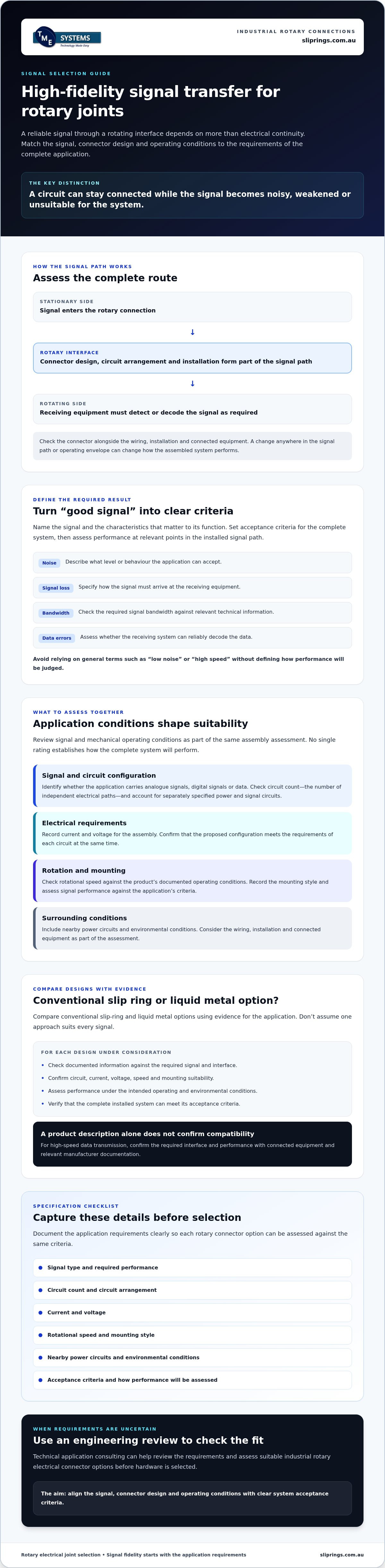
A useful rotary-joint specification pairs electrical requirements with mechanical conditions. Use this checklist to turn application needs into clear selection criteria and identify details that still need engineering validation.
- Define the signal. Identify whether it is analogue, digital or data, and describe what the connected equipment needs to receive.
- Set performance and acceptance criteria. Specify relevant measures such as noise, loss, bandwidth or data errors, and how the complete system will be assessed.
- Record circuit requirements. State the required circuit count and identify which paths carry signals and which carry power.
- Document electrical conditions. Provide the voltage and current requirements for each relevant circuit.
- Describe mechanical operation. Record the expected rotational speed, operating cycle and mounting arrangement, including shaft or space constraints.
- Describe the environment. Note temperature, contamination, vibration and other conditions that may affect installation or operation.
- Identify interfaces and equipment. Include connected equipment, cable interfaces and installation constraints that could affect integration.
Information to prepare before requesting a technical review
Gather system diagrams, signal documentation, the required operating envelope and relevant manufacturer datasheets. Mark each item as a confirmed requirement or an assumption that still needs validation. This helps a reviewer focus on open questions without treating provisional details as fixed specifications.
How to evaluate a proposed configuration
Check each proposed specification against the system’s acceptance criteria and connected equipment. Ask what manufacturer evidence supports the stated signal, speed and environmental suitability under the intended conditions. If documentation doesn’t resolve a requirement, record the gap and seek clarification before approving the configuration. A product description alone may not establish suitability for the complete application.
For high fidelity signal transfer for rotary joints, compare the proposed electrical and mechanical details as one specification. TME Systems’ technical application consulting can help assess circuit count, voltage, current, speed, mounting style and environmental requirements for product selection.
Prepare your application details when you review technical application consulting from TME Systems.
Choosing a rotary-joint supplier for signal-critical applications
For signal-critical applications, a supplier should help connect the electrical requirements to the mechanical installation, not simply point to a product category. Technical application consulting can help review the signal, circuit count, voltage, current, rotational speed, mounting arrangement and environment together. This gives the selection process a clear basis and helps identify what still needs confirmation.
What application engineering should clarify
Review the proposed connector’s documented specifications against the application’s requirements and acceptance criteria. Check whether the documentation covers the signal type and required performance, as well as the intended speed, mounting and operating environment. If a relevant specification is missing or an assumption remains unverified, record it as an open question rather than treating it as confirmed.
Before approval, clarify who will resolve those gaps and whether a final engineering review is needed. Ask for evidence that addresses the actual application, not just a general product description. A useful technical review should leave you with an understood fit, identified limitations and a clear record of outstanding assumptions. Use manufacturer documentation alongside technical application consulting to check the proposed configuration against the application requirements.
When to discuss a specific product category
Bring your signal, speed, circuit, mounting and environmental data to a product discussion. That information helps assess whether a product range merits closer review, without assuming its name or category proves compatibility. TME Systems supplies industrial rotary electrical connectors and slip rings across Australia, including Mercotac, Meridian Laboratory, BGB Innovation and Prosper Rotation ranges.
For example, you can review Prosper Rotation slip rings as a supplied product range, then check the relevant documentation against your application criteria. Don’t infer a performance claim without product-specific evidence.
High fidelity signal transfer for rotary joints calls for evidence-based selection across the complete operating envelope. If your requirements are defined but product suitability or an assumption remains unclear, TME Systems’ technical application consulting can help review the information needed for selection.
Turn your signal requirements into a confident selection
Reliable rotary signal transfer starts with a clear definition of the performance your system needs. Assess the electrical requirements alongside the joint’s speed, mounting arrangement and operating environment. A connector that maintains continuity isn’t automatically the right choice for your signal or installation.
That’s the practical basis for high fidelity signal transfer for rotary joints: match documented product specifications to the application, and resolve assumptions before selecting hardware. TME Systems provides technical application consulting to support product selection, with access to Mercotac, Meridian Laboratory, BGB Innovation and Prosper Rotation slip rings.
Frequently Asked Questions
What does high-fidelity signal transfer mean in a rotary joint?
High-fidelity signal transfer means maintaining the signal characteristics the application requires as the signal crosses a rotating electrical interface. It’s more than uninterrupted electrical continuity: the signal must also meet the system’s criteria for measures such as noise, loss, bandwidth or data errors. There’s no single threshold for every application. Define the required performance and how the complete system will be assessed.
Can a slip ring transfer high-speed data without signal degradation?
A slip ring may suit high-speed data transmission, but suitability depends on the specific connector, interface and system requirements. Confirm that the manufacturer documents compatibility with the required signal or protocol and operating conditions. Check the specified bandwidth or data rate, then assess performance with the connected equipment in the intended arrangement. A general product description or continuity rating alone doesn’t demonstrate that data will transfer without degradation.
How do you reduce electrical noise in a rotary connection?
Start by identifying the noise limits the receiving equipment can tolerate, then check the rotary connector’s documentation and installation guidance against those criteria. Review the signal and power circuit arrangement, cable interfaces, wiring and connected equipment as part of the same path. Follow any manufacturer guidance on installation, grounding or circuit separation. Confirm performance in the complete system rather than assuming one measure will resolve noise.
What information is needed to select a rotary joint for signal transfer?
Provide the signal type, required performance and acceptance criteria first. Then document circuit count, voltage, current, rotational speed, mounting arrangement and environmental conditions, including temperature or contamination where relevant. Include the connected equipment, cable interfaces, operating cycle and installation constraints. System diagrams and relevant signal documentation can help clarify the arrangement. Mark assumptions separately from confirmed requirements so they can be checked during product selection.
Does rotational speed affect signal fidelity in a slip ring?
Rotational speed is a selection parameter, but its rating doesn’t by itself prove signal performance at that speed. Check the product’s documented operating limits and verify signal suitability under the application’s intended conditions. Include the installation, contact method and connected equipment in the review. If documentation doesn’t establish performance for the required signal and speed together, ask the manufacturer or a technical adviser to clarify the evidence before selection.
Are liquid metal rotary connectors suitable for signal transmission?
They may be suitable, but the contact method alone doesn’t confirm compatibility with a particular signal. Liquid metal rotary connectors use a pool of conductive liquid metal to maintain electrical continuity. Check the specific product’s documented signal capabilities, circuit configuration, speed, mounting and environmental limits against the application. Treat claims about noise or data performance as product-specific and verify them with manufacturer documentation before deciding.
How can I verify that a rotary joint is suitable for my application?
Compare the connector’s documented specifications with your system’s acceptance criteria, connected equipment and full operating envelope. Check signal performance, circuit count, voltage, current, speed, mounting and environmental requirements, and resolve any assumptions that remain unverified. TME Systems supplies industrial slip rings and rotary electrical connectors across Australia and offers technical application consulting to help assess product selection against these details.
To discuss your application, share your signal requirements, circuit details and operating conditions with TME Systems. Discuss your rotary-joint application requirements.