A rotary connector can appear suitable on paper and still fail to match an application’s operating conditions or interfaces. Knowing how to write a technical specification for a rotary connector means documenting more than circuit count and voltage. Engineers need enough context to assess compatibility and performance before selecting a solution.
A useful specification works as an engineering handover, not just a parts list. It separates mandatory requirements from preferences and gives each option the same criteria for comparison. That makes it easier to spot missing information before it affects selection.
This guide covers the electrical, mechanical and environmental information to capture, including the operating profile, mounting arrangement and connections. It also explains how to record constraints and open questions so technical reviewers can identify gaps and compare rotary connector technologies consistently. The result is a practical starting point for application engineering and technical review.
Key Takeaways
- Use a rotary connector specification as an engineering handover, rather than a parts list.
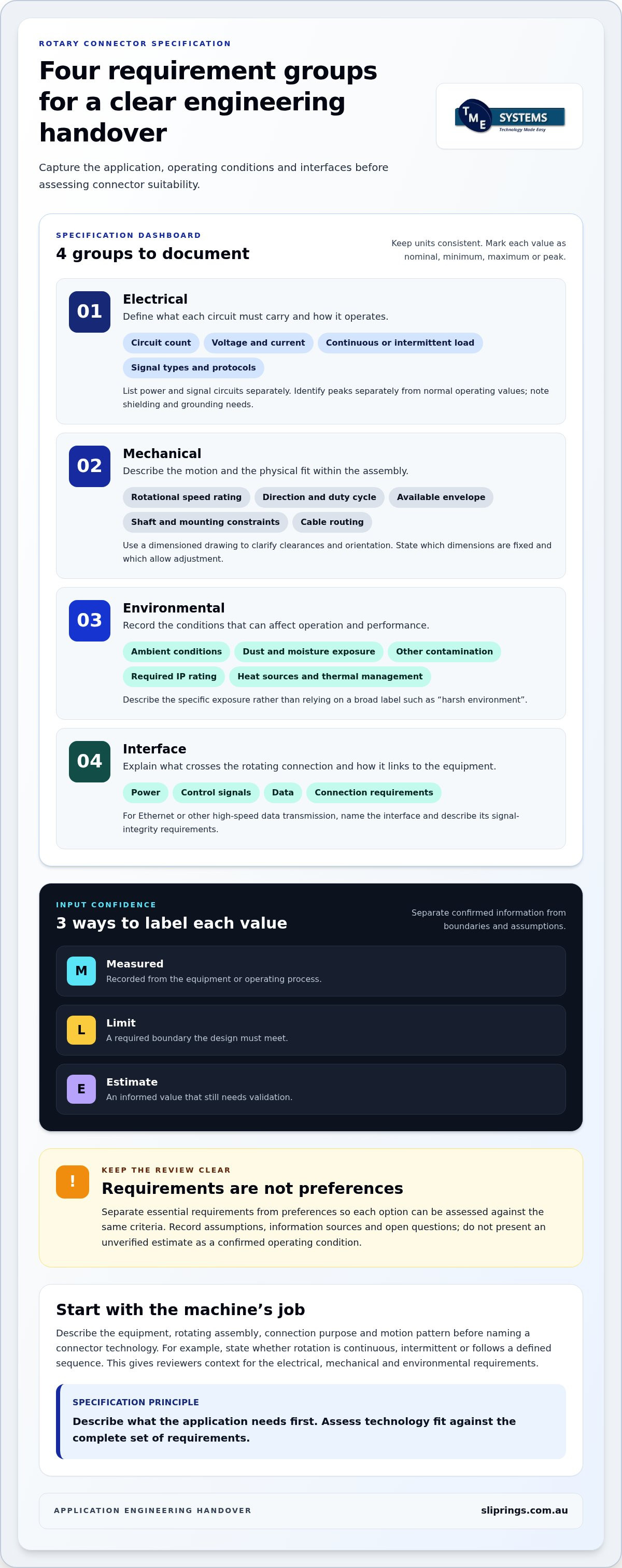
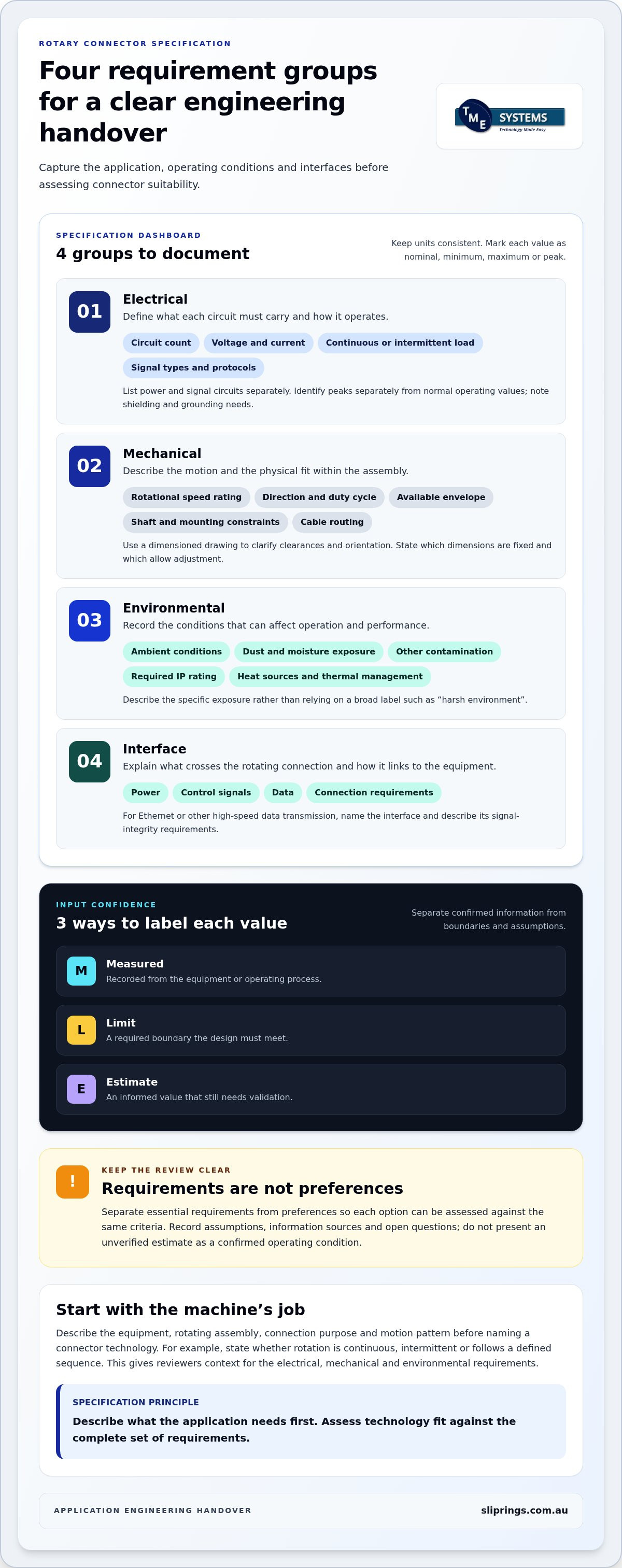
- Group requirements by electrical, mechanical, environmental and interface needs, and record values with consistent units.
- Separate mandatory requirements from preferences so candidate technologies can be compared against the same criteria.
- Capture assumptions, information sources and open actions in a structured draft before technical review.
- Seek application engineering input when requirements conflict or the right rotary connector technology is unclear.
What a Rotary Connector Technical Specification Needs to Achieve
A rotary connector technical specification is an application-specific record of the equipment, operating conditions and interfaces that a rotary electrical connection must support. It gives engineers and suppliers a shared basis for assessing suitability, identifying missing information and comparing possible approaches. Describe what the application needs before naming a product or connector technology.
Starting with a preferred product can narrow the review before the operating conditions are understood. A written brief instead connects the machine’s function to its electrical and mechanical demands. It also makes trade-offs visible, so a preference can be weighed against a requirement without either being mistaken for a fixed design limit.
Start with the equipment and rotary function
Begin with the machine and rotating assembly, then explain why the electrical connection must cross the rotating interface. A turntable, for example, may need to pass power and control signals between stationary equipment and a rotating platform. That context helps reviewers interpret the requirements that follow. For an overview of the mechanism, see Slip ring (rotary connector).
State what the connection carries: power, control signals, data, or a combination. Describe the motion too. Is rotation continuous, intermittent, or governed by a defined pattern, such as repeated turns followed by a stop? Include the operating sequence if it affects how the connection is used. These details describe the duty the connector must perform, rather than leaving reviewers to infer it from isolated electrical values.
Keep the description tied to the application. For example: “The connector transfers power and control signals between the stationary frame and rotating assembly of the machine during intermittent rotation.” Replace those example functions with the machine’s actual duties. Avoid choosing a slip ring type in this statement; assess technology fit against the complete set of requirements.
Set the boundary between requirements and assumptions
Label information according to how it is known. A measured operating value differs from a design limit, and both differ from an estimate. Keeping those categories distinct stops an unverified assumption from being treated as a confirmed operating condition. Use a consistent notation or a dedicated field, and identify who supplied the value where that context matters.
- Measured: Recorded from the equipment or operating process.
- Limit: A required boundary the design must meet.
- Estimate: An informed value that still needs validation.
Write unresolved inputs as questions or open actions, not settled facts. If the rotation pattern hasn’t been measured, record that it needs confirmation rather than describing it as continuous. Then separate essential requirements from preferences. This gives technical application consulting a clear basis to resolve gaps and explain trade-offs, while keeping the design engineer’s knowledge of the machine and its intended operation central.
How to Record Electrical, Mechanical and Environmental Requirements
Once the application is defined, organise its technical inputs into four groups: electrical, mechanical, environmental and interface. This makes it easier to assess whether a proposed rotary connector can carry the required loads, fit the assembly, operate in its surroundings and connect with adjacent equipment. For each value, record the unit and whether it is nominal, minimum, maximum or peak. Use consistent units within each group so reviewers can compare values without converting or guessing.
Include the source and confidence level of preliminary inputs. A value measured on operating equipment differs from a design estimate, so mark each clearly and note what still needs validation. This field-by-field approach helps prevent an early assumption from being treated as a confirmed limit.
Document electrical loads and signal interfaces
For each circuit, state its purpose, circuit count, voltage and current, then indicate whether the load is continuous or intermittent. List signal types and protocols separately from power circuits. If the application needs Ethernet or other high‑speed data transmission, name the interface and describe its signal-integrity requirements. Record shielding and grounding needs as application requirements rather than assuming a particular connector design will provide them.
Where values vary during operation, capture the relevant range and identify the peak separately from the normal operating value. For example, specify whether a current figure describes continuous operation or a short-duration peak. This gives reviewers a clear basis for assessing electrical fit.
Describe operating conditions and physical integration
Record the required rotational speed rating, direction of rotation and duty cycle, along with any defined operating pattern. For mechanical integration, document the available envelope, shaft arrangement, mounting constraints and cable routing. A dimensioned drawing can clarify clearances and orientation. Identify which dimensions are fixed and which allow adjustment.
Describe the environment in terms that relate directly to operation. Include expected ambient conditions, exposure to dust, moisture or other contamination, and the required IP rating. Note heat sources and thermal management considerations, since operating temperature can affect allowable electrical load and connector performance. Avoid a broad label such as “harsh environment” without specifying the exposure that matters to the equipment.
Electrical data defines what must pass across the interface, mechanical data sets the motion and fit, environmental data describes the conditions of use, and interface data establishes how the connector integrates with surrounding equipment. If standards apply to the application, identify the relevant document and edition rather than relying on an informal description. NIST Standards.gov provides background on standards and their use.
For application-specific technical input, see technical application consulting for rotary connectors.
How to Compare Rotary Connector Technologies Against the Specification
A comparison is useful only when every candidate is assessed against the same application requirements. Set up a matrix with one requirement per row and one candidate technology or configuration per column. Use the specification as the source for each row, not product descriptions alone. Mark each result as meeting, not meeting or requiring clarification, and note any trade-off that needs engineering review.
Include factors that could affect the application:
- Signal needs: Record the required signal types, protocols and signal-integrity expectations for each candidate.
- Electrical load: Compare circuit count, voltage and current against the stated operating and peak values.
- Motion: Assess the required speed, direction and duty pattern against the candidate’s documented limits.
- Installation: Compare mounting arrangement, available envelope and cable routing requirements.
- Operating environment: Check the stated exposure and IP rating needs against available product information.
- Maintenance expectations: Record the expected maintenance approach and any assumptions that need review.
Keep a separate note for missing or incomparable data. A blank cell is not evidence that a candidate meets the requirement; it signals that the comparison needs further technical input.
Compare contact methods and circuit functions
Start with the task the connector must perform. An application prioritising low-noise signals may need a different assessment from one focused on power transfer; mixed circuits need both functions considered. Liquid metal rotary connectors are brushless rotary connectors that use a pool of conductive liquid metal to maintain electrical continuity, eliminating wear and reducing noise. Treat liquid metal technology as a contact method to assess against the specification, not as a guarantee of performance in every application.
Compare each proposed contact method against the documented circuit functions, signal needs, current, speed and environment. If signal integrity is mandatory, make it a distinct row rather than relying on a general product description. Record the evidence and any open questions for each candidate.
Compare mounting and configuration constraints
If the rotating shaft or auxiliary components need to pass through the centre, include a through-bore slip ring as a configuration to assess. Consider capsule or modular system options when their form or configuration addresses a defined installation requirement. This keeps the comparison focused on fit and function rather than adding options without a clear reason.
A named candidate, such as Prosper Rotation slip rings, can occupy a column in the matrix. Assess it against the same requirements as every other candidate. Suitability depends on the complete application specification, including electrical, mechanical, environmental and interface needs. The comparison makes gaps and trade-offs visible without selecting a technology by name alone.
How to Draft and Review the Rotary Connector Specification
A repeatable template makes the specification easier to draft, update and review. Start with the application purpose, operating sequence and connection function, then group the detailed requirements so reviewers can find each input quickly. Label every entry as mandatory, preferred, provisional or not applicable. This prevents a preferred feature from being mistaken for a condition the design must meet.
Use a repeatable specification template
Build the document in a consistent order: application summary, operating sequence, electrical requirements, mechanical requirements, environmental conditions, interfaces, assumptions and supporting documentation. Include drawings or connection diagrams where they clarify the installation. For each requirement, use a table with fields for:
- Requirement: The characteristic or condition being specified.
- Value and unit: The stated value, with its unit recorded consistently.
- Priority: Mandatory, preferred, provisional or not applicable.
- Source: The drawing, measurement, design input or person responsible for the value.
- Open action: The question or validation task still to be completed.
This format helps you write a technical specification for a rotary connector without hiding uncertainty in free-form notes. If a value is provisional, label it and state what evidence or decision would resolve it. If a field does not apply, mark it as such rather than leaving it blank. A blank could mean the requirement was overlooked.
Acceptance criteria should be testable or reviewable. State the condition and how it will be assessed, using limits supplied by the application design or an applicable project requirement. For example, specify that a mounting interface must fit a referenced drawing and identify the drawing revision. Don’t invent a speed, current or environmental limit to make the document look complete. If a limit is undecided, record it as an open action.
Run a completeness and consistency review
Review the document from beginning to end before it is issued. Check that units, terminology and operating limits agree across sections. A speed requirement should not conflict with the stated duty pattern; consider an electrical load alongside thermal management; and check the mounting envelope against the referenced assembly drawing. Flag conflicts rather than silently choosing one value.
Use an ordered review so the handover is ready for technical assessment:
- Confirm the application summary and operating sequence describe the intended use.
- Check each requirement has a value, unit, priority and source, or is clearly marked as unresolved.
- Compare interfaces, dimensions and operating conditions for inconsistencies.
- Record each open question, the responsible reviewer and the decision needed.
- Issue the reviewed version with its revision identifier and supporting documents.
Keep review comments tied to specific requirements so the reason for each revision is clear. If Prosper Rotation slip rings are among the candidates under review, compare the Prosper Rotation slip ring range with the documented application requirements.
When to Seek Technical Review for a Rotary Connector Specification
A technical review is useful when key operating data is incomplete, requirements compete or the right connector technology is uncertain. For example, signal performance, available mounting space and operating conditions may point towards different trade-offs. A reviewer can help identify which inputs need clarification and compare candidate approaches against the application rather than a preferred product name.
Review supports the design engineer’s application knowledge; it doesn’t replace it. The engineer remains responsible for defining the machine’s intended operation and design needs. Specialist input can test whether the brief communicates those needs clearly, highlight conflicts and identify the decisions required before a selection can be assessed. This is a practical final step when writing a rotary connector specification.
Prepare an effective engineering handover
Share the draft specification with enough context for a reviewer to interpret it. Include the equipment description, operating sequence, connection function and relevant interface drawings. If a drawing has a revision identifier, include it so comments refer to the correct version. Attach supporting information that explains how the application operates, not just a list of connector values.
Make uncertainties visible. List provisional values, missing measurements and unresolved design choices, then state what decision each review point should support. A focused handover can ask the reviewer to:
- Identify conflicting or incomplete requirements.
- Flag interface details or operating inputs that need clarification.
- Compare candidate technology considerations against the stated priorities.
- Separate confirmed information from assumptions that need engineering validation.
For mining or quarrying applications, assess whether AS/NZS 5368:2025, Electrical equipment in mines and quarries, is relevant to the project. It relates to mining and quarrying equipment and is distinct from AS/NZS 3000:2018, the Australian/New Zealand wiring rules standard for electrical installations. Tie a standards reference to the application and project requirements, rather than adding it as a general statement about every rotary connector.
Turn review findings into a selection-ready document
After review, update the specification with agreed values, consistent units, priorities and measurable acceptance criteria. Keep provisional entries marked until they’re resolved. Record the outcome of each open action, who made or approved the decision, and which document revision it affects. This provides a traceable record if requirements change or a candidate is reassessed.
A useful review closes with a clear status for each requirement: accepted, revised, still open or not applicable. That status helps application engineering compare options fairly and shows what remains before technical selection. Technical application consulting can clarify gaps and trade-offs while keeping the engineer’s knowledge of the equipment central to the decision.
If you’re preparing a draft or have competing requirements to resolve, discuss your rotary connector application with TME Systems Pty Ltd.
Make the Specification the Starting Point for Selection
A specification should keep pace with the design. As the machine or operating requirements change, update the document so it remains a reliable reference for engineering decisions, procurement and future reviews. Record why a requirement changes rather than simply replacing its value. That history helps the team understand the basis for later decisions.
Knowing how to write a technical specification for a rotary connector gives your team a practical way to move from application needs to a considered selection. Use the document to test assumptions and clarify trade-offs before they become design constraints.
A clear handover gives application engineering a useful starting point for reviewing the requirements and identifying the next decisions.
Frequently Asked Questions
Is a rotary connector technical specification the same as a product datasheet?
No. A datasheet describes a particular product and its stated characteristics; a technical specification describes what the application requires. Use the specification to define the machine’s operating needs, then refer to a datasheet as evidence when assessing a candidate. If a datasheet doesn’t address a requirement, record that as an information gap rather than assuming the product meets it.
Should I put a preferred product or manufacturer in the specification?
You can name a preferred product or manufacturer as a reference, but distinguish that preference from a mandatory requirement. Explain why it is preferred, such as an existing interface or an established design choice. This lets reviewers assess whether the reference is essential or whether another option could meet the application needs. If only a specific product is acceptable, record the design reason for that restriction.
How should I specify intermittent operation for a rotary connector?
Describe the operating sequence rather than simply labelling it “intermittent”. State when rotation starts and stops, how long the assembly remains stationary, whether direction changes, and whether electrical loads remain active during stops. If the pattern varies between operating modes, document each mode separately. This helps the reviewer understand the actual duty and identify which operating details still need measurement or confirmation.
Do I need to specify Ethernet or other data protocols?
Yes, if the rotating interface must carry data. Name the protocol, such as Ethernet, and include relevant interface requirements from the system design, such as the required data rate or connection arrangement. “Data” alone can be too broad to assess. If the protocol or performance requirement is undecided, mark it as provisional and identify who will resolve it before selection.
Should a rotary connector specification include AS/NZS 5368:2025?
Include the standard in the specification when the project’s requirements call for it. Record the exact reference and edition, and identify the project requirement or design decision that makes it relevant. If its application is still being assessed, list that as an open action rather than treating compliance as established. This gives reviewers a clear point to address without implying that the standard applies to every rotary connector.
What should I do when some specification values are not known yet?
Mark unknown values as provisional or open questions; don’t leave them blank or present estimates as confirmed limits. Note the value’s source, who will validate it and what decision depends on it. This distinction helps reviewers identify which conclusions are firm and which must wait for further application data.