If your six-axis robot arm loses critical data packets every time it reaches peak RPM, is it truly a precision asset or a high-cost liability? Most engineers recognise that mechanical articulation is only as reliable as the electrical backbone supporting it. You've likely experienced the frustration of signal interference or the downtime caused by a failing slip ring for industrial robotics. These failures don't just stall production; they compromise the safety and efficiency of your entire automated cell.
Selecting the right rotary connector requires more than matching a part number. It demands a thorough understanding of how contact materials and mechanical footprints impact long-term performance. This guide provides the technical framework you need to identify high-performance components that offer zero-maintenance operation and flawless signal integrity. We will examine essential parameters like circuit counts, RPM limits, and environmental sealing. By the end of this article, you'll be equipped to specify a solution that ensures high-speed data transmission and durability, helping your facility meet the rigorous requirements of the updated ISO 10218-1:2025 safety standards.
Key Takeaways
- Understand the transition from simple power transfer to high-bandwidth data transmission required for modern automated arms.
- Learn how to specify a slip ring for industrial robotics by defining electrical loads, RPM limits, and duty cycles for each robotic joint.
- Evaluate the technical advantages of liquid metal connectors, such as Mercotac, compared to traditional gold-on-gold contact technologies.
- Follow a structured technical audit to ensure your rotary solution meets the latest ISO safety and cybersecurity standards for industrial automation.
- Leverage local technical consulting to access high-spec components from world-leading manufacturers like Meridian Laboratory and BGB Innovation.
The Critical Role of Slip Rings in Modern Industrial Robotics
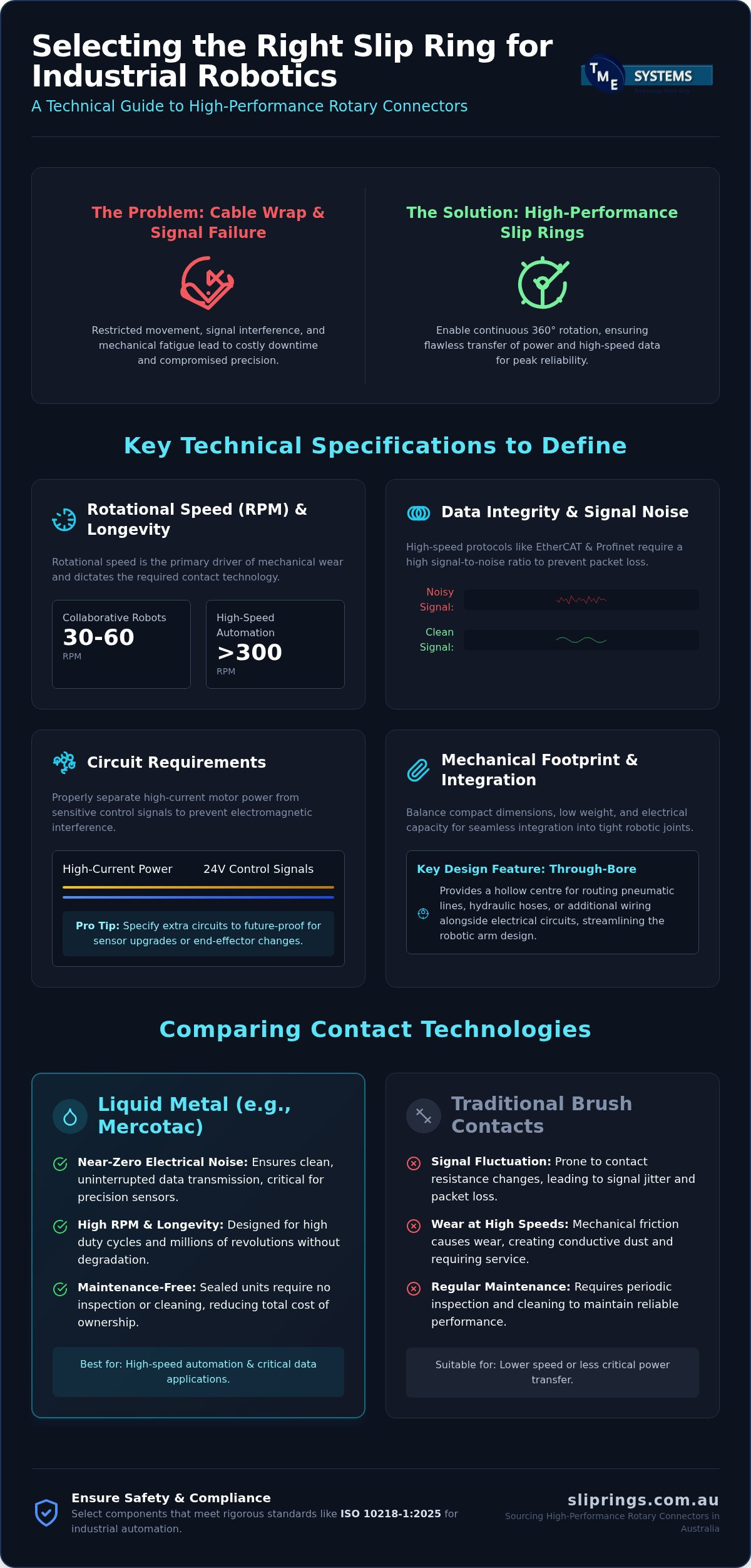
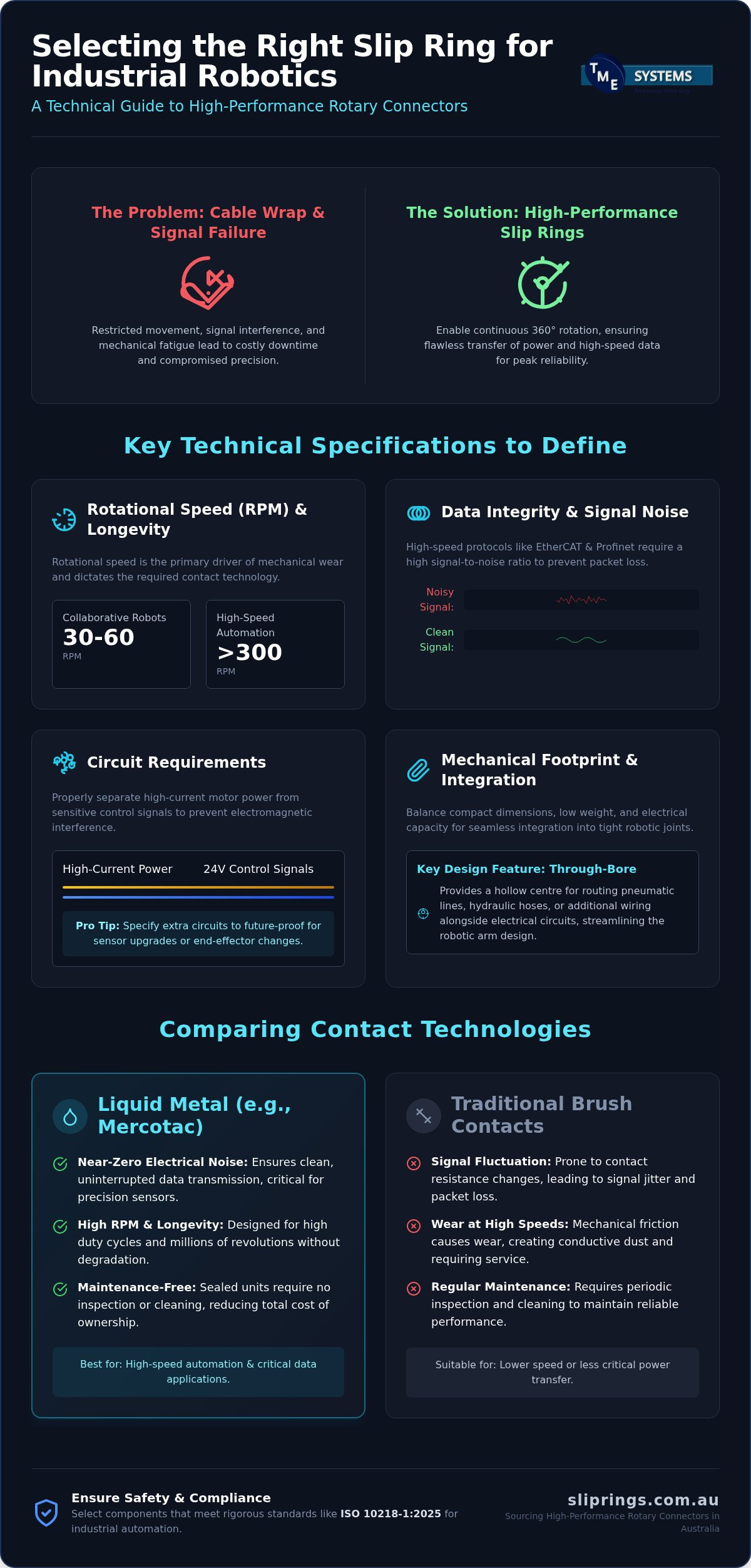
In a modern automated cell, a slip ring for industrial robotics functions as the central nervous system of the assembly. This electromechanical device facilitates the seamless transfer of power and high-speed data across rotating joints, allowing for 360-degree continuous movement. Without this capability, robot arms would be restricted by "cable wrap," where tethered lines twist and eventually fail due to mechanical fatigue. While early industrial models focused primarily on power delivery, today’s high-speed pick-and-place systems require the transmission of complex control signals and high-bandwidth data without interruption.
Choosing an inferior component often results in signal jitter or total mechanical seizure. These failures lead to costly downtime and can compromise the precision of robotic sensors. By integrating a high-performance rotary connector, engineers ensure that the robot maintains its speed and accuracy over millions of cycles, reducing the total cost of ownership. Selecting a specialised slip ring for industrial robotics often involves prioritising a small footprint to avoid interfering with the robot's range of motion.
Data Integrity in High-Speed Automation
Modern robotics relies on real-time protocols such as EtherCAT, Profinet, and high-speed Ethernet to synchronise movement. As rotational speeds increase, the challenge of maintaining a high signal-to-noise ratio becomes more acute. Traditional brush-based systems can struggle with contact resistance fluctuations, leading to packet loss. Signal noise in robotic sensor feedback refers to the unwanted electrical fluctuations that distort the primary data stream, often caused by friction or electromagnetic interference at the contact interface. To combat this, advanced solutions like Mercotac Slip Rings use liquid metal technology to provide a near-zero-noise connection, ensuring data remains clean even at high RPMs.
Mechanical Constraints and Joint Integration
Integrating components into tight robotic joints requires a balance between compact dimensions and electrical capacity. Engineers often face the challenge of fitting a high-circuit-count connector into the confined space of a robotic wrist or elbow. Weight is another critical factor, particularly for end-of-arm tooling (EOAT), where every extra gram reduces the robot's effective payload and dynamic response.
Many applications benefit from through-bore designs, which provide a hollow centre for routing pneumatic or hydraulic lines alongside electrical circuits. High-precision options from Meridian Laboratory or specialised joints from Prosper Rotation are designed to meet these specific spatial requirements. These compact configurations allow for more streamlined robotic designs that can operate in restricted work envelopes without sacrificing durability or signal integrity.
Technical Specifications for High-Speed Robotic Articulation
Selecting a slip ring for industrial robotics requires a precise audit of your machine's dynamic performance. A collaborative robot (cobot) might only rotate at 30 to 60 RPM to comply with ISO 10218-1:2025 safety standards. In contrast, a high-speed pick-and-place arm often exceeds 300 RPM. These differences dictate the contact technology required to prevent premature wear. High-spec units also need to separate high-current motor power from sensitive 24V control signals. Mixing these without proper shielding or circuit separation leads to electromagnetic interference, which causes erratic robot behaviour. It is also prudent to specify extra circuits during the design phase to accommodate future sensor upgrades or end-effector changes.
RPM and Rotational Longevity
Rotational speed is the primary driver of mechanical degradation. For packaging and sorting robotics, where arms operate at high duty cycles, the total millions of revolutions must be calculated to determine the service interval. Traditional carbon brush designs require regular inspection and cleaning to remove conductive dust. In many Australian industrial settings, where downtime is expensive, engineers prefer maintenance-free designs. High-speed rotary solutions from Meridian Laboratory or Mercotac Slip Rings are often specified because they utilise liquid metal or specialised precious metal contacts. These technologies allow for hundreds of millions of revolutions without the need for manual brush replacement, ensuring the robot remains operational through extended production runs.
Sealing and Protection Standards
Australian industrial environments often present harsh conditions that can compromise internal electrical contacts. Fine dust in mining or agricultural robotics can act as an abrasive, while moisture in food-grade wash-down areas can cause short circuits. Specifying an IP-rated housing is essential in these scenarios. IP65-rated connectors offer protection against dust and low-pressure water jets, while IP67-rated units from Prosper Rotation provide total protection against immersion. For chemical processing, corrosion-resistant housings made from stainless steel or specialised polymers are necessary to prevent housing failure. Consulting with a specialist at sliprings.com.au can clarify these environmental requirements before you commit to a procurement decision. This technical audit ensures the chosen component matches the specific environmental variables of your facility.
Comparing Contact Technologies: Liquid Metal vs. Gold-on-Gold
The interface where stationary and rotating components meet is the most critical failure point in any slip ring for industrial robotics. Historically, industrial systems relied on carbon brushes; however, these are largely unsuitable for modern data-driven automation. Carbon brushes generate conductive debris and have high electrical resistance, which distorts high-frequency signals and risks short-circuiting sensitive electronics. To meet the demands of 2026 robotics, engineers have shifted toward precious metal contacts and liquid metal technologies. These materials offer significantly lower electrical noise and better resistance to oxidation, ensuring that control signals remain clear over millions of cycles.
The Mercotac Advantage for Signal Clarity
Liquid metal rotary connectors represent a significant departure from traditional mechanical brush designs. By using a pool of molecularly bonded liquid metal as the conductive medium, these units eliminate the "brush bounce" effect. This phenomenon occurs when a physical brush vibrates or lifts slightly off the ring due to high-speed rotation or external vibration, causing micro-interruptions in the data stream. Because there is no solid-to-solid friction, signal integrity remains flawless. While liquid metal is the gold standard for low-noise signals, certain sectors like food processing or medical robotics may require mercury-free rotary connectors to comply with strict environmental safety standards. You can learn more about Mercotac Slip Rings and their application in signal-sensitive environments.
Traditional Precious Metal Contacts
For applications where liquid metal is not suitable, precious metal fibre brushes provide a robust alternative. Gold-on-gold contacts are particularly effective for low-current control circuits. Gold does not oxidise, which maintains low contact resistance over the entire life of the component. These systems are often found in multi-axis arms where high vibration is a constant factor, as the multiple fibre contact points provide electrical redundancy. When you explore Prosper Rotation solutions, you will find designs that balance wear rates with electrical stability. These units are built for durability.
Meridian Laboratory technology takes this precision further, offering extreme reliability for sensitive robotic instrumentation. Their specialised contact designs are engineered to handle high-bandwidth data without the packet loss associated with lower-spec components. Choosing between these technologies depends on your specific bandwidth requirements and the mechanical stresses of the robotic joint. A thorough technical audit of these variables is the only way to ensure long-term reliability in the field.
Specifying Slip Rings for Multi-Axis Robotic Arms
Selecting a slip ring for industrial robotics isn't a one-size-fits-all process. It requires a systematic audit of the robot's electrical and mechanical requirements. Engineers must move beyond basic part matching to ensure the chosen component doesn't become the weak link in the automated system. A logical progression through the following five steps will help you specify a solution that meets the demands of high-cycle industrial environments.
- Step 1: Define the electrical load: Map every circuit based on its specific Amps and Volts. High-current lines for motors must be physically separated from low-voltage control signals to prevent interference.
- Step 2: Determine operating RPM and duty cycle: Match the connector's speed rating to the robot's peak articulation. Consider the total revolutions expected over the machine's service life.
- Step 3: Identify the mounting style: Choose between through-bore, flange, or capsule designs based on the physical integration points of the robotic joint.
- Step 4: Assess data transmission protocols: Verify that the connector can handle high-bandwidth signals like USB 3.0, HDMI, or industrial Ethernet without packet loss or signal degradation.
- Step 5: Review environmental factors: Evaluate the operating temperature range and the presence of high-frequency vibration within the robotic cell.
Mounting and Physical Configuration
The physical footprint of the connector often dictates the robot's range of motion. Through-bore slip rings are the standard choice for hollow robotic joints, allowing for the passage of shafts or fluid lines through the centre of the assembly. If you're working with miniature robotic assemblies or compact end-effectors, capsule designs offer a self-contained, pre-wired package that saves significant assembly time. For applications with severe vertical height constraints, such as flat robotic bases or turntables, pancake slip rings provide a low-profile solution by arranging the circuits on a flat disc rather than a cylindrical drum. Each configuration impacts how the cables are routed and secured, which is vital for preventing lead wire fatigue.
Managing Signal Interference
Data integrity is frequently compromised when sensitive signal circuits are placed too close to high-power motor lines. Effective shielding techniques are necessary to isolate these channels. Using low-resistance contacts is also critical; it prevents the voltage drops that lead to data packet loss in high-speed protocols. If your system experiences intermittent communication errors, you should consult our guide on Troubleshooting Signal Noise in Rotary Connections for advanced diagnostic steps. Ensuring these electrical parameters are met during the specification phase prevents the need for costly retrofits later. You can view our specialised robotics range to find components designed specifically for high-bandwidth data integrity.
Sourcing High-Performance Rotary Connectors in Australia
Procuring a slip ring for industrial robotics from an overseas vendor often introduces unnecessary risks to an automation project. While global marketplaces offer a vast array of components, they frequently lack the application-specific engineering support required to ensure long-term reliability. For Australian firms, the challenge lies in selecting a component that meets local safety standards while surviving the unique environmental conditions of the region. Working with a national distributor allows engineers to bypass the complexities of international logistics and gain direct access to technical specialists who understand the nuances of robotic integration.
A local partner ensures that every specification, from IP ratings to circuit separation, is thoroughly vetted before the order is placed. This consultative approach reduces the likelihood of component failure and ensures that the integration process remains on schedule. By prioritising local supply, Australian manufacturers can secure the technical support needed to troubleshoot complex signal integrity issues in real time.
Why Technical Consulting Matters
Many procurement officers fall into the "off-the-shelf" trap, selecting a part based solely on its basic dimensions and circuit count. However, robotic applications demand a deeper analysis of dynamic variables like acceleration torque and rotational friction. TME Systems assists engineers by conducting a technical audit of these parameters, ensuring that the chosen RPM ratings and circuit configurations are fit for purpose. This level of custom specification prevents the premature wear often seen in generic components. For high-precision applications requiring sub-milliohm resistance, we provide access to Meridian Laboratory Precision Slip Rings, which are engineered for sensitive instrumentation.
National Supply and Support
Streamlined procurement is essential for maintaining production timelines in the Australian automation sector. Accessing world-leading brands through a national distributor provides the benefit of reduced lead times and local warranty support. When your project requires robust, large-scale solutions for harsh industrial environments, we offer BGB Innovation Heavy Duty Slip Rings. These components are designed to withstand the rigours of heavy manufacturing and primary industry.
Beyond hardware availability, a national partner ensures compliance with Australian electrical and safety standards. This is particularly relevant when integrating a slip ring for industrial robotics into a system that must adhere to the latest ISO 10218-1:2025 requirements. Having a local point of contact for technical queries means that your engineering team can resolve integration challenges quickly, without waiting for time-zone-delayed responses from overseas factories. This reliable support structure is what separates a simple vendor from a true technical partner.
Optimising Your Robotic System for Long-Term Reliability
Securing the operational life of an automated arm depends on the integrity of its electrical backbone. Choosing a high-performance slip ring for industrial robotics is no longer just about matching dimensions; it requires a deep technical audit of rotational speeds, signal-to-noise ratios, and environmental sealing. By prioritising liquid metal or precious metal fibre contacts, you eliminate the data packet loss and mechanical wear that frequently lead to unplanned downtime in high-cycle packaging or manufacturing cells.
Success in robotic integration is achieved when technical accuracy meets local expertise. As the authorised Australian distributor for world-leading brands like Mercotac and Meridian Laboratory, we bridge the gap between complex hardware and your specific engineering needs. Our team provides specialist technical support to ensure your rotary connections remain reliable within harsh Australian industrial environments and comply with the latest safety standards. To ensure your next project operates with zero-maintenance efficiency, consult with our technical engineers for your robotic slip ring specification. Getting the details right at the design phase ensures a more resilient automation strategy.
Frequently Asked Questions
What is the main advantage of using a slip ring in a robotic arm?
The primary benefit of integrating a slip ring for industrial robotics is the ability to achieve continuous 360-degree rotation without tangling or damaging tethered cables. This electromechanical solution eliminates "cable wrap," which otherwise restricts the range of motion and causes premature lead failure through mechanical fatigue. By allowing for unrestricted articulation, robots can perform complex, repetitive tasks with higher efficiency and a significantly reduced risk of downtime caused by broken wiring.
Can slip rings transmit high-speed data like Ethernet or EtherCAT?
High-performance rotary connectors are specifically engineered to handle high-speed data protocols including Ethernet, EtherCAT, and Profinet. To ensure data integrity, these units must maintain a high signal-to-noise ratio, often achieved through liquid metal or gold-on-gold contact technologies. Selecting a specialised slip ring for industrial robotics from manufacturers like Meridian Laboratory ensures that high-bandwidth signals are transmitted without packet loss, even during high-speed rotation or in environments with significant electromagnetic interference.
How do I choose between a through-bore and a capsule slip ring for my robot?
Your choice depends on the robot's mechanical design and the need for internal routing. Through-bore slip rings feature a hollow centre, making them ideal for mounting over a central shaft or passing pneumatic and hydraulic lines through the joint. Conversely, capsule designs are compact, self-contained units perfect for miniature assemblies or end-of-arm tooling where space is restricted. A technical audit of your joint's dimensions and required circuit count will determine which configuration is most suitable.
What maintenance is required for industrial robotic slip rings?
Maintenance requirements vary significantly based on the contact technology used. Traditional carbon brush systems require periodic inspection and cleaning to remove conductive dust and prevent short circuits. However, modern solutions like Mercotac liquid metal connectors are effectively maintenance-free, as they don't rely on solid friction. For Australian industrial applications where downtime is costly, choosing a zero-maintenance precious metal or liquid metal design is often the most cost-effective strategy over the machine's operational lifespan.
Are there mercury-free alternatives for liquid metal rotary connectors?
Yes, mercury-free rotary connectors are available for applications where environmental or safety regulations prohibit the use of mercury, such as in food processing or medical robotics. While standard liquid metal units offer superior signal clarity, precious metal fibre brushes from Prosper Rotation provide a high-performance, mercury-free alternative. These fibre brushes offer multiple contact points per circuit, ensuring reliable power and signal transmission without the specific handling requirements associated with liquid metal components.
How does rotational speed (RPM) affect the life of a slip ring?
Rotational speed is a critical factor in determining the service life of any mechanical slip ring. Higher RPMs increase the linear speed at the contact surface, which accelerates the wear of traditional brush materials and can generate heat. Most manufacturers specify a lifespan in millions of revolutions, meaning a robot operating at 300 RPM will reach its service interval much faster than a slow-moving cobot. For high-speed articulation, maintenance-free liquid metal options are generally preferred.
What IP rating do I need for a robotic slip ring in a dusty environment?
For environments with fine particulates, such as those found in Australian mining or agricultural robotics, an IP65 rating is the minimum requirement to ensure dust-tight protection. If the robot is subject to wash-down procedures or temporary immersion, an IP67 rating is necessary. These sealed housings protect the internal electrical contacts from contamination and corrosion, which are the primary causes of signal degradation and electrical failure in harsh industrial settings.
Can I combine power and signal circuits in a single slip ring unit?
You can combine power and signal circuits within a single hybrid unit to save space and simplify cable management. However, it's vital to ensure that high-current lines are adequately shielded from sensitive data circuits to prevent electromagnetic interference. Our technical application consulting helps you select a configuration with the correct circuit separation and shielding to maintain signal integrity. This approach ensures that motor power doesn't disrupt critical feedback from robotic sensors or control systems.