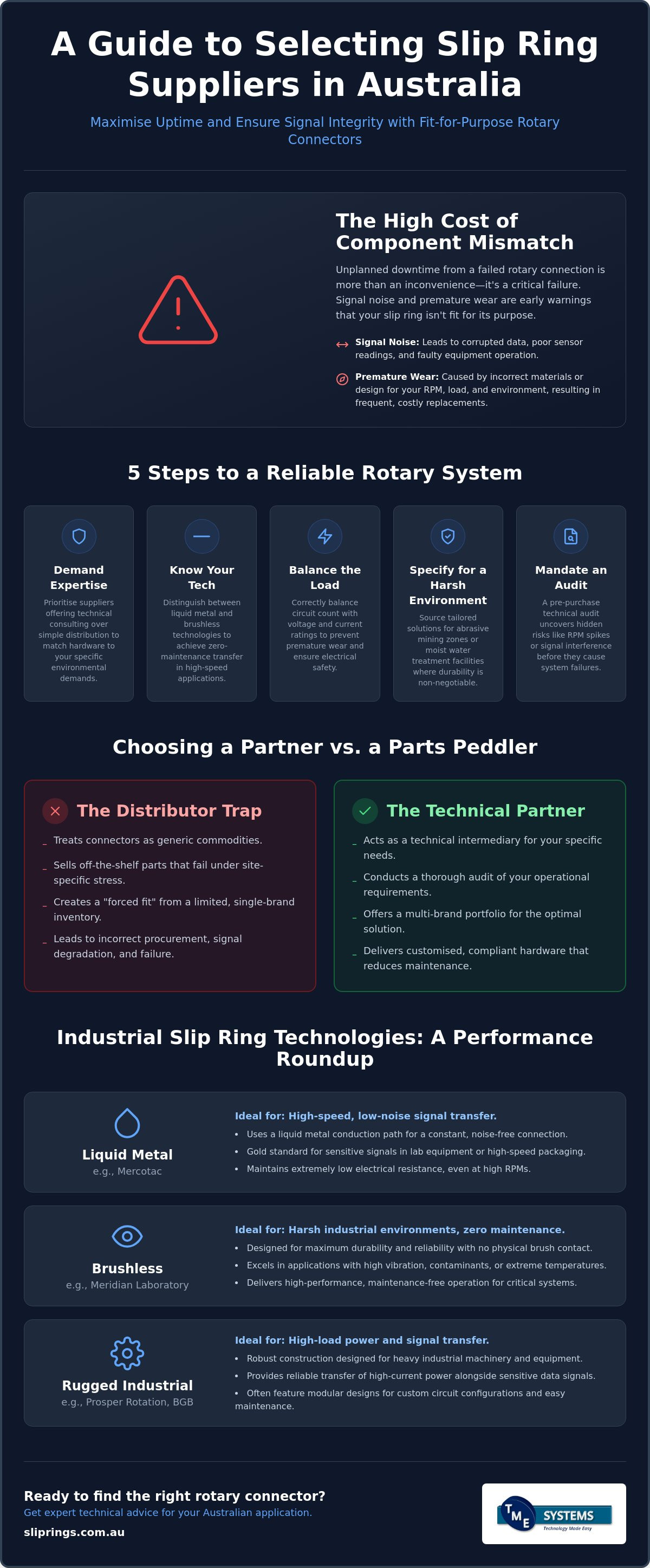
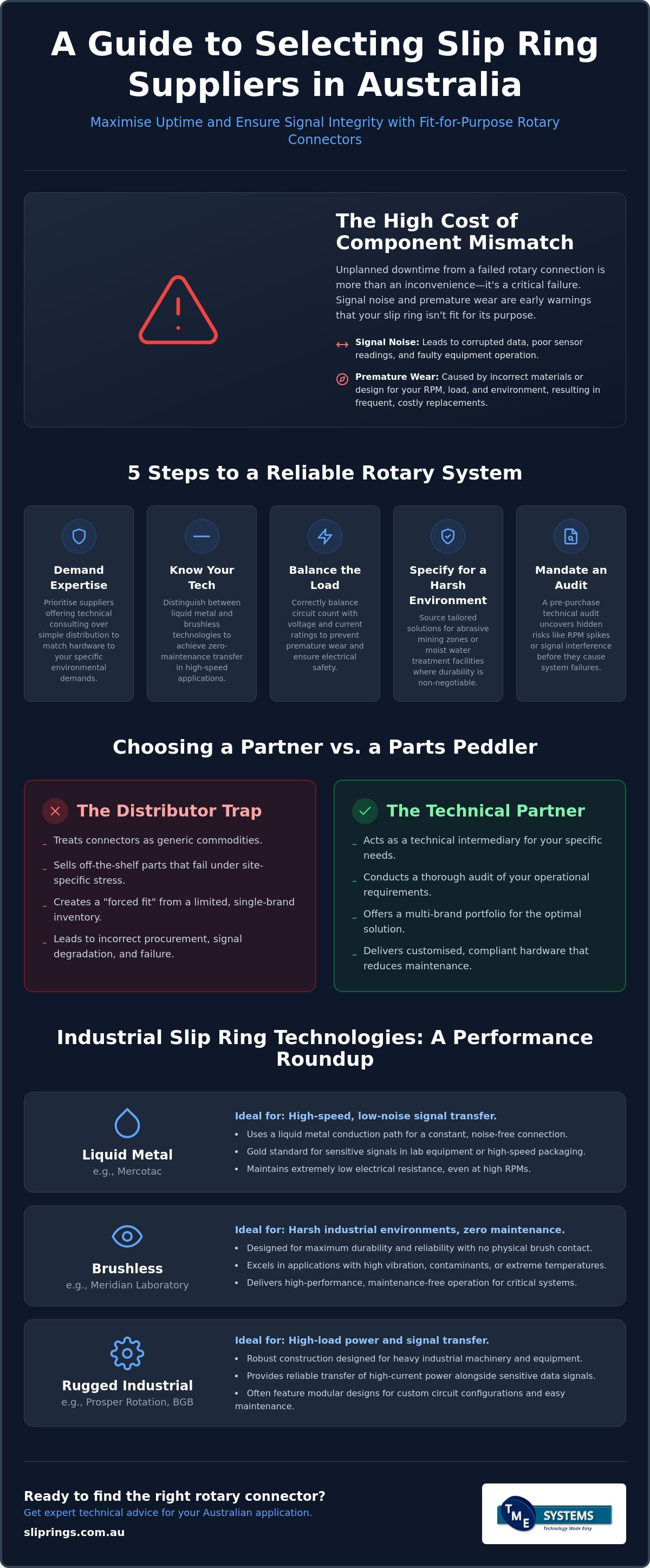
How much does a single hour of unplanned downtime cost your facility when a critical rotary connection fails? Most maintenance managers recognise that signal noise and premature wear aren't just minor inconveniences; they're symptoms of a component that isn't fit for purpose. Finding a reliable slip ring supplier Australia can trust involves more than just browsing a catalogue. It requires a technical understanding of how different rotary technologies perform under the specific environmental stresses of your local site.
We understand that sourcing niche technical advice for complex applications can be difficult. This guide is designed to help you identify the most reliable rotary electrical connectors for your specific requirements through a technical roundup of leading industrial technologies. You'll learn how to achieve clean signal and power transfer for 360-degree rotation while significantly reducing your maintenance intervals. We will also preview the performance profiles of specialised brands like Meridian Laboratory and Prosper Rotation, ensuring your procurement process aligns with Australian electrical standards and RCM requirements.
Key Takeaways
- Selecting a slip ring supplier Australia can rely on requires prioritising technical consulting over simple product availability to ensure hardware matches specific environmental demands.
- Learn to distinguish between liquid metal and brushless technologies, such as Mercotac or Meridian Laboratory ROTOCON, to achieve zero-maintenance signal transfer in high-speed applications.
- Understand how to balance circuit count with voltage and current ratings to prevent premature wear and ensure electrical safety in high-load industrial settings.
- Discover tailored solutions for harsh environments, including abrasive mining zones and water treatment facilities, where component durability is non-negotiable.
- Identify why a technical audit is essential for uncovering hidden operational risks like RPM spikes or signal interference before they lead to costly system failures.
Key Criteria for Selecting a Slip Ring Supplier in Australia
Choosing a slip ring supplier Australia trusts involves more than checking a price list. For Australian engineers and maintenance managers, the procurement of rotary electrical connectors is a high-stakes engineering decision. A proficient supplier acts as a technical intermediary, bridging the gap between sophisticated manufacturing capabilities and the harsh, site-specific realities of local industry. It is not enough to simply stock parts. The supplier must demonstrate a history of success in sectors like mining and water treatment, where environmental factors such as abrasive dust, extreme heat, and moisture are constant variables. Reliability in these conditions requires a partner who understands that a component's mechanical properties are just as critical as its electrical specifications.
Technical Expertise vs. Simple Distribution
Procurement teams often fall into the trap of treating rotary connectors as generic commodities. Off-the-shelf solutions frequently fail in specialised equipment because they are not rated for specific RPM spikes, electrical noise tolerances, or the duty cycles required on-site. A knowledgeable slip ring supplier Australia depends on will conduct a thorough technical audit before suggesting a part number. They will ask about your specific voltage, current, and signal requirements to ensure the hardware is fit for purpose. Slip ring technology is inherently diverse; choosing the wrong contact material or housing can lead to immediate signal degradation or mechanical failure. Local technical support is invaluable here, as it reduces the risk of incorrect procurement and ensures that the specified component accounts for voltage drops under load.
Range and Brand Compatibility
A versatile supplier maintains a multi-brand portfolio to avoid the "forced fit" scenario. This occurs when a customer is sold a product simply because it is the only one in a vendor's inventory. Your supplier should offer a range of technologies, including:
- Liquid Metal Connectors: Such as those from Mercotac, which are superior for low-noise signal and high-speed applications.
- Brushless Connectors: High-performance units from Meridian Laboratory designed for harsh environments.
- Rugged Industrial Units: Reliable power and signal solutions from Prosper Rotation and BGB Innovation.
The ability to facilitate custom configurations is another hallmark of a professional partner. Standard units often fail to meet requirements for non-standard mounting or specific circuit counts. You need a partner who can coordinate these modifications while ensuring compliance with Australian electrical standards. This level of service transforms a vendor into a long-term technical partner, helping you reduce maintenance intervals and achieve clean signal transfer across all 360 degrees of rotation.
Industrial Slip Ring Technologies: A Performance Roundup
Understanding the landscape of Industrial Slip Ring Technologies is essential for any engineer tasked with maintaining system uptime. As a professional slip ring supplier Australia depends on, we categorise these solutions based on their contact method and environmental resilience. Different applications require distinct mechanical approaches to ensure that power and data transfer remain uninterrupted during continuous rotation. Selecting the wrong technology doesn't just lead to signal noise; it can cause premature component failure and costly production halts.
Mercotac liquid metal connectors represent the gold standard for high-speed applications requiring extremely low electrical noise. Unlike traditional brush systems, these units use a liquid metal conduction path that remains constant, even at high RPMs. This makes them ideal for sensitive signal transfer in laboratory equipment or high-speed packaging lines. Conversely, Meridian Laboratory ROTOCON units utilise a brushless design that excels in harsh industrial environments. These high-performance connectors are engineered to handle high RPM requirements without the friction-related wear associated with conventional contacts.
Liquid Metal vs. Brushless Rotary Connectors
The choice between liquid metal and brushless technology often comes down to the specific data integrity requirements of your system. Mercotac units are virtually maintenance-free because they eliminate the physical wear of brushes, providing a consistent, low-resistance path for sensitive signals. However, when your application involves extreme RPMs or requires a robust housing for aggressive environments, specifies the brushless ROTOCON technology. These units maintain signal integrity by removing the mechanical vibration and debris common in brush-based assemblies. You can view our full technical specifications to compare these models side-by-side based on your specific circuit requirements.
Heavy Duty and Conventional Slip Ring Assemblies
For large-scale industrial operations, conventional slip ring assemblies remain a staple due to their versatility and high current capacity. BGB Innovation specialises in these heavy-duty solutions, which are frequently found in wind turbines and water treatment plants across Australia. Their designs are built to withstand the torque and environmental exposure typical of these sectors. Explore our BGB Innovation range for heavy-duty requirements where durability in outdoor or high-vibration zones is the primary concern.
Prosper Rotation provides a balance of cost and performance for standard industrial machinery. Their compact designs are versatile enough for commercial applications like rotating signage or small-scale automated assembly lines. While they may not offer the extreme low-noise profile of liquid metal, they provide a reliable and cost-effective solution for power transfer where space is at a premium. Matching these technologies to your operational reality is the key to reducing long-term maintenance costs.
Critical Specification Factors for Australian Industry
Successful procurement starts with a detailed technical brief. A reliable slip ring supplier Australia relies on will usually ask for four primary data points: circuit count, electrical ratings, rotational speed, and mounting constraints. Balancing these factors is essential to avoid overheating or signal loss. For instance, combining high-current power circuits with sensitive Ethernet data in a single assembly requires specialised shielding to prevent crosstalk. If the internal configuration isn't managed correctly, the electromagnetic interference from the power lines will degrade your data integrity.
Voltage and current ratings must reflect the peak loads of your equipment, not just the nominal operating levels. Over-specifying provides a safety margin that extends component life. Speed ratings also dictate the contact material choice. High RPMs generate heat and friction; while conventional brushes work for slow rotation, high-speed applications often require the liquid metal or brushless technologies mentioned in our performance roundup. Finally, you must select a mounting style that fits your mechanical footprint. Through-bore (hollow-shaft) designs allow the unit to slide over a central shaft, while capsule designs offer a compact solution for space-constrained installations.
Environmental Resilience and IP Ratings
Australian mining and marine environments are notoriously unforgiving. Specifying IP65 or IP67 ratings is non-negotiable for equipment exposed to high-pressure wash-downs, abrasive dust, or salt spray. Dust ingress can cause arcing and rapid contact degradation, while temperature fluctuations in the Outback can lead to condensation within the housing. Corrosion resistance is equally vital for coastal wastewater plants. In these scenarios, stainless steel housings or specialised coatings are required to protect the rotary joint from chemical exposure. Choosing a Prosper Rotation or BGB Innovation unit with the correct IP rating ensures that your hardware survives the site conditions.
Low-Noise Signal and Data Transfer
Maintaining the integrity of Ethernet or Fieldbus protocols through a rotating interface requires precise engineering. High contact resistance creates signal noise, which manifests as dropped packets or intermittent errors in PLC communication. Signal noise in slip rings is an electrical interference caused by fluctuating contact resistance that disrupts the timing and clarity of digital data packets. To ensure reliable automation, specify connectors with low-noise profiles, such as those found in the Meridian Laboratory or Mercotac ranges. These technologies are specifically designed to handle high-speed data circuits without the signal degradation common in standard carbon brush systems.
Application-Specific Solutions for Rotating Equipment
A specialised slip ring supplier Australia relies on must provide more than just hardware; they must deliver solutions tailored to the physical demands of specific local industries. Rotating equipment in a clean-room packaging facility faces entirely different stressors than a clarifier in a wastewater plant or a drill rig in the Pilbara. Matching the mechanical configuration and contact technology to the application is the only way to ensure long-term reliability and prevent the signal noise that disrupts automated systems. Every environment presents a unique set of variables that dictate the choice of housing, seal, and contact material.
Reliability in Mining and Resource Extraction
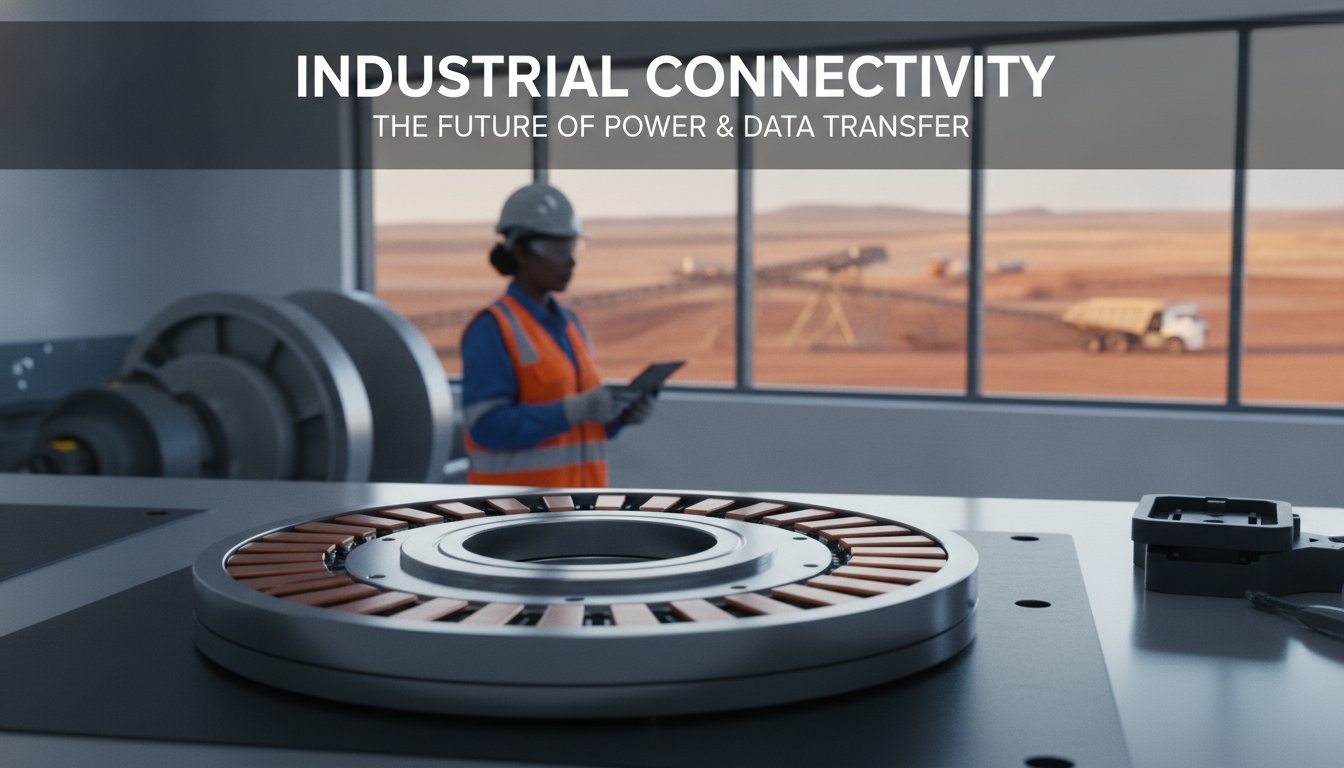
Continuous operation in remote Australian mining sites requires components that can withstand abrasive dust, extreme ambient temperatures, and constant high-frequency vibration. In these environments, component failure doesn't just stop a machine; it can halt an entire production chain in a location where replacement parts are hours or days away. Heavy-duty slip rings are essential for the rotating booms of stacker-reclaimers and the complex circuitry of underground boring machines. We recommend BGB Innovation solutions for these heavy-duty requirements, as their assemblies are engineered specifically for the rugged demands of resource extraction. These units provide the mechanical resilience needed to maintain electrical contact despite the grit and heat typical of local mine sites.
Precision in Automation and Packaging
Industrial automation and robotics present a different set of challenges, primarily focused on space constraints and high-cycle reliability. In high-speed packaging lines, slip rings must manage thousands of rotations per hour while maintaining signal stability for quality control sensors. Compact designs are necessary for integration into robotic arms where every millimetre of space is accounted for. Low-torque rotation is critical here; high friction can interfere with the precision movements of the robot, leading to positioning errors. For these delicate applications, technologies that offer minimal drag and consistent signal integrity are paramount. If you are unsure which technology fits your specific machine footprint, consult our technical team for a specification audit to ensure your hardware choice supports your operational goals.
Water and wastewater treatment facilities also require a specific approach, particularly for clarifiers and thickeners. These systems often operate in high-humidity environments where corrosion can quickly degrade standard electrical contacts. Reliable power transfer is essential to keep these slow-moving but critical systems functioning 24/7. Similarly, food processing equipment must balance high-cycle reliability with strict hygiene standards, often requiring specialised housings that can withstand aggressive chemical wash-downs without compromising the internal electrical paths. Identifying these nuances early in the procurement process prevents premature wear and reduces the total cost of ownership over the life of the machine.
The Value of Technical Consulting in Slip Ring Procurement
Procuring a rotary electrical connector is a technical decision that directly impacts the long-term reliability of your machinery. A professional slip ring supplier Australia relies on doesn't simply take orders; they act as a technical partner to ensure every specification is validated against the operational reality of the site. A technical audit is the essential first step in this process. By evaluating the specific mechanical and electrical parameters of your installation, a specialist can identify hidden risks that standard catalogues often overlook. These might include unexpected RPM spikes, high-frequency signal interference, or thermal expansion variables that could lead to premature failure if not accounted for during the initial specification phase.
Correct initial specification is the most effective way to reduce the total cost of ownership (TCO) for rotating equipment. While a cheaper, off-the-shelf component might seem attractive initially, the costs associated with unplanned downtime and frequent maintenance intervals far outweigh the investment in a fit-for-purpose solution. TME Systems Pty Ltd serves as a knowledgeable intermediary, bridging the gap between global manufacturing capabilities and the specific technical needs of Australian industrial projects. This consultative approach ensures that the hardware you install today will perform reliably for its intended service life.
How to Organise a Technical Application Consultation
To begin a consultation, you should provide a comprehensive data set including your required circuit count, operating voltage, maximum rotational speed, and the environmental conditions of the installation. This information allows experts to help you navigate the performance trade-offs between different technologies. For example, they can determine whether your application requires the low-noise profile of Mercotac liquid metal connectors or the extreme durability of Meridian Laboratory brushless options. This process also ensures that your chosen hardware meets all relevant Australian safety and performance standards, including RCM compliance.
Long-Term Support and Spare Parts
The relationship with your supplier should continue long after the initial purchase. Access to local stock for critical industrial components is vital for minimising the impact of wear-and-tear in high-cycle environments. Technical support also plays a key role in troubleshooting intermittent signal issues or planning preventative maintenance schedules. A partner who understands the history of your specialised application can provide much faster resolutions than a generic distributor. If you're looking to optimise your rotary connections, you should contact TME Systems Pty Ltd for a technical review of your requirements to ensure your systems remain operational and efficient.
Optimising Your Rotary Electrical Infrastructure
Securing long-term reliability for rotating machinery depends on a procurement process that prioritises technical accuracy over convenience. The difference between a high-performing system and one plagued by signal noise often comes down to the initial specification of contact materials and environmental seals. Whether you're managing high-speed data in a packaging line or heavy-duty power transfer in a remote mine site, your choice of hardware must be fit for purpose.
Partnering with a specialist slip ring supplier Australia can trust ensures that your components align with local electrical standards and site-specific demands. TME Systems Pty Ltd serves as the authorised Australian distributor for global leaders like Mercotac and Meridian Laboratory, providing the technical expertise required for high-speed and low-noise applications. Our team delivers specialised solutions across the mining, water treatment, and automation sectors, focusing on reducing your total cost of ownership through precise engineering.
Take the next step in securing your facility's uptime. Consult with TME Systems Pty Ltd for your industrial slip ring requirements and ensure your rotary connections are engineered for performance. We look forward to helping you solve your most complex engineering challenges.
Frequently Asked Questions
What is the difference between a slip ring and a rotary electrical connector?
A slip ring and a rotary electrical connector are essentially synonymous terms for the same technology. While "slip ring" is the common industrial name, "rotary electrical connector" is often used in technical specifications to describe the component's function. Both devices facilitate the transmission of electrical power and signals across a rotating interface, ensuring continuous 360-degree rotation without tangling wires.
How do I choose between a liquid metal and a brushless slip ring?
Your choice depends on your signal integrity and speed requirements. Liquid metal units, such as those from Mercotac, provide extremely low electrical noise, making them ideal for sensitive data. However, brushless technology from Meridian Laboratory is often preferred for high-RPM applications or harsh environments where traditional contact wear must be eliminated. Consulting a specialised slip ring supplier Australia relies on will help you match these performance profiles to your duty cycle.
Can slip rings transfer high-speed data like Ethernet or CAT6?
Yes, specialised slip rings can transfer high-speed data protocols including Ethernet, CAT6, and various Fieldbus types. These units are engineered with specific shielding and impedance matching to prevent signal degradation across the rotating joint. It's essential to specify the data rate and protocol during the procurement phase to ensure the internal configuration supports the required bandwidth without packet loss or intermittent errors.
What maintenance is required for industrial slip rings?
Maintenance requirements vary significantly based on the internal contact technology. Conventional carbon brush systems require periodic cleaning to remove conductive dust and inspections to monitor brush wear. In contrast, liquid metal and brushless connectors are generally considered maintenance-free for their rated service life. You should still inspect external seals in abrasive environments to prevent ingress that could damage the internal assembly and lead to premature failure.
Are there mercury-free alternatives for food grade or medical applications?
Mercury-free alternatives are readily available for sensitive sectors like food processing and medical manufacturing. While liquid metal connectors often utilise mercury for its conductive properties, brushless or gold-on-gold contact slip rings provide a safe and effective alternative. These units deliver high performance without the environmental or safety risks associated with liquid metal, ensuring compliance with strict industry hygiene and safety standards.
What information should I provide to a slip ring supplier for a quote?
You should provide the circuit count, electrical ratings for power and signal, maximum rotational speed (RPM), and the operating environment. Additionally, specify any mounting constraints, such as the need for a through-bore or a compact capsule design. Providing these data points to your slip ring supplier Australia allows for an accurate technical audit and ensures the specified hardware is fit for your specific application.
How does RPM affect the lifespan of my slip ring?
Rotational speed directly impacts the mechanical wear and thermal load of the internal contacts. In brush-based systems, higher RPMs accelerate the degradation of the brushes and rings, shortening the overall service life. For brushless and liquid metal units, lifespan is typically measured in total revolutions; therefore, operating at higher speeds will cause the unit to reach its end-of-life cycle in a shorter calendar timeframe.
Can slip rings be used in hazardous or explosion-proof environments?
Slip rings can be used in hazardous environments if they are specifically rated and certified for those conditions. These units feature explosion-proof housings designed to contain any internal arcing or sparks, preventing them from igniting external gases or combustible dust. It's critical to confirm that the chosen component carries the necessary local and international certifications required for your specific hazardous zone classification before installation.