How much of your annual operational budget is currently being swallowed by the "maintenance trap" of traditional brushed slip rings? For many Australian industrial facilities, the constant cycle of cleaning contacts and replacing worn brushes is viewed as an unavoidable cost of doing business. When specifying Meridian Laboratory slip rings Australia, you're looking for a solution that moves beyond the signal degradation and electrical noise that plague precision data circuits. It's a common frustration, but it doesn't have to be your standard operating procedure.
This reference guide explores how the ROTOCON brushless design eliminates friction-related wear and provides a maintenance-free solution for the life of your machine. We'll examine the technical superiority of liquid metal contacts for clean Ethernet and sensor signal transfer. You'll also learn how to navigate the specification process with expert local guidance to ensure your hardware thrives in demanding conditions. From high-current capacity to zero bit-error data transmission, we'll cover the essential parameters required for your next system upgrade. By the end of this guide, you'll understand why brushless technology is the benchmark for modern Australian automation.
Key Takeaways
- Understand how Meridian Laboratory’s brushless liquid metal technology eliminates the mechanical wear and signal noise inherent in traditional carbon brush systems.
- Learn why ROTOCON units are designed for maintenance-free operation for the life of the machine, removing the need for regular brush replacements and downtime.
- Discover the environmental sealing requirements necessary to maintain performance in harsh Australian industrial conditions, including heat and dust resilience.
- Gain insight into the professional specification of Meridian Laboratory slip rings Australia to ensure your electrical and mechanical parameters are perfectly aligned.
- Evaluate the technical capacity of these systems for high-speed data transfer, including certified zero bit-error performance for sensitive industrial Ethernet protocols.
Overcoming the Limitations of Conventional Slip Ring Technology
A slip ring is an electromechanical device designed to transmit power and electrical signals from a stationary structure to a rotating one. While Conventional Slip Ring Technology has supported industrial rotation for decades, the reliance on physical contact between a rotating ring and a stationary carbon brush creates a fundamental engineering bottleneck. In high-speed or precision data applications, this contact point is almost always the primary source of system failure. Professionals specifying Meridian Laboratory slip rings Australia typically do so because they've reached the functional limits of these traditional, friction-based systems.
The Problem with Physical Contact Brushes
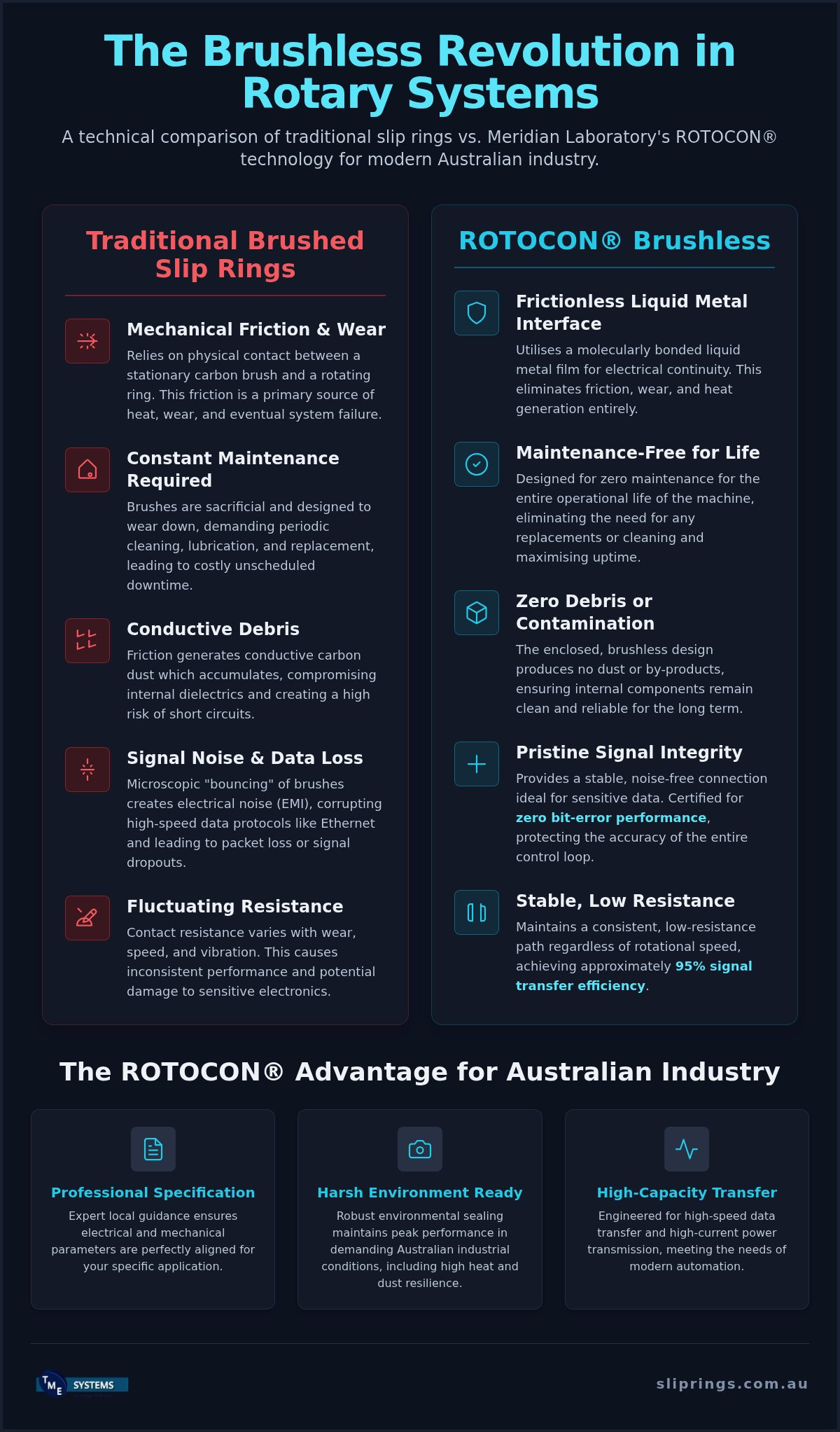
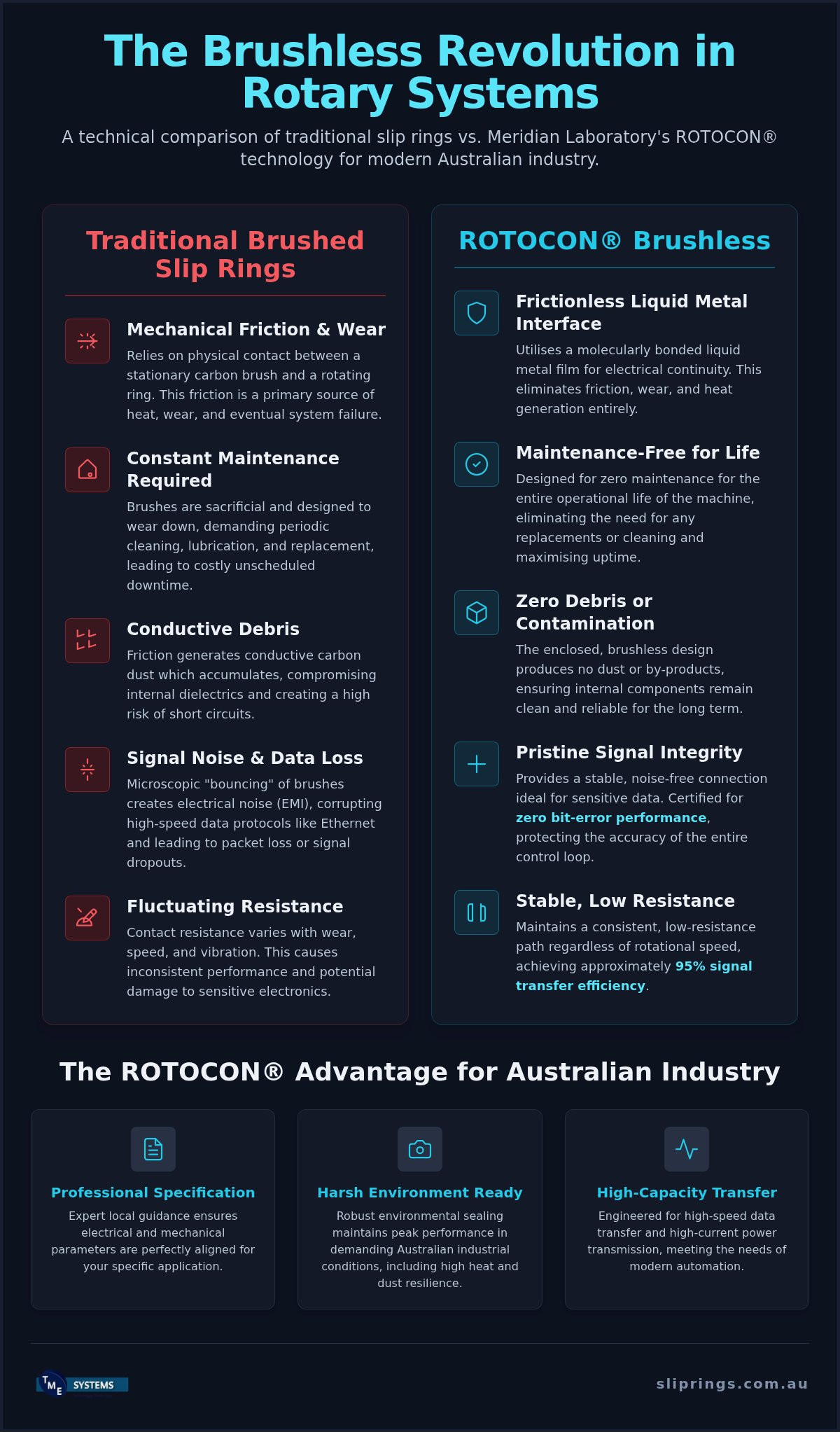
Traditional brushes are sacrificial components by design. They're intended to wear down over time, which necessitates periodic lubrication and eventual replacement. This friction generates significant heat and produces conductive carbon dust. As this debris accumulates within the housing, it compromises the internal dielectric strength and can lead to short circuits. This wear also causes fluctuating contact resistance. For a power circuit, this might be a minor efficiency loss; for a sensitive data circuit, it's a recipe for inconsistent performance and hardware damage.
Signal Noise and Data Integrity Challenges
Modern industrial automation relies on high-speed data protocols such as Ethernet, EtherCAT, and Profinet. These circuits are highly sensitive to electrical noise, or electromagnetic interference (EMI), which is frequently generated by the microscopic "bouncing" of mechanical brushes. Even minor machine vibrations can disrupt the stability of a physical contact, leading to packet loss or signal dropouts. Maintaining a high signal-to-noise ratio is non-negotiable for precision sensor feedback. If the interface introduces even millivolts of noise, the accuracy of the entire control loop is compromised.
In the context of Australian production lines, the hidden cost of traditional technology is unscheduled downtime. Every hour spent cleaning contacts or clearing carbon dust is an hour of lost revenue. Precision automation requires a shift toward brushless technology to ensure long-term reliability. By eliminating the friction and debris associated with physical contact, facilities can achieve the stability required for sensitive data circuits and high-duty cycles. Choosing Meridian Laboratory slip rings Australia allows engineers to move away from these mechanical constraints and toward a truly maintenance-free rotary interface.
The ROTOCON Advantage: Brushless Performance for Precision Signal Transfer
The transition from traditional mechanical contacts to Meridian Laboratory’s proprietary ROTOCON technology represents a significant shift in rotary interface engineering. While conventional units rely on the physical friction of carbon brushes, ROTOCON utilises a specialised liquid metal interface to maintain electrical continuity. This design choice is particularly relevant when specifying Meridian Laboratory slip rings Australia for high-stakes industrial environments where signal degradation isn't an option. By replacing the sliding contact with a molecularly bonded liquid film, these units achieve a level of signal integrity that mechanical systems cannot replicate.
One of the most critical metrics in rotary signal transfer is constant contact resistance. In a brushed system, resistance fluctuates as the brush bounces or wears, creating "noise" that can corrupt sensitive data. The ROTOCON interface provides a stable, low-resistance path that remains consistent regardless of rotational speed. This stability allows for approximately 95% efficiency in signal transfer across the rotary union, ensuring that the data leaving the stationary side is identical to the data received at the rotating end. It's this precision that makes the technology essential for high-frequency applications and sensitive sensor circuits.
Understanding the Brushless Mechanism
The engineering behind the brushless liquid metal interface focuses on eliminating the two primary enemies of electrical rotation: friction and heat. Because the contact is fluid rather than solid, there is no mechanical wear and, consequently, no production of conductive debris or carbon dust. This molecular bond ensures a continuous electrical path that can support both low-level signals and High-Current Capabilities without the arcing or pitting common in standard rings. This advanced contact physics allows the unit to maintain its performance specifications throughout its entire operational life.
Benefits of a Zero-Maintenance Design
For Australian facility managers, the most tangible benefit of this technology is the move toward a zero-maintenance operational model. These units are capable of operating for billions of revolutions without requiring service intervals or lubrication. This significantly reduces the total cost of ownership (TCO) by eliminating the labour and spare parts costs associated with brush replacement. This reliability is vital for equipment located in inaccessible areas or within critical mission-profile machinery where a failure would result in catastrophic downtime. If you're designing a system that requires absolute uptime, you might consult with a technical specialist to determine the ideal ROTOCON configuration for your specific machine life requirements.
Technical Specifications: High-Speed and High-Current Capabilities
The technical flexibility of Meridian Laboratory slip rings Australia allows engineers to address specific mechanical constraints without sacrificing electrical performance. Unlike standard components that offer a "one size fits all" approach, the ROTOCON range is categorised by its ability to handle simultaneous power and high-frequency data across various mounting configurations. Whether your application requires a compact capsule design for tight spatial envelopes or a through-bore unit to accommodate a central shaft, the selection process focuses on balancing rotational speed with electrical load and thermal dissipation.
High-Speed Rotation and RPM Limits
Rotational speed is a primary factor in selecting a rotary interface. While standard industrial applications operate at moderate speeds, specialised testing and turbomachinery require ultra-high-speed performance. Meridian offers models capable of reaching 40,000 RPM, where maintaining signal stability is a significant engineering challenge. At these speeds, centrifugal forces can disrupt the contact integrity of traditional brushed systems. The liquid metal interface in a ROTOCON unit remains stable under these extreme forces, ensuring that data transmission remains constant without the vibration-induced jitter common in mechanical alternatives.
Multi-Channel and Circuit Count Selection
Modern Australian industrial projects often require the transmission of diverse signals through a single rotary union. It's common to see high-voltage power lines running alongside sensitive EtherCAT or sensor circuits. Organising these channels requires sophisticated shielding and internal layout to prevent crosstalk. Meridian's design architecture allows for custom circuit configurations, ensuring that high-frequency data remains isolated from power-induced interference. This is particularly relevant for a slip ring assembly for harsh environments where physical space is limited but signal reliability is paramount.
Power Transfer and Rotary Grounds
For heavy industrial use, such as high-current welding or electro-plating, the ability to manage thermal dissipation is critical. Standard ROTOCON units are available with current ratings from 400A to 10,000A, with custom options extending to 15,000A for massive industrial loads. These high-current rotary grounds are designed to operate at voltages exceeding 600V, providing a robust solution for heavy machinery. Managing the heat generated by such high power levels requires a design that prioritises thermal conductivity. By utilising a fluid contact, the system maintains a larger surface area for electrical transfer, which naturally aids in heat management compared to the point-contact of a carbon brush. If your project involves these high-power requirements, reviewing the Meridian Laboratory slip rings Australia technical documentation will help identify the correct thermal and voltage ratings for your specific application.
Specifying ROTOCON for Harsh Australian Industrial Environments
Australia’s industrial landscape presents environmental challenges that quickly degrade standard rotary interfaces. From the fine, abrasive dust found in Western Australian mining operations to the high humidity and salt spray of coastal processing plants, hardware must be engineered for extreme resilience. When specifying Meridian Laboratory slip rings Australia, the focus shifts from purely electrical parameters to the physical protection of the internal contacts. A failure in sealing or material selection often leads to catastrophic downtime before the electrical components have even reached their design life. It's vital to assess the specific stressors of your site before selecting a model.
Sealing and Ingress Protection
Effective sealing is the primary defence against ingress. Fine particulate matter is a constant threat in agricultural and mining sectors. If dust enters the slip ring housing, it acts as an abrasive that accelerates wear and contaminates the contact zone. ROTOCON units offer various sealing levels, including IP65 and IP67 ratings, to ensure internal components remain isolated. For food and beverage processing, where daily high-pressure wash-downs are standard, these seals prevent liquid ingress that would otherwise cause short circuits. We also provide pressurised or vacuum-compatible variants for high-altitude aerospace applications where maintaining a specific internal atmosphere is required.
Material Selection and Durability
Selecting the right housing for Meridian Laboratory slip rings Australia involves evaluating the chemical and thermal profile of the installation site. For marine or offshore applications, stainless steel housings provide the necessary corrosion resistance to withstand constant exposure to salt spray. Australian outdoor installations also face extreme temperature swings, often exceeding 45°C in summer. Meridian’s hardware is designed to maintain structural integrity across these broad ranges. Consider these environmental factors:
- Corrosion resistance: Essential for coastal and chemical processing facilities.
- Shock and vibration: Critical for heavy transport and mining machinery.
- Thermal stability: Ensures consistent signal transfer during extreme heat events.
Because the liquid metal interface is inherently more resistant to vibration than mechanical brushes, these units are ideally suited for heavy machinery where continuous 24/7 loads are common. They don't suffer from the "brush bounce" that causes signal dropouts in high-vibration environments. To ensure your hardware is fit for purpose, you can consult with our technical specialists to specify the correct environmental protections for your specific site conditions.
Technical Consulting and Procurement: Sourcing Meridian Laboratory in Australia
Sourcing Meridian Laboratory slip rings Australia requires a methodical approach to ensure the selected hardware matches the operational life of the machine. Unlike generic components, a ROTOCON unit is a precision-engineered interface. We don't just sell a part; we assist in the engineering of a connection. This process begins with a technical audit to define the exact mechanical and electrical boundaries of your application. This consultative phase is critical because it identifies potential failure points, such as thermal bottlenecks or signal interference, before the hardware is commissioned. It's the difference between a temporary fix and a permanent engineering solution.
The Technical Selection Process
A successful specification depends on three primary data points: the electrical load, the mechanical interface, and the environment. You'll need to define your circuit count, including a clear breakdown of power versus signal channels. It's essential to specify the maximum continuous current and peak voltage for each channel to prevent internal arcing or overheating. We then evaluate the mounting style, determining if a flange, shaft-end, or through-bore configuration is required to integrate with your existing drivetrain. Finally, we account for the environmental stressors discussed in previous sections, such as ambient temperature and potential exposure to particulates. This data allows us to recommend a specific model that provides the necessary IP rating and material durability for your site.
Ongoing Support and Local Expertise
TME Systems serves as the authorised Australian distributor, providing the technical bridge between Meridian Laboratory’s manufacturing capabilities and your specific project needs. Our engineers provide direct consultation to ensure your hardware is compatible with local industrial standards and existing machinery. We specialise in custom engineering for non-standard requirements, helping you navigate complex specifications that off-the-shelf catalogues can't address. This local presence means you have access to technical assistance throughout the procurement and installation phases. It's a partnership designed to reduce ambiguity and ensure the technical success of your project.
If you're managing a project that requires high-speed data integrity or zero-maintenance power transfer, accessing local expertise is the most efficient way to avoid specification errors. You can Learn more about Meridian Laboratory solutions or contact our technical team to begin the audit process. We prioritise long-term reliability and technical success over quick sales, ensuring that the Meridian Laboratory slip rings Australia you specify are the correct fit for the life of your equipment. By focusing on the specific parameters of your application, we help eliminate the guesswork often associated with rotary electrical interfaces.
Optimising Your Rotary Interface for Machine Longevity
Transitioning to brushless liquid metal technology is more than a simple hardware upgrade; it's a strategic investment in machine uptime and data integrity. By eliminating the friction and conductive debris associated with traditional contacts, you secure a noise-free signal path that's essential for precision automated systems. Specifying Meridian Laboratory slip rings Australia allows your facility to move beyond the cycle of periodic maintenance and the risks of signal degradation in harsh environments.
As the authorised Australian distributor, TME Systems brings decades of experience and specialist application engineering support to every project. We understand that every industrial application has unique variables, from rotational speed to environmental stressors. Our team acts as a dedicated problem-solver, helping you define the exact parameters required for long-term reliability. We ensure that the hardware you receive is perfectly matched to the life of your machinery.
Contact TME Systems for a Technical Consultation on Meridian Laboratory Slip Rings to ensure your next system upgrade is engineered for technical success. We look forward to assisting you in solving your most complex rotary connection challenges.
Frequently Asked Questions
What makes Meridian Laboratory ROTOCON slip rings different from standard ones?
ROTOCON units utilise a brushless liquid metal interface instead of traditional carbon brushes. This design eliminates mechanical friction, wear, and the production of conductive debris. Because there's no physical brush wear, many units have remained in service for over 30 years. This technology provides a constant, low-resistance electrical path that's superior to the fluctuating contact of standard brushed rings, making Meridian Laboratory slip rings Australia ideal for precision signal transfer.
Can ROTOCON slip rings handle high-speed data like Ethernet or EtherCAT?
Yes, ROTOCON technology is specifically engineered for high-speed data protocols including Ethernet, EtherCAT, and Profinet. These slip rings are certified for zero bit errors and zero packet loss, which is essential for real-time industrial automation. The brushless design ensures that vibration and rotational speed don't introduce the electrical noise that typically disrupts high-frequency data in standard rotary unions, ensuring your control circuits remain stable and reliable.
Do Meridian Laboratory slip rings require regular maintenance or lubrication?
No, Meridian Laboratory slip rings Australia are designed to be maintenance-free for the entire life of the machine. Unlike brushed alternatives, they don't require periodic lubrication or brush replacements. There's also no carbon dust accumulation to clean out, which prevents internal short circuits and dielectric failure. This "set and forget" capability significantly reduces operational downtime and the total cost of ownership for complex Australian industrial equipment and automation lines.
What is the maximum RPM rating for a Meridian Laboratory rotary connector?
While standard models accommodate most industrial speeds, specialised Meridian Laboratory rotary connectors are rated for ultra-high-speed applications up to 40,000 RPM. Even at these extreme speeds, the liquid metal contact remains stable and provides a noise-free signal. Choosing the correct RPM rating involves balancing your speed requirements with other factors like circuit count and current load. Our technical team helps you navigate these parameters during the initial specification process.
Are there mercury-free versions of Meridian Laboratory slip rings available?
Meridian Laboratory focuses on brushless liquid metal technology to achieve superior performance. While their core ROTOCON range utilises a liquid metal interface to ensure constant contact, they offer various configurations to meet specific industrial and safety requirements. If your application has strict material prohibitions or environmental compliance standards, it's best to consult with TME Systems. We'll help you identify the most appropriate model that meets both your performance and regulatory needs.
How do I choose between a through-bore and a capsule slip ring design?
The choice depends on your machine's mechanical layout and mounting requirements. Use a through-bore design if you need to mount the slip ring over an existing shaft or pass hydraulic and pneumatic lines through the centre. Capsule designs are more compact and are typically mounted at the end of a shaft. Both configurations maintain the same high-performance brushless technology for power and signal transmission, ensuring reliable electrical continuity regardless of the physical envelope.
What environmental protection ratings are available for these slip rings?
These slip rings are available with various ingress protection ratings, including IP65 and IP67, to suit different Australian environments. This ensures the internal contacts are protected from fine dust in mining or high-pressure wash-downs in food processing. We also offer hermetically sealed and vacuum-compatible variants for specialised aerospace and laboratory applications where absolute isolation from the external atmosphere is a critical requirement for maintaining signal integrity and hardware longevity.
How can I get technical support for Meridian Laboratory products in Australia?
Technical support is available directly through TME Systems, the authorised distributor for Meridian Laboratory slip rings Australia. Our engineers provide specialist application consulting to help you define mechanical and electrical parameters before purchase. You can contact the local team for assistance with complex specifications, ensuring that the rotary interface you select is perfectly suited to your specific industrial environment, rotational speed requirements, and expected machine life.