What if the most critical rotating connection in your machinery never required a brush change for the life of the equipment? While many engineers accept that periodic downtime is an inevitable cost of operation, specifying Meridian Laboratory slip rings Australia allows you to bypass the traditional maintenance trap entirely. You've likely experienced the frustration of electrical noise disrupting sensitive sensor data or the physical wear that leads to component failure in harsh Australian environments. These aren't just minor inconveniences; they're significant risks to your operational reliability and your data integrity.
This reference guide explores how ROTOCON brushless technology provides a permanent solution to these legacy mechanical issues. You'll discover how liquid metal wetting ensures maintenance-free performance and delivers the clean, noise-free signal transfer required for high-speed Ethernet and sensitive sensors. We also preview the technical consulting provided by TME Systems to ensure your specifications meet every environmental and electrical requirement of your project, from high-amperage power to precision data circuits.
Key Takeaways
- Learn why conventional carbon brushes cause electrical noise. You'll see how Meridian Laboratory's brushless liquid metal interface eliminates mechanical wear.
- Understand the technical parameters required for high-speed data transmission. This ensures clean Ethernet and sensor signals without signal degradation.
- Identify the correct sealing standards, such as IP67 or hermetic sealing. These protect your rotary connections against Australia's unique dust and heat challenges.
- Discover the consultative process for specifying Meridian Laboratory slip rings Australia. It's the best way to match hardware to specialised circuit counts and rotational speeds.
- Gain insights into achieving maintenance-free operation for the life of your equipment. This is made possible through advanced ROTOCON engineering.
Overcoming the Limitations of Conventional Slip Ring Technology
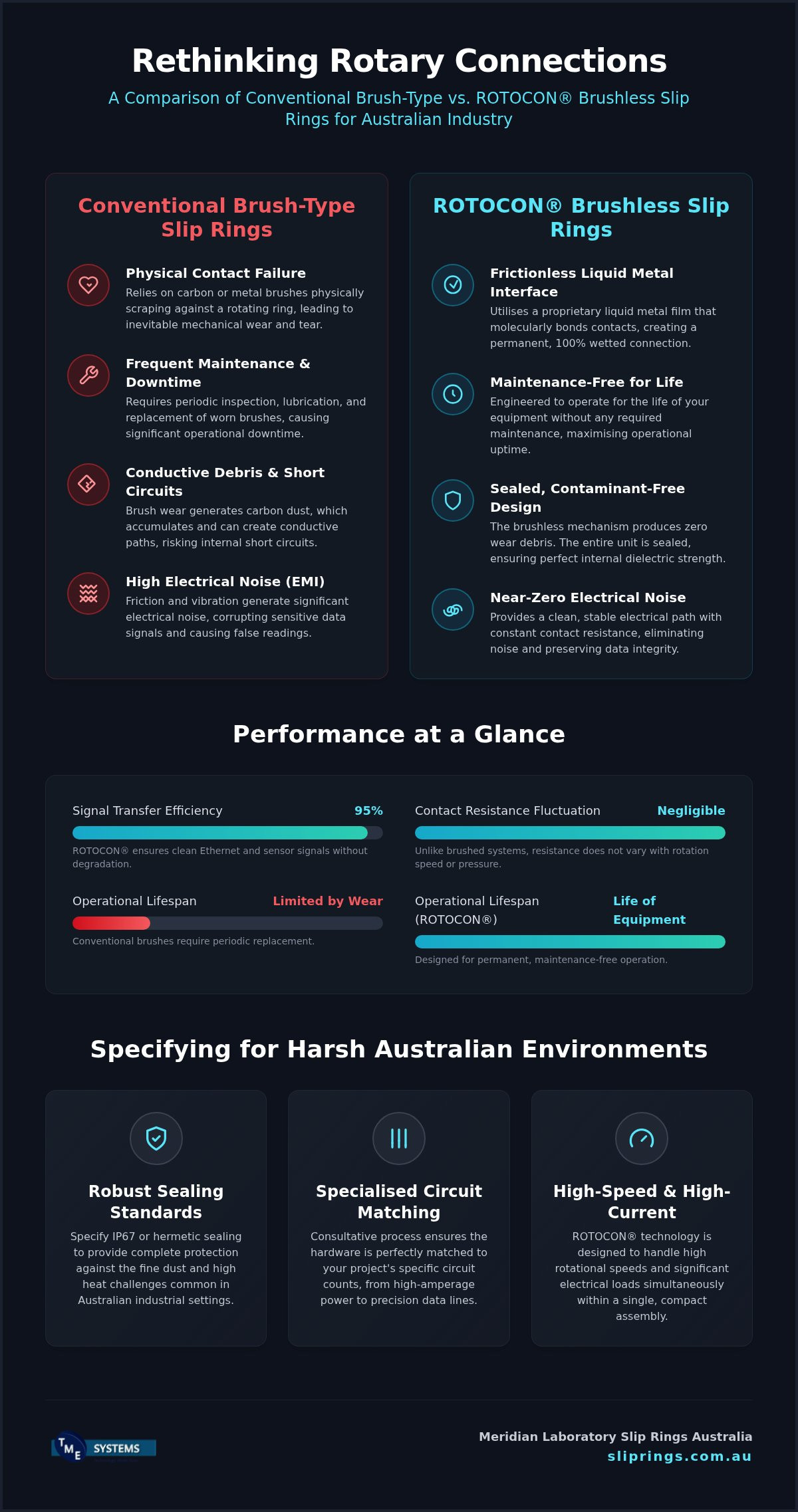
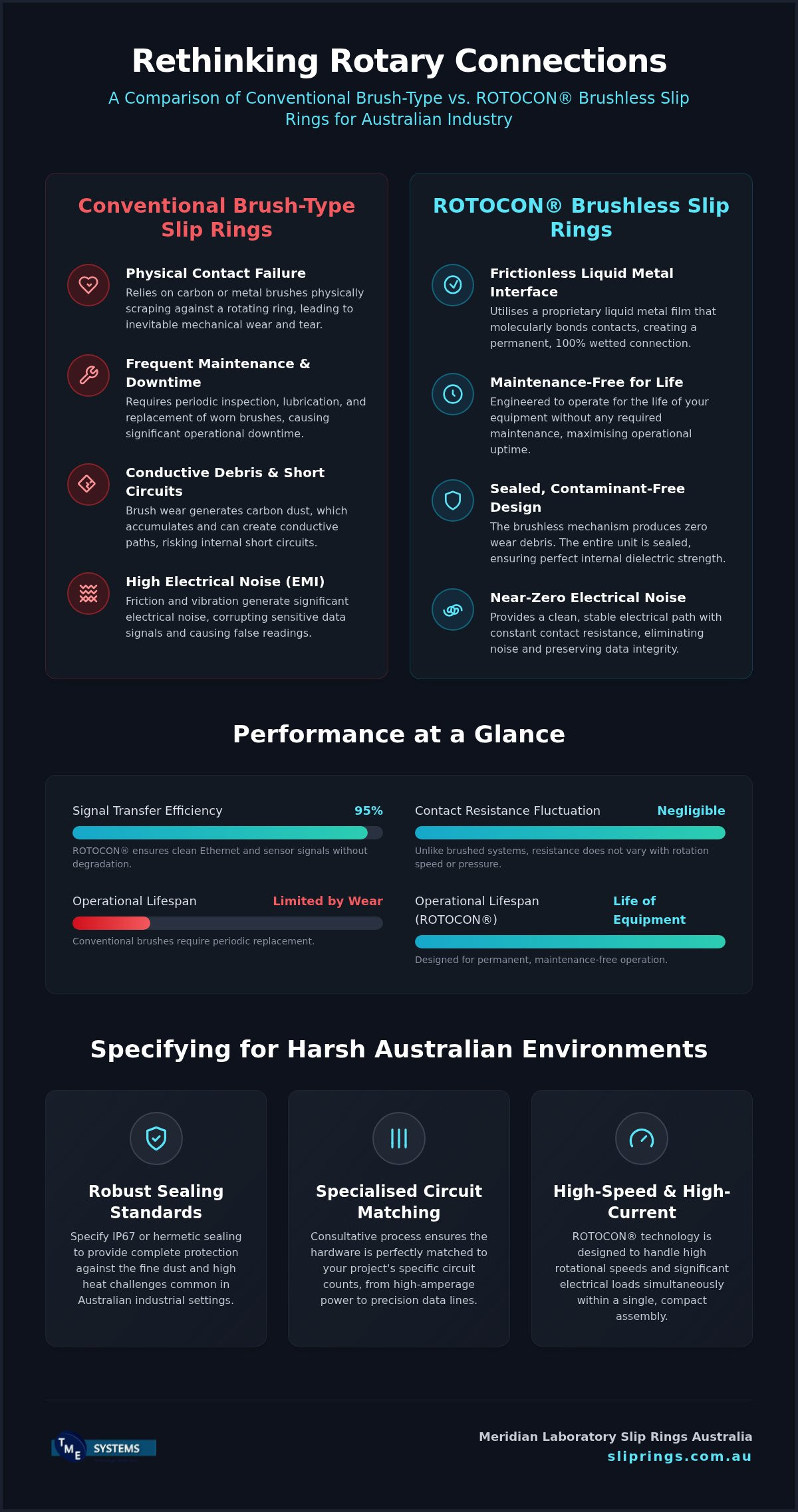
A slip ring serves as a critical rotary electrical interface, enabling the continuous transmission of power and data between stationary and rotating components. While Conventional Slip Ring Technology has facilitated industrial rotation for decades, the reliance on sliding mechanical contacts introduces inherent vulnerabilities. Most standard units use carbon or metal brushes that press against a rotating ring. This physical interface is the primary source of failure in high-demand Australian machinery, where environmental factors often accelerate component degradation.
For engineers managing local production lines, the hidden costs of these components often exceed the initial purchase price. Frequent maintenance intervals to replace worn brushes or clean conductive debris lead to significant unplanned downtime. When precision automation is the goal, the transition to Meridian Laboratory slip rings Australia represents a fundamental shift from reactive maintenance toward long-term operational stability. By removing the physical wear cycle, facilities can focus on throughput rather than component repair.
The Problem with Physical Contact Brushes
Mechanical wear is an inescapable reality for brush-based systems. These components require periodic lubrication and inspection to prevent catastrophic failure. As the brushes wear down, they generate carbon dust that accumulates within the housing. This debris isn't just a cleaning nuisance; it creates conductive paths that can compromise internal dielectric strength and lead to short circuits. Additionally, contact resistance is never constant in a brushed system. It fluctuates based on rotation speed and brush pressure, which directly impacts the reliability of the electrical connection and the life of the machine.
Signal Noise and Data Integrity Challenges
Modern industrial applications increasingly rely on high-speed data protocols like Ethernet and sensitive sensor feedback. Traditional rings often struggle to maintain the signal integrity required for these circuits. The friction of the brush contact generates significant electrical noise, often referred to as EMI, which can corrupt data packets or trigger false readings in precision sensors. Mechanical vibration further complicates this by causing the brushes to bounce or lose contact momentarily. These micro-breaks are devastating for high-speed data transfer. Specifying Meridian Laboratory slip rings Australia ensures these noise-related issues are engineered out of the system, maintaining the high signal-to-noise ratio essential for modern automation.
The ROTOCON Advantage: Brushless Performance for Precision Signal Transfer
The ROTOCON range by Meridian Laboratory provides a technical solution that bypasses the friction-based limitations of standard hardware. By utilising a proprietary liquid metal interface, these units maintain a stable electrical path even under high rotational speeds or significant vibration. This stability is vital for precision circuits where any fluctuation in contact resistance leads to immediate signal degradation. When you specify Meridian Laboratory slip rings Australia, you're investing in a system designed for 95% efficiency in signal transfer across the rotary union. This ensures that your data remains intact and accurate from the sensor to the controller.
This technical stability originates from a constant contact resistance that does not vary with rotation. In traditional systems, the brush pressure and surface condition change constantly, creating electrical noise. ROTOCON technology eliminates these variables. The result is a clean, noise-free connection that allows for the simultaneous handling of high power and sensitive signals within a single, compact assembly. For Australian engineers, this means a reduction in troubleshooting time and a higher level of confidence in automated system performance.
Understanding the Brushless Mechanism
Unlike carbon brushes that mechanically scratch against a metal ring, ROTOCON technology uses a thin film of liquid metal to bridge the gap between stationary and rotating contacts. This film creates a molecular bond in the contact zone, providing a 100% wetted surface area at all times. Because there is no mechanical friction, the system does not generate heat or conductive debris. This preserves the internal dielectric integrity of the assembly. The physics of this molecular bond ensure that the connection remains stable even as the machine accelerates or operates in high-vibration environments.
Benefits of a Zero-Maintenance Design
Conventional units require regular service intervals to prevent failure, but ROTOCON assemblies are built to operate for billions of revolutions without any internal intervention. This "fit and forget" capability significantly reduces the total cost of ownership for industrial machinery. It's the ideal choice for equipment located in inaccessible areas or for critical mission profiles where downtime isn't an option. If you're looking to upgrade your current system, you can explore the specialised ROTOCON range to find a configuration that fits your specific application requirements.
Technical Specifications: High-Speed and High-Current Capabilities
Selecting a rotary interface involves more than just matching a part number; it requires a precise understanding of the mechanical and electrical demands of your application. The range of Meridian Laboratory slip rings Australia offers versatile configurations, including through-bore designs for mounting on existing shafts and compact capsule units for space-constrained installations. These options allow engineers to integrate high-performance connections into virtually any machinery architecture without compromising on signal or power integrity. By offering both standard and customisable footprints, these units solve the physical integration challenges often found in legacy equipment upgrades.
High-Speed Rotation and RPM Limits
Rotational speed is often the limiting factor for traditional brush-based systems. While standard Meridian models handle typical industrial speeds with ease, ultra-high-speed transmitters are engineered to perform at up to 40,000 RPM. At these extreme velocities, mechanical brushes would lose contact due to centrifugal forces and vibration. The liquid metal interface within a ROTOCON unit maintains a continuous molecular bond, ensuring signal stability even at peak speeds. This capability is essential for high-speed testing rigs and precision centrifuges where data accuracy is non-negotiable. Balancing these speed requirements with mechanical longevity is a core feature of the brushless design.
Multi-Channel and Circuit Count Selection
Complex automation often requires the simultaneous transfer of high-voltage power and sensitive data. You can specify units with multiple channels, carefully organised to prevent crosstalk between circuits. Effective shielding is built into the design to protect low-voltage signals from electromagnetic interference generated by adjacent power lines. For unique Australian projects, custom circuit configurations are available. This allows for a tailored mix of Ethernet, thermocouple, and high-amperage power circuits within a single, integrated assembly. This level of organisation ensures that even the most complex data protocols remain clean and reliable during continuous rotation.
Power Transfer and Rotary Grounds
Heavy industrial applications like welding, plating, and large-scale manufacturing demand robust power handling. Meridian Laboratory provides high-current rotary grounds designed to manage these loads without the voltage drops associated with sliding contacts. Standard voltage ratings often exceed 600V, with specialised variants capable of handling up to 10,000V for high-tension requirements. Single-channel units can manage currents up to 10,000A, while multi-channel units handle up to 3,000A. These units are engineered for efficient thermal dissipation, preventing the heat build-up that can lead to component failure in high-power scenarios. By managing these loads effectively, the hardware maintains a stable electrical path throughout the life of the machine.
Specifying ROTOCON for Harsh Australian Industrial Environments
Australian industrial operations often face environmental extremes that compromise standard electrical components. From the fine, abrasive dust of remote mining sites to the high humidity of coastal processing plants, the hardware must be resilient. Specifying Meridian Laboratory slip rings Australia allows engineers to account for these variables during the design phase. These units aren't just modified standard parts; they're specifically engineered to maintain signal integrity where heat and moisture would typically cause conventional brush contacts to oxidise or fail. By selecting the correct housing and sealing configuration, you ensure that the rotary interface is no longer the weakest link in your system.
Sealing and Ingress Protection
Proper sealing is the primary defence against premature failure. Ingress protection ratings like IP65, IP67, or even IP68 define how well a unit resists dust and liquid. For food processing facilities requiring frequent wash-downs, IP67-rated housings prevent water from reaching internal circuits. In mining applications, hermetic sealing is often necessary to keep out microscopic particulate matter that can act as an abrasive. For specialised aerospace or laboratory applications, vacuum-compatible and pressurised variants ensure the liquid metal remains stable even under extreme atmospheric pressure changes. This level of protection prevents the internal dielectric strength from being compromised by external contaminants.
Material Selection and Durability
Material choice is critical for longevity in corrosive environments. Stainless steel housings are standard for marine or chemical processing applications where salt spray or caustic cleaners would degrade aluminium or plastic alternatives. These units are designed to withstand the high operating temperatures common in Australian outdoor installations, maintaining their molecular bond even when ambient heat rises. This structural integrity is essential for 24/7 industrial loads. In mining and heavy transport, constant shock and vibration are the norm. While mechanical brushes would experience "brush bounce" and signal loss, the liquid metal film in a ROTOCON unit remains in constant contact. This provides a level of reliability that is simply not possible with traditional contact technology.
If your project requires a connection that survives these conditions, you can view the specialised ROTOCON range to ensure your equipment remains operational under the most demanding loads.
Technical Consulting and Procurement: Sourcing Meridian Laboratory in Australia
Sourcing specialised industrial hardware requires more than a simple catalogue search. For Australian procurement officers and engineers, the process begins with a comprehensive technical audit. This ensures that the selected unit matches the specific rotational dynamics and electrical loads of your machinery. TME Systems acts as the authorised distributor and technical partner for Meridian Laboratory slip rings Australia, bridging the gap between high-end manufacturing and local application needs. Rather than simply supplying a component, the focus is on a consultative approach to solve complex engineering challenges and reduce the risk of component failure.
To provide an accurate specification, several critical data points must be established. This includes the maximum rotational speed, the number of required circuits, and the specific signal types being transmitted. Whether you're integrating high-speed Ethernet or high-amperage power, each parameter influences the final design. Custom engineering solutions are frequently developed for non-standard rotary requirements, ensuring that even the most unique Australian industrial projects have access to reliable brushless technology. This methodical selection process guarantees that the hardware is fit for purpose before it reaches the production floor.
The Technical Selection Process
Precision starts with defining the electrical environment. You'll need to specify the circuit count, peak current, and operating voltage for each channel. Mechanical integration is equally important; you must assess mounting styles like flange, shaft-end, or through-bore configurations to ensure a seamless fit. Identifying environmental constraints early prevents costly redesigns or premature wear. Factors such as ambient temperature, potential for chemical exposure, and ingress protection requirements are all documented before finalising the specification. This detailed audit ensures the hardware performs reliably for the life of the machine.
Ongoing Support and Local Expertise
Working with a local specialist provides access to technical assistance from TME Systems engineers who understand the nuances of the Australian industrial sector. They ensure that new ROTOCON assemblies are fully compatible with existing machinery and comply with local operational standards. This expertise is particularly valuable during the retrofit of legacy equipment where standard off-the-shelf parts often fail to meet modern data integrity requirements. You can Learn more about Meridian Laboratory solutions to begin the specification process for your specific application.
Optimising Rotary Reliability for Australian Industry
Transitioning to brushless technology is a strategic move that eliminates the mechanical friction and signal noise inherent in traditional rotary connectors. By specifying Meridian Laboratory slip rings Australia, you ensure your machinery operates with constant contact resistance and zero maintenance requirements for the life of the equipment. This stability is critical for the high-speed data transmission and high-current power loads required in modern industrial automation. Whether your project involves precision sensors or heavy-duty power transfer in harsh environments, the right specification is essential for long-term success.
As the authorised Australian distributor, TME Systems provides specialist application engineering support backed by decades of experience in rotary electrical connectors. Our team helps you navigate the technical selection process to match hardware to your exact circuit count and environmental constraints. Don't let legacy brush failures dictate your production schedule.
Contact TME Systems for a Technical Consultation on Meridian Laboratory Slip Rings to secure a durable, noise-free solution for your next project. We look forward to helping you achieve a higher standard of operational reliability.
Frequently Asked Questions
What makes Meridian Laboratory ROTOCON slip rings different from standard ones?
ROTOCON units utilise a brushless liquid metal film instead of traditional carbon or metal brushes. This design eliminates the mechanical friction and wear associated with standard contacts. Because there is no physical rubbing, the connection maintains a constant resistance and zero electrical noise. This provides a level of signal integrity that standard brushed rings cannot match, especially in precision automation and high-speed data circuits.
Can ROTOCON slip rings handle high-speed data like Ethernet or EtherCAT?
Yes, Meridian Laboratory slip rings Australia are specifically engineered to handle high-speed data protocols like Ethernet and EtherCAT. The liquid metal interface ensures a 100% wetted contact area, which prevents the packet loss and signal jitter common in brush-based systems. These units achieve approximately 95% efficiency in signal transfer. This makes them ideal for modern industrial networks where data integrity and low latency are critical requirements.
Do Meridian Laboratory slip rings require regular maintenance or lubrication?
No, Meridian Laboratory slip rings are designed to be maintenance-free for the entire life of the machine. Unlike traditional rings that require periodic lubrication and brush replacement, the brushless ROTOCON design has no internal parts that wear out. There is no carbon dust to clean or physical contacts to adjust. This "fit and forget" capability significantly reduces machine downtime and the total cost of ownership for industrial facilities.
What is the maximum RPM rating for a Meridian Laboratory rotary connector?
Rotational limits vary by model, but specialised ultra-high-speed transmitters can operate at up to 40,000 RPM. Standard industrial models comfortably handle speeds that would cause mechanical brushes to bounce or fail. The liquid metal interface maintains a molecular bond regardless of the centrifugal forces involved. This allows for continuous, noise-free electrical transmission in high-velocity applications like centrifuges, turbine testing, and precision high-speed spindles.
Are there mercury-free versions of Meridian Laboratory slip rings available?
Yes, mercury-free versions are available for applications where environmental or safety regulations prohibit the use of liquid mercury. These alternatives maintain the high-performance standards of the ROTOCON range while complying with specific industry requirements. TME Systems provides technical consulting to help you determine if a mercury-free unit is the correct choice for your specific project constraints or your particular regulatory environment.
How do I choose between a through-bore and a capsule slip ring design?
The choice depends on your mechanical mounting requirements. A through-bore design features a hollow centre, allowing the unit to slide directly onto an existing rotating shaft. This is ideal for integrated machinery builds. A capsule design is a self-contained unit typically mounted at the end of a shaft or in space-constrained areas. Both configurations provide the same brushless performance, but the selection is dictated by your machine's physical architecture.
What environmental protection ratings are available for these slip rings?
A wide range of ingress protection ratings is available to suit different industrial environments. Standard units often feature IP65 sealing, but you can specify IP67 or IP68 ratings for wash-down areas or submerged applications. Hermetically sealed variants are also available for mining sites with fine particulate dust or for aerospace vacuum conditions. These seals protect the internal contacts from contaminants, ensuring long-term reliability in the most demanding Australian conditions.
How can I get technical support for Meridian Laboratory products in Australia?
Technical support for Meridian Laboratory products is provided nationally by TME Systems Pty Ltd. As the authorised distributor, they offer specialist application engineering support to assist with technical specifications and product selection. You don't have to navigate complex manufacturing data alone; their engineers help define circuit counts, power loads, and environmental requirements. This local expertise ensures that the hardware you procure is perfectly matched to your industrial application.