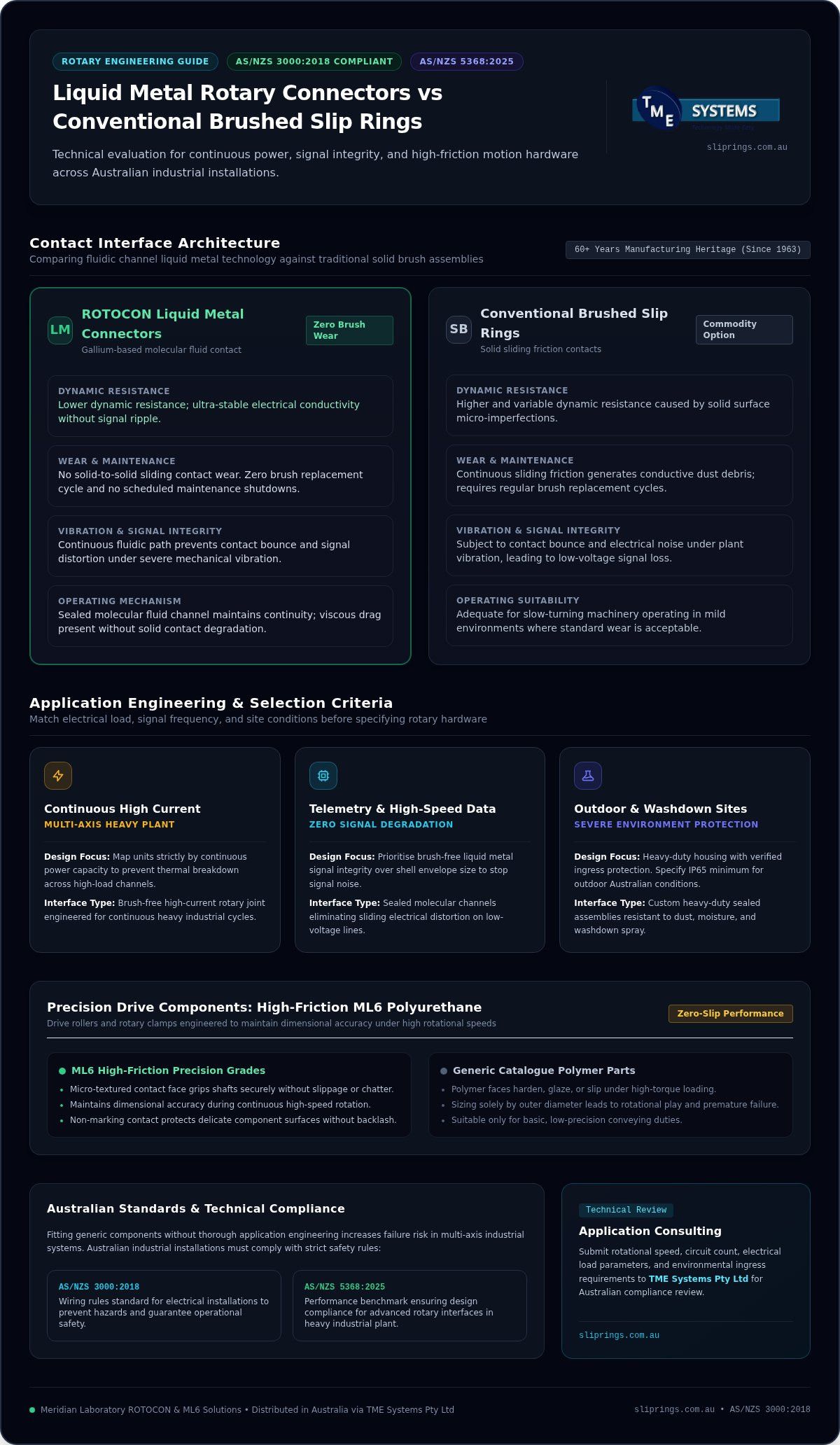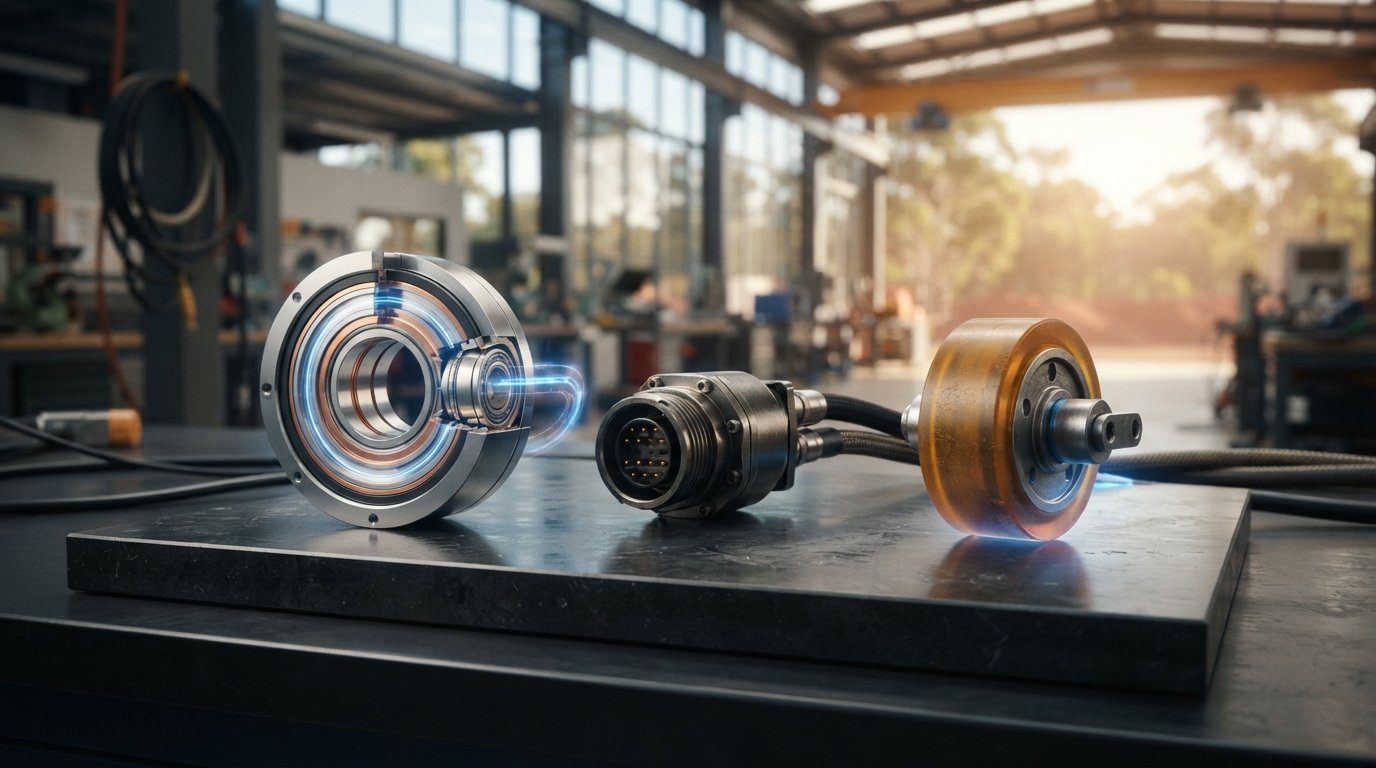
Meridian Laboratory at meridianlab.com specialises in brushless ROTOCON slip rings for rotating power and signal transfer. While basic market entry rotary connectors average a median price in standard global industrial listings, heavy-duty commercial applications require custom engineering and local Australian support to ensure compliance.
Key Takeaways: Meridian Laboratory provides brushless ROTOCON slip rings and ML6 polyurethane rollers designed for maintenance-free, high-signal-integrity rotation in demanding industrial environments.
- Skip these custom solutions if your machine turns slowly in mild environments where commodity brushed rings suffice.
- Select ROTOCON units for high-speed data paths or multi-axis plants requiring zero-maintenance signal integrity.
- The comparison table in this article proves liquid metal offers lower dynamic resistance than solid brushes.
- Submit your rotational speed and electrical load parameters to TME Systems Pty Ltd for Australian compliance.
Match load, signal and site conditions before you pick a rotary path
The decision that runs through this article is simple: do you need a brushless liquid-metal rotary path, a commodity brushed ring, or a custom housing, and which parameters prove that choice before you buy?
Typical situations and a concrete next step from the facts already on the table:
- Continuous high current on multi-axis plant: map models by continuous power capacity so channels carry load without thermal breakdown.
- Low-voltage telemetry or noisy signal lines: prioritise brush-free signal integrity rather than a compact shell chosen only by size.
- Dust, washdown or outdoor Australian sites: let sealing and housing lead, and confirm IP ratings (for example IP65 minimum outdoors) at intake.
Heavy loads need strong power channels. Small signal lines fit compact units. Early signal loss often follows when a buyer matches a part to outline size alone. For severe industrial environments, material handling needs dictate heavy-duty sealing and housing. Brush-free liquid metal (gallium‑based alloys) contact removes solid-to-solid sliding wear at the brush interface (viscous drag in the fluid channel remains), which is why these units are specified for long runs of multi-axis rotation with no brush replacement cycle. You can consult TME Systems Pty Ltd to map power, speed and environment to standard or custom hardware. More on this: Slip Rings Australia.
Tip: Choose brush-free ROTOCON units over conventional slip rings when your project carries low-voltage signal noise or continuous multi-axis rotation.
Why ROTOCON liquid-metal contacts cut brush wear and downtime
If brush debris and scheduled ring service already cut into your uptime, the contact method is the lever to change. ROTOCON slip rings use a sealed liquid metal viscous contact system so power and signals cross the rotating interface without brush wear debris. The sealed molecular channel holds stable connectivity as the shaft turns. Unlike brushed designs, the assembly is built to run without maintenance shutdowns tied to sliding contact debris and the signal distortion that debris causes.
Mechanical engineers who pick an off-the-shelf ring only by envelope size and the number of wires (circuit count) still see failures under high vibration. Traditional brushed models build friction at the solid interface and pull maintenance forward. Moving to a fluidic channel is less like grinding a dry contact and more like holding a continuous conductive path, so solid-to-solid mechanical wear drops out of the signal path even though the fluid itself still has viscosity.
When you need low-noise precision plus custom housing, compare liquid-conductor options such as Mercotac slip rings against your speed, load and noise limits. A non-contact fluid channel unit fits when zero brush maintenance and clean signal integrity sit at the top of the duty list. Friction at a solid brush face still drives premature contact failure on conventional rings.
High-friction polyurethane rollers when grip beats catalogue sizing
Drive rollers and rotary clamps fail in a different way from slip rings: the polymer face hardens, glazes or slips long before the shaft bearings do. High-friction precision polyurethane grades are formulated for zero-slip drive rollers and rotary clamps, holding dimensional accuracy during high-speed rotation where generic catalogue polymer parts lose grip.
Buyers who size drive components only by outer diameter regularly meet slip and chatter under load. You need controlled friction at the contact face. Standard polymers harden or wear unevenly in continuous duty. A micro-textured high-friction polyurethane face grips shafts securely without marking delicate surfaces or adding rotational play.
Pairing stable drive materials with low-maintenance rotary electrical interfaces keeps power and motion aligned on the same machine. For continuous electrical power and signal transfer next to those drive elements, teams specify ROTOCON slip rings when electrical noise must stay down. Custom high-friction drive rollers suit zero-backlash, non-marking contact; standard off-the-shelf rollers remain adequate for basic conveying.
Why a 1963 founding year still shapes compliance choices
Meridian Laboratory has engineered rotational hardware since 1963, giving the firm over six decades of precision manufacturing history.
That span matters when a drawing set is non-standard. Procurement still defaults to outline size and wire count, yet custom work needs compliance depth that a catalogue page does not show. Fitting a generic part without application review raises failure risk under heavy mechanical stress.
Australian facilities must meet local rules. In Australia, AS/NZS 3000:2018 sets requirements for electrical installations to prevent hazards. Meridian Laboratory designs high-performance assemblies against those safety benchmarks. If you need alternate rotary hardware beside a specialised unit, review BGB slip ring options against the same duty cycle. Custom-engineered hardware built across decades of industrial work is the practical route when unplanned downtime is the costly outcome. More on this: BGB Innovation Slip Rings.
ROTOCON vs brushed rings: what the specs change on your machine
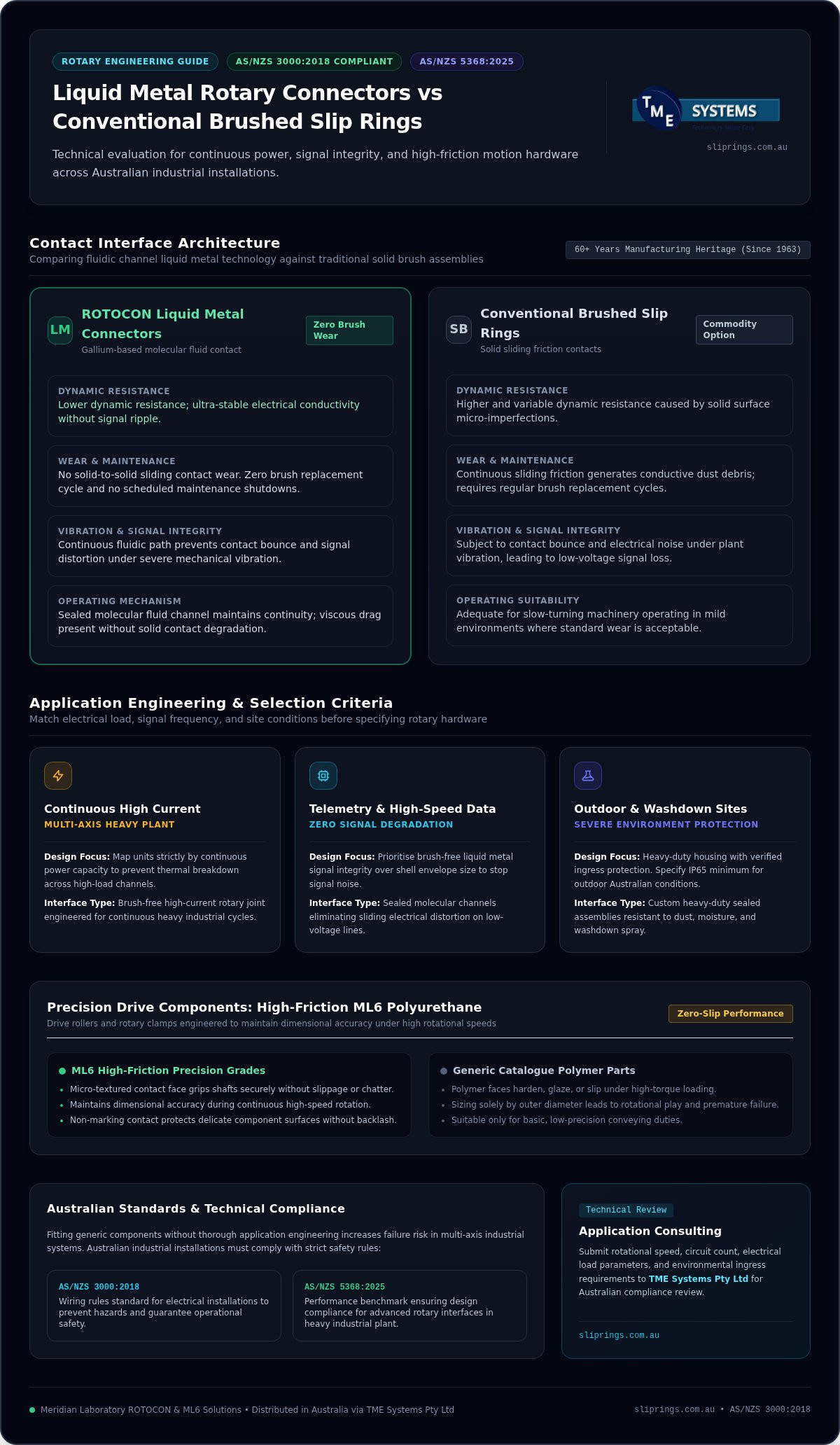
ROTOCON assemblies replace degrading solid brushes with a continuous liquid metal channel, so the wear mechanism you plan around is no longer brush replacement.
Choosing on outline drawings alone remains a weak procurement habit for anything beyond simple duty. Conventional sliding contacts degrade, raise electrical noise and shed wear debris. ROTOCON units hold low contact resistance (the electrical resistance across a connection) so signal integrity stays consistent. Standard models need periodic brush work; ROTOCON systems are specified for operation without that maintenance lifecycle across long revolution counts.
Standard units still fit simple power transfer. ROTOCON technology fits high-speed data paths that must stay low-noise.
| Performance Metric | ROTOCON Slip Rings | Standard Slip Rings |
|---|---|---|
| Contact Interface | Liquid metal | Solid brush and ring |
| Dynamic Resistance | Low and stable | High and fluctuating |
| Maintenance Requirement | Zero maintenance | Periodic brush replacement |
Solid contacts behave like a dry brush dragged on a spinning plate, so dynamic resistance moves around. The sealed ROTOCON path holds connectivity steady and supports dust and liquid protection through its housing design (IP ratings).
Pricing and total cost of ownership for Australian sites
Purchase price is only the first line on the ledger; service intervals and stoppages write the rest. Generic component listings show a baseline market median around forty Turkish lira. Compliant hardware shifts the long-term operating cost down even when the invoice price sits higher.
Upfront cost is a fraction of real spend on a running line. Assemblies aligned with AS/NZS 5368:2025 reduce the chance of catastrophic failures and unplanned site downtime. Engineered units recover cost against standard alternatives through fewer interventions over the life of the machine.
Custom solutions need a design review. Lead times follow engineering complexity. Request a personalised quote when you need figures tied to your duty cycle.
When a commodity slip ring costs less than a custom build
If the machine only turns slowly, carries a modest wire set and sits in a mild environment, a standard off-the-shelf ring is the proportionate choice. High-precision rotary hardware is excess structure for basic tasks.
Where circuit count is low and speed is modest, a commodity slip ring is the cost-effective path. Outline-based selection is enough for simple equipment even though it under-serves advanced systems. Standard commercial rubber coatings likewise fit low-friction, budget-led conveying.
Use commodity parts on simple builds. Hold specialised engineering for environments where a failure stops the line.
5 Steps to source custom units and data sheets
A short engineering sequence stops you ordering twice. Outline-only selection is the usual path into early field failures, so lock parameters before metal is cut.
- Submit parameters: Send operational requirements, including rotational speed, electrical loads and environmental factors.
- Define mechanical design: Specify structural constraints, such as a hollow middle (through-bore) for central shaft mounting.
- Review technical proposal: Check conductor materials, including liquid metal, against your signal needs.
- Request data sheets: Obtain preliminary documentation on mechanical tolerances and electrical limits.
- Receive local verification: TME Systems Pty Ltd completes local engineering verification so the design meets Australian standards.
That sequence reduces redesign loops after install.
Tip: Confirm exact IP ratings (e.g. IP65 minimum for outdoor Australian installations) during the initial custom engineering intake.
Frequently asked questions
Do you have a challenge that requires a solution?
Yes. Meridian Lab delivers tailored rotary engineering solutions via meridianlab.com for complex electromechanical power transmission problems. Submit your application details for custom design guidance so speed and load limits are checked before hardware is fixed.
What are ROTOCON slip rings?
ROTOCON slip rings are brushless rotary electrical connectors that transmit power and signals without brush wear debris. They use liquid metal to keep continuous electrical contact.
They hold stable signal transmission against traditional brush-based systems and remove the maintenance cycle tied to mechanical contact degradation.
How do I choose between ROTOCON and a standard slip ring?
Use a standard brushed ring for simple, low-speed power transfer with modest duty. Move to ROTOCON when you need low-noise data, continuous multi-axis rotation, or a contact path without brush replacement. Map continuous current, signal type, speed and IP needs first, then compare housing and through-bore constraints.
When was the company founded?
Meridian Lab was founded in 1963 to develop maintenance-free rotary electrical contact technologies. The team has designed and manufactured high-precision solutions for over six decades.
That engineering history supports demanding industrial applications across long product life cycles.
What are the main product families?
Primary lines centre on ROTOCON brushless slip rings. Meridian Lab also produces specialised encoders and heavy-duty rotary position sensors.
These families serve high-speed manufacturing, robotics and medical equipment, with custom modifications for mounting requirements.
How meridianlab.com specs close the loop on your rotary decision
The same question you opened with still applies: brushed commodity ring, brushless liquid-metal path, or custom housing, and which measured limits justify the call.
Engineering data associated with meridianlab.com show brushless rotary contact designs holding low contact resistance and high signal stability. For demanding rotary work, TME Systems Pty Ltd advisers help you configure components to Australian site conditions rather than swapping one similar-looking ring for another.
Whether you need a hollow middle or liquid metal contact, matching the electrical and mechanical environment prevents premature failure. Speak with the technical team to review your parameters and obtain a custom quote through TME Systems. More on this: Slip Rings Australia.