A rotary connection can look straightforward on a specification sheet but carry operational risk if it is assessed against the wrong assumptions. For Australian engineering teams considering Prosper Rotation slip rings Australia, start the selection case with the machine’s actual duty and reliability requirements.
Management needs a clear reason to support a component decision, and technical details alone may not make that case. Comparing options under different operating conditions can also produce a misleading result. A consistent assessment links engineering requirements to operational risk in terms decision-makers can evaluate.
This article explains how to compare rotary connection options using the same assumptions, build an evidence-based recommendation and identify the information needed for engineering review. It covers circuit count, current, voltage, rotational speed, mounting style and environmental requirements, and how TME Systems’ technical application consulting can help connect these needs with Prosper Rotation options.
Key Takeaways
- Build the case for Prosper Rotation slip rings Australia by linking component selection to the machine’s duty, operating environment and consequences of failure.
- Record application requirements and distinguish measured site data from manufacturer specifications and engineering assumptions.
- Compare each rotary connection option against the same operating conditions, evidence sources and assessment criteria.
- Give management a concise recommendation covering the requirement, options assessed, supporting evidence, trade-offs and decision sought.
- Use technical application consulting to align Prosper Rotation selection with documented requirements and identify information for engineering review.
Prosper Rotation slip rings in Australia: why reliability needs a management case
A rotary connector is a visible line in a component schedule. The effects of a poor fit may not become clear until electrical continuity is interrupted, maintenance is needed or product quality is affected. That makes reliability difficult to assess from the component decision alone.
Assess the connection against the machine’s duty, operating environment and the impact of failure. A unit intended for intermittent operation may face different demands from one used continuously. Dust, moisture, vibration and temperature variation may also affect suitability. These are application questions to check against the relevant specifications, not assumptions to settle from a headline rating.
A reliability business case is a documented comparison of component options against verified operating requirements, failure consequences and known evidence gaps. It does not promise uninterrupted operation or savings. It explains why a particular decision fits the application better than the alternatives assessed.
What management needs from a reliability recommendation
Keep three things distinct: the operational problem, the engineering requirement and the proposed component decision. For example, a recurring interruption is the problem; maintaining the required electrical paths throughout rotation is an engineering requirement; selecting a rotary electrical joint is the decision to evaluate. This separation lets management follow the reasoning rather than see only a product preference.
Translate consequences into production, maintenance or quality exposure only where records support the link. Use fault histories, inspection findings, process records or documented operating conditions. If downtime impact has not been measured, say so. An estimate may help frame a question, but should not be presented as an established fact.
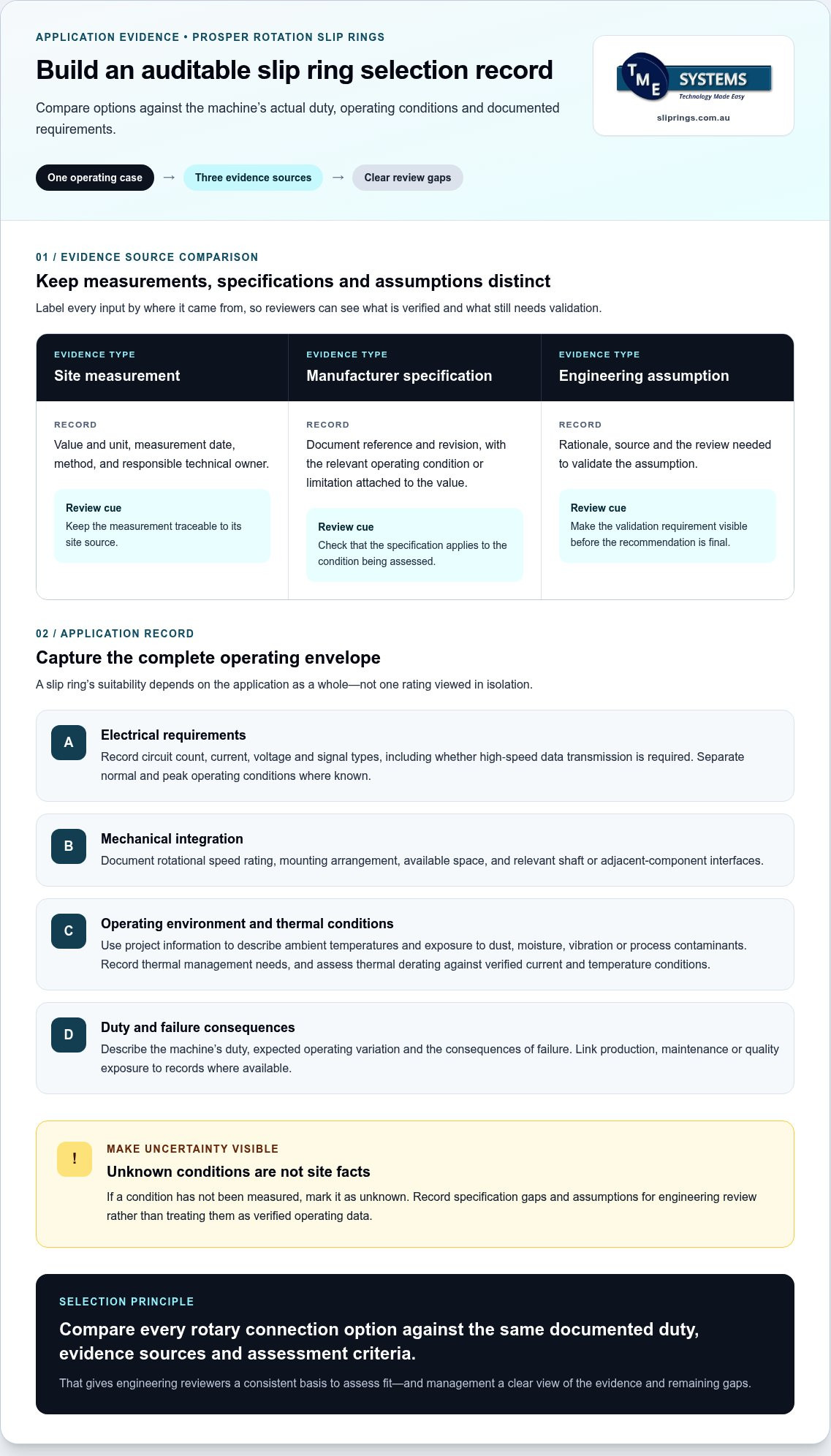
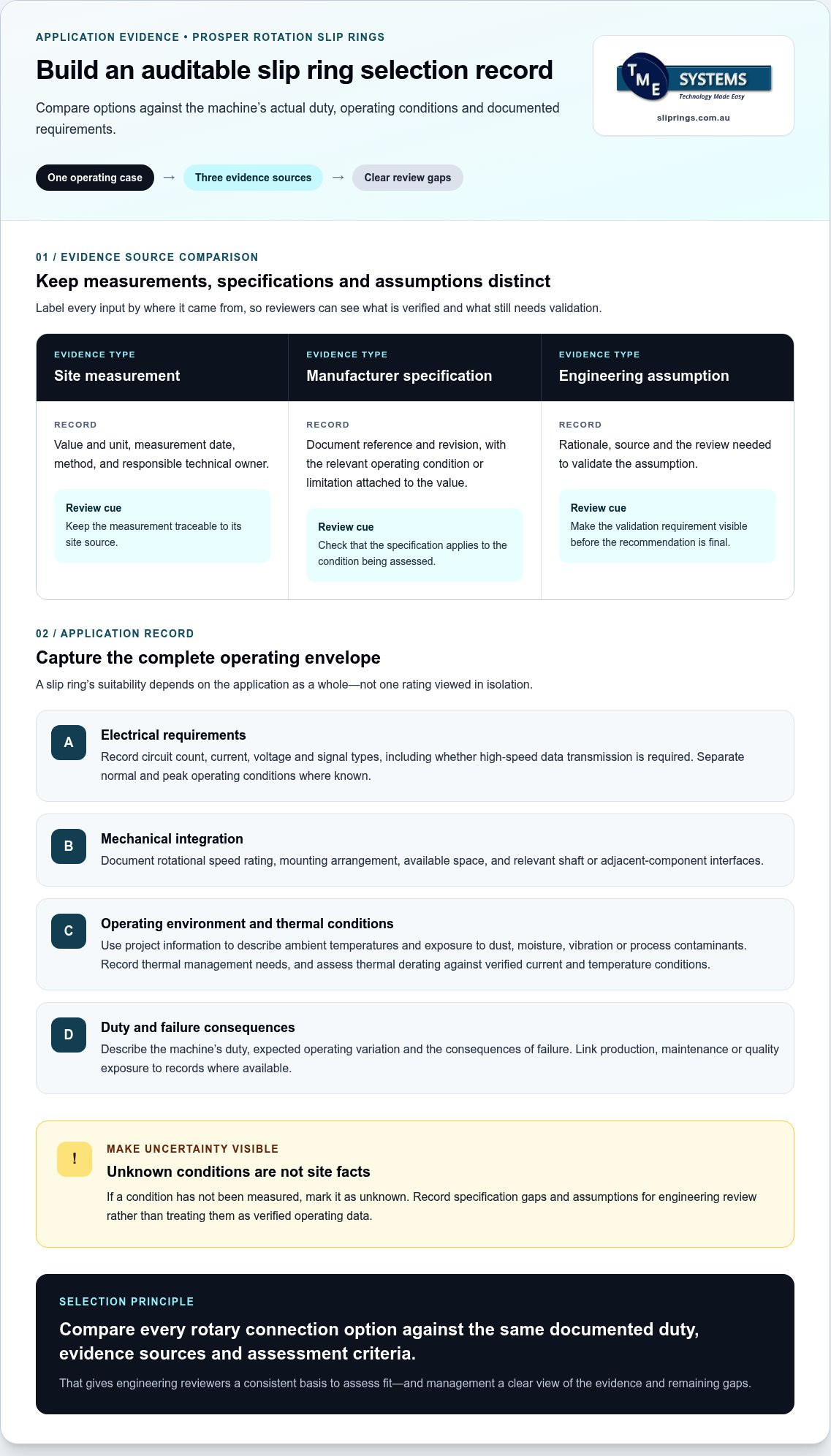
Label each item of evidence by source: site measurement, manufacturer specification or engineering assumption. This makes uncertainty visible and shows reviewers what still needs to be resolved.
Why a rotary connection cannot be selected by headline specification alone
A slip ring transfers power or signals between stationary and rotating parts. For an introductory explanation of its function, see What is a slip ring? For a specific application, however, a single rating cannot establish whether an assembly is suitable.
Circuit count, current and voltage requirements, rotational speed, mounting style and the surrounding environment interact. The circuit arrangement must suit the signals and power being carried. Assess electrical loading and speed alongside operating conditions. Mounting affects mechanical integration, while environmental exposure informs protection and installation requirements. A favourable value in one category does not resolve a mismatch in another.
Assess Prosper Rotation slip rings Australia against verified project requirements, not as a universal solution. TME Systems’ Prosper Rotation slip ring range is one product option to evaluate against the machine’s documented duty. Record unmeasured conditions or specification gaps for engineering review before treating the recommendation as final.
Build the evidence base for a high-reliability rotary electrical connector
A defensible selection starts with an application evidence record, not a product preference. Capture the machine’s verified duty, electrical and mechanical requirements, operating environment, failure consequences and the source for each input. This gives engineers a consistent basis for evaluating options and helps management see what is measured and what still needs review.
Component suitability depends on the complete operating envelope, not on any single rating viewed in isolation. A connector’s fit can change with electrical load, speed, mounting arrangement and surrounding conditions. Describe the application as it operates, including expected variation, rather than relying only on nominal design values.
Which application details belong in the recommendation?
Record circuit count, current, voltage and signal types, including whether the application requires high‑speed data transmission. Separate normal and peak operating conditions where those values are known. For mechanical integration, document rotational speed rating, mounting arrangement, available space and relevant shaft or adjacent-component interfaces.
Describe environmental exposure using project information, such as measured ambient temperatures or documented contact with dust, moisture, vibration or process contaminants. Record thermal management needs and assess possible thermal derating against verified current and temperature conditions. If those conditions have not been measured, mark them as unknown rather than treating an assumed value as a site fact.
How to make reliability evidence auditable
Give each input a traceable source. A practical record can include:
- Site measurement: value, unit, date, measurement method and responsible technical owner.
- Manufacturer specification: document reference and revision, with the operating condition or limitation attached to the value.
- Engineering assumption: rationale, source and the review needed to validate it.
Apply the same discipline to reliability claims. Separate observed failure history, supported by maintenance or fault records, from forecast risk based on engineering judgement. Note existing controls, such as inspection routines or operating limits, only where project records show they are in place. This prevents a possible concern from being presented as a proven failure pattern.
Before citing a standard or product claim, check its scope, applicability and supporting documentation as part of the engineering review. For a Prosper Rotation assessment, TME Systems’ technical application consulting can help organise requirements such as circuit count, current, voltage, speed, mounting style and environmental conditions into a clear selection brief. The Prosper Rotation slip ring range can then be assessed against that documented application, with evidence gaps kept visible for review.
Compare Prosper Rotation slip ring options against the same operating case
A fair comparison holds the application constant. Use one set of verified requirements, evidence sources and operating assumptions for every candidate. Then record where each option fits, where integration needs further work and what remains unknown. Otherwise, an option may appear stronger simply because it was assessed against a different duty or a less demanding interpretation of a requirement.
Keep the comparison focused on technical fit and lifecycle considerations. Do not add purchase price or claim savings. If project records show an interruption affects production, maintenance activity or product quality, describe the evidence and its source. Where the consequence is anticipated rather than recorded, label it as a potential outcome for engineering review.
Compare technical fit, not disconnected headline ratings
Check every candidate against the complete electrical, mechanical and environmental requirement set. Use the same operating conditions and manufacturer-documentation standard for each. Mark each requirement as met, not met or unverified, and cite the supporting document or site evidence. A strong match on one rating does not establish overall suitability if another requirement, such as mounting or environmental exposure, remains unresolved.
| Comparison criterion | Option A | Option B |
|---|---|---|
| Circuits, load and signal requirements | Record fit and evidence source | Record fit and evidence source |
| Speed and mounting integration | Record fit, constraints and gaps | Record fit, constraints and gaps |
| Environmental requirements | Record documented suitability | Record documented suitability |
| Lifecycle and unresolved evidence | Record project-based considerations | Record project-based considerations |
Use the table as a decision record, not a scorecard that conceals uncertainty. Different connector technologies are not automatically interchangeable. Their construction and operating characteristics must suit the same verified application. For Prosper Rotation slip rings Australia, assess the relevant option against this shared case rather than treating the product range as a universal answer.
Show trade-offs and uncertainty transparently
For each option, note required mounting changes, space constraints, environmental limitations and additional review. Separate confirmed manufacturer information from design assumptions and anticipated outcomes. If a product claim cannot be traced to current documentation, mark it unverified until the engineering review resolves it.
Apply the same care to material and technology descriptions. Use the term mercury‑free liquid metal only when documentation for the specific product under review verifies that construction. Do not infer it from a general technology description. The comparison should give management a clear view of technical fit, evidence gaps and lifecycle trade-offs without implying guaranteed reliability or unsupported savings. TME Systems’ Prosper Rotation slip ring options can be assessed within this evidence-led framework.
Presenting reliability-led component advice to management
A management recommendation should make the decision easy to understand without hiding the engineering behind it. Lead with the operational requirement, state which options were assessed and explain why the preferred option fits the documented application. Keep detailed specifications and supporting records available for technical reviewers.
A five-step approval workflow
- Define the operating problem. Describe what the machine must do and the consequence if the rotary connection does not meet that requirement. Use operational records to support any claimed effect on production, maintenance or quality.
- Assemble verified application inputs. Gather project information on duty, electrical requirements, mechanical integration and environmental conditions. Identify missing measurements rather than filling gaps with unlabelled estimates.
- Compare feasible options on equal terms. Apply the same requirements and assumptions to each candidate. Record technical fit, integration constraints and evidence gaps so the comparison reflects the application rather than a product preference.
- Summarise lifecycle considerations. Use internal maintenance and operating records to describe relevant patterns or controls. Keep observed history separate from forecast risk, and do not claim reduced downtime or financial return without supporting evidence.
- State the decision required. Ask management to approve a defined component direction, further engineering review or the next validation step. Make clear what the approval covers and what remains open.
Make the recommendation useful to technical and commercial reviewers
Put the requested decision and its rationale first. A concise opening might state that the preferred option meets the documented requirements, subject to a specified engineering validation. Follow with the options assessed, the evidence supporting the recommendation, the material trade-offs and any assumptions that could affect the decision.
Then attach the technical record. Identify exclusions, outstanding checks, validation steps and the people responsible for completing them. A commercial reviewer can understand the decision and its operational basis, while an engineer can trace each requirement to its evidence. If you include quantified impacts, use figures supported by verified organisational records and identify the source and period covered.
For a recommendation involving Prosper Rotation slip rings Australia, distinguish confirmed manufacturer information from application assumptions. Do not describe a component as guaranteeing reliability, preventing failures or delivering savings. State what the available evidence supports, what remains uncertain and how that uncertainty will be addressed in the engineering review.
If you are preparing an application brief, TME Systems’ technical application consulting can help connect documented requirements with component selection. Review Prosper Rotation slip ring options against the requirements and decision criteria set out in your recommendation.
Where Prosper Rotation and application engineering fit in the final decision
The engineering review is the point to resolve questions that could change the selection, rather than carry them forward as untested assumptions. TME Systems supplies Prosper Rotation slip rings to Australian customers and provides technical assistance to help select the right slip ring based on circuit count, current, voltage, speed, mounting style and environmental requirements. This input supports the selection process; it does not replace the project’s engineering approval.
The Prosper Rotation slip ring range provides the product context for the review. Keep the decision specific to the equipment and record which manufacturer statements have been checked against current documentation. Assess any standard or compliance claim for its scope and relevance to the application before using it as evidence.
When technical application consulting adds value
Technical application consulting is useful when the review needs to distinguish a confirmed specification from a project assumption, or when an interface condition could affect installation. It can also help define which unresolved questions need an engineering owner and what evidence would address them. This creates a clearer handover from preliminary selection to final technical assessment.
Prepare the information needed for a productive discussion
Bring the latest equipment drawing and revision, interface or control documentation, and notes explaining how the current assembly is installed. Include the operational issue prompting the review, the configuration under consideration and the project’s decision date. Mark uncertain details clearly. An incomplete drawing or unknown operating condition is more useful when identified than when silently assumed.
With that information, discuss the application and the specific questions still open. A focused review can help define the next engineering action and create a traceable basis for the final decision.
Carry your selection case into the next engineering decision
After approval, keep the decision record with the equipment documentation so future design or operating changes can be assessed against the basis for selection. Set a review trigger for changes to the machine’s duty, interfaces or operating environment. This helps the team recognise when the original component decision may need to be revisited.
For Prosper Rotation slip rings Australia, a clear record also gives new project stakeholders context for the component choice and its limits. Preserve the review outcome with relevant drawings and document revisions, so later decisions build on traceable engineering information rather than informal recollection.
Ready to progress your application? Discuss your Prosper Rotation application with TME Systems and get technical assistance with component selection.
Frequently Asked Questions
How do I justify a high-reliability component if the current one has not failed?
A component need not fail before a replacement or upgrade can be considered. Base the case on documented operating conditions, inspection findings, changes in machine duty and the recorded consequences if the connection stops performing its required function. Make clear that this is a preventive decision, not evidence that failure is imminent. If there are no relevant records, identify what monitoring or inspection would provide a stronger basis for review.
Can reliability be compared when suppliers publish different specifications?
Yes, provided the comparison normalises what each specification means. Check whether values describe continuous or peak operation, the same environmental conditions and comparable test methods. Record units, document revisions and stated limitations beside each value. If a supplier’s figure lacks enough context for a fair comparison, mark it unresolved rather than treating it as equivalent to a better-defined specification. This preserves a useful comparison without overstating certainty.
What information should I give management when proposing a Prosper Rotation slip ring?
Give management a short decision brief that states the machine function, why a rotary connection is required and what decision or approval is sought. For a Prosper Rotation slip rings Australia proposal, add the required signal and power functions, operating pattern, mechanical interface and conditions that could affect operation. Include the operational records behind the request, then put detailed drawings and technical documents in an appendix so reviewers can trace the basis without losing the main point.
How much reliability evidence is enough for an internal approval?
There is no single evidence threshold that suits every organisation or application. The record should cover each requirement that could change the selection decision and show the source supporting it. For example, a drawing may establish the interface, while operating logs can substantiate duty or interruption history. Clearly identify remaining gaps, then follow the organisation’s engineering approval process to decide whether they are acceptable or need further validation.
What happens if the application specification is incomplete?
An incomplete specification calls for a staged decision, not an assumption that the unknowns do not matter. Separate confirmed requirements from provisional values, then identify which missing details could affect fit, safety or integration. For instance, if the actual operating speed is unknown, record how it will be established and keep the selection conditional on that result. This gives the project a clear next step without presenting a preliminary assessment as final approval.
Should a management business case include a comparison with the existing component?
Yes. The existing component provides a useful baseline, provided the comparison uses recorded information rather than assumptions about its performance. Note its configuration, known operating history, maintenance observations and any changes to the machine or duty since it was selected. Then assess alternatives against the current requirement, not just the old component’s nominal details. This helps reviewers see whether the case reflects a genuine application change or a like-for-like replacement decision.