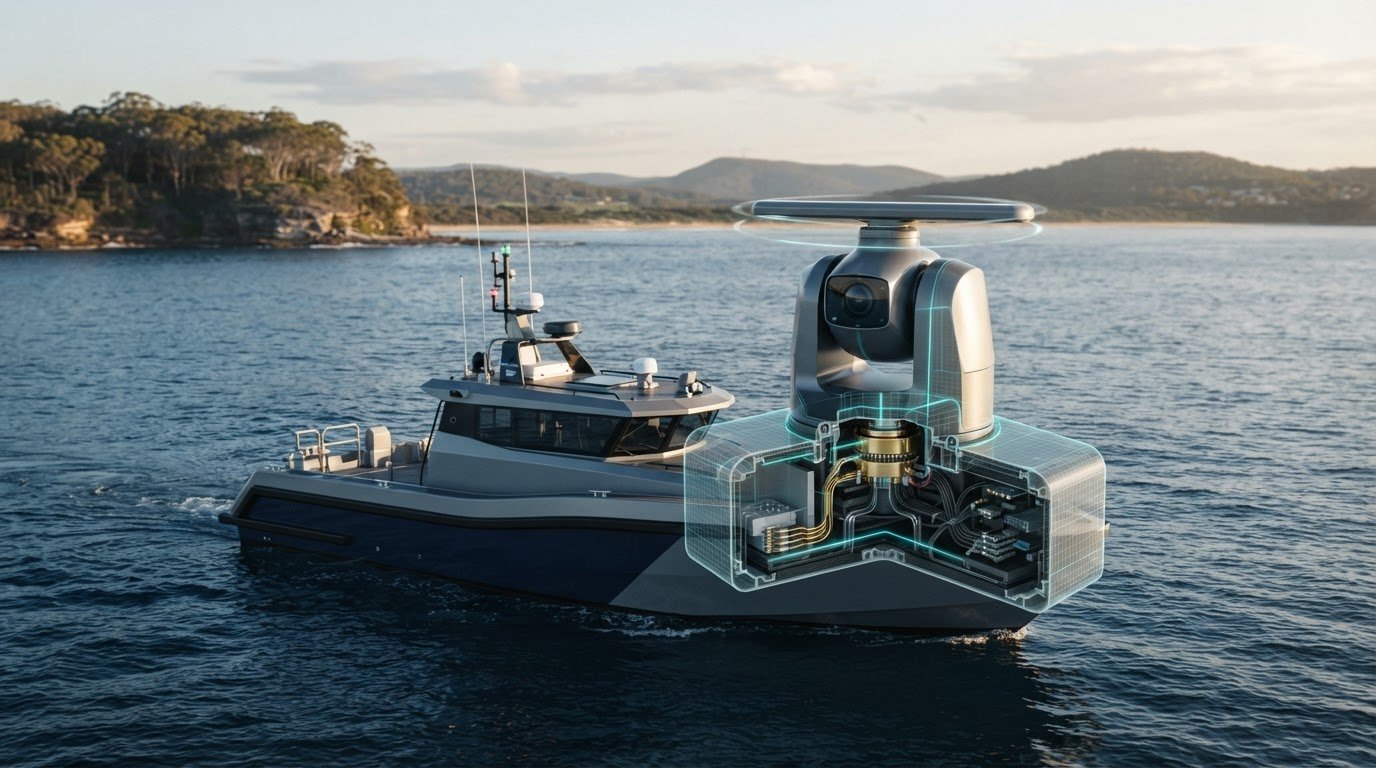
The right rotary connector for an autonomous vessel depends less on the vessel label than on the equipment that needs to turn. A rotary connector for autonomous surface vessels must match its payload, whether that’s a radar assembly, sensor pod or communications antenna, and the power, signal and data paths it requires.
Selection starts with the payload and installation. Circuit count, current, voltage and rotational speed all affect the choice. So do the mounting arrangement and the conditions where the connector will operate. A connector suited to one rotating payload may not meet another’s requirements, even on the same vessel.
This guide compares contact technologies, including conventional slip rings and liquid metal rotary connectors, and explains how mounting options affect selection. It also covers the application details to define before assessing Prosper Rotation slip rings or other options. Use the practical specification outline to prepare requirements for supplier review, based on the rotating payload and installation rather than assumptions about the vessel category.
Key Takeaways
- Choose a rotary connector for autonomous surface vessels by starting with the rotating payload and the electrical paths it needs.
- Use a wiring schedule to establish circuit count, then document current, voltage, speed and data requirements.
- Compare contact technologies and mounting options against the application rather than assuming one design suits every vessel.
- Check environmental suitability, IP rating and data compatibility against the selected manufacturer’s documentation.
- Prepare a clear specification for supplier review, including interfaces and any unresolved application requirements.
What a Rotary Connector Does on an Autonomous Surface Vessel
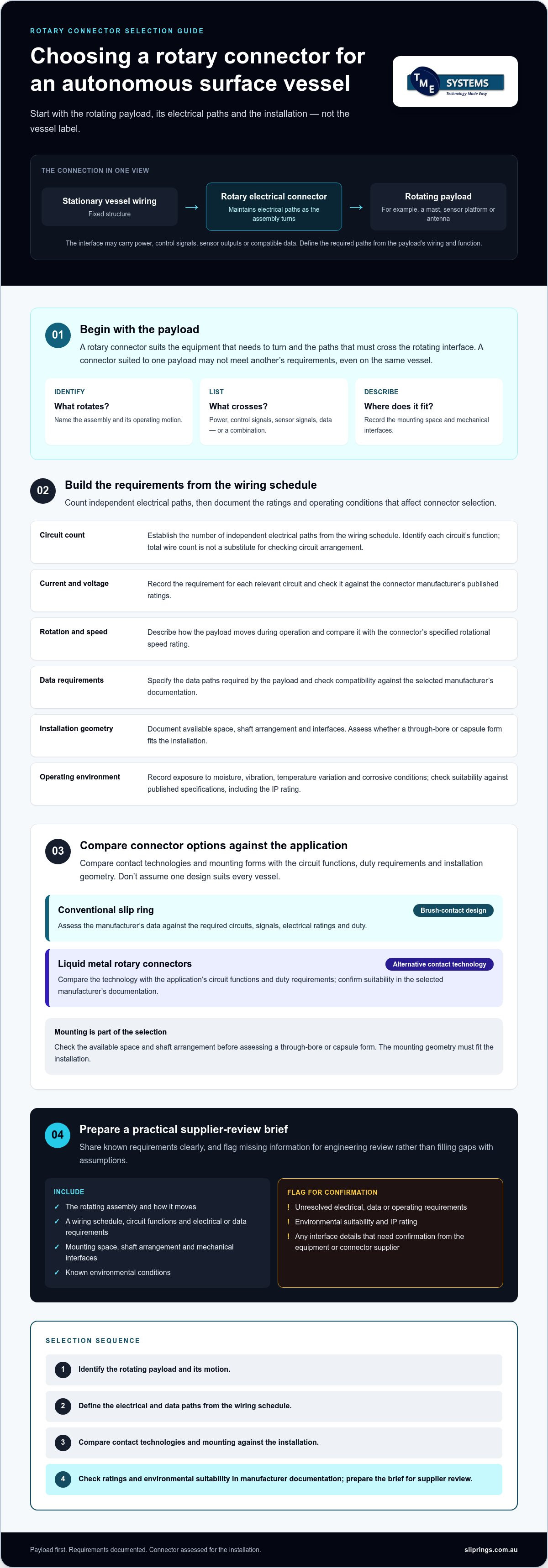
A rotary electrical connector transfers electrical power, signals and compatible data between stationary vessel wiring and equipment mounted on a rotating assembly. It sits between the fixed structure and rotating payload, maintaining electrical paths as the payload turns. A slip ring is one common type of rotary electrical connector. This slip ring overview provides a general explanation of its principle and construction.
On an autonomous vessel, a rotating mast, sensor platform or antenna may need a continuous connection to vessel systems. Depending on the payload, the interface may carry power, control signals, sensor outputs or data. Define the required paths from the payload’s wiring and function, not simply from the fact that it rotates.
A rotary electrical connector is different from a rotary joint designed to carry fluids. If an assembly needs both electrical connections and fluid transfer, specify each function separately and include both in the system design. One type of joint does not automatically replace the other.
Which vessel components may need a rotary electrical connection?
Start by identifying equipment that rotates relative to the vessel structure. A mast, sensor platform or other payload might rotate continuously, move through a limited arc or follow another operating pattern. Its motion and wiring help determine whether a rotary interface is needed.
Then list what must cross the interface: power, control signals, sensor signals, data, or a combination. Don’t assume every rotating component needs the same connection. This is the first step in defining a suitable rotary connector for autonomous surface vessels.
What information should the initial application brief include?
Describe the stationary and rotating sides, the intended installation position and the mechanical arrangement around the connector. Include a wiring schedule that identifies each circuit’s function and electrical or data requirements. Record known operating conditions and flag missing information for engineering review rather than filling gaps with assumptions.
A useful initial brief can capture:
- Which assembly rotates and how it moves during operation.
- The function of each circuit and its electrical or data requirements.
- Available mounting space and mechanical interfaces.
- Environmental conditions the connector must be assessed against.
- Unresolved details that need confirmation from the equipment or connector supplier.
This gives a supplier a practical basis for technical selection assistance. It also keeps the discussion focused on the payload and installation before a connector type or configuration is chosen.
Match Vessel Rotation, Power, and Data Requirements to Connector Design
Connector selection must account for the rotating payload’s electrical demands and the conditions at its installation point. A design may meet current and circuit requirements but still be unsuitable if its speed rating, mounting arrangement or environmental specifications don’t match the application.
Start with the wiring schedule. Circuit count means the number of independent electrical paths required for power and signal transmission. Count those paths and identify each circuit’s function. Don’t use the total wire count as a substitute for checking the connector’s circuit arrangement. Check voltage and current requirements against the manufacturer’s documentation as well.
Comparison factor | What to establish
Contact technology | Whether a brush-contact design or liquid metal technology suits the circuit functions and duty requirements.
Circuit count | The independent electrical paths needed, based on the wiring schedule.
Electrical ratings | Required voltage and current for each relevant circuit, then confirmation against published ratings.
Speed | The operating rotation and the connector’s specified rotational speed rating.
Mounting | Available space, shaft arrangement and whether a through-bore or capsule form fits the installation geometry.
Environment | Exposure to moisture, vibration, temperature variation and corrosive conditions, checked against published specifications.
Compare contact technologies against signal and duty requirements
Brush-contact slip rings transfer circuits through physical contacts. Check the manufacturer’s data to confirm the operating limits and suitability for the required signals. Liquid metal rotary connectors are brushless rotary connectors that use a pool of conductive liquid metal to maintain electrical continuity, eliminating wear and reducing noise. This technology uses the liquid metal to provide a low-resistance electrical path. These general descriptions don’t establish that a particular unit suits a vessel payload. Check product documentation for circuit, signal, speed and environmental compatibility.
Validate high-speed data transmission explicitly. Confirm that the selected configuration supports the required data interface and performance. Don’t infer compatibility from a general description of a slip ring.
Relate mounting, rotation, and environment to the installation
A through-bore slip ring has a hollow centre, allowing it to fit over a rotating shaft or accommodate auxiliary components such as hydraulic lines. A capsule slip ring is a compact solid unit for end-of-shaft mounting. Choose between them based on the assembly’s geometry and available space, not a universal preference.
Check the rotational speed rating, vibration and temperature limits, moisture protection and corrosion suitability in the manufacturer’s documentation. An IP rating defines protection against dust and water ingress; it doesn’t establish complete marine suitability. For broader installation context, the IEEE Recommended Practice for Marine Cable concerns marine cable, not proof of a rotary connector’s suitability.
Use these criteria to compare the Prosper Rotation slip ring range against the application. Confirm each model’s ratings for the intended installation.
Compare Rotary Connector Options Without Assuming One Type Suits Every Vessel
No single contact technology or form factor suits every rotating payload. Compare options against the application’s signal integrity, power demand, circuit count, rotational speed, mounting geometry and operating environment. Treat catalogue descriptions as a starting point. Manufacturer specifications and an application review must confirm uncertain performance or compatibility claims.
Conventional slip rings use physical contacts to maintain electrical paths across rotation. Assess the manufacturer’s data for the required circuits, electrical ratings, signals and duty. Liquid metal rotary connectors are brushless rotary connectors that use a pool of conductive liquid metal to maintain electrical continuity, eliminating wear and reducing noise. These category-level characteristics don’t confirm that a particular unit suits a vessel payload. Check product documentation for circuit, signal, speed and environmental compatibility.
Other arrangements may be relevant where the installation or interface requirements differ. Compare each option against the same application brief. Don’t assume an alternative will transfer a particular data type or meet a specific power requirement. For high-speed data transmission, ask for confirmation against the required interface and operating conditions.
When should a liquid metal rotary connector be evaluated?
Consider this contact method when its documented ratings and configuration appear relevant to the required circuits and duty. Confirm the payload’s signal types, power needs, rotational speed and environmental conditions, then compare them with the selected product’s specifications. Don’t infer a particular product’s noise, wear or maintenance performance from the technology category alone. If mercury-free liquid metal is a selection requirement, verify the composition in the manufacturer’s documentation.
When might a different slip ring configuration fit better?
Use the mounting envelope and shaft arrangement to guide the form-factor comparison. A through-bore slip ring has a hollow centre, allowing it to fit over a rotating shaft or accommodate auxiliary components such as hydraulic lines. A capsule slip ring is a compact solid unit for end-of-shaft mounting. Consider other configurations only when their mechanical and electrical details have been confirmed.
For a product-level comparison, review Prosper Rotation slip rings and BGB Innovation slip rings as ranges to assess, not as confirmed vessel-specific solutions. Check published specifications for signal integrity, power, circuit count, speed, mounting and environmental limits. If information is unclear, technical application consulting can help define the requirements for supplier review before selection.
How to Build a Rotary Connector Specification for Vessel Evaluation
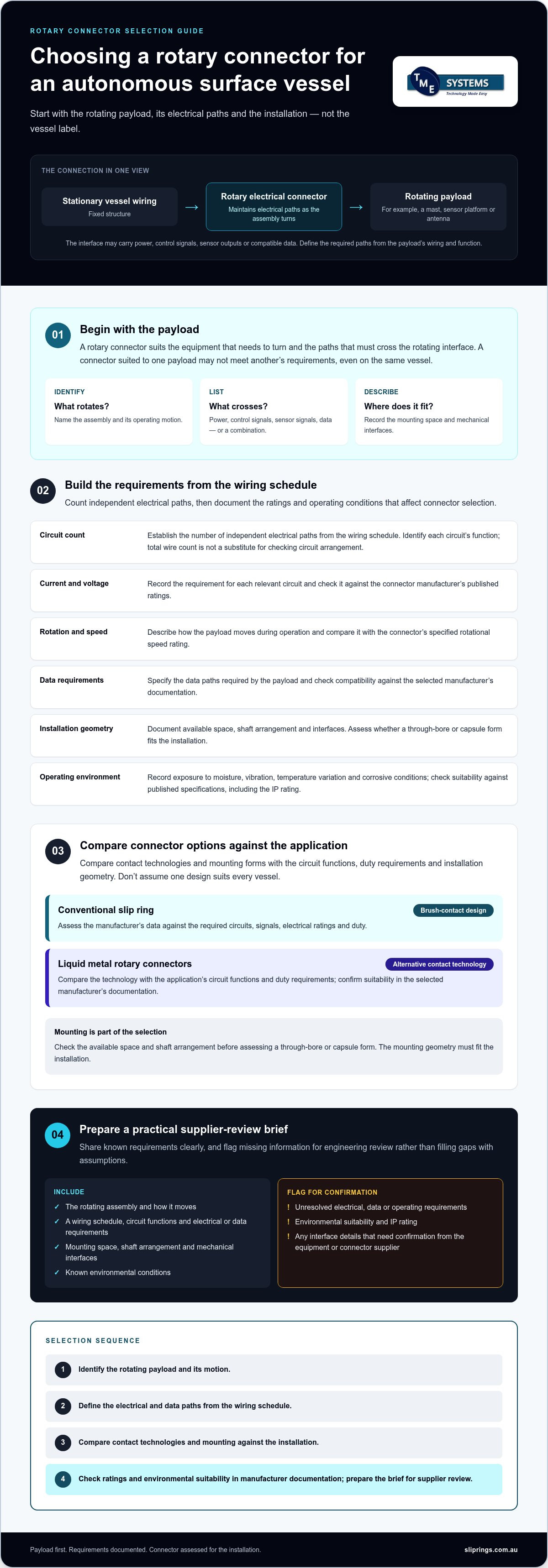
A clear specification helps suppliers assess whether a rotary connector for autonomous surface vessels matches the payload and installation. Work through the requirements in order, distinguishing confirmed values from estimates and open questions. Don’t fill gaps with assumed ratings or capabilities.
- Define the payload. Identify the rotating equipment, its function, and the stationary and rotating sides of the interface.
- Document each electrical path. Build a circuit schedule that states each circuit’s function, voltage, current and whether it carries power or a signal. Use it to establish circuit count.
- Describe data needs. Name the protocols and performance requirements. Flag shielding, grounding or noise concerns for technical review, and confirm compatibility against manufacturer documentation.
- Record motion and mounting. Specify the installation geometry, shaft arrangement, available space, required mounting style and expected rotation profile. Include the operating speed needed to check the rotational speed rating.
- Describe the environment. Record expected vibration, temperature and exposure conditions. Note the required IP rating and identify any additional environmental requirements for separate confirmation.
- Compare options and arrange review. Assess candidate connector types against the recorded requirements. Ask the supplier to confirm ratings, interfaces and unresolved compatibility questions against product documentation.
Collect electrical, signal, and data requirements
Make the circuit schedule specific enough to distinguish a power path from a sensor signal or data link. Record known voltage and current values for each relevant circuit, along with the required data protocol and performance. Label estimates as estimates. Note concerns about signal integrity, shielding or grounding without prescribing a design before the application has been reviewed.
Treat high-speed data transmission as a requirement to verify, not an assumed slip ring capability. Ask the manufacturer to confirm that the proposed configuration supports the specified interface and operating conditions.
Document mechanical and environmental conditions
Describe how the connector fits into the assembly, including the shaft arrangement, mounting points and available space. Record whether the payload rotates continuously or follows another pattern, and provide expected speed and vibration conditions. For the environment, state known temperature and moisture exposure, along with any corrosion concerns. An IP rating addresses dust and water ingress; confirm other environmental needs separately.
Mark each specification item as confirmed, estimated or awaiting manufacturer confirmation. This makes uncertainty visible during review. TME Systems provides technical application consulting based on circuit count, current, voltage, speed, mounting style and environmental requirements. Request technical application consulting to discuss the specification before selecting hardware.
Choose a Supplier for Technical Review and Rotary Connector Selection
A final engineering review should show how the proposed configuration addresses the vessel payload’s documented requirements. For a rotary connector for autonomous surface vessels, check that the arrangement, ratings and interfaces match the circuit schedule, motion profile, mounting geometry and environmental conditions. The review should also identify unresolved risks rather than treating unconfirmed assumptions as verified specifications.
What to ask during supplier and engineering review
Ask which manufacturer specifications support the proposed configuration and request the relevant documentation. Confirm how each circuit and signal will be handled, and whether the connector’s electrical ratings, speed and mounting details fit the application. Check that environmental claims apply to the intended installation, not just to a general product category.
If information is incomplete, ask what additional details are needed before selection. This may include clarification of data compatibility, interfaces or operating conditions. A useful review makes clear what is confirmed, what remains uncertain and who must verify each open point.
Prepare an application brief for TME Systems
Give the supplier enough context to assess the application. Include a brief system description and, where available, a drawing of the rotating assembly and its mechanical envelope. Attach the circuit schedule, voltage and current requirements, data protocol and performance needs, expected speed, mounting arrangement and operating conditions. Clearly mark estimates and open questions.
TME Systems provides technical assistance to discuss circuit count, current, voltage, speed, mounting style and environmental requirements. Its represented manufacturer ranges, including Prosper Rotation slip rings, can be assessed against the application. Suitability for a particular vessel must be confirmed using the relevant product documentation and review.
Share the application requirements with TME Systems to discuss technical selection support. Send your rotary connector application requirements, including available drawings and circuit details, so the review can focus on the payload and installation.
Turn your vessel requirements into a review-ready specification
Select a rotary connector for autonomous surface vessels by matching the rotating payload and installation to the connector’s verified capabilities. Start with the wiring schedule: circuit count, voltage, current and data needs define the electrical requirements. Then check the rotational speed rating, mounting arrangement and environmental conditions against manufacturer documentation.
Compare contact technologies and form factors against those requirements rather than assuming one option suits every vessel. A useful supplier review should confirm how the proposed configuration addresses each circuit and interface, and identify open questions that need further engineering input.
TME Systems’ technical assistance can help clarify circuit count, current, voltage, speed, mounting style and environmental requirements. If considering AS/NZS 5368:2025, verify its scope and relevance to the vessel application before making compliance claims.
Prepare your application details and discuss your vessel application with TME Systems. A clear brief gives the selection discussion a practical starting point and helps you work towards a well-supported connector decision.
Frequently Asked Questions
What does a rotary connector do on an autonomous surface vessel?
A rotary connector maintains electrical paths between stationary vessel wiring and a rotating assembly. It can transfer power, control or sensor signals, and compatible data to or from equipment such as a rotating mast or sensor platform. The connection sits at the rotating interface, allowing the payload to turn without relying on a fixed cable that could twist during rotation. The required circuits depend on the payload.
How do I choose a rotary connector for an autonomous surface vessel?
Choose a rotary connector for autonomous surface vessels by matching its documented capabilities to the rotating payload and installation. Start with a wiring schedule, then establish circuit count, voltage, current, data interface, speed and mounting geometry. Record environmental conditions, including moisture, vibration and temperature, and verify the proposed connector’s ratings against manufacturer documentation. Treat unknown values as open questions for supplier review, not assumptions about product suitability.
Are liquid metal rotary connectors suitable for marine vessels?
They may be considered, but suitability depends on the specific product and vessel installation. Liquid metal technology uses a pool of conductive liquid metal to provide a low-resistance electrical path. Verify ratings, data compatibility and environmental suitability in the manufacturer’s documentation.
What is the difference between a slip ring and a rotary joint?
A slip ring is an electrical rotary connector that maintains electrical paths between stationary and rotating assemblies. Rotary joint can also refer to a component that transfers fluids across a rotating interface. These serve different functions: an electrical connector doesn’t automatically carry fluids, and a fluid rotary joint doesn’t automatically provide electrical circuits. If the payload needs both, specify each requirement and assess suitable components for the system.
How many circuits should a vessel rotary connector have?
Base circuit count on the wiring schedule, not a generic vessel allowance. Circuit count is the number of independent electrical paths a slip ring provides for power and signal transmission. List each path’s function, such as power, control, sensor signal or data, and check the proposed configuration against that schedule. The required count depends on the payload and system design. Ask the supplier to confirm the circuit arrangement and ratings.
What happens if a rotary connector’s IP rating is not suitable?
An unsuitable IP rating may leave the connector without the documented protection needed for its exposure to dust or water. Depending on the installation and conditions, ingress may affect electrical performance or contribute to deterioration. Check the IP rating against the equipment’s actual location and exposure, and verify whether the rating covers the relevant water conditions. An IP rating alone doesn’t establish full marine suitability, so review other environmental requirements separately.
What information should I send a supplier for a rotary connector review?
Send a system description, details of the stationary and rotating assemblies, and a drawing or mechanical envelope if available. Include the circuit schedule, voltage, current, data requirements, expected operating speed, mounting arrangement and environmental conditions. Clearly mark estimates and unresolved questions. TME Systems’ technical assistance considers circuit count, current, voltage, speed, mounting style and environmental requirements, helping frame the selection discussion around the application.