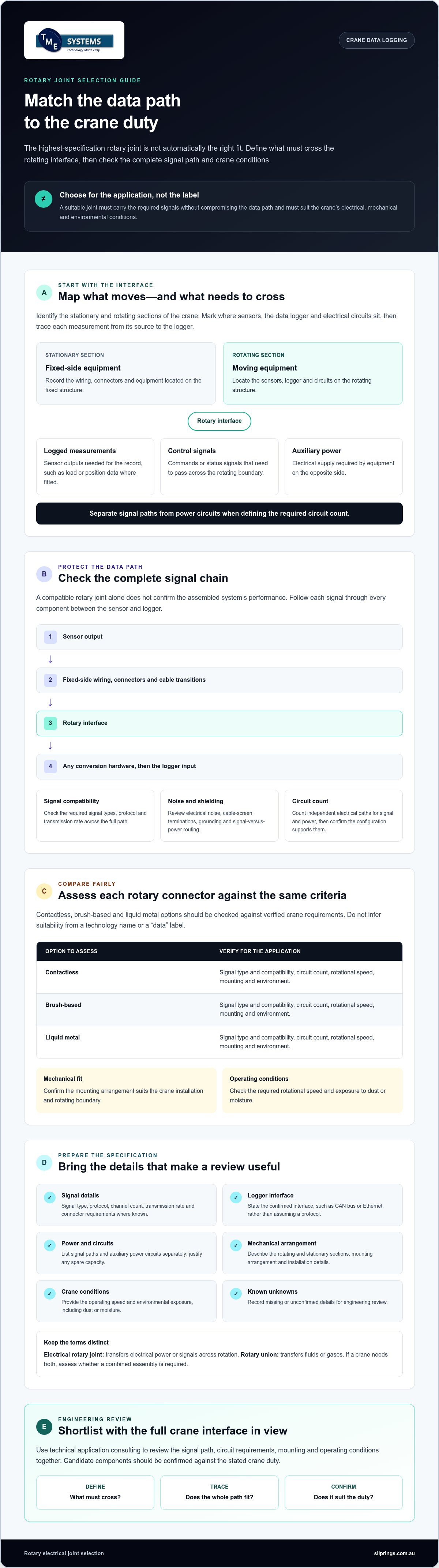
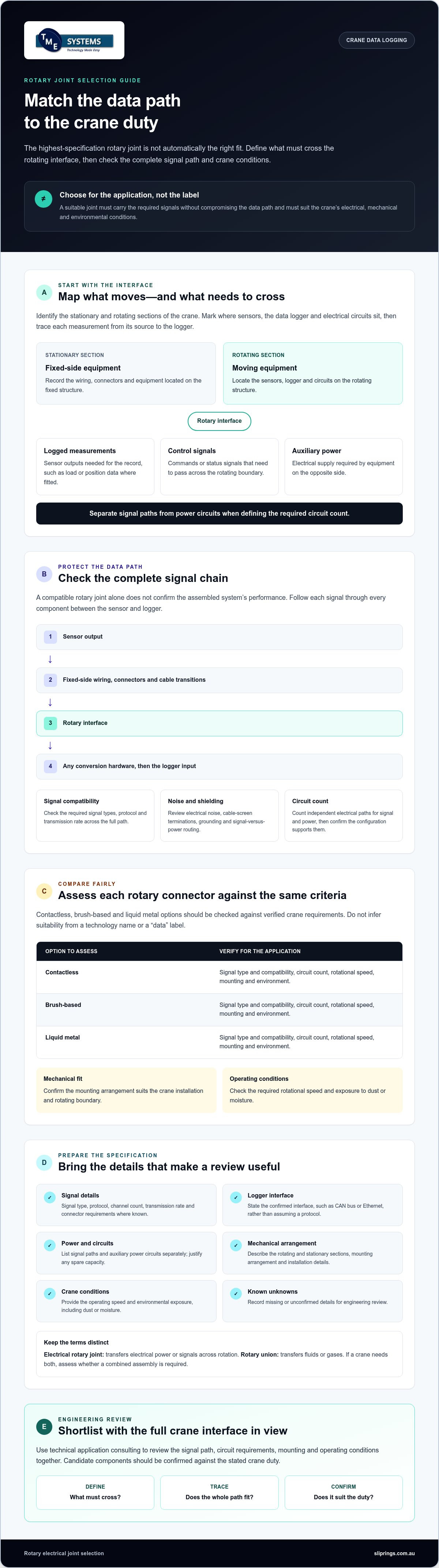
The highest-specification rotary joint isn’t automatically the right one for a crane. A rotary joint for construction crane data logging must carry the required signals across the rotating interface without compromising the data path, and suit the crane’s electrical, mechanical and environmental conditions.
It’s understandable to focus first on the data logger. But if signals are interrupted, records may be incomplete, or the joint may not work with the installed hardware. Start by defining what must cross the interface, including signal types, protocols, power requirements and operating conditions.
This guide explains how to set those requirements before comparing rotary joint options. You’ll learn how to assess contactless, brush-based and liquid metal rotary connectors against practical criteria such as signal compatibility, circuit count, rotational speed, mounting arrangement and exposure to dust or moisture.
With those details in hand, you can make a more useful comparison and prepare for a supplier engineering review. The aim is to match the data path and crane duty to a suitable joint, rather than choosing a technology based on its label alone.
Key Takeaways
- Map the crane’s stationary and rotating sections, then identify which sensors, logger and electrical circuits need a path across the interface.
- Trace each signal through the complete system, including connectors and conversion hardware, before assessing whether a rotary joint for construction crane data logging is suitable.
- Compare contactless, brush-based and liquid metal options against verified requirements for signal type, circuit count, rotational speed, mounting and operating environment.
- Gather the available signal, power, mechanical, environmental and installation details to make your rotary joint specification more useful.
- Use technical application consulting to review the full crane interface specification, with candidate components subject to confirmation against the stated duty.
What does a rotary joint need to carry for construction crane data logging?
An electrical rotary joint carries electrical power and signals between stationary and rotating parts of a machine. A slip ring is one form of this electromechanical interface. For a rotary joint for construction crane data logging, first establish which parts of the crane move relative to one another and which components sit on each side of that boundary.
On a slewing crane, for example, sensors may be mounted on the rotating structure while other equipment is fixed to the undercarriage. The logger could be on either side. Map the actual arrangement, then trace each measurement from sensor to logger. This shows which signals must cross the interface and which stay entirely within the rotating or stationary section.
Keep three requirements distinct in the initial circuit map:
- Logged measurements: Sensor outputs required for the record, such as load or position data where fitted.
- Control signals: Commands or status signals that also need to pass across the rotating boundary.
- Auxiliary power: Electrical supply required by equipment on the opposite side.
Separating these functions helps establish the required circuit count and prevents a signal path from being overlooked when you assess power and logging requirements together.
Which crane signals need to cross the rotating interface?
List each signal the logging system requires rather than specifying only “data”. Depending on the crane architecture, this could include analogue or digital sensor outputs, encoder or pulse signals, control lines and network traffic. For each, record the signal type, channel count, transmission rate and connector requirements where known. Mark where each measurement originates and check whether its route to the logger crosses the rotating interface.
Don’t assume every crane sensor needs a rotary path. Some may connect directly to a logger on the same structure; others may require conversion hardware or connectors along the route. Record those components too, and confirm compatibility across the complete path.
What is the difference between a rotary joint and a rotary union?
An electrical rotary joint transfers electrical power or signals across rotation; a rotary union transfers fluids or gases. They aren’t interchangeable terms. If the crane design requires both electrical connections and fluid transfer, assess whether a combined assembly is needed. Otherwise, define the electrical interface on its own and leave fluid-transfer requirements out of its specification.
How do you protect data logging performance through a crane rotary joint?
Trace each logging signal through the complete path: sensor, fixed-side wiring, rotary interface, any conversion hardware and the logger input. Include connectors and cable transitions. A compatible rotary joint alone doesn’t confirm the performance of the assembled system; every part of the signal chain must suit the required interface.
Include electrical noise, shielding and grounding in the design review. Confirm how cable screens are terminated, how signal and power circuits are routed, and whether the proposed arrangement maintains the required signal integrity during crane operation. Treat these as application checks, not outcomes to assume from a product description.
Circuit count is the number of independent electrical paths a slip ring provides for power and signal transmission. Count logging channels and auxiliary circuits separately, then confirm the selected configuration supports the required connections.
How should circuit count and protocols be specified?
List required paths by function, separating power circuits from signal circuits. Include spare capacity only where the design justifies it. State the logger’s confirmed interface, such as CAN bus or Ethernet, rather than assuming a protocol based on the crane type. Then check manufacturer documentation for data rate, channel isolation, connection details and interface compatibility. Record unknowns for engineering review.
Verify high-speed data transmission capability for the full system rather than inferring it from a “data” label. Confirm that the rotary interface, connectors, cables and any converters can work together at the required rate. If the signal has specific shielding or termination requirements, include them in the review and confirm how the installation will meet them.
When should contactless or liquid metal technology be considered?
Compare contactless transmission and conventional slip ring approaches against the actual signal interface, circuit needs and crane operating conditions. Liquid metal rotary connectors are another technology category to assess, not an automatic fit for a crane logging circuit. Verify claims about mercury-free liquid metal, data rates and protocol support against current manufacturer documentation for the specific configuration.
Keep compliance checks tied to the project’s applicable requirements. The US crane safety regulation is a reference for US workplaces, not an Australian compliance basis. Confirm relevant Australian requirements for the crane and installation separately. TME Systems’ technical application consulting can help review the electrical and interface details before you select a candidate.
How should you compare rotary joint options for a construction crane?
Compare candidates against the same application requirements, not a product label or example configuration. For a rotary joint for construction crane data logging, separate manufacturer-confirmed information from project assumptions and questions that still need an engineering answer. This makes gaps visible before you treat a candidate as suitable.
Use a comparison table to keep the review consistent. Enter your crane’s requirements, then ask suppliers to confirm each candidate against current documentation.
| Comparison area | What to record or confirm |
|---|---|
| Signal type | Required protocols, data rate and signal characteristics, confirmed for the complete interface. |
| Circuit count | Independent power and signal paths required, plus justified spare capacity. |
| Speed | Crane operating speed and the candidate’s documented rotational speed rating. |
| Mounting | Available envelope, shaft access, attachment arrangement and cable routing. |
| Environment | Operating temperature, vibration, contamination and water exposure; verify the IP rating against actual conditions. |
| Integration | Connectors, conversion hardware, grounding, shielding and compatibility with connected equipment. |
Which rotary joint technology best fits the data path?
Assess contactless, brush-based and liquid metal approaches by the required protocol, data rate, circuit arrangement and system architecture. Don’t infer performance from the technology category alone. Ask the supplier to confirm compatibility across the rotary interface and connected equipment, including connectors and any conversion hardware. No category by itself guarantees uninterrupted or error-free logging.
For every comparison entry, label it confirmed, assumed or unresolved. For example, a protocol named in a project brief isn’t confirmed as compatible until the specific candidate and system arrangement have been checked. Keep unresolved details visible for the engineering review instead of treating them as accepted specifications.
If heavy-duty options are part of the review, BGB Innovation slip rings can be included as a candidate for assessment. Its suitability for a particular crane data logging application must be confirmed against the stated duty and manufacturer information.
How do mounting and operating conditions change the comparison?
Check the installation space, shaft access and cable route before comparing form factors. A through-bore slip ring may be relevant where a hollow centre is needed for shaft mounting or other components, but the crane layout must support that arrangement. Record the required rotational speed rating and actual operating conditions, including vibration, temperature, contamination and water exposure.
An IP rating defines protection against dust and water ingress. Verify the candidate’s documented rating against the crane environment; don’t treat an example rating as a universal requirement. The final comparison should show what the manufacturer has confirmed, what the project assumes and what still needs resolution.
What information belongs in a crane rotary joint specification?
A useful specification gives a supplier enough detail to assess the complete rotating interface, not just the logger connection. For a rotary joint for construction crane data logging, include confirmed requirements, attach supporting documents and label unknowns clearly instead of filling gaps with assumptions.
What electrical and mechanical details should you collect?
Gather the logger and sensor interface documentation, wiring diagrams and relevant duty-cycle information. Include available mechanical drawings or measurements so the mounting arrangement can be reviewed against the crane layout.
Use this numbered checklist as a starting point:
- 1. Signals: List each sensor and control signal, protocol, data rate, channel count and connector requirement. Identify which signals must cross the rotating interface.
- 2. Power: Record supply voltage and current for each circuit, noting whether power and signal paths need to be separated.
- 3. Circuit count: State the required number of independent electrical paths and include spare circuits only where the design calls for them.
- 4. Mechanical fit: Provide the mounting arrangement, shaft dimensions, available installation envelope, rotation profile and cable routing constraints. Identify auxiliary lines or components that could affect assembly space or whether a through-bore slip ring is relevant.
- 5. Operating duty: Supply the required rotational speed rating, operating cycle details and the expected duration or pattern of rotation where known.
- 6. Environment: Describe exposure to dust, water, temperature changes, vibration and any other conditions relevant to the installation. Where applicable, request confirmation of the IP rating against actual exposure.
- 7. Thermal conditions: Provide ambient and operating information needed to assess thermal management. Ask whether thermal derating needs to be considered for the stated current and conditions.
- 8. Installation: Note access, mounting clearances, connector orientation, cable entry and any restrictions that could affect installation.
Use Discuss your rotary connector application to share the requirements and supporting information for review.
What environmental and standards checks belong in the review?
Separate environmental facts from target ratings: record the expected exposure first, then verify any proposed protection level against manufacturer documentation. Establish which standards are relevant to the crane and installation before making a compliance statement. Check whether AS/NZS 5368:2025 applies to the project and substantiate any product-specific claim; don’t assume it qualifies a rotary joint.
AS/NZS 3000:2018 is the Australian/New Zealand wiring rules standard for electrical installations. Include it in the review where relevant to the electrical installation, and have the project team confirm its application to the specific design.
How can application engineering narrow the shortlist for crane data logging?
A supplier review can bring the crane’s electrical, mechanical and environmental requirements together before a rotary joint is selected. For a rotary joint for construction crane data logging, this helps identify whether a candidate suits the stated application and which details still need confirmation. Treat supplier and product options as candidates for review, not confirmed fits for a particular crane duty.
The process works best when each requirement can be traced to an application detail. For example, check a specified logger interface against manufacturer information for the proposed rotary joint and connected equipment. Mounting dimensions, cable connections, operating conditions and environmental protection also need to match the crane installation. If a requirement is unresolved, keep it visible rather than assuming a product will accommodate it.
What should a supplier engineering review confirm?
Ask the supplier to review the specified signals and protocols, required data rate, circuit arrangement and operating conditions. The assessment should also cover mounting, cable interfaces, environmental protection and constraints from the surrounding crane design. Request manufacturer documentation for applicable ratings and limitations, and ask which conclusions depend on project assumptions or further confirmation.
This review can help distinguish a potential technical match from a verified one. A product category or example configuration alone doesn’t establish compatibility with the logger, sensors or crane duty. Confirm suitability against the complete application information and current manufacturer documentation.
How should you prepare a useful enquiry?
Send enough information for the application to be assessed as a system, rather than asking only whether a particular slip ring can carry data. Include:
- An application diagram showing the stationary and rotating sections, sensor locations, logger position and signal route.
- Logger and sensor documentation, including confirmed interfaces, protocols, connectors and data requirements.
- A circuit schedule separating power and signal paths, with current, voltage and circuit count where known.
- The mechanical arrangement, including mounting details, shaft dimensions, available space and cable routing.
- The operating profile and relevant environmental conditions, such as speed, temperature, vibration, dust or water exposure.
Mark each item as confirmed or unresolved. That makes it easier to focus the technical discussion on genuine gaps, such as an unconfirmed protocol or an installation dimension that still needs checking. TME Systems’ technical application consulting can help review circuit, electrical, mechanical and environmental requirements together. To begin the review, request technical application consulting and provide the application details you have available.
Specify the interface before choosing a rotary joint
Reliable crane data logging starts with a clear picture of the complete signal path. Identify which measurements, control signals and power circuits cross the rotating interface, then document the logger and sensor requirements alongside the crane’s mechanical and environmental conditions.
Compare rotary joint options against those application requirements, not a technology label alone. Confirm the circuit count, protocol compatibility, data rate, mounting arrangement and operating limits against manufacturer information. Keep assumptions and unresolved details visible so they can be addressed during engineering review.
The right rotary joint for construction crane data logging depends on how the full system is configured and operated. TME Systems supplies industrial slip rings and rotary electrical connectors, and offers technical application consulting to help review requirements and assess suitable candidates for further confirmation.
Discuss your crane rotary joint requirements and share the application details you have available. A well-prepared specification is a practical first step towards a suitable solution.
Frequently Asked Questions
What does a rotary joint do on a construction crane?
A rotary joint transfers electrical power or signals between stationary and rotating parts of a crane. It can provide a path for sensor measurements or control signals to reach equipment on the other side of the rotating interface, such as a data logger. The required circuits depend on the crane’s layout. First identify which components move relative to one another and whether their electrical connections need to cross that boundary.
Can a rotary joint transmit data logging signals while a crane rotates?
Yes, a rotary joint can carry data logging signals across a rotating interface, provided the selected configuration suits the signals and operating conditions. Confirm the signal type, protocol and data rate against manufacturer documentation. Check the complete path too, including sensors, connectors, cables, conversion hardware and logger inputs. A product description alone doesn’t establish that the assembled system will maintain the required signal performance during crane operation.
How do I choose a rotary joint for crane data logging?
Choose a rotary joint by matching its documented capabilities to the complete crane application. For a rotary joint for construction crane data logging, establish which signals and power circuits cross the interface, then assess circuit count, protocol compatibility, data rate, rotational speed rating, mounting and environmental conditions. Compare technology options against these requirements, and ask the supplier to confirm candidate suitability with the manufacturer. Don’t assume a technology label guarantees performance.
What information should I provide when specifying a crane rotary joint?
Provide an application diagram, sensor and logger documentation, a circuit schedule and the crane’s operating profile. Include signal types, protocols, data rates, circuit count, current, voltage, connector details, mounting arrangement, shaft dimensions and available space where known. Describe expected speed, temperature, vibration, dust and water exposure. Separate confirmed specifications from unknowns, and attach relevant wiring diagrams so a supplier can identify what needs clarification.
Can Ethernet or CAN bus pass through a crane rotary joint?
Ethernet or CAN bus may be carried through a rotary joint if the specific interface and complete system support the required protocol and data rate. Confirm compatibility for the rotary unit, cables, connectors and any conversion hardware with the manufacturer. Also check relevant installation details, such as shielding and termination. Don’t treat a general “data” or “high-speed” description as proof that a particular crane logging network will work.
What is the difference between an electrical rotary joint and a rotary union?
An electrical rotary joint transfers electrical power or signals across a rotating interface. A rotary union transfers fluids or gases, so the terms describe different functions and shouldn’t be used interchangeably. A crane may require both types of transfer, depending on its design. If electrical and fluid connections must cross the same rotating boundary, identify both requirements and confirm whether a combined assembly is appropriate.
How does circuit count affect a rotary joint for data logging?
Circuit count is the number of independent electrical paths a slip ring provides for power and signal transmission. It affects whether the assembly has enough separate paths for logger channels, control signals and auxiliary power. Count these requirements by function and avoid treating one circuit as interchangeable with another. Include spare circuits only where the design calls for them, then verify the proposed configuration and connections against manufacturer documentation.