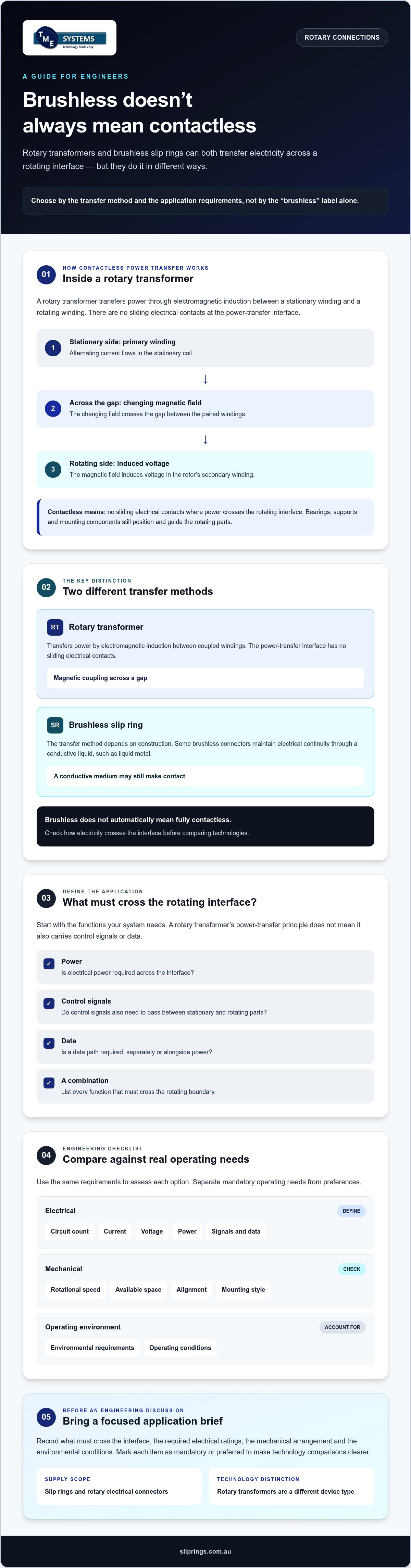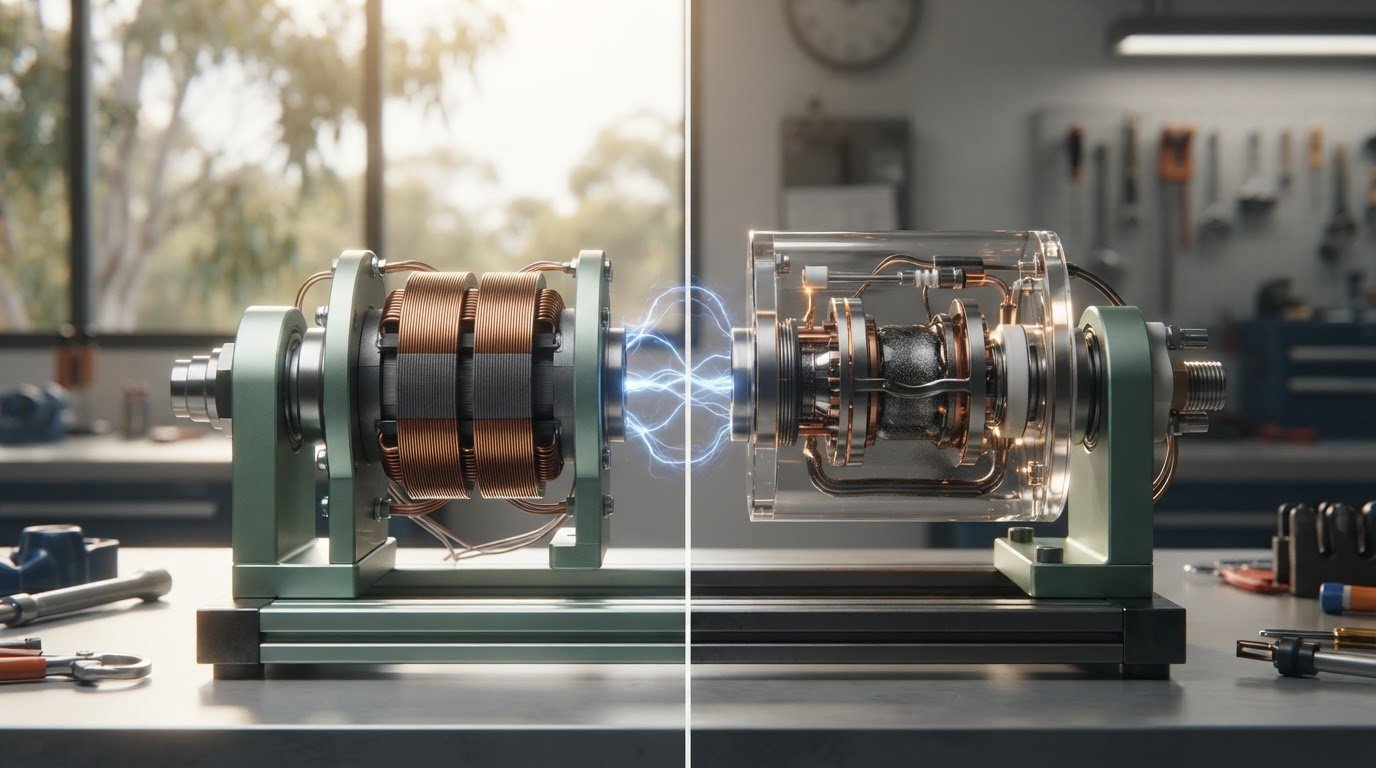
Brushless doesn’t always mean contactless. For engineers comparing brushless slip rings Australia, the distinction matters: a rotary transformer transfers power through magnetic coupling across a gap, while some brushless connectors maintain electrical continuity through a conductive liquid. Both avoid conventional sliding brush contacts, but they work differently and suit different requirements.
If you’re looking to reduce contact wear, a contactless design may seem like the clear choice. But it won’t automatically provide every power, signal or mechanical capability your rotating application needs. Choose based on the interface and operating conditions, not the “brushless” label alone.
This article explains how rotary transformers transfer power, compares them with brushless slip-ring technologies such as liquid metal rotary connectors, and outlines the electrical and mechanical details to define before selection. TME Systems supplies industrial slip rings, not rotary transformers, and offers technical application consulting to help assess circuit count, current, voltage, speed, mounting style and environmental requirements. Use these factors to prepare for a focused engineering discussion.
Key Takeaways
- Identify what must cross the rotating interface, power, control signals, data or a combination, before comparing technologies.
- Check how each design transfers electricity: “brushless” can describe a liquid-contact connector as well as a fully contactless rotary transformer.
- Compare brushless slip rings Australia options against circuit count, electrical ratings, speed, mounting and environmental conditions.
- Separate mandatory operating requirements from preferences to make comparisons more useful and focused.
- Prepare your application details for a technical discussion. TME Systems supplies slip rings and rotary electrical connectors, not rotary transformers.
What is a rotary transformer for contactless power transfer?
A rotary transformer transfers electrical power between stationary and rotating parts through electromagnetic induction, without sliding electrical contacts at the transfer interface. The stationary assembly is commonly called the stator, and the rotating assembly the rotor. Each carries a winding, or coil. Alternating current in one coil creates a changing magnetic field, which induces a voltage in the other.
Definition: A rotary transformer is a contactless rotary electrical device that transfers power between a stationary winding and a rotating winding by electromagnetic induction across a gap, rather than through conductive sliding contacts.
The coils are arranged to remain magnetically coupled as one side turns. This differs from a conventional slip ring, where brushes physically touch conductive tracks to carry current across the rotating boundary. A rotary transformer reference describes the principle and applications such as helical-scan tape heads. Construction varies by design, so confirm the arrangement and any supporting electronics with the supplier or engineering team.
How does a rotary transformer transfer power across a rotating interface?
Think of the two sides as a matched pair separated by a small physical gap. The primary winding receives an alternating electrical supply. Its changing magnetic field crosses the gap and induces voltage in the secondary winding, which rotates with the equipment. Power is transferred magnetically, not through a continuous metal path between the windings.
This operating principle doesn’t mean every rotary transformer also carries control signals or data. Those functions may need separate channels or another connection method. Define what the interface must transfer before comparing designs.
What does “contactless” mean in a rotary connection?
Here, “contactless” means there are no sliding electrical contacts where power crosses from the stationary side to the rotating side. It doesn’t mean the complete assembly has no physical contact: bearings, supports and mounting components still position and guide the rotating parts. Nor is it simply wireless power sent between unrelated devices. The transformer is designed for a rotating system, with paired components aligned across its interface.
Performance depends on how the electrical design fits the mechanical assembly and operating conditions. Consider required power, voltage and any signal or data paths, along with rotational speed, available space, alignment and the surrounding environment. These details help determine whether contactless transfer suits the application. The “brushless” label alone does not.
For readers comparing brushless slip rings Australia, check the construction of each option rather than assuming brushless means fully contactless. TME Systems supplies slip rings, including Prosper Rotation slip rings, but not rotary transformers. Understanding the distinction helps you compare technologies against the application’s electrical and mechanical requirements.
Rotary transformer vs brushless slip ring: understand the difference
Both technologies can transfer electricity across a rotating interface, but “brushless” describes a broad category, not a single operating principle. A rotary transformer transfers power through electromagnetic induction without sliding electrical contacts. A brushless slip ring may still maintain electrical continuity through a conductive medium.
Contactless transfer has no conductive contact at the power-transfer interface; brushless contact technology can transfer current through a conductive medium without conventional brushes.
| Comparison point | Rotary transformer | Brushless slip ring |
|---|---|---|
| Transfer method | Power transfers by electromagnetic induction between coupled windings. | Depends on construction; some designs use conductive liquid metal to carry current. |
| Contact interface | No sliding electrical contacts at the power-transfer interface. | May not use conventional brushes, but can still use a conductive contact medium. |
| Circuit needs | Confirm how the design provides the required power paths and whether separate signal or data paths are needed. | Confirm circuit count and the suitability of each path for the required power, signals or data. |
| Application constraints | Assess electrical requirements, physical arrangement and operating conditions for the coupled assembly. | Assess electrical requirements alongside the connector’s construction, mounting and operating conditions. |
Does brushless mean the rotary connection is contactless?
No. The term alone doesn’t tell you how electrical continuity is achieved. liquid metal rotary connectors use a pool of conductive liquid metal as the contact path, so they are brushless but not contactless. Check the design details rather than inferring the transfer method from a product description. For a connector example, review the Mercotac slip ring range.
When should engineers compare a rotary transformer with a slip ring?
Compare them once you know what must cross the interface: power, signals, data or a defined combination. Then specify circuit count, voltage, current and rotational speed, along with available space, mounting arrangement and environmental conditions. These requirements help establish whether a candidate design is worth assessing. Neither technology is automatically the better choice; suitability depends on how its construction meets the application.
Research into an inductive power transfer (IPT) system examines a rotary transformer as an alternative to slip rings, offering context for a technology comparison. If you need a slip ring, use your defined operating conditions to guide product selection and technical discussion.
Which application requirements determine whether contactless transfer fits?
When assessing brushless slip rings Australia, define the operating requirements before choosing a transfer method. Voltage, current, circuit count, signal type, rotational speed, mounting arrangement, available space and environmental exposure all affect whether a proposed rotary interface is suitable. Start with the equipment specification, not a general assumption about what a technology can handle.
Electrical load, required signal paths, mechanical fit, operating environment and system integration should be considered together because each can affect whether contactless power transfer meets the application’s requirements.
What electrical requirements should be defined first?
List what must cross the rotating interface and how each path will be used. For each power or signal circuit, record the required voltage and current, circuit count and signal type. State whether power and signals must operate simultaneously, and whether data transmission is also required. This helps distinguish essential functions from assumptions about what a connector should provide.
Use figures from the equipment specification or system design. Don’t infer capacity from a product category or general description. Check any candidate’s electrical limits against the selected manufacturer’s documentation, including the conditions under which those limits apply.
Which mechanical and environmental factors affect the interface?
Describe how the rotary connection will fit and operate in the machine. Record the required rotational speed rating, mounting arrangement, available space and shaft configuration. Include movement or alignment constraints if they affect how the stationary and rotating parts can be positioned.
Then document the environment around the interface, including operating temperature, moisture, dust, contamination and other relevant exposure. Confirm any IP rating and thermal management approach against the application and product documentation. Don’t assume either from the technology name.
What must the complete system accommodate?
Consider the interface as part of the equipment, not in isolation. Check how it connects to the stationary and rotating assemblies, what space is available for associated components, and whether it must carry power, control signals, data or a combination. Confirm that installation and operating conditions align with the candidate’s stated requirements.
Before comparing brushless slip rings Australia options with contactless designs, separate mandatory limits from preferences. A short specification sheet covering electrical, mechanical, environmental and integration needs gives an engineering discussion a clear starting point and helps identify which technologies warrant closer assessment.
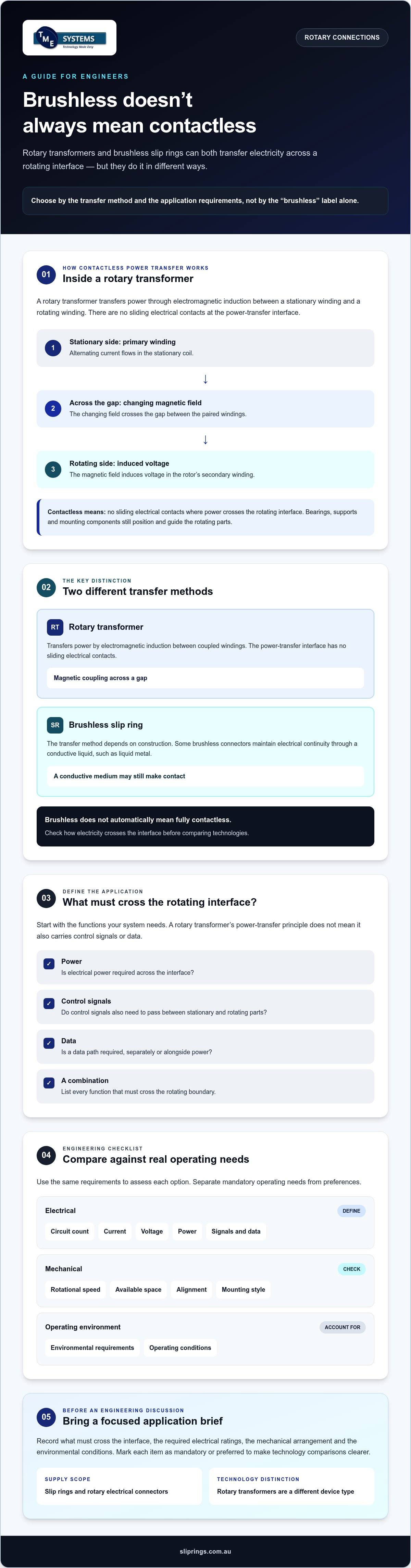
How to compare rotary transformer options with a practical engineering checklist
Use a documented process to compare rotary transformers with brushless slip rings Australia options. Start with the equipment’s function and operating conditions, then separate mandatory requirements from preferences. This avoids letting a technology label or a single feature drive the decision before its fit has been checked.
- 1. Define the function. State what the rotating assembly must do and what must cross the interface: power, control signals, data or a combination.
- 2. Record electrical requirements. Document voltage, current, circuit count and signal type. Note any required data performance, and confirm interface needs with the equipment designer.
- 3. Describe the mechanical arrangement. Record mounting method, shaft configuration, available space and rotational speed rating. Include relevant installation constraints.
- 4. Specify the operating environment. Note temperature, moisture, dust, contamination and other exposure that could affect operation. Identify any IP rating or thermal management requirements that need verification.
- 5. Separate requirements from preferences. Mark non-negotiable limits clearly, then list preferred attributes separately. Assess each candidate against the mandatory criteria first.
- 6. Track unknowns and verify evidence. List assumptions, manufacturer data still needed and system integration questions. Confirm candidate specifications against documentation for the particular design.
What information should an engineering comparison record?
Keep the comparison specific enough for another engineer to review. Include electrical loads and signal requirements, circuit count, mounting and shaft details, rotational speed rating, available space, environmental conditions and required data performance. If the interface must carry power and signals at the same time, record that explicitly.
How should engineers assess trade-offs?
Compare candidates against the same operating conditions and mandatory limits. Don’t assume a rotary transformer or slip ring is the universal winner. The better fit is the option whose verified specifications meet the application and integrate with the equipment as designed.
Consider thermal expansion if the documented design makes temperature-driven dimensional change relevant to alignment or clearances. Check thermal derating where current capacity must be assessed against operating temperature. Treat both as design-specific questions, not automatic concerns or assumed performance limits.
For related product selection, review Prosper Rotation slip rings. If your comparison includes a slip-ring requirement, prepare the checklist and ask TME Systems for technical application consulting to help assess the stated selection factors.
Plan the next step with Australian rotary connector application support
Once you’ve compared transfer methods, turn your findings into a concise application brief before requesting a technical discussion. TME Systems supplies industrial slip rings and rotary electrical connectors to customers across Australia, not rotary transformers. Its technical application consulting can help assess slip-ring requirements and relevant options using the information you provide.
What should you provide for an initial technical discussion?
Start with a plain-language description of the equipment and rotary interface. Explain what needs to pass between the stationary and rotating sides, such as power, control signals, data or a combination. Include drawings, existing specifications or other system documentation where available, so the requirements can be considered in context.
Record the known selection details:
- Electrical: circuit count, voltage, current and signal or data requirements.
- Mechanical: rotational speed, shaft arrangement, mounting style and available space.
- Environmental: operating temperature, moisture, dust, contamination and other relevant exposure.
- Open items: assumptions to check, interface questions and manufacturer specifications that still need confirmation.
Mark which requirements are mandatory and which are preferences. If a figure is unknown, identify it as an open question rather than estimating. This keeps the discussion focused on what can be confirmed and what information the equipment designer or manufacturer still needs to provide.
How can Australian buyers move from comparison to a reviewed requirement?
Use the brief to ask for technical assistance assessing relevant slip-ring options against the documented application. Confirm product specifications with the manufacturer’s documentation before treating a candidate as suitable. A technology label alone can’t establish compatibility with the required electrical, mechanical and environmental conditions.
If liquid metal technology is part of your comparison, the Mercotac rotary connector information provides a product reference to consider alongside the construction details and specifications relevant to your application. It isn’t a rotary transformer selection page and doesn’t confirm that a particular design meets your requirements.
For brushless slip rings Australia, a clear requirements brief gives the technical conversation a practical starting point. Contact TME Systems about your application to discuss your slip-ring requirements and the information you’ve prepared.
Brushless slip rings Australia: final selection checks
Before shortlisting a rotary connector, use the same checks for every candidate:
- Confirm the transfer method and what the interface needs to carry.
- Compare documented electrical ratings, mounting, speed and environmental suitability with the application requirements.
- List unknowns and verify them with the manufacturer or equipment designer before treating a product as suitable.
This process keeps the comparison focused on verified requirements rather than assumptions based on the “brushless” or “contactless” label.
Define your requirements before choosing a rotary connector
Contactless power transfer is a specific design approach, not a synonym for every brushless rotary connector. A rotary transformer transfers power through electromagnetic induction, while some brushless slip-ring designs maintain electrical continuity through a conductive medium. Start the comparison with the equipment’s actual operating requirements.
For brushless slip rings Australia, define what must cross the rotating interface, then document circuit count, current, voltage, speed, mounting style and environmental conditions. Check candidate specifications against manufacturer documentation, and separate mandatory limits from preferences before making a selection.
TME Systems supplies industrial slip rings and rotary electrical connectors to customers across Australia, not rotary transformers. Its technical assistance can help assess slip-ring requirements and relevant options using the application details you provide.
Prepare your equipment information and open technical questions, then discuss your rotary connector application with TME Systems. A clearly defined brief is a practical starting point for a focused engineering discussion and considered selection.
Frequently Asked Questions
Is a rotary transformer the same as a brushless slip ring?
No. A rotary transformer transfers power magnetically between windings, while “brushless slip ring” can describe different connector designs. Some brushless rotary connectors maintain electrical continuity through a conductive medium, so they aren’t necessarily contactless. When comparing brushless slip rings Australia options, check how each design transfers current and whether its documented specifications meet the application. The technology label alone doesn’t establish suitability.
Can a rotary transformer transfer data as well as power?
Not necessarily. A rotary transformer’s power-transfer function doesn’t confirm that it can also carry data or control signals. The design may need separate signal paths or another interface for those functions. Define the data type, required performance and whether data must operate at the same time as power. Then verify the proposed configuration against the manufacturer’s documentation and the equipment designer’s interface requirements.
What information is needed to compare rotary transformers and slip rings?
Start with what must cross the rotating interface: power, control signals, data or a combination. Record voltage, current, circuit count and signal requirements, then add rotational speed, mounting style, shaft arrangement, available space and environmental conditions. Mark mandatory limits separately from preferences. Use the equipment specification for required performance figures, and check candidate ratings against documentation for the specific design.
Does brushless mean a rotary connector has no electrical contacts?
No. “Brushless” means the design doesn’t use conventional sliding brushes, but it doesn’t specify how electrical continuity is achieved. liquid metal rotary connectors use conductive liquid metal as the electrical contact medium, so they’re brushless but not contactless. A rotary transformer, by contrast, transfers power through electromagnetic induction without sliding electrical contacts at that interface. Confirm the connector’s construction before comparing options.
When should I use technical application consulting for a rotary connector?
Seek technical application consulting when defining a slip-ring requirement or comparing options and you need to check how they fit the equipment. TME Systems supplies industrial slip rings and rotary electrical connectors across Australia, and its technical assistance can help assess circuit count, current, voltage, speed, mounting style and environmental requirements. Bring available drawings or specifications, and identify any figures or interface details that still need confirmation.
What does an IP rating tell me about a rotary connector?
An IP rating defines the level of protection against dust and water ingress for electrical equipment. Use the rating stated in the specific product documentation, then compare it with the conditions the connector will face. Don’t assume an IP rating covers every environmental requirement or confirms overall suitability. Temperature, contamination, mounting and other operating conditions may also need to be assessed against the manufacturer’s specifications.