A ROTOCON model label alone won’t tell you whether a rotary connector suits your machine. When assessing Rotocon slip rings Australia, start by matching the connector’s electrical and mechanical requirements to the equipment’s actual operating conditions.
Brushless construction may be a useful starting point, but it doesn’t settle the selection. Circuit count, current, voltage and rotational speed matter, as do mounting format, available space and exposure to dust, moisture or temperature changes. A single headline rating cannot describe the complete application.
This article explains where ROTOCON, Meridian Laboratory’s brushless rotary connector range, fits among industrial slip rings and what information to assemble before selecting a configuration. TME Systems supplies Meridian Laboratory slip rings to customers across Australia and provides technical application consulting to help match product requirements to rotating equipment.
Key Takeaways
- ROTOCON is Meridian Laboratory’s brushless rotary connector range, designed to transfer electrical power or signals between stationary and rotating equipment.
- Match circuit count, current, voltage and speed requirements to the machine’s operating conditions before narrowing down a configuration.
- Mounting format, available space and installation constraints help determine which rotary connector arrangement can fit the equipment.
- Prepare machine details and distinguish confirmed values from estimates or changing conditions to make an application review more precise.
- For Rotocon slip rings Australia, TME Systems supplies Meridian Laboratory slip rings and offers technical application consulting for industrial requirements.
What are ROTOCON slip rings in industrial systems?
ROTOCON is Meridian Laboratory’s range of brushless rotary electrical connectors. ROTOCON is the range name; a slip ring is the connector type. Its role in equipment is to maintain an electrical path between stationary wiring and a rotating assembly. The right configuration depends on the machine’s circuits and operating conditions, not the brand name alone.
A rotary connector solves a practical problem: wires crossing a rotating joint can twist or become constrained as the machine turns. A slip ring provides an interface between the fixed and rotating sides, allowing electrical power or signals to pass during operation. For a foundational overview, see What is a Slip Ring?
In a ROTOCON brushless design, conductive liquid metal bridges the stationary and rotating parts to maintain electrical continuity. Brushless describes the contact method: it does not rely on conventional sliding carbon brushes. That distinction alone does not establish whether a connector suits an application. The circuit requirements and machine conditions still need to be assessed.
How does a brushless rotary electrical connector work?
One side of the connector is fixed to the stationary structure; the other turns with the equipment. Conductive paths within the connector carry current across the rotating interface. Power circuits supply electrical energy, control circuits carry machine commands, and signal or data circuits transmit information. Because these functions have different electrical requirements, identify each circuit’s purpose when describing the application.
Circuit count, current, voltage and signal characteristics all affect selection. Don’t assume a connector suitable for power will also suit a sensitive signal or data path simply because both require electrical continuity. Consider each path in the context of the equipment. ROTOCON’s brushless construction describes how the connection is made, not the ratings or configuration required for a particular machine.
Where might ROTOCON fit in industrial equipment?
Rotating interfaces are used in applications such as wind turbines, water treatment equipment and industrial automation, where power or signals may need to pass to a rotating assembly. The task varies by machine: one may need to supply power to a rotating component, maintain control connections, or transfer signals without cables twisting with the movement.
These examples describe application contexts, not a claim that every ROTOCON format suits every machine. A wind turbine has different installation and operating conditions from an automated production system. The connector’s electrical paths must match the required circuits, and its physical arrangement must suit the machine interface. For Australian buyers considering Rotocon slip rings Australia, TME Systems supplies Meridian Laboratory slip rings and provides technical application consulting. Start by describing what must cross the rotating joint and how the connector fits into the equipment.
Which application requirements shape ROTOCON slip ring selection?
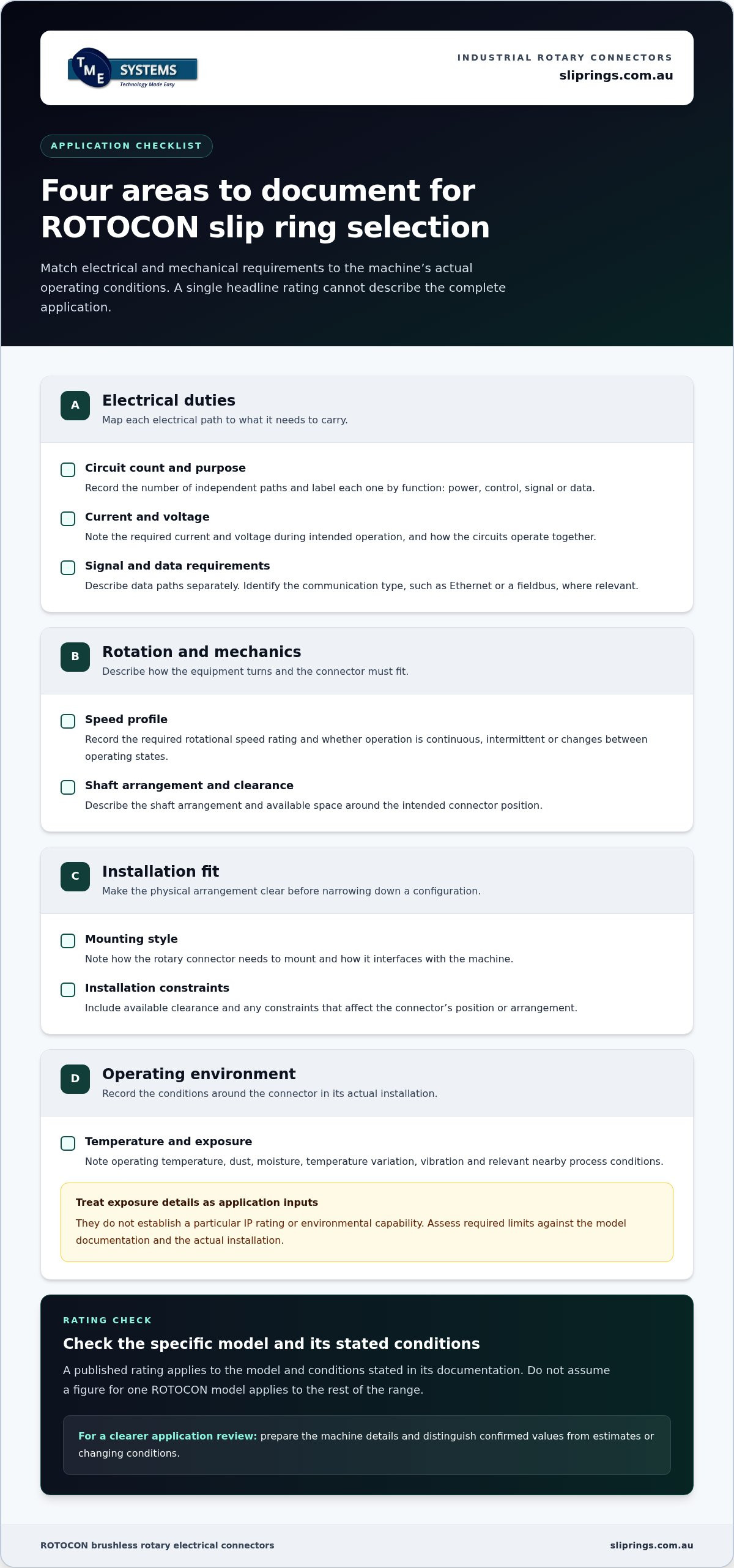
Start with the machine’s operating requirements, not a preferred format. For Rotocon slip rings Australia, organise the review around four areas: electrical duties, mechanical operation, environmental exposure and installation constraints. This makes missing information easier to spot and avoids relying on one headline rating to represent the whole application.
Assess a slip ring against the full application. A published rating applies to the model and conditions stated in its documentation. Don’t assume a figure for one ROTOCON model applies to the rest of the range. Use the relevant manufacturer documentation when assessing a configuration.
What electrical details should engineers gather?
Begin with the circuit count, the number of independent electrical paths for power and signal transmission. List each path by function, such as power, control or signal, and record its required current and voltage during intended operation. Note how the circuits operate together rather than treating each value as an isolated maximum.
Describe data paths separately. Record whether the application requires high‑speed data transmission, such as Ethernet or a fieldbus, and identify the communication type. This helps distinguish a power-transfer requirement from a signal-integrity requirement. Don’t assume that a connector suited to one circuit duty will automatically meet another.
How do speed, mounting and environment affect the choice?
Describe the expected rotation pattern, including the required rotational speed rating and whether the equipment runs continuously, intermittently or through changing operating states. Then record the shaft arrangement, available clearance and mounting style. These details show how the connector must integrate mechanically, as well as what it must transmit electrically.
Complete the picture with environmental information. Record relevant exposure, such as dust, moisture, temperature variation, vibration or nearby process conditions. Treat these as application inputs, not proof of a particular IP rating or environmental capability. Assess the required limits against the model documentation and actual installation.
Use this checklist to organise the review:
- Electrical: circuit count, circuit purpose, current, voltage and data protocol.
- Mechanical: speed profile, shaft arrangement, available space and mounting style.
- Environmental: operating temperature and relevant exposure conditions.
- Installation: connection access, orientation and nearby components that could affect fit or routing.
Separate fixed requirements from estimates and conditions that vary during operation. For example, label a measured shaft speed differently from an expected peak, and state whether environmental conditions remain constant or change across operating cycles. This gives application engineering a clearer basis for assessing the complete duty instead of relying on an uncertain assumption.
To relate these requirements to Meridian Laboratory’s range, explore Meridian Laboratory slip rings alongside the machine details before a technical discussion.
How should you compare ROTOCON formats with other rotary connector options?
Compare the connector with the machine interface before comparing model names. Review mounting, available space, circuit needs, operating conditions and integration constraints. This keeps physical format separate from electrical duty and helps determine whether a candidate suits both the equipment layout and its operating requirements.
| Comparison point | Questions for the application |
|---|---|
| Mounting | Does the assembly need to fit over a shaft, or is end-of-shaft mounting practical? |
| Space | What clearance is available around the rotating interface? |
| Circuit needs | Which power, control, signal or data paths must cross the joint? |
| Operating conditions | What speed and environmental exposure apply during operation? |
| Integration | Must the connector share space with a shaft or auxiliary components? |
When might a through-bore or capsule format suit the machine?
A through-bore slip ring has a hollow centre, allowing it to mount over a rotating shaft or accommodate auxiliary components such as hydraulic lines. It may suit a layout where the shaft passes through the connector or the centre needs to remain available for other equipment.
Through-bore vs capsule slip rings is a comparison of installation formats. A capsule slip ring is a compact, solid unit for end-of-shaft mounting where the machine layout allows it. Neither format is right for every machine. Compare the available space and mounting arrangement with the dimensions and performance specifications of the particular model.
When should a different rotary connector technology be considered?
Compare technologies against the required electrical transfer and the machine’s mechanical and environmental conditions. The distinction in collector ring vs slip ring is useful: collector rings are heavy-duty rotary connectors designed for high current capacity, while standard slip rings are typically optimised for signal integrity and lower currents. Let the circuit duty, not terminology alone, guide the comparison.
Liquid metal rotary connectors are another technology to consider alongside ROTOCON, not a synonym for the range. Compare product documentation and application requirements, including circuit duties and mounting constraints, before narrowing the options.
For Rotocon slip rings Australia, a structured comparison helps clarify which requirements are fixed and which depend on the installation. Where a liquid-metal contact approach is part of the decision, the Mercotac slip ring range offers another technology to consider alongside the machine’s requirements. Suitability depends on matching the application to the relevant product specifications.
What should you prepare before a ROTOCON application review?
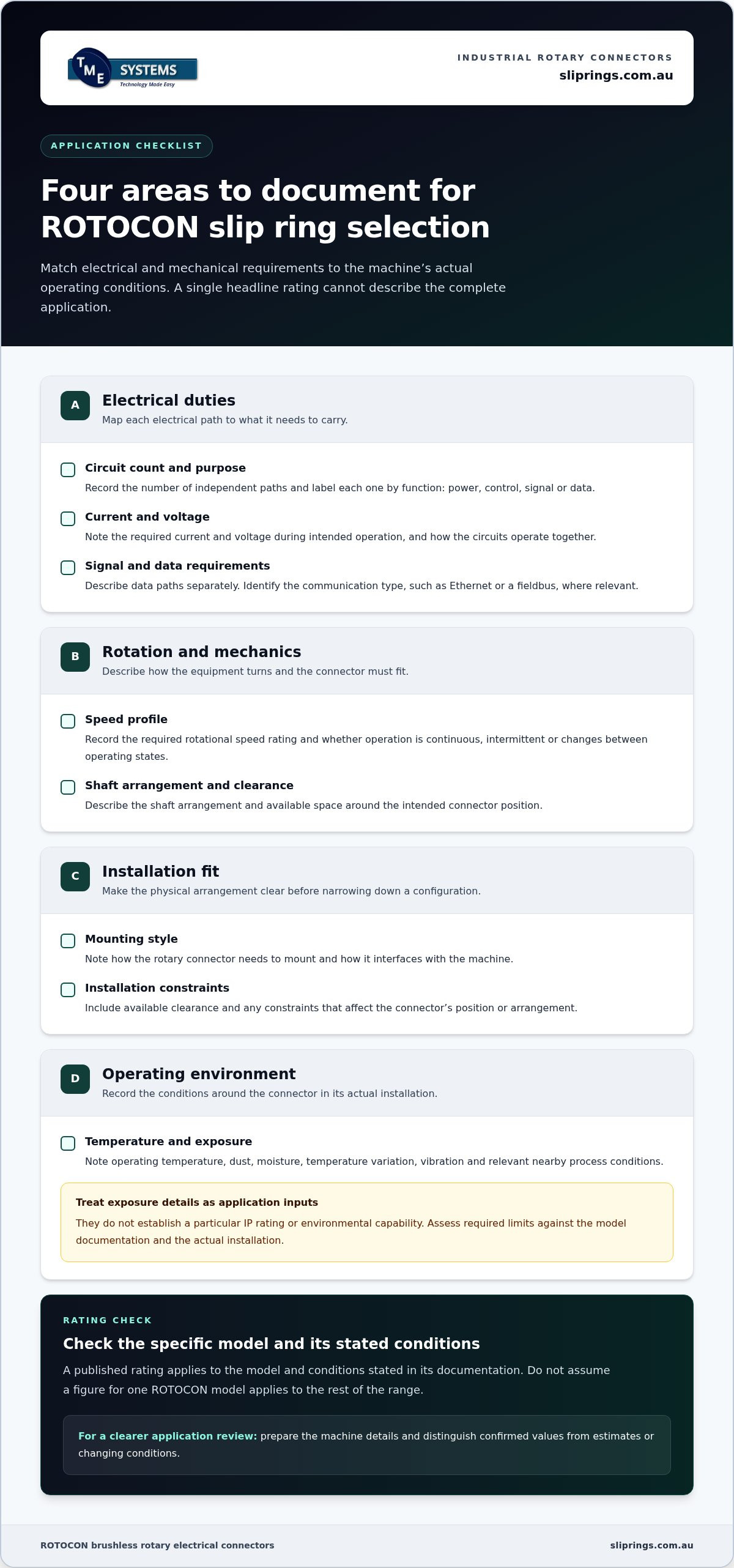
A well-organised application brief turns machine requirements into a focused technical discussion. For Rotocon slip rings Australia, gather information in sequence: describe the equipment, define the electrical circuits, record operating conditions, then document installation constraints. Mark each value as specified, measured, estimated or variable so assumptions aren’t mistaken for design requirements.
What information belongs in an application brief?
Start with the equipment’s function and rotating interface. Describe what turns, how the assembly operates and which electrical paths must cross the joint. Give enough context to explain the connector’s role in the machine, rather than presenting ratings without describing how the equipment is used.
- Describe the machine: note its function, rotation pattern and the location of the rotary interface.
- Define the circuits: record circuit count, each circuit’s power, control or signal purpose, required current and voltage, and any data protocols.
- Record operating conditions: state the required rotational speed rating, whether operation is continuous or intermittent, and relevant environmental exposure.
- Document installation constraints: include shaft arrangement, available space, mounting requirements, cable or connection access, and nearby components.
Separate firm requirements from estimates. Distinguish a specified operating speed from an expected peak, for example, and identify temperatures or loads that vary during a duty cycle. A variable condition may affect selection even when the typical operating value appears suitable. Where available, include the source of key values, such as a machine drawing, measurement or project specification.
Consider current and temperature together where relevant. Thermal management means controlling temperature rise during operation. If ambient or operating temperature affects allowable current, thermal derating, the reduction of allowable current as temperature rises, may need to be considered against the applicable product documentation. Don’t infer a suitable model from current alone.
How can technical review reduce selection ambiguity?
TME Systems’ technical application consulting considers circuit count, current, voltage, speed, mounting style and environmental requirements. Application engineering uses these details to relate the machine’s operating demands to suitable hardware and identify gaps or conditions that need clarification. This is more useful than selecting from a model label without checking the relevant specifications.
A specific ROTOCON model should not be recommended from incomplete application information. Assess model ratings and limits against the relevant manufacturer documentation and the conditions described in the brief. A clear record of what is known, estimated and variable helps keep the review grounded in the machine’s requirements.
Prepare your equipment details for technical application consulting to support a more precise rotary connector selection.
How can Australian buyers source ROTOCON slip rings with technical support?
A ROTOCON enquiry is most useful when it connects the connector decision to the equipment design and project documentation. TME Systems supplies Meridian Laboratory products, including ROTOCON, and provides technical application consulting to Australian industrial customers. The Meridian Laboratory slip rings page provides product context for the discussion.
What does an Australian ROTOCON supply enquiry involve?
Use the application brief as a design handoff. Include the machine context and any drawings that clarify the rotary interface, and note the document revision so everyone refers to the same design. Identify which details are approved requirements and which remain provisional. This helps distinguish firm selection constraints from open design decisions.
State the project stage and the decision the team needs to make, such as assessing physical fit or progressing a specification. If the design is still changing, flag the affected interfaces rather than presenting provisional dimensions as final. This gives the discussion a practical focus without treating an estimate as a settled requirement.
How does technical support connect product choice to the application?
Technical support connects product documentation to the intended equipment use. Keep the selection record with the project documents, noting the configuration considered and the assumptions behind it. This gives engineering and procurement teams a shared reference as the design develops and helps maintain continuity if the machine interface or project requirements change.
Use an Australian slip ring procurement guide alongside product information when planning how selection fits into procurement. This helps keep technical fit and purchasing decisions connected, rather than relying on a product name alone.
To progress your project, share the ROTOCON application brief with TME Systems and discuss your equipment requirements.
Move from requirements to a considered selection
A rotary connector decision can become a useful reference as a machine moves from design into procurement. Aligning the chosen configuration with the project’s engineering records helps keep the equipment specification coherent as the build progresses.
For Rotocon slip rings Australia projects, TME Systems supplies Meridian Laboratory products and provides technical application consulting. A focused discussion can help move the project from research towards a considered product decision.
Discuss your ROTOCON application with TME Systems and take the next step with a clear brief.
Frequently Asked Questions
What is a ROTOCON slip ring?
A ROTOCON slip ring is a rotary electrical connector in Meridian Laboratory’s ROTOCON range. ROTOCON identifies the range, while slip ring describes the connector’s role in transferring electricity across a rotating interface. In a machine design, it may form part of a rotary joint or assembly. Selection depends on the required electrical function and how the connector must fit the equipment.
Is ROTOCON a brushless rotary electrical connector?
Yes. ROTOCON is Meridian Laboratory’s brushless rotary connector range. Brushless refers to the contact approach, not a particular mounting format or rating. It describes how continuity is maintained, but does not establish whether a unit suits a specific duty. Assess the application requirements against the applicable model documentation.
Can ROTOCON slip rings transmit both power and data?
ROTOCON configurations may be considered for power and data transmission, but the specific model and circuit arrangement determine suitability. A machine, for example, may need to supply electrical power to a rotating assembly and maintain a data connection for monitoring or control. Identify the data protocol and electrical conditions, then compare them with the relevant manufacturer specifications rather than assuming every configuration supports both.
How do I choose between a through-bore and capsule slip ring?
Choose based on the machine’s physical layout. A through-bore format has a hollow centre to accommodate a shaft or auxiliary components passing through it. A capsule format is a solid unit for end-of-shaft mounting where the assembly allows. Compare mounting direction, available clearance and interface dimensions with each model’s specifications. The format alone does not indicate electrical suitability.
What information is needed to select a ROTOCON slip ring?
Prepare the machine context as well as the electrical details. Include a drawing or description of the rotating interface, the required power and signal functions, operating conditions, and mounting or access constraints. Label any value that is estimated or varies during operation. This helps the technical review distinguish design limits from assumptions and identify details that need closer assessment.
Does a ROTOCON slip ring need routine maintenance?
Maintenance requirements depend on the specific model and its operating conditions, so don’t assume a brushless design is maintenance-free. Follow the manufacturer’s documentation for the selected configuration and consider the equipment’s duty and environment when planning inspection or servicing. If the connector is part of a larger machine maintenance programme, include its documentation and installation details in the programme’s technical records.
Can a ROTOCON slip ring be customised for an industrial application?
Application requirements can be reviewed against suitable ROTOCON configurations, with the model’s documented limits guiding selection. An installation with an unusual shaft arrangement or a combination of circuit functions, for example, needs its mechanical and electrical requirements considered together. Technical application consulting helps relate those requirements to suitable hardware. Keep configuration decisions grounded in product specifications and the machine’s actual operating conditions.
Where can Australian businesses source ROTOCON slip rings?
Australian businesses can source ROTOCON-related products and technical selection support through TME Systems, which distributes Meridian Laboratory slip rings to customers across Australia. For Rotocon slip rings Australia enquiries, prepare the equipment details and circuit requirements for a focused technical discussion. This connects the product range to the intended installation and gives engineering and procurement teams a clearer basis for assessing the appropriate configuration.