The most durable rotating electrical joint on paper might actually be the wrong choice for your machinery. When evaluating Schleifring vs Mercotac technologies, engineers face a fundamental trade-off between versatile mechanical contact slip rings and sealed liquid metal rotary connectors. Specifying the wrong interface often results in contact chatter degrading sensitive fieldbus signals, unexpected thermal expansion issues, or excessive maintenance downtime caused by inspecting and replacing worn brush assemblies.
If you have dealt with intermittent electrical noise corrupting high-speed data transmission or the constant overhead of routine servicing, you know how quickly microvolt fluctuations halt automated production. This guide evaluates mechanical contacts against liquid metal technology across signal integrity, rotational speed rating limits, and operating life so you can select the correct rotating joint. We outline the critical engineering trade-offs, wiring considerations under AS/NZS 3000:2018, and a straightforward selection framework to match your plant operating conditions.
Key Takeaways
- Resolve the Schleifring vs Mercotac debate by evaluating how sealed liquid metal pools eliminate contact chatter compared to traditional sliding brush assemblies.
- Discover which rotary joint design protects sensitive instrumentation and strain gauge data from microvolt signal distortion.
- Identify critical mechanical constraints, including when a through-bore slip ring is required and how liquid metal containment affects shaft orientation.
- Apply a structured selection framework to balance rotational speed rating limits, circuit count, and AS/NZS 3000:2018 installation requirements.
Understanding the Core Technologies: Mechanical Slip Rings vs Liquid Metal Rotary Connectors
Selecting rotating electrical interfaces requires a precise look at how current bridges a moving boundary. In industrial automation, the engineering decision often centres on mechanical slip rings versus liquid metal rotary connectors. While terms like "Schleifring" (the German descriptor for collector rings, as well as a prominent manufacturer) represent classic sliding electro-mechanical assemblies, units from brands like Mercotac slip rings employ a fundamentally different physical mechanism based on fluid conduction.
The core differences in how these technologies operate shape their operational life and maintenance demands across Australian processing plants:
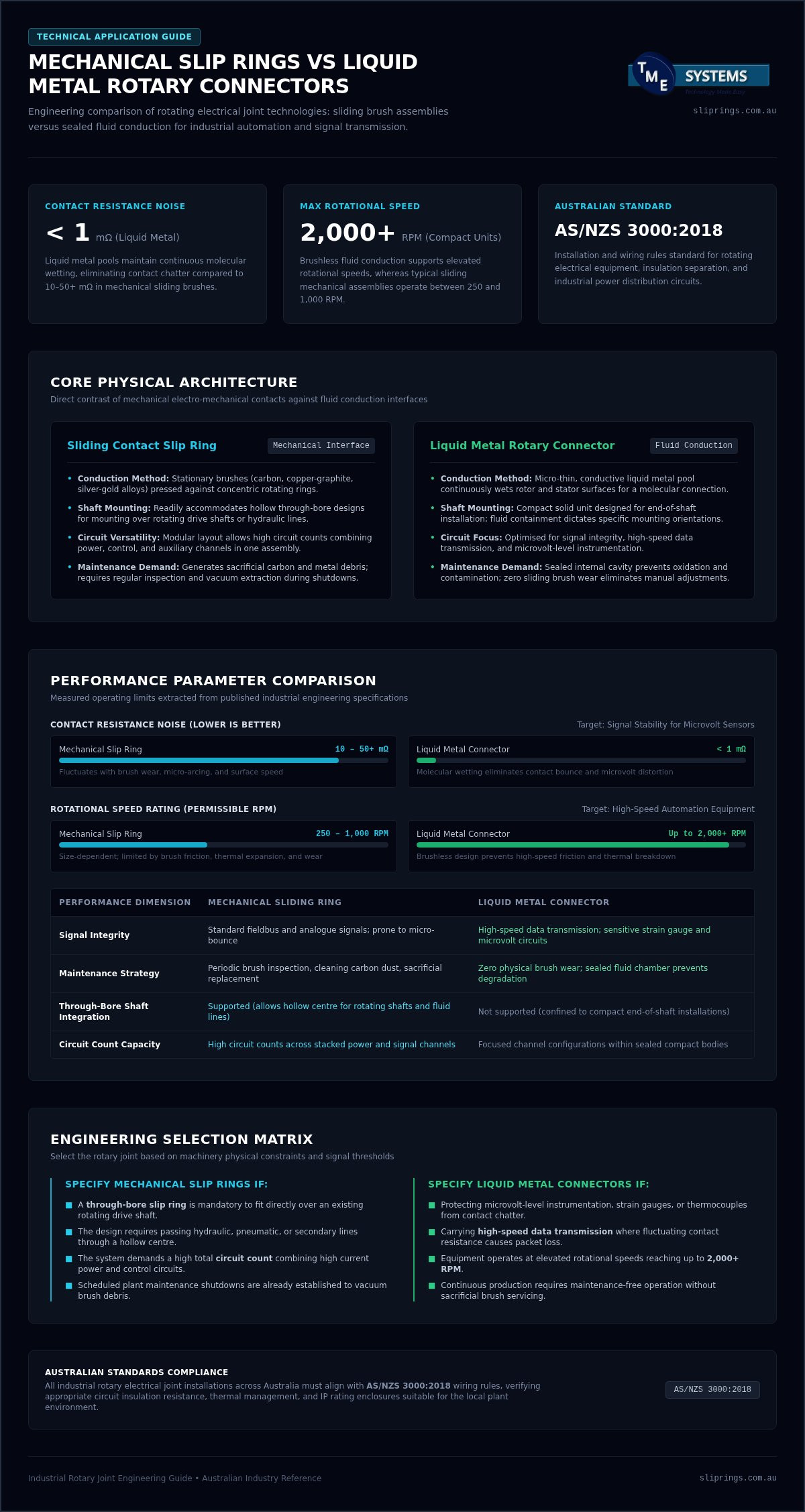
- Sliding Contact Systems: Rely on stationary conductive brushes sprung against rotating metallic rings, forming an electro-mechanical interface subject to continuous friction.
- Liquid Metal Systems: Replace solid mechanical contacts with a sealed pool of conductive liquid metal, creating a continuous molecular connection without sliding friction.
- Maintenance Overhead: Mechanical assemblies generate sacrificial brush debris that requires scheduled extraction, whereas sealed brushless units operate without physical brush replacement.
Understanding the distinction in Schleifring vs Mercotac architectures prevents mismatching component physics to demanding rotational duties.
Operating Principles of Sliding Contact Slip Rings
Conventional slip rings maintain continuity through physical pressure. Stationary brushes composed of carbon, copper-graphite, or silver-gold alloys press directly onto concentric copper or gold-plated rings. This friction generates microscopic wear particles over millions of cycles. In enclosed industrial assemblies, conductive carbon dust accumulates between rings, reducing insulation resistance unless vacuumed during preventative shutdowns. However, this mechanical architecture offers unmatched configuration freedom. It accommodates a high circuit count across power, control, and sensory channels within a single housing, and readily adapts to hollow through-bore shafts.
How Mercotac Liquid Metal Connectors Maintain Continuity
Liquid metal rotary connectors eliminate friction points entirely. Electrical current flows through a micro-thin, conductive liquid metal pool sealed inside a compact housing. Because fluid constantly wets the rotating contact surfaces, the connection forms a stable molecular path. This brushless design prevents mechanical wear, eliminates contact bounce, and stops the micro-arcing typical of dry sliding contacts. The sealed internal cavity protects the fluid from ambient oxidation and contaminants, maintaining consistent contact resistance below 1 milliohm without manual brush adjustments. As a result, the Schleifring vs Mercotac comparison highlights a balance between mechanical versatility and maintenance-free fluid reliability.
Performance Comparison: Signal Integrity, Electrical Noise, and Speed Limits
Signal corruption in rotating machinery typically traces back to dynamic contact resistance. When evaluating Schleifring vs Mercotac units for precision automation, electrical noise separates mechanical sliding surfaces from fluid conduction. Standard mechanical assemblies experience micro-bounces and microscopic surface imperfections, causing contact resistance to fluctuate by tens of milliohms during rotation. Conversely, patented formulations for Liquid Metal Rotary Connectors maintain continuous molecular wetting across the rotor and stator, holding resistance variation below 1 milliohm even under continuous operation.
| Performance Metric | Mechanical Slip Ring | Liquid Metal Connector |
|---|---|---|
| Contact Resistance Noise | 10 to 50+ mΩ (fluctuates with brush wear) | < 1 mΩ (exceptionally stable) |
| Rotational Speed Rating | Typically 250 to 1,000 RPM (size dependent) | Up to 2,000+ RPM (compact models) |
| Data Signal Compatibility | Standard fieldbus, analog signals | High-speed data, microvolt sensors |
| Service Life Expectancy | Brush replacement at scheduled intervals | Exceeds 100 million revolutions |
Electrical Noise and Contact Resistance Stability
Mechanical brush bounce generates high-frequency electrical noise that distorts sensitive microvolt measurements. Thermocouple readings drift, strain gauges pick up artificial spikes, and industrial Ethernet packets drop when sliding brushes hit micro-imperfections. Because liquid metal rotary connectors provide an uninterrupted fluid channel, resistance stays practically flat. This makes fluid contacts ideal for sensitive PLCs, high-definition video lines, and high-speed data transmission where packet retransmissions cannot be tolerated.
Rotational Speed Ratings and Thermal Management
Rotational velocity directly affects heat generation and contact stability. At elevated RPM, mechanical slip rings suffer from accelerated brush lift, vibration chatter, and friction-induced heating. Liquid metal units operate smoothly at higher rotational speed rating thresholds because fluid film shear generates minimal acoustic vibration. However, careful thermal management remains necessary. Fluid viscous shear creates internal heat at high speeds, and running equipment in hot enclosures demands thermal derating to prevent thermal expansion from straining internal seals. If you are balancing complex thermal envelopes or high-speed data channels, reviewing parameters with our technical application consulting team helps verify component operating envelopes before installation.
Mechanical Integration and Physical Design Constraints
Physical mounting dictates whether a rotary joint operates reliably or fails prematurely. When weighing Schleifring vs Mercotac hardware, mechanical packaging often settles the debate before electrical specifications come into play. A traditional sliding assembly offers broad installation versatility across multiple planes, whereas liquid metal devices impose strict physical rules to preserve fluid containment.
Neither connector type should ever serve as a mechanical support bearing. Subjecting either unit to external radial runout or thrust loads damages internal seals and induces rapid contact failure. To prevent housing strain, installations must isolate the body using floating anti-rotation torque restraints rather than rigid bolted brackets. Wiring terminations must follow AS/NZS 3000:2018 guidelines, ensuring flexible leads are properly secured to prevent tension or vibration from pulling against internal terminals.
Mounting Orientation and Housing Form Factors
Liquid metal rotary connectors rely on gravity and precision internal seals to retain their fluid pools. Standard models require vertical installation with the body pointing down. Operating these units horizontally demands specialised factory seals, and inverted mounting is strictly prohibited to avoid internal pool shorting. Conversely, mechanical units present no orientation penalties. They function upright, inverted, or horizontally without risk.
Hollow drive shafts represent another critical dividing line. Liquid metal units exclusively feature compact, end-of-shaft capsule configurations. When an application requires routing pneumatic lines, hydraulic hoses, or drive shafts straight through the rotational centre, a through-bore slip ring is mandatory. In comparing through-bore vs capsule slip rings, mechanical platforms accommodate central bores up to several hundred millimetres, simplifying complex machine layouts.
Circuit Count and Channel Density Trade-offs
Channel density marks another clear distinction in the Schleifring vs Mercotac comparison. Fluid units focus on high signal purity across modest channel paths. For applications requiring 1 to 8 clean channels, investigating specialised Mercotac slip rings provides an ultra-compact footprint with zero maintenance overhead.
Complex automation cells, however, frequently require dozen of electrical pathways. Mechanical sliding assemblies scale easily into large multi-tier stacks:
- Modular System Integration: Stacking separate power rings alongside shielded signal tracks inside one enclosure.
- Mixed Current Capabilities: Carrying 240V/415V utility feeds, safety interlocks, and sensor buses simultaneously.
- High Circuit Count: Supporting 24 to 50+ isolated pathways within a single assembly.
If your machinery demands high circuit density alongside central shaft access, mechanical assemblies remain the practical solution.
Application Suitability: Selecting the Correct Rotating Connection
Every industrial production environment imposes unique mechanical stress, rotational profiles, and cleanliness demands. Resolving the Schleifring vs Mercotac choice requires aligning these variables against the operating limits of each technology. While fluid conduction excels in high-speed, vibration-isolated signal tracking, mechanical assemblies withstand the physical punishment typical of heavy industrial processing.
Ideal Operating Scenarios for Mercotac Connectors
Continuous rotation at high velocities quickly degrades traditional sliding brushes. In automated packaging machinery, heated roll laminators, and high-speed rotary indexing tables, replacing worn brushes causes expensive production halts. Liquid metal rotary connectors deliver clean, uninterrupted continuity across millions of revolutions without manual servicing. They also provide the microvolt stability needed on sensitive test rigs, where strain gauges and thermocouple channels cannot tolerate dynamic contact chatter.
When Mechanical Slip Rings Remain the Superior Solution
Mechanical slip rings dominate when installations demand raw current handling, hollow-shaft integration, or severe mechanical resilience. Heavy crane slewing drives, industrial winches, and multi-tier carousels require substantial power transmission alongside dozens of auxiliary control lines. In wet or dusty environments where enclosure sealing is critical, industrial assemblies such as BGB Innovation slip rings provide the IP rating and physical durability needed to operate continuously under harsh operating conditions.
Environmental, Safety, and Compliance Considerations
Operational regulations heavily influence rotary joint selection across Australian facilities. Under the Minamata Convention and national chemical management standards listed on the IChEMS Register, mercury-containing devices face strict restrictions in food, pharmaceutical, and cleanroom manufacturing. In these sectors, engineering teams must specify mercury-free liquid metal designs using gallium-based alloys or rely on gold-on-gold mechanical contacts. Installations in heavy industry and mining must also align with AS/NZS 3000:2018 wiring rules and mining equipment requirements under AS/NZS 5368:2025. For tailored application engineering and regulatory validation across your plant, request technical application consulting to review your machinery specifications before procurement.
Engineering Selection Framework: How to Specify Your Rotary Joint
Specifying an industrial rotary electrical joint demands a structured engineering audit. Rushing component selection without validating operational limits leads to rapid brush degradation, signal dropout, or containment failure. When assessing Schleifring vs Mercotac designs, applying a systematic four-step selection framework ensures the chosen hardware matches your mechanical envelope and duty cycle:
- Step 1: Electrical Audit: Quantify continuous current, surge peaks, operating voltage, circuit count, and data protocols to separate power circuits from sensitive signal lines.
- Step 2: Mechanical Envelope: Establish rotational speed rating, shaft dimensions, mounting orientation, and whether a central hollow passage is needed.
- Step 3: Environmental Evaluation: Check ambient operating temperatures, vibration frequency, chemical exposure, and required IP rating for dust and moisture protection.
- Step 4: Application Validation: Coordinate with technical specialists to verify contact longevity, thermal dissipation, and compliance with local electrical codes.
Defining Electrical, Mechanical, and Thermal Parameters
Quantifying boundary conditions upfront avoids premature failure. Start by reviewing peak rotational velocity and duty cycle. While liquid metal units excel at speeds over 1,500 RPM, high ambient operating temperatures require careful thermal derating. Heat from high current draw combines with rotational friction, raising internal temperatures and risking thermal expansion across seals or contact tracks.
Next, define the spatial envelope. Compact end-of-shaft capsule joints suit space-restricted installations where only a few signal paths are required. Conversely, complex automation cells needing pneumatics or high circuit counts benefit from versatile mechanical units like Prosper Rotation slip rings, which offer hollow through-bore mounting to accommodate structural shafts.
Collaborating with Technical Specialists for Final Verification
Selecting rotary joints involves navigating trade-offs between zero-maintenance liquid metal continuity and the multi-channel capacity of mechanical contacts. Reviewing dynamic operating factors before finalizing drawings prevents costly plant modifications. When standard catalogue hardware cannot accommodate unique mounting tolerances or mixed power channels, engineering teams often require custom configurations tailored to specific plant footprints. To verify rotational ratings, review thermal limits, or discuss custom configurations, consult the engineering team via TME Systems technical support for an impartial technical review.
Selecting the Right Rotary Joint for Long-Term Reliability
Choosing between sliding contact assemblies and fluid conduction comes down to the operational demands of your machinery. While resolving the schleifring vs mercotac decision requires balancing noise immunity against mechanical envelope constraints, neither technology is a universal fit. Liquid metal rotary connectors deliver near-zero contact resistance for sensitive data and high-speed shafts. Conversely, multi-channel mechanical slip rings provide the physical routing freedom and current capacity required for heavy industrial machinery.
Getting this specification right from the start protects your plant from costly downtime and signal dropouts. As an authorised Australian distributor for Mercotac, Meridian Laboratory, BGB Innovation, and Prosper Rotation, TME Systems brings decades of engineering experience to your equipment design. Our team provides dedicated technical application consulting to help verify rotational speed limits, thermal envelopes, and mounting geometries against your exact operating parameters. When you are ready to finalise your rotating interface, consult TME Systems for expert rotary connector selection to ensure dependable performance across every revolution.
Frequently Asked Questions
What is the main functional difference between a conventional slip ring and a Mercotac connector?
The main functional difference lies in the contact medium used to conduct electricity across the rotating joint. Conventional slip rings use solid graphite or precious metal brushes sliding against metallic rings, creating mechanical friction. In contrast, Mercotac connectors use a sealed pool of conductive liquid metal. This fluid interface maintains an uninterrupted molecular connection without mechanical wear, separating the two technologies in the schleifring vs mercotac engineering choice.
Can a Mercotac liquid metal rotary connector be mounted in any orientation?
No, standard Mercotac liquid metal connectors cannot be mounted in any arbitrary position. Because they rely on internal fluid pools, standard models must be installed vertically with the body pointing down to prevent fluid displacement. Specific horizontal models exist with specialised internal barriers, but upside-down mounting is prohibited. Conventional mechanical slip rings operate reliably in vertical, horizontal, or inverted orientations without fluid containment risks.
How does electrical noise compare between mechanical slip rings and liquid metal connectors?
Liquid metal connectors produce substantially lower electrical noise than mechanical slip rings. Mechanical units generate resistance fluctuations between 10 and 50 milliohms due to brush bounce, vibration, and surface roughness. Liquid metal connectors keep dynamic resistance variation below 1 milliohm. This negligible noise floor prevents signal attenuation, making fluid interfaces the preferred option for microvolt sensor circuits, thermocouples, and sensitive instrumentation.
Are liquid metal rotary connectors permitted in all industrial manufacturing facilities?
No, liquid metal connectors face regulatory limits in specific industrial sectors. Devices containing mercury are restricted in food processing, pharmaceutical production, and cleanroom environments under the Minamata Convention and national IChEMS chemical standards. Facilities operating under these restrictions must specify mercury-free liquid metal connectors that use non-toxic gallium alloys, or implement sealed mechanical slip rings to comply with health, safety, and AS/NZS 3000:2018 installation requirements.
How many electrical circuits can a single Mercotac unit accommodate compared to a slip ring?
Mercotac connectors typically support a modest circuit count ranging from 1 to 8 distinct electrical pathways. Their compact housing design focuses on signal purity and space efficiency rather than channel density. Mechanical slip rings scale into modular stacks that readily support 20 to 50 or more channels. This high capacity allows mechanical units to carry complex combinations of 415V power lines, safety circuits, and control signals.
What maintenance is required for conventional slip rings versus brushless rotary connectors?
Conventional slip rings require scheduled preventative maintenance to inspect brush wear, adjust spring tension, and vacuum conductive brush dust from the housing. Failure to service brushes can cause dielectric breakdown or ring scoring. Brushless liquid metal connectors eliminate sliding friction entirely. They require zero contact maintenance or adjustments over their lifespan, providing an operational life exceeding 100 million revolutions when operated within specified electrical and thermal limits.
Can traditional mechanical slip rings transmit high-speed industrial data signals without loss?
Yes, mechanical slip rings can transmit high-speed industrial data, provided they are engineered with precious-metal contacts and internal shielding. Gold-on-gold contact pairings minimise resistance noise sufficiently for protocols like Ethernet, Profinet, and CANbus. When deciding between schleifring vs mercotac hardware for data links, mechanical units excel when high-speed protocols must run alongside high-current power channels within a single hollow-shaft assembly.
How do operating rotational speeds influence the choice between slip rings and Mercotac units?
Rotational speed directly impacts contact friction, thermal rise, and electrical stability. Standard mechanical slip rings generally operate between 250 and 1,000 RPM, as higher speeds cause brush bounce, contact chatter, and rapid brush erosion. Mercotac liquid metal units operate effectively at speeds up to 2,000 RPM or higher because fluid contact eliminates mechanical chatter, though proper thermal management is required to dissipate viscous shear heat at high velocities.