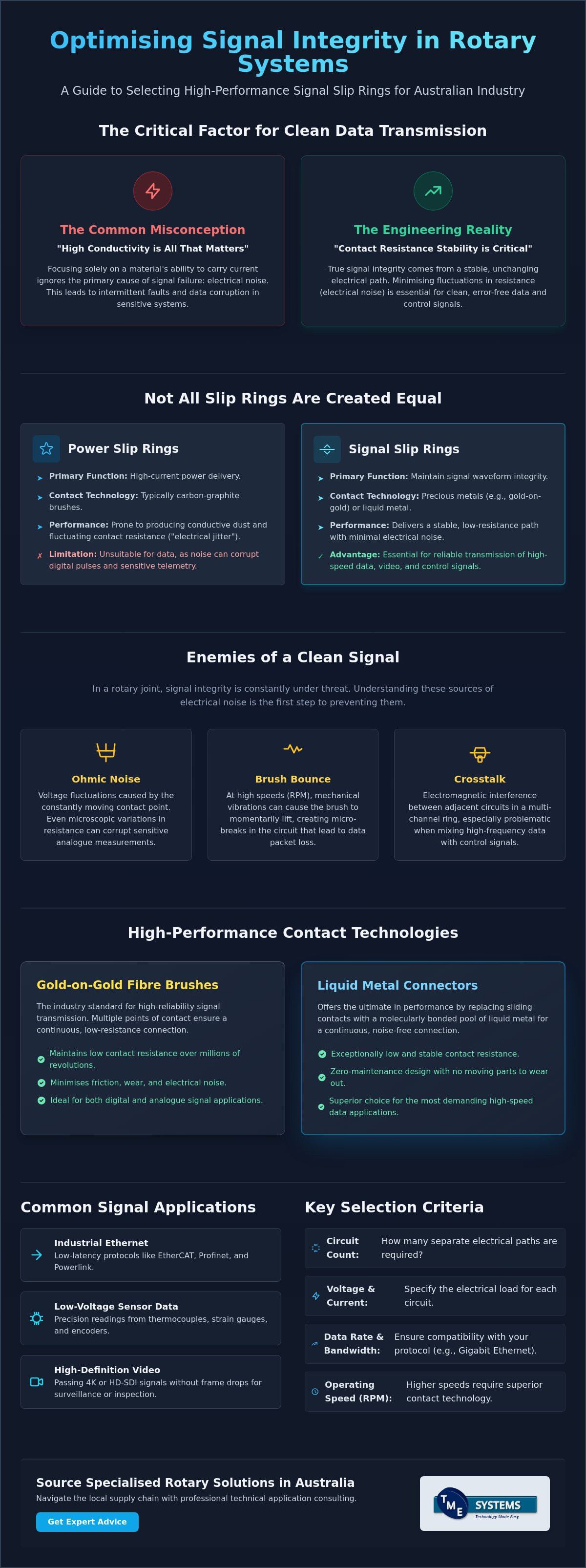
High conductivity is often mistaken for the most critical metric in rotary joint performance, yet true signal integrity is actually a function of contact resistance stability. When your high-speed equipment suffers from signal degradation or frequent telemetry interference, the culprit is rarely the material's capacity to carry current. Instead, it's the fluctuating electrical noise generated at the interface. Finding a high-performance signal slip ring requires moving beyond basic conductivity and focusing on the precision of the contact technology to ensure data remains clean and actionable.
You likely understand the frustration of routine maintenance cycles caused by traditional carbon brushes that simply cannot keep up with modern data requirements. This article provides the technical framework to help you specify and select components that ensure noise-free data and control transmission in Australian industrial environments. We will clarify the functional distinctions between power and signal rings, discuss the benefits of gold-on-gold contacts for low-current circuits, and provide a pathway to sourcing reliable hardware from established distributors like Mercotac or Meridian Laboratory. By the end of this guide, you'll have the criteria needed to optimise your rotary systems for long-term reliability.
Key Takeaways
- Understand why a signal slip ring is essential for maintaining data integrity in high-speed rotary systems by minimising dynamic contact resistance.
- Identify the technical causes of electrical noise in rotating joints and how to specify components that prevent telemetry degradation.
- Evaluate the performance advantages of gold-on-gold fibre brushes and liquid metal connectors for low-maintenance, high-reliability applications.
- Learn to calculate the necessary circuit count and bandwidth requirements to ensure compatibility with modern industrial protocols like Gigabit Ethernet.
- Discover how to navigate the Australian supply chain to source specialised rotary solutions through professional technical application consulting.
What is a Signal Slip Ring and Why is it Critical?
A signal slip ring is a specialised rotary interface designed to transfer low-voltage data and control signals between a stationary platform and a rotating structure. While the basic concept of What is a Slip Ring? applies to any device that maintains an electrical connection through rotation, the signal variant focuses on maintaining waveform integrity rather than just raw current delivery. In Australia's growing robotics and automation sectors, these components serve as the vital link that allows sensors, cameras, and controllers to communicate without interruption.
Standard power rings often fail to meet the stringent signal-to-noise requirements of modern digital systems. They typically use carbon-graphite brushes that produce conductive dust and fluctuating contact resistance. While a few milliohms of "jitter" won't affect a heavy-duty motor, it can easily corrupt a 5V digital pulse or a high-speed data packet. A dedicated signal slip ring solves this by using precious metal contacts that ensure a stable, low-resistance path. This prevents data loss or system errors in sensitive telemetry applications. Precision is the priority.
The Anatomy of a High-Performance Signal Ring
Reliable data transmission depends on the physical precision of the internal components. High-performance rings feature precision-machined tracks and specialised brush interfaces, often using gold-on-gold technology to minimise friction and wear. This gold-on-gold approach is widely regarded for its ability to maintain low contact resistance over millions of revolutions. Effective shielding is also integrated to block electromagnetic interference (EMI) from nearby high-voltage lines. Many designs, such as those found in Mercotac Slip Rings, use liquid metal or compact housing to ensure the assembly fits into restricted spaces like robotic joints or gimbal centres.
Common Signal Types Transmitted
Engineers must ensure the chosen hardware supports the specific bandwidth of their application. These components are frequently used to transmit:
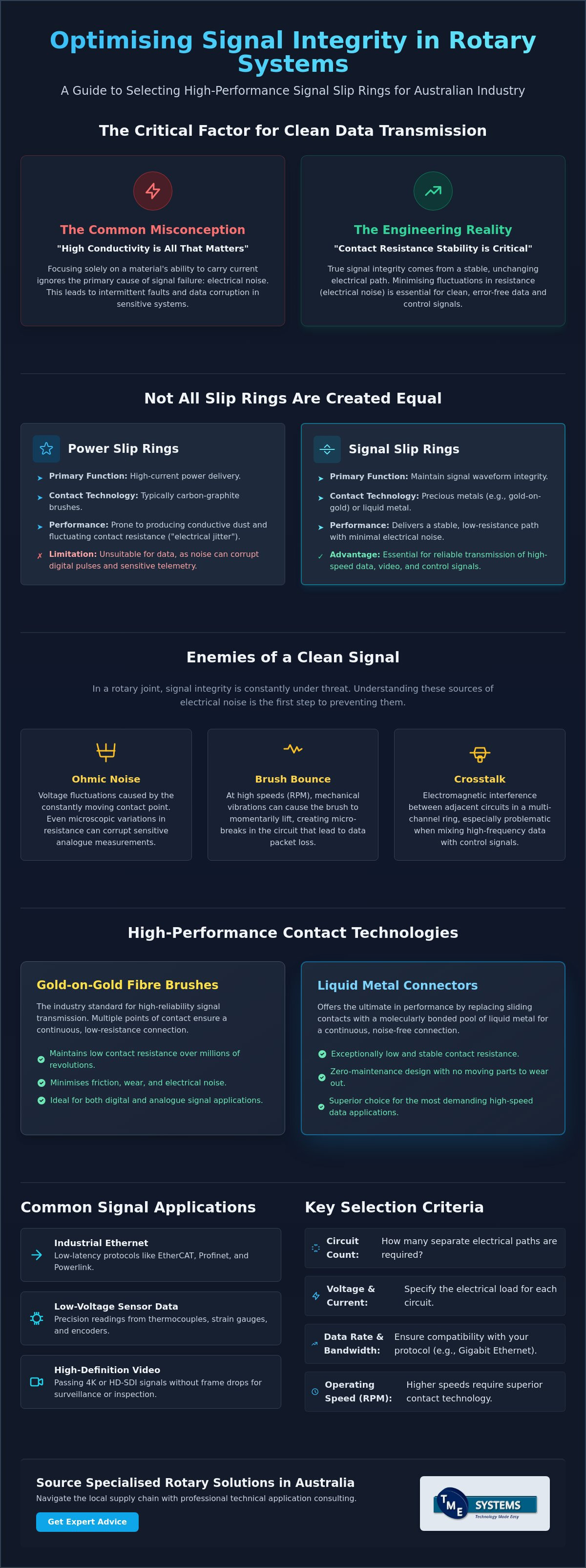
- Industrial Ethernet: This includes high-speed protocols like EtherCAT, Profinet, and Powerlink, which require low-latency performance.
- Low-Voltage Sensor Data: Precision readings from thermocouples or strain gauges depend on stable resistance to remain accurate.
- High-Definition Video: Surveillance and inspection tools often use these rings to pass 4K or HD-SDI video signals without frame drops.
For applications requiring zero-maintenance and exceptionally low noise, Meridian Laboratory Slip Rings offer advanced solutions that exceed the capabilities of traditional brush-based systems.
Understanding Signal Integrity and Resistive Noise
Electrical noise in a rotary joint is the primary barrier to clean data transmission. Unlike a static cable where resistance is constant, a signal slip ring introduces variability because the contact point is always moving. This movement creates "ohmic noise," which appears as voltage fluctuations that can confuse digital logic gates or introduce errors into sensitive analog telemetry. In industrial applications, ignoring this noise leads to intermittent faults that are notoriously difficult to diagnose.
Rotational speed, or RPM, significantly influences signal clarity. As speed increases, the risk of "brush bounce" grows. This occurs when mechanical vibrations cause the brush to momentarily lift from the track, creating a micro-break in the circuit. For high-speed data protocols, even a microsecond of disconnection can trigger packet loss or a system-wide fault. Managing this requires a deep understanding of Contact Technologies to ensure the brush remains seated regardless of the mechanical load.
Multi-channel rings face the additional challenge of crosstalk. When multiple signals are packed into a compact housing, electromagnetic fields from one circuit can induce noise in the adjacent one. This is particularly problematic when mixing control signals with high-frequency data. If you're experiencing data dropouts in your current setup, technical application consulting can help determine if your circuit layout or ring selection is prone to this type of interference.
Dynamic Contact Resistance (DCR)
In technical specifications, DCR is usually measured in milliohms. Dynamic Contact Resistance is the variation in resistance during a full 360-degree rotation. While a low absolute resistance is helpful, stability is the real goal for a signal slip ring. A signal with 10 milliohms of constant resistance is easier to process than one that fluctuates between 2 and 15 milliohms, as these spikes create the jitter that degrades signal-to-noise ratios.
EMI and Shielding Strategies
Effective noise management requires robust shielding. Internal barriers are often used to isolate power circuits from sensitive signal tracks within the same unit. The choice of housing material also plays a role; aluminium provides excellent weight-to-shielding ratios, while stainless steel is preferred for harsh Australian industrial environments where corrosion resistance is paramount. Proper grounding of the rotating interface ensures that stray currents are shunted away from the data path, preserving the integrity of the transmission.
Contact Technologies: Choosing the Right Interface
Choosing the correct interface for a signal slip ring determines whether your data remains clean or becomes corrupted by mechanical interference. Traditional carbon brushes, commonly used in heavy-duty power applications, are generally unsuitable for high-speed data transmission. These brushes rely on sliding friction that generates conductive dust; this debris creates micro-shorts and unpredictable resistance spikes. For telemetry or digital control, such as Ethernet or Profibus, the resulting signal-to-noise ratio is often unacceptable for reliable operation.
Instead, modern industrial applications in Australia utilise either precious metal fibre brushes or liquid metal interfaces. Gold-on-gold contacts are the industry standard for reliable, low-current signals. These systems use multiple contact points to provide redundancy, ensuring that if one filament momentarily loses contact due to vibration, the signal path remains closed. This design is essential for maintaining the stability of the dynamic contact resistance required for sensitive electronics.
Liquid Metal vs Traditional Contacts
For applications requiring near-zero electrical noise, liquid metal rotary connectors represent the pinnacle of performance. When comparing signal-to-noise ratios in Mercotac slip rings, the liquid interface provides a continuous, molecular bond that eliminates the mechanical "chatter" found in solid brushes. This technology is particularly effective in environments with high vibration where a traditional brush might bounce. However, orientation and operating temperature ranges must be carefully managed to ensure the liquid remains contained and conductive. When your project demands extreme rotational speeds or high-frequency precision without the limitations of physical wear, it's often necessary to choose Meridian Laboratory for their specialised high-speed brushless designs.
Fibre Brush Technology
Fibre brush technology is the preferred choice for long-life, maintenance-free operation in standard industrial conditions. These systems utilise a bundle of silver or gold filaments that "sweep" the ring surface. This multi-point contact system provides high reliability and a self-cleaning action that removes oxides as the unit rotates. When specifying a signal slip ring with fibre brushes, you can typically expect a lifespan of tens of millions of revolutions before any significant degradation in signal quality occurs. This makes them ideal for robotics and automation where downtime for brush replacement is cost-prohibitive. Choosing this technology ensures a stable interface for sensitive sensor data and high-definition video feeds.
Key Specifications for Selecting a Signal Slip Ring
Selecting a signal slip ring requires a methodical audit of your system's electrical and mechanical boundaries. It's not enough to simply count the number of wires needed; you must evaluate the specific nature of the data being transferred. For instance, a system running 1000Base-T Ethernet demands a ring designed with controlled impedance and minimal crosstalk to maintain high data rates. If the hardware isn't matched to these bandwidth requirements, you'll likely face packet loss and reduced system throughput, regardless of the quality of your stationary cabling.
Mechanical integration is the next critical factor. You must choose a mounting style that suits your assembly's architecture. Through-bore designs allow the ring to be mounted over a central shaft, which is often necessary for hydraulic lines or structural supports. Capsule rings offer a compact, self-contained solution for smaller assemblies, while flange mounts provide a stable surface-attachment point. Matching the operating speed, measured in RPM, to the mechanical limits of the assembly is vital to prevent premature wear or brush bounce.
Electrical and Mechanical Parameters
Voltage ratings must be carefully partitioned between control signals and power circuits. While signal channels might only carry 5V or 24V, they often share a housing with circuits carrying much higher voltages. Torque requirements also play a significant role, particularly in small motorised systems where excessive rotational resistance can lead to motor overheating or positioning inaccuracies. IP67-rated rings are essential for wash-down or dusty Australian mining environments. These ratings ensure that neither fine iron ore dust nor high-pressure cleaning fluids compromise the internal contact surfaces.
Data Protocol Compatibility
Modern industrial settings rely on a variety of ruggedised protocols, including CANbus, RS-485, and Profibus. Each has unique requirements for shielding and resistance stability. High-fidelity applications, such as those involving USB 3.0 or HDMI video feeds, require specialised internal geometries to prevent signal attenuation. When your project involves complex, multi-channel requirements, Prosper Rotation offers modular configurations that allow you to combine different circuit types within a single unit. This versatility is essential for custom robotics or specialised processing equipment.
If you're unsure which parameters are most critical for your specific application, you can request a technical consultation to ensure your hardware selection meets all operational and environmental demands.
Sourcing and Specifying Signal Slip Rings in Australia
Sourcing a high-quality signal slip ring in the Australian market involves more than just comparing SKU numbers. Because these components are often integrated into complex machinery, a standard off-the-shelf solution might not account for specific environmental variables like the high ambient temperatures found in challenging inland industrial settings or the corrosive salt air prevalent in maritime and coastal infrastructure projects. Navigating the supply chain requires a partner who can bridge the gap between international manufacturing capabilities and local operational requirements. Technical application consulting is the most effective way to avoid the common pitfalls of signal degradation and premature mechanical failure.
Ensuring compliance with Australian electrical and safety standards is non-negotiable for industrial installations. While many products follow international guidelines, specific requirements like AS/NZS 3112:2017+A1:2021 govern the plug portions of electrical equipment used across Australia and New Zealand. Additionally, local suppliers often reference standards such as DIN VDE 0298-4 to determine current-carrying capacity in low-voltage networks. Verifying that your hardware meets these benchmarks protects both your equipment and your personnel. It's vital to confirm that any imported component aligns with these domestic regulations before it reaches the factory floor.
The TME Systems Pty Ltd Consultative Approach
Australian engineers frequently face the challenge of balancing circuit count with mounting constraints. Our consultative approach focuses on identifying these bottlenecks early in the design phase. By leveraging global brands like BGB Innovation, we provide heavy-duty signal solutions that are engineered for longevity in the toughest sectors. This local technical support ensures that application engineering expertise from TME Systems Pty Ltd is available in your timezone. We help you select the correct circuit count and mounting style to ensure your rotary system remains stable and noise-free throughout its service life.
Next Steps for Your Project
Before initiating a purchase, you should gather the specific parameters of your application. This data is essential for an accurate specification and includes:
- Operational Speed: Confirm the maximum and continuous RPM.
- Circuit Types: Distinguish between analogue sensors, high-speed digital data, and any shared power requirements.
- Environmental Constraints: Identify if you require IP65 or IP67 protection for wash-down or dusty environments.
Requesting a technical audit of your existing rotary connections can often reveal why previous components failed. Contacting TME Systems Pty Ltd for a specialised signal integrity assessment is the most reliable way to ensure your new signal slip ring performs as expected from day one. We help you move from a generic specification to a high-performance solution tailored to your exact industrial needs.
Securing Reliable Data Transmission in Rotary Systems
Achieving noise-free performance in rotating equipment depends on selecting a signal slip ring that prioritises waveform stability over raw conductivity. By addressing the dynamic contact resistance and environmental sealing factors we’ve explored, you can ensure your data remains clean even in high-vibration applications. The transition from traditional brush systems to precision-engineered interfaces is the most effective way to eliminate the intermittent faults that often lead to costly industrial downtime.
TME Systems Pty Ltd provides the technical consulting necessary to integrate these high-performance components into your specific workflow. Based in Ingleburn, NSW, our team has decades of experience supporting Australian industrial rotary solutions across mining, robotics, and processing sectors. As an authorised distributor for Mercotac and Meridian Laboratory, we offer a direct pathway to the world’s most reliable contact technologies. Contact TME Systems Pty Ltd for expert technical advice on your signal slip ring requirements to secure your project's operational success. We are ready to help you optimise your system for long-term, maintenance-free performance.
Frequently Asked Questions
What is the difference between a power slip ring and a signal slip ring?
A power slip ring is engineered to transfer high current and voltage to drive motors or heaters; whereas a signal slip ring is designed for low-voltage data integrity. Power variants often use carbon brushes that generate conductive dust and electrical noise. Signal variants utilise precious metal or liquid metal interfaces to ensure a stable connection with minimal resistance fluctuations.
Can I transmit Ethernet data through a standard slip ring?
Transmitting Ethernet through a standard power slip ring is generally unsuccessful because these units lack the necessary shielding and impedance control. Standard rings introduce excessive electrical noise that leads to high packet loss and latency. To maintain a stable 1000Base-T or EtherCAT connection, you must use a specialised rotary joint designed for high-frequency data protocols.
How much electrical noise is acceptable for digital signals?
Most digital systems require dynamic contact resistance to stay below 10 to 20 milliohms for reliable operation. While absolute resistance matters, the "jitter" or spikes in resistance during rotation cause the most issues. If noise levels exceed these thresholds, digital logic gates may misinterpret signal pulses, leading to intermittent system faults or corrupted telemetry data.
Are mercury-wetted slip rings legal for use in Australia?
Mercury-wetted slip rings are legal for industrial use in Australia provided they meet relevant environmental and safety standards. Many distributors offer products that comply with RoHS and REACH directives to ensure hazardous substances are managed correctly. However, many engineers now prefer mercury-free liquid metal alternatives that provide similar performance without the specific disposal and handling requirements of mercury.
What is the typical lifespan of a signal slip ring in an industrial environment?
The lifespan of a high-quality signal slip ring typically ranges from 50 million to over 100 million revolutions depending on the contact technology. Fibre brush systems are designed for long-term, maintenance-free operation in robotics and automation. Liquid metal variants often have an even longer service life because they eliminate the mechanical friction and wear associated with solid brushes.
How do I reduce EMI in my rotary electrical connection?
Reducing electromagnetic interference requires a combination of internal isolation and external shielding. You should specify rings with metal housings, such as aluminium or stainless steel, and ensure that signal circuits are physically separated from power lines within the assembly. Proper grounding of the stationary and rotating components is also essential to shunt stray currents away from sensitive data paths.
Do signal slip rings require regular maintenance or lubrication?
Most modern signal-grade rotary connectors are designed to be maintenance-free for the duration of their service life. Fibre brushes have a self-cleaning action that removes oxides from the rings as they rotate. Adding external lubrication is usually counterproductive as it can attract dust or create an insulating layer that increases electrical noise and degrades signal integrity.
What mounting style is best for a high-speed signal application?
Capsule mounts are often preferred for high-speed applications because their compact, self-contained design minimises mechanical vibration. If your system requires a through-bore mount, precision alignment of the central shaft is critical to prevent brush bounce at high RPM. Ensuring the assembly is balanced and securely fastened reduces the centrifugal forces that can interfere with stable contact.