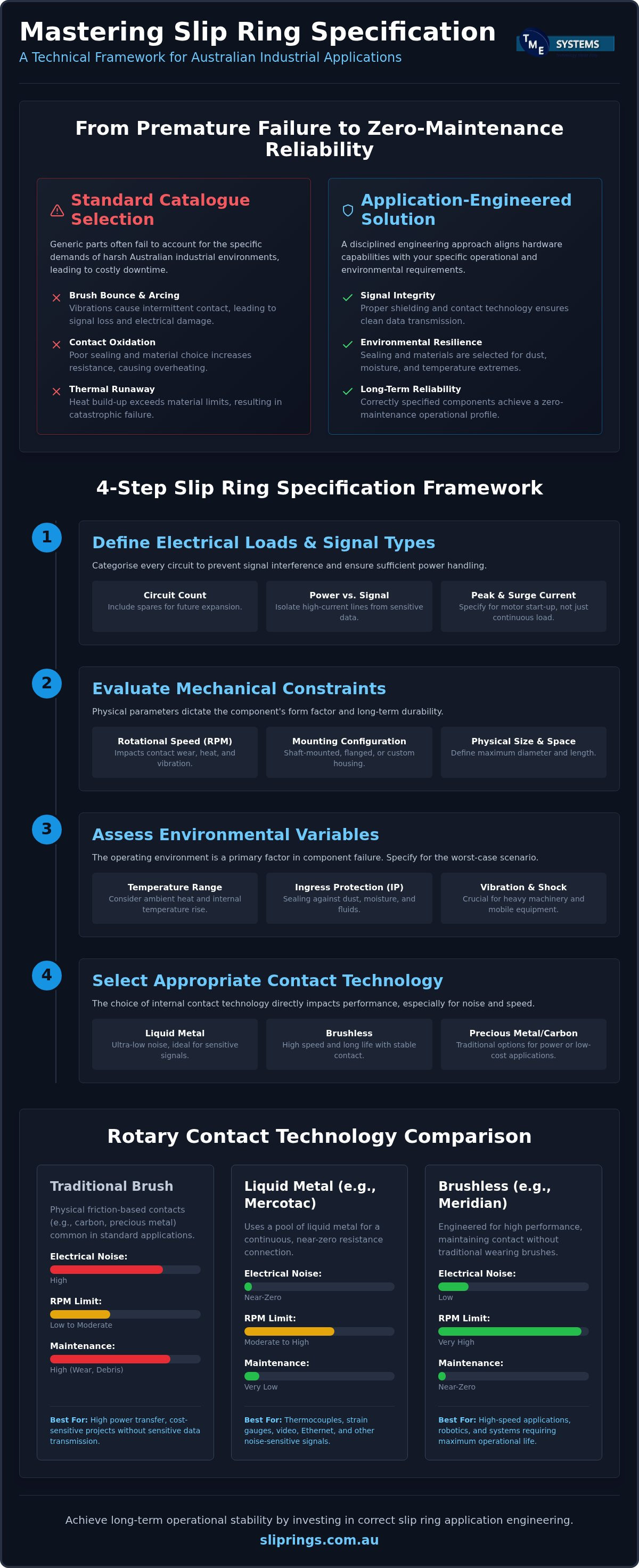
A standard catalogue selection is often the quickest route to premature component failure in harsh Australian industrial environments. Success in slip ring application engineering requires more than just matching a part number; it demands a thorough understanding of how signal noise and environmental ingress affect long-term reliability. You likely recognise that off-the-shelf solutions rarely account for the specific complexities of your local operating conditions, whether you are managing high-speed processing lines or heavy-duty mining equipment.
This technical guide empowers you to master the parameters required to specify high-performance rotary connectors for any industrial application. You'll learn how to evaluate electrical loads, RPM limits, and environmental variables to achieve reliable, zero-maintenance connections. We will provide a clear framework for selecting specialised parts from manufacturers like Mercotac and Meridian Laboratory, bridging the gap between global hardware capabilities and your specific engineering requirements.
Key Takeaways
- Understand why off-the-shelf rotary connectors often fail in specialised industrial rigs and how to align mechanical constraints with electrical needs.
- Master the technical framework of slip ring application engineering to specify hardware that manages continuous loads without signal interference.
- Identify the environmental variables, such as temperature extremes and dust ingress, that determine component reliability in Australian operating conditions.
- Evaluate the technical advantages of liquid metal and brushless contact technologies for applications requiring high speeds or sensitive data transmission.
- Implement a step-by-step specification process to define electrical loads and signal types, ensuring your rotary systems achieve a zero-maintenance profile.
The Role of Application Engineering in Rotary Systems
Effective rotary systems depend on the precise alignment of mechanical constraints and electrical requirements. While a basic understanding of what a slip ring is provides a starting point, industrial success requires a deeper dive into slip ring application engineering. This discipline treats the rotary union as a critical system component rather than a standalone commodity. In Australia, where industrial sites often face extreme heat and remote locations, an off-the-shelf connector chosen from a catalogue frequently fails. These generic parts cannot handle the specific vibrations, mounting tolerances, or data integrity requirements of a specialised rig. Professional consulting identifies how mounting configurations and shaft run-out impact the longevity of the internal contact surfaces before the hardware is even ordered.
Bridging the Gap Between Catalogue and Customisation
Specifying a "close enough" component often leads to catastrophic failure in high-speed or high-duty cycle applications. Technical application consulting ensures that manufacturer data sheets are interpreted correctly for local conditions. A distributor acts as a knowledgeable intermediary, identifying hidden requirements that a standard catalogue might overlook. These parameters include surge currents during motor start-up, duty cycles that affect thermal dissipation, and electromagnetic interference (EMI) that can corrupt sensitive control signals. For instance, high-performance systems from Meridian Laboratory require exact alignment to maintain their brushless advantages. This is a detail often missed without professional oversight during the design phase.
The Consequences of Specification Errors
The cost of a specification error extends far beyond the price of the replacement part. In the Australian mining and manufacturing sectors, unplanned downtime can cost thousands of dollars per hour. Selecting a unit based solely on continuous current ratings without accounting for peak surge events is a frequent cause of premature failure in heavy machinery. Common failure modes resulting from poor engineering include:
- Brush Bounce: Mechanical vibrations causing intermittent contact, which leads to data loss and electrical arcing.
- Contact Oxidation: Inadequate sealing or incorrect material selection leading to increased resistance and excessive heat.
- Thermal Runaway: Internal heat build-up that exceeds the material limits of the housing or lubricants.
Poor slip ring application engineering also degrades signal-to-noise ratios. This is particularly problematic for Ethernet or control signals, where even minor interference leads to dropped packets or unreadable data feeds. By considering the entire system, including mounting stability and cable management, engineers can eliminate these risks and ensure long-term operational stability. Professional consulting reduces maintenance overheads by selecting the right technology, such as Mercotac slip rings, for applications where low electrical noise is non-negotiable.
Critical Electrical and Mechanical Parameters
Successful slip ring application engineering requires a precise balance between electrical capacity and mechanical durability. It's not enough to simply count circuits; you must categorise them by function. Mixing high-current power lines with sensitive low-voltage signal wires within the same housing requires careful internal shielding and circuit separation to prevent crosstalk. If your system requires transmitting sensitive data alongside 240V power, selecting a low-noise interface is mandatory to maintain signal integrity and prevent data corruption.
Managing Circuit Count and Power Requirements
When determining circuit count, engineers must account for future-proofing and current overheads. Continuous loads generate heat, but peak surge currents during motor start-up often dictate the minimum wire gauge and contact surface area required. Overheating is a primary cause of dielectric breakdown and premature seal failure. For applications where electrical noise must be kept to an absolute minimum, Mercotac Slip Rings utilise liquid metal contact technology to provide near-zero resistance. This differs significantly from traditional carbon brushes, which rely on physical friction and are prone to wear, debris accumulation, and fluctuating contact resistance.
Speed Ratings and Mechanical Stability
Rotational speed, measured in RPM, directly impacts the wear rate of the contact surfaces. However, surface speed is the more critical metric for longevity. A larger diameter slip ring rotating at the same RPM as a smaller one will experience faster surface wear because the contact point travels a greater distance per revolution. High-speed applications, sometimes reaching 10,000 RPM or more, require specialised bearings and balanced housings to prevent harmonic vibrations that can disrupt signal stability.
While some aerospace or high-vacuum industries explore Specialised Rotary Contact Technologies like inductive or wireless couplings to avoid contact wear entirely, mechanical slip rings remain the primary standard for high-power transmission. Selecting the correct mounting configuration, whether through-bore for passing hydraulic lines or end-of-shaft for compact rigs, ensures the unit remains stable under centrifugal loads. If you are unsure which mounting style or housing material fits your specific torque and speed requirements, seeking advice from sliprings.com.au can prevent costly integration errors during the procurement phase.
Environmental Resilience in Australian Industry
Australian industrial environments present unique challenges that standard European or American specifications often fail to address. From the intense heat of outback mining sites to the corrosive offshore rigs in our coastal waters, environmental resilience is a core pillar of slip ring application engineering. Selecting the correct Ingress Protection (IP) rating is the first step; however, sealing against fine, abrasive dust requires a more robust approach than simple splash protection. If the seal fails, particulates contaminate the contact surfaces, leading to arcing and signal degradation. Lubricants must also be selected for high thermal stability, as internal friction combined with high ambient temperatures can cause material breakdown if the heat isn't managed correctly.
Mining and Heavy Machinery Requirements
Remote mining sites subject equipment to constant vibration and high-impact loads. Abrasive dust can infiltrate standard housings, causing rapid wear on contact surfaces and bearings. For these heavy-duty scenarios, BGB Innovation Slip Rings provide the necessary mechanical endurance. These units are designed with maintenance access in mind, allowing for inspection and cleaning without total system disassembly. While some specialised designs might incorporate a magnetic slip ring to mitigate certain mechanical issues, the primary focus for mining remains ruggedisation. Ensuring the housing can withstand the physical shock of mobile equipment is just as vital as the electrical performance of the rings themselves.
Marine and Subsea Application Engineering
Corrosion resistance is non-negotiable for offshore and marine installations. Saltwater exposure requires housings made from 316 stainless steel or specialised anti-corrosive coatings to prevent structural failure. In subsea applications, such as Remotely Operated Vehicles (ROVs) or winching systems, the engineering challenge shifts to pressure compensation and deep-sea sealing. Maintaining signal integrity in these environments is critical, especially when transmitting high-definition video or complex sensor data through several hundred metres of cable.
Specialised slip ring application engineering ensures that every seal and connector material is compatible with the chemical and physical stresses of the Australian coastline. This methodical approach prevents the costly retrieval of subsea equipment due to a single failed rotary joint. By specifying ruggedised connectors from the outset, operators can avoid the premature wear that typically plagues components in high-salinity environments. It's about building a system that survives the conditions, not just one that works in a controlled workshop.
A Step-by-Step Slip Ring Specification Framework
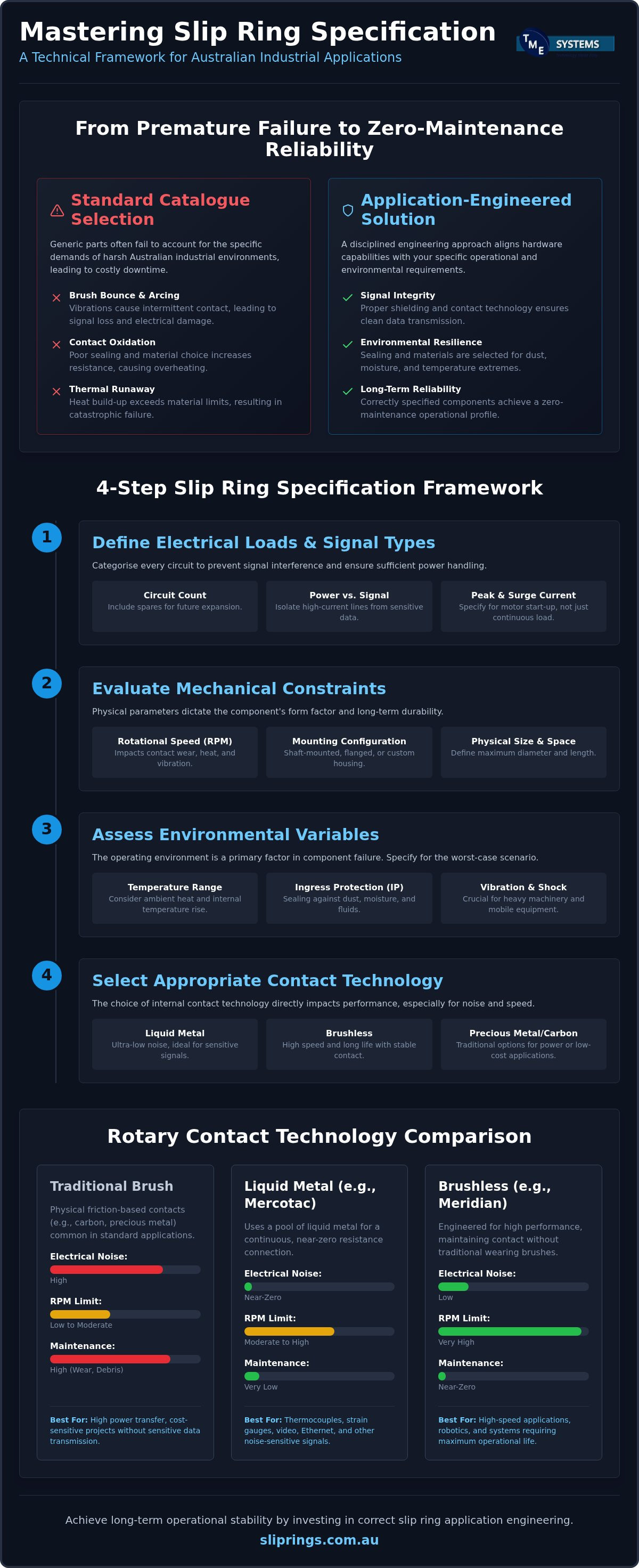
Procuring a rotary connector that meets long-term reliability standards requires a disciplined approach to slip ring application engineering. Rather than browsing a catalogue for a part that looks correct, engineers should follow a five-step framework to ensure the hardware matches the electrical and mechanical stresses of the application. This process identifies potential failure points before they become operational hazards.
- Step 1: Define Electrical Load: Document the peak and continuous voltage and amperage for every circuit to prevent thermal runaway.
- Step 2: Identify Signal Types: Categorise circuits by protocol, such as analogue sensors, digital control, or high-speed Ethernet.
- Step 3: Determine Mechanical Constraints: Specify the maximum operating RPM, available mounting space, and required bore size.
- Step 4: Audit Environmental Variables: Establish the necessary IP rating based on local dust levels, moisture, and temperature fluctuations.
- Step 5: Select Contact Technology: Choose between liquid metal, carbon brushes, or precious metal contacts based on noise limits and maintenance cycles.
The Signal Integrity Audit
Modern industrial automation relies on the "transparency" of the slip ring within the network. If the rotary joint introduces impedance mismatches or electrical noise, the entire control system can fail. Mapping out data protocols ensures that shielding and grounding are sufficient to eliminate cross-talk between high-power circuits and sensitive data lines. For applications requiring high-precision data transfer with minimal signal degradation, Meridian Laboratory Slip Rings offer specialised brushless technology that maintains signal integrity even at high rotational speeds. This audit prevents the "ghost" errors often found in poorly specified data links.
Mechanical Integration and Mounting Style
The physical integration of the unit determines its long-term stability. You must choose between through-bore slip rings, which allow for the passage of shafts or pneumatic lines, and compact capsule designs for space-constrained assemblies. Calculating torque requirements and bearing life is essential; a bearing rated for 10,000 hours of operation will fail prematurely if the mounting is misaligned or subjected to excessive vibration. Finalising the envelope dimensions ensures the unit fits within your existing housing without compromising cable bend radiuses or cooling airflow. If you need assistance with complex specifications, you can request a technical consultation to verify your selection before procurement.
Leveraging Specialised Rotary Contact Technologies
Selecting the right contact technology is the final, critical step in the slip ring application engineering process. While traditional carbon brushes remain a staple for many heavy-duty industrial applications, specialised technologies offer superior performance for data-sensitive or high-speed systems. By choosing between liquid metal, advanced brush systems, or modular circuit stacking, engineers can tailor the rotary union to the specific electrical and mechanical demands of the project. This selection directly influences the maintenance cycle and the overall reliability of the rotating assembly.
Liquid Metal vs. Traditional Brushes
Liquid metal rotary connectors, such as those manufactured by Mercotac, provide a unique solution for applications requiring near-zero electrical noise. Unlike standard carbon brushes that create debris and require periodic maintenance, liquid metal contacts are essentially maintenance-free and offer constant resistance throughout the component’s life. Liquid metal contacts eliminate the mechanical friction and arcing associated with sliding brushes, resulting in a signal-to-noise ratio that is virtually undetectable by most industrial sensors. While mercury-wetted units are the industry standard for performance, mercury-free options are available for environments where specific material restrictions apply. This technology is particularly effective in high-frequency signal transmission where even minor fluctuations in resistance could lead to data corruption in Ethernet or Fieldbus networks.
The TME Systems Engineering Advantage
Advanced systems from Meridian Laboratory utilise brushless or high-performance brush technologies to achieve extreme rotational speeds while maintaining signal stability. For heavy-duty industrial rotation where maintenance access is paramount, BGB Innovation Slip Rings offer robust collector ring configurations that handle high current loads in challenging environments. For projects requiring a bespoke approach, Prosper Rotation provides modular systems that allow for customised circuit stacking. This flexibility ensures the unit fits precisely within the specified mechanical envelope while accommodating diverse signal and power requirements in a single assembly.
TME Systems acts as the bridge between global manufacturing capabilities and local Australian technical needs. Our role involves a final engineering review to ensure that every parameter, from voltage peaks to environmental sealing, is correctly addressed before procurement. Accessing local technical support for these global brands reduces the risk of miscommunication and ensures that the hardware is fit for the Australian climate. This pragmatic approach prevents the common errors associated with generic part selection and ensures your system remains operational with minimal downtime. Whether you are ruggedising a mining rig or optimising a high-speed packaging line, our team provides the technical expertise required to ensure long-term reliability. Consult with our application engineers for your next project to finalise your specification and secure local technical support.
Optimising Rotary Performance for Australian Industry
Achieving long-term reliability in rotary systems requires a transition from generic part selection to rigorous slip ring application engineering. By prioritising precise electrical parameters and environmental resilience, you can eliminate the signal noise and premature wear that often disrupt sensitive industrial data. Whether your project involves high-speed processing or the abrasive conditions of a remote mining site, the correct specification framework ensures your hardware is fit for purpose.
As the authorised Australian distributor for Mercotac and Meridian Laboratory, TME Systems provides the specialised expertise needed to bridge the gap between global manufacturing and local technical requirements. Our team offers pragmatic advice on high-speed rotary connectors and heavy-duty industrial applications, ensuring your selection aligns with the physical and functional realities of your operation. It's vital to avoid leaving your system's uptime to chance with an off-the-shelf solution that hasn't been audited for your specific environment.
Discuss your technical requirements with our Australian application engineers to ensure your next rotary connection is engineered for maximum performance. We look forward to assisting with your specific engineering challenges.
Frequently Asked Questions
What is the difference between a slip ring and a collector ring?
While the terms are often used interchangeably, a collector ring typically refers to a heavy-duty assembly used in large motors or generators to collect current. A slip ring is a broader term for any rotary electrical interface. In industrial contexts, collector rings are often larger, open-frame units found in the mining or power generation sectors, whereas slip rings include compact, sealed units for data and power transmission.
How do I reduce electrical noise in my rotary connection?
Reducing noise requires selecting the correct contact technology and shielding. Liquid metal rotary connectors from Mercotac provide the lowest possible noise because they use a molecular bond rather than mechanical friction. For traditional systems, using precious metal contacts or high contact pressure can help. Proper slip ring application engineering also involves separating signal wires from power lines and using twisted-pair, shielded cabling to prevent electromagnetic interference across the rotary joint.
Can slip rings transmit high-speed data like Ethernet or HDMI?
Yes, specialised slip rings can transmit high-speed data protocols including Ethernet up to 1Gbps, HDMI, and various Fieldbus types. Success depends on maintaining controlled impedance throughout the rotary joint. Meridian Laboratory offers high-precision units designed specifically for these data-heavy applications. It's critical to specify the exact protocol during the design phase to ensure the internal wiring and contact surfaces are optimised for high-frequency signal integrity and minimal packet loss.
What maintenance is required for a standard industrial slip ring?
Maintenance requirements vary significantly by technology. Standard carbon brush slip rings require periodic inspection for brush wear and the removal of conductive dust build-up to prevent short circuits. Conversely, Mercotac liquid metal units are essentially maintenance-free because they have no sliding parts to wear out. It's important to monitor the operating temperature and vibration levels of any rotary joint to ensure they remain within the manufacturer's specified mechanical limits over time.
How do I choose between a through-bore and a capsule slip ring?
The choice depends on your mechanical mounting requirements and available space. A through-bore slip ring features a hollow centre, allowing you to pass a drive shaft, hydraulic lines, or pneumatic pipes through the middle of the unit. Capsule slip rings are compact, fully enclosed units designed for end-of-shaft mounting where space is limited. If your application requires the rotary joint to be integrated around an existing shaft, the through-bore configuration is the standard solution.
What are the benefits of liquid metal rotary connectors over traditional brushes?
Liquid metal connectors offer near-zero electrical noise, lower resistance, and significantly longer lifespans compared to traditional sliding brushes. Because they utilise a pool of liquid metal to maintain the electrical connection, there is no mechanical wear or debris generated during rotation. This makes them ideal for sensitive sensors and high-speed data. They also maintain consistent performance throughout their service life, whereas traditional brushes experience fluctuating resistance as the contact surfaces wear down.
How does RPM affect the lifespan of a slip ring?
Higher rotational speeds increase the surface wear on traditional mechanical brushes, which shortens the maintenance interval and overall lifespan. Centrifugal forces at high RPM can also impact the stability of the electrical contact, leading to increased signal noise. For high-speed applications, specialised bearings and balanced internal components are required. Meridian Laboratory provides units rated for extreme RPM, but it's vital to consult with an engineer to match the speed rating to your specific duty cycle.
Are there explosion-proof slip rings available for hazardous zones?
Yes, specialised slip rings are available with certifications for hazardous environments where explosive gases or dust may be present. These units feature ruggedised, explosion-proof housings designed to contain any internal arcing or thermal events. While TME Systems provides technical assistance for selecting these high-performance units, you must ensure the selected hardware complies with relevant Australian safety standards for your specific hazardous zone classification before completing the procurement and installation process.