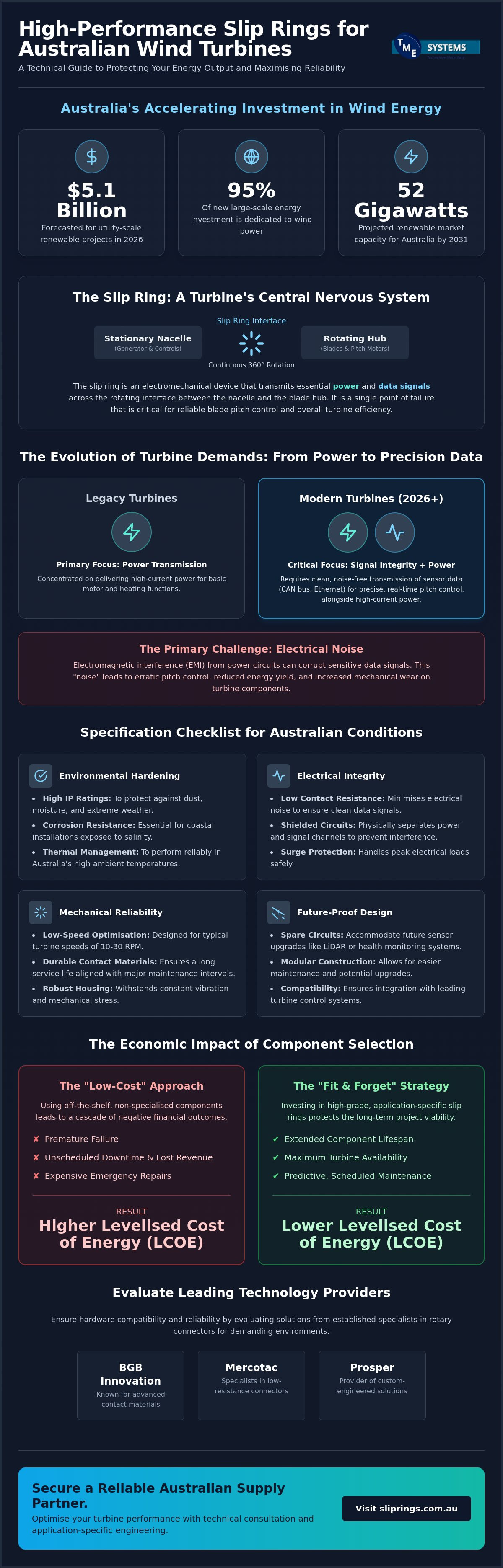
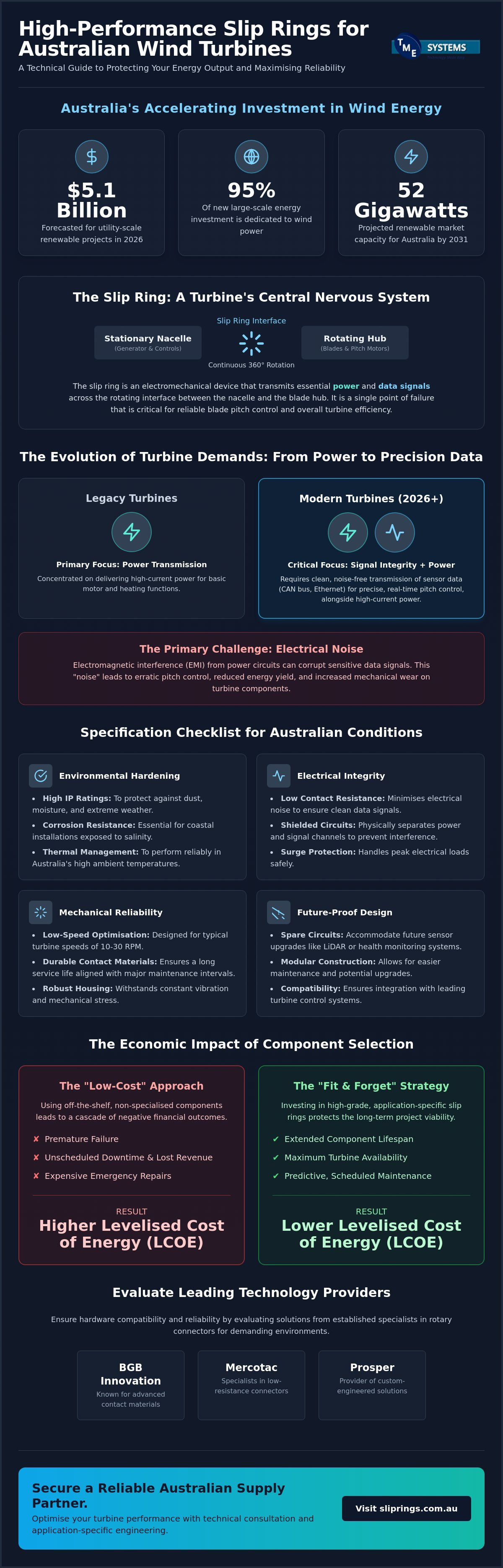
With AUD 5.1 billion forecasted for utility-scale renewable projects in 2026, wind power now accounts for 95% of Australia's new large-scale energy investment. This massive scale-up places immense pressure on asset managers to ensure every component, down to the smallest contact, performs under extreme conditions. You understand that in remote Australian environments, the high cost of turbine downtime and frequent maintenance cycles can quickly erode project feasibility. Selecting the right slip rings for wind turbines Australia is no longer just a procurement task; it's a critical strategy for protecting your energy output.
This guide provides a technical framework to help you select and maintain high-performance rotation solutions that withstand local climate stressors. We'll analyse how to secure clean signal transmission for pitch control and extend your service intervals through precise hardware selection. You'll also learn how to evaluate technologies from BGB Innovation, Mercotac, and Prosper to find a reliable, Australian-based supply partner for your 2026 operations.
Key Takeaways
- Understand why maintaining signal integrity is as vital as power transmission for reliable pitch control in modern turbine hubs.
- Learn to specify circuit counts and voltage ratings that handle peak loads while providing essential surge protection.
- Identify the specific Ingress Protection (IP) ratings and thermal management features required for slip rings for wind turbines Australia to survive extreme heat and coastal salinity.
- Evaluate the performance profiles of BGB Innovation, Mercotac, and Prosper to ensure hardware compatibility with your specific turbine architecture.
- Recognise how application-specific engineering prevents the premature failure often associated with off-the-shelf rotary connectors.
The Role of Slip Rings in Australian Wind Energy Infrastructure
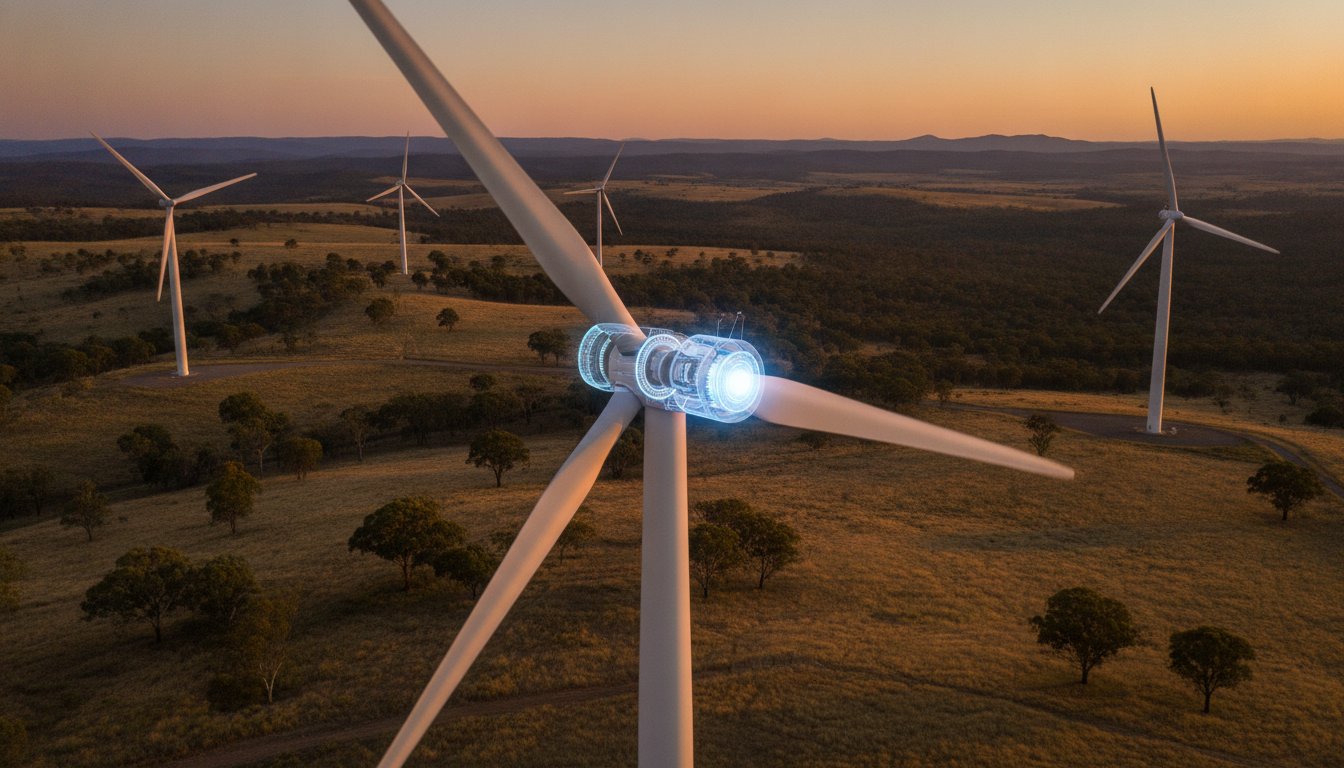
A wind turbine's nacelle houses the generator while the hub controls the blades. Connecting these two requires a rotary interface capable of continuous 360-degree rotation. This component is the slip ring. If you are asking What is a Slip Ring?, it's an electromechanical device that allows the transmission of power and electrical signals from a stationary to a rotating structure. Within the sector of slip rings for wind turbines Australia, these units act as the central nervous system, ensuring pitch control motors receive both the energy to move and the data to know when to act.
The Australian renewable market is projected to reach 52 gigawatts by 2031. To meet these targets, turbine availability must remain at an all-time high. This puts the spotlight on the slip ring as a potential single point of failure. Modern 2026 standards have shifted the focus from simple power transfer to complex data handling. As turbines grow in size, with many now exceeding 6 MW capacities, the technical demands on these rotary joints have increased proportionally.
As these data requirements evolve, integrating them into a unified system becomes critical for asset managers. For insights on architecting a robust industrial digital thread, visit PLM-Sme FZC.
Power Transmission vs. Signal Integrity
Older turbine models focused primarily on high-current power. Today, signal integrity is just as vital. Modern Australian wind farms rely on real-time sensor data to adjust blade pitch for maximum efficiency. High-current power for heater systems and motors must coexist with sensitive data signals without causing electromagnetic interference. Any "noise" in these signals leads to erratic pitch control, which reduces energy yield and increases mechanical wear. The industry is rapidly moving toward advanced contact materials, such as those used by BGB Innovation Slip Rings, to ensure clean transmission across both power and data circuits.
The Economic Impact of Component Reliability
Reliability is a financial necessity in the Australian landscape. Wind farms are often located in remote regions where mobilising a crane for a nacelle-level repair is an expensive logistical exercise. A low-cost slip ring that fails prematurely is never truly "cheap." It results in lost generation revenue and significant labour costs. Current trends in 2026 show operators prioritising "fit and forget" solutions. By selecting high-grade slip rings for wind turbines Australia, asset managers can align component lifespans with major service intervals. This shift toward predictive maintenance helps lower the levelised cost of energy (LCOE) across the project's life.
Technical Specifications for Pitch Control and Power Transmission
Precision in technical specification is the only way to ensure long-term reliability in the field. Understanding how various wind turbine components interact is fundamental to specifying the correct rotary interface. For slip rings for wind turbines Australia, the selection process must account for the high-torque, low-speed rotation characteristic of large-scale utility turbines. Unlike high-speed industrial motors, wind turbine shafts typically rotate at 10 to 30 RPM, requiring contact materials that don't glaze or degrade at lower velocities.
Electrical noise is a primary concern for pitch control systems. Modern turbines utilise sensitive data protocols like CAN bus or Industrial Ethernet to communicate blade positions. If the slip ring produces excessive electrical noise, these signals become corrupted. This leads to "hunting" where the pitch motors make constant, unnecessary micro-adjustments. These errors increase mechanical wear and reduce the turbine's capacity factor. Specifying a unit with low dynamic contact resistance is essential for maintaining signal integrity.
Selecting the Right Circuit Configuration
Determining the optimal circuit count involves balancing current power needs with future sensor requirements. A standard hub may require high-current circuits for blade de-icing heaters and pitch motors, alongside low-current circuits for encoders and limit switches. It's best practice to separate power and signal circuits with physical shielding or dedicated grounding rings. This prevents cross-talk, which is a common cause of data corruption in high-load environments. When designing for the 2026 market, consider adding spare circuits to accommodate future LiDAR or structural health monitoring sensor upgrades.
Mechanical Mounting and Integration
The physical architecture of your drivetrain dictates the mounting style. Through-bore designs allow the slip ring to slide over the main shaft, which is often necessary for hydraulic lines or central cabling. Capsule designs are more compact and suit smaller platforms or specific gearbox configurations. Compatibility with existing interfaces is a non-negotiable requirement for retrofit projects. Using standardised mounting flanges ensures that slip rings for wind turbines Australia can be swapped during planned outages without extensive nacelle modifications. If you are unsure which configuration suits your specific drivetrain, Technical Application Consulting can help align your mechanical constraints with the right hardware.
Voltage and current ratings must be designed for peak loads, not just average operating conditions. Australian grids can experience significant voltage fluctuations and surge events, particularly during storm seasons. Ensuring your slip ring has a robust dielectric strength and sufficient creepage distances prevents catastrophic arcing. By prioritising these technical parameters, you reduce the risk of unplanned breakdowns and extend the operational life of the entire pitch control assembly.
Overcoming Environmental Challenges in the Australian Landscape
Australian wind farms operate in some of the most demanding climates on Earth. While a standard technical datasheet might suggest a component is suitable for global use, it often fails to account for the specific stressors of the Pilbara's heat or the Great Australian Bight's salt spray. When selecting slip rings for wind turbines Australia, you must prioritise hardware that is engineered for environmental resilience rather than just electrical capacity.
Inland installations face the constant threat of fine, abrasive red dust. This particulate matter can infiltrate standard housings, where it acts as an insulator on contact surfaces or an abrasive that accelerates brush wear. Without high-quality sealing, this dust contaminates lubricants and leads to premature mechanical failure. Protecting the internal contact environment is the first step in ensuring a turbine remains operational through a decade of outback summers.
Managing Heat and Thermal Expansion
Ambient temperatures across regional Australia regularly exceed 40°C. Inside a nacelle, these temperatures can climb significantly higher during peak generation periods. Extreme heat reduces the viscosity of lubricants, which can lead to dry contact and a spike in electrical noise. High-performance slip rings manage this through design features such as heat-dissipating fins and specialised internal venting. For most utility-scale applications in Australia, components should be rated for a continuous thermal operating range of -40°C to +80°C to ensure stability during peak summer loads.
Sealing and Corrosion Resistance
Coastal wind farms face a different but equally destructive challenge: constant salt-laden air. This environment accelerates oxidation on contact surfaces, which is a primary cause of signal degradation in pitch control systems. Choosing BGB Innovation Slip Rings is often the preferred route for these heavy industrial environments due to their robust housing materials and advanced sealing technology. These units are designed to maintain a pristine internal atmosphere even when subjected to high-humidity coastal winds.
Effective sealing must be paired with superior material selection. Utilising stainless steel for external components and specialised polymers for internal insulators prevents the structural degradation caused by UV exposure and humidity. This is a critical consideration given the current state of wind operations and maintenance in Australia, where the logistical difficulty of repairing complex rotary components makes long-life, corrosion-resistant hardware a strategic priority. An IP65 or IP67 rating is non-negotiable for any site where moisture or salt ingress could compromise the turbine's electrical integrity.
Comparing Leading Brands: BGB Innovation, Mercotac, and Prosper
Selecting the right hardware requires a careful balance between mechanical durability and electrical precision. In the context of slip rings for wind turbines Australia, your choice of manufacturer often dictates your long-term maintenance schedule and the reliability of your pitch control data. While several global brands compete in this space, BGB Innovation, Mercotac, and Prosper Rotation represent the three primary technical approaches used in modern Australian wind energy assets.
BGB Innovation: Engineered for Reliability
BGB Innovation is widely regarded as the gold standard for heavy-duty wind turbine applications. Their systems are designed specifically for the high-vibration, high-load environments found in utility-scale nacelles. The core advantage of BGB Innovation Slip Rings lies in their robust brush gear and specialised collector rings. These components are engineered to provide a long service life, often aligning with major turbine overhaul cycles. For operators of large 6 MW+ platforms, the mechanical stability of a BGB unit provides the "fit and forget" reliability essential for reducing the levelised cost of energy in remote regions.
Mercotac vs. Traditional Brushes
When your priority is ultra-low electrical noise and high-speed data transmission, the traditional brush-and-ring architecture may not be the optimal choice. This is where Mercotac Slip Rings excel. Unlike conventional units that rely on physical friction, Mercotac utilises a liquid metal conductive path. This technology offers several distinct advantages for signal-heavy turbines:
- Constant Resistance: Because the connection is liquid, the contact resistance remains near zero and perfectly constant throughout rotation.
- Zero Maintenance: There are no brushes to wear down or dust to clear away, making them ideal for sealed hubs.
- Signal Integrity: They are perfect for transmitting sensitive Ethernet or CAN bus signals without the "noise" typical of mechanical contacts.
For a deeper technical dive into these liquid metal solutions, consult our Mercotac Distributors Australia: Professional Guide to Liquid Metal Rotary Connectors.
Prosper Rotation: Flexibility in Design
Not every turbine follows a standardised architecture. Smaller-scale projects or decentralised energy systems often face unique space constraints that off-the-shelf units cannot accommodate. Prosper Rotation Slip Rings solve these challenges through modularity. Their designs allow for easy circuit expansion and field maintenance, ensuring that if a single circuit requires attention, the entire unit doesn't necessarily need replacement. This flexibility makes Prosper a pragmatic choice for custom turbine configurations where adaptability is as important as performance.
Matching the brand to your specific application is the most effective way to minimise future downtime. If you need assistance determining which technology best suits your drivetrain and environmental stressors, contact our technical team for a professional application audit.
Optimising Turbine Performance through Technical Consultation
Generic, off-the-shelf hardware often fails to meet the rigorous demands of the Australian wind sector. A rotary joint that performs adequately in a temperate European climate may quickly degrade when subjected to the thermal cycling and particulate ingress common in regional New South Wales or South Australia. Successful specification of slip rings for wind turbines Australia requires more than just matching a part number; it demands a thorough understanding of the drivetrain's electrical profile and mechanical constraints.
Technical application consulting bridges the gap between complex manufacturing capabilities and the practical realities of site operations. By evaluating factors such as peak voltage surges, duty cycles, and vibration profiles, engineers can identify the specific contact technologies that will minimise maintenance intervals. This consultative approach ensures that the selected component isn't just compatible, but is actually optimised for the asset's remaining operational life.
The Selection Process: A Collaborative Approach
Specifying a replacement or upgrade begins with a detailed data audit. You should provide specific parameters to ensure the hardware is fit for purpose. These critical data points include:
- Electrical Loads: Continuous current vs. peak surge ratings for pitch motors and de-icing systems.
- Signal Protocols: The specific data types being transmitted, such as Ethernet, Profibus, or CAN bus, to determine the required shielding.
- Mechanical Interface: Shaft diameters, mounting flange dimensions, and available space within the hub.
- Environmental History: Analysis of previous component failures to identify if dust ingress or thermal expansion was the root cause.
Adhering to Australian electrical and safety standards is a non-negotiable part of this process. A professional technical audit identifies potential failure points before they lead to an unplanned outage, allowing you to transition from reactive repairs to a more cost-effective predictive maintenance model.
Long-Term Support and Procurement
Reliable procurement is just as vital as the technical specification itself. Relying on international supply chains for critical components can lead to extended lead times that keep turbines stationary for weeks. TME Systems Pty Ltd supports Australian engineers by providing local expertise for global brands like BGB Innovation, Mercotac, and Prosper Rotation. This local presence streamlines the supply chain, ensuring that technical documentation and installation guidance are readily available in your time zone.
Strategic Australian distribution reduces the logistical risks associated with remote wind farm operations. When you have access to local stock and technical specialists who understand the Australian energy market, you can plan your maintenance windows with greater confidence. If you are ready to upgrade your fleet's reliability, Contact TME Systems Pty Ltd for expert technical assistance with your wind turbine slip rings. We'll help you navigate the selection process to ensure your assets achieve maximum energy output with minimal downtime.
Securing Your Wind Asset Reliability for 2026 and Beyond
Maintaining high energy output in the Australian climate requires a move away from generic hardware toward specialised, application-engineered components. You've seen how precise technical specifications and robust environmental sealing are the only ways to minimise downtime and protect your pitch control integrity. By matching the specific stressors of your site with proven technology from BGB Innovation or Mercotac, you ensure your turbines remain operational through the most demanding seasons. Reliability shouldn't be a variable.
As an authorised distributor for these leading brands, TME Systems Pty Ltd provides the specialised technical application consulting needed to align hardware with your specific drivetrain architecture. Our Australian-based support and procurement team focuses on reducing lead times and providing the technical documentation required for successful field integration. Choosing the right slip rings for wind turbines Australia is a strategic investment in your project's long-term levelised cost of energy. It's about ensuring your fleet is ready for the next generation of renewable energy demands.
Consult with our technical experts at TME Systems Pty Ltd for the right slip ring solution to secure your technical success and project profitability.
Frequently Asked Questions
How long do slip rings typically last in a wind turbine?
High-quality slip rings for wind turbines Australia typically last between 10 and 20 years, provided they are correctly specified for the site's environmental stressors. While the conductive rings can endure for 100 million revolutions, the brushes require more frequent replacement. Aligning your component selection with the turbine’s major overhaul cycle is the most effective way to maximise generation time and reduce crane mobilisation costs.
What is the difference between a slip ring and a collector ring?
A collector ring is technically the individual conductive ring within the assembly, while a slip ring refers to the complete electromechanical device. In the Australian wind industry, engineers often use these terms interchangeably. A full slip ring assembly includes the housing, bearings, and brush gear required to facilitate the rotary connection between the stationary nacelle and the rotating hub.
Can Mercotac liquid metal connectors be used in wind turbine pitch control?
Mercotac liquid metal connectors are highly effective for pitch control systems that require clean, low-noise data transmission. Their constant contact resistance makes them superior for sensitive sensor feedback and high-speed data protocols. However, it's essential to verify that the specific model's amperage rating is sufficient for the high-current demands of the pitch motors used in your turbine architecture.
How often should wind turbine slip rings be inspected for maintenance?
You should inspect your slip rings every 6 to 12 months as part of a standard preventative maintenance schedule. These inspections focus on brush wear, dust accumulation, and signs of thermal stress on the contact surfaces. In harsh inland or coastal Australian environments, more frequent checks are often necessary to identify potential failures before they lead to an unplanned outage.
Are there mercury-free alternatives for rotary connectors in Australia?
Mercury-free rotary connectors are readily available through brands like Meridian Laboratory, which utilise alternative conductive fluids such as gallium alloys. Traditional brush-based systems from BGB Innovation also provide a high-performance, mercury-free solution for utility-scale turbines. These alternatives are often specified for sites with strict environmental compliance requirements or where mercury is prohibited.
What IP rating is required for a slip ring in a coastal wind farm?
An IP65 or IP67 rating is non-negotiable for slip rings for wind turbines Australia installed in coastal regions. These ratings ensure the internal contact surfaces remain protected from salt-laden air and moisture ingress. Without this level of sealing, rapid oxidation will occur, which is the primary cause of signal degradation and catastrophic arcing in maritime environments.
How do I reduce electrical noise in my turbine’s data transmission?
Reducing electrical noise requires a combination of high-quality contact materials and proper circuit separation. Switching to liquid metal connectors or units with gold-on-gold contacts significantly lowers dynamic contact resistance. It's also vital to ensure that data cables are physically shielded and separated from high-current power circuits within the nacelle to prevent electromagnetic interference.
Can I replace my existing slip ring with a different brand?
Replacing an existing slip ring with a different brand is a common practice for improving asset reliability. This process requires a technical audit to ensure the new unit matches the mounting flange dimensions and electrical specifications of the original drivetrain. Technical application consulting is recommended to ensure a seamless transition that doesn't require extensive nacelle or gearbox modifications.