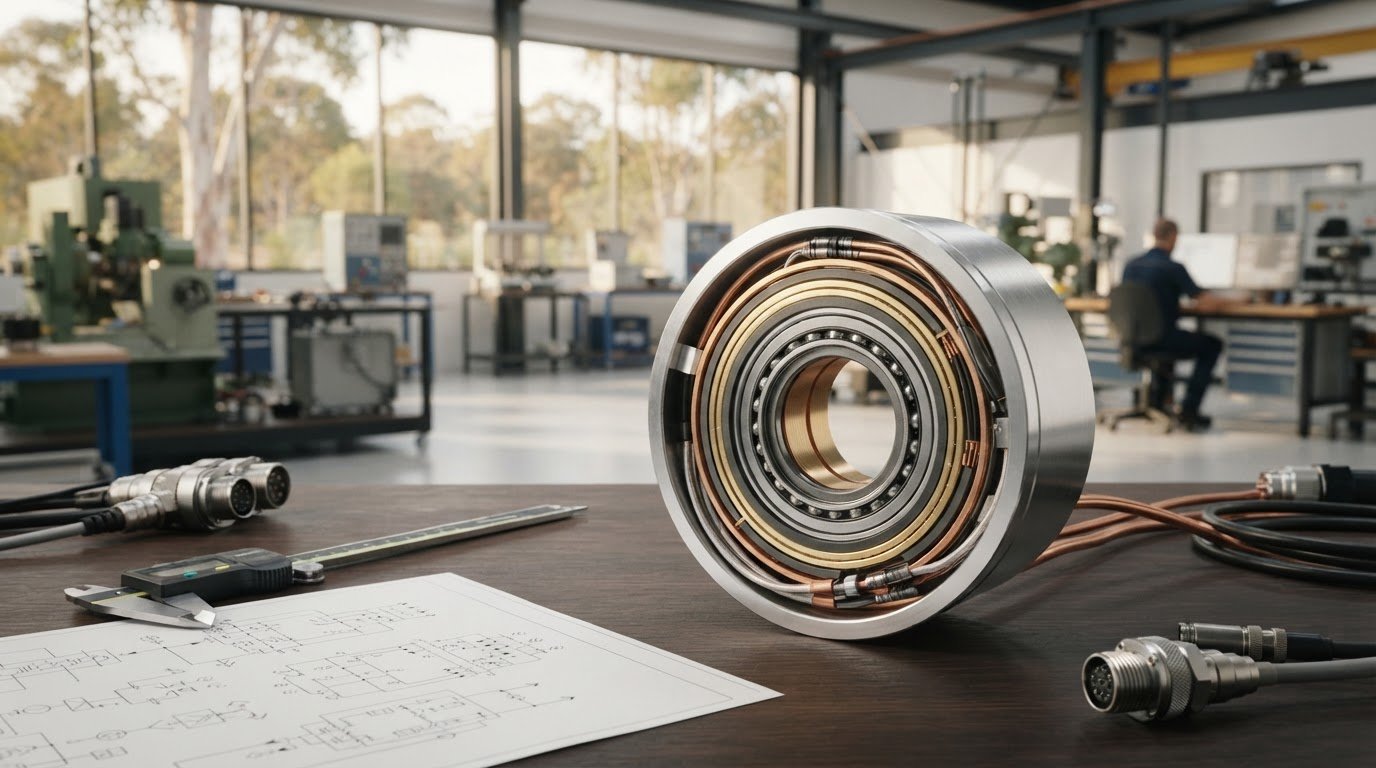
What if securing a reliable SPINNER slip ring alternative didn't involve waiting months for European air freight to arrive? Australian engineering and procurement teams routinely face costly project delays when replacing specialised rotary joints from overseas manufacturers. You know the precise mechanical dimensions, mounting tolerances, and electrical parameters your assembly requires, yet getting timely technical support for custom configurations remains a persistent hurdle.
Direct equivalent engineering eliminates extended offshore lead times without compromising rotary signal fidelity across your Ethernet, video, or high-frequency communication channels. In this guide, you'll discover proven industrial options that match exact circuit counts and rotational speed ratings. We examine drop-in mechanical designs, compare contact technologies, and explain how nationwide technical application consulting ensures complete installation confidence across Australian industry.
Key Takeaways
- Learn how selecting a suitable SPINNER slip ring alternative bypasses lengthy European freight schedules while preserving mechanical fit and circuit integrity.
- Compare contacting assemblies, non-contacting designs, and liquid metal rotary connectors to determine optimal electrical noise profiles across your target rotational speed rating.
- Apply a systematic technical audit to separate high-amperage power circuits from sensitive Ethernet, video, and fieldbus communication lines.
- Explore modular platforms, including Prosper Rotation slip rings, to configure custom channel layouts and mounting options within your existing machinery envelope.
- Discover how domestic technical application consulting and pinout verification eliminate cross-compatibility risks before hardware procurement.
Evaluating the Need for a SPINNER Slip Ring Alternative
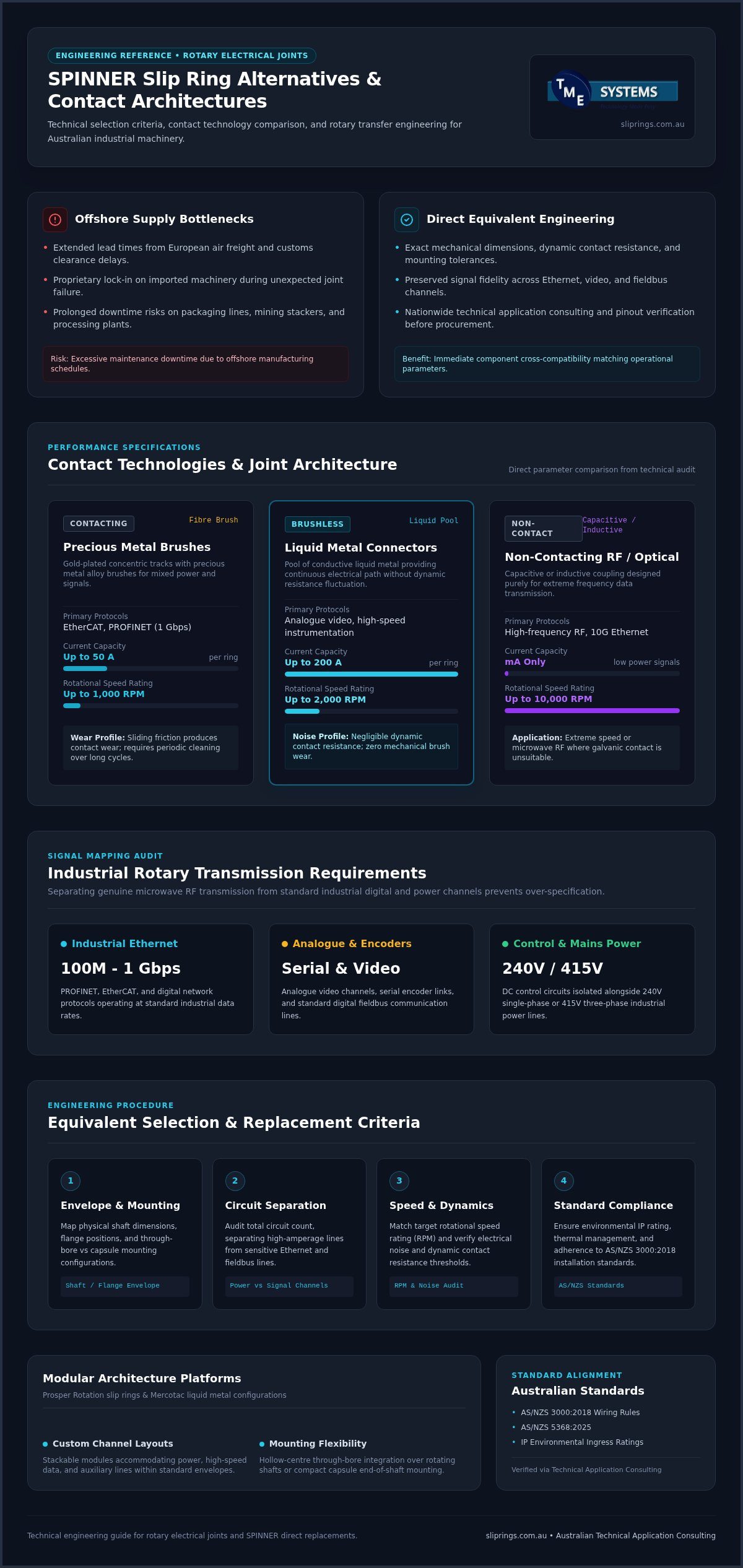
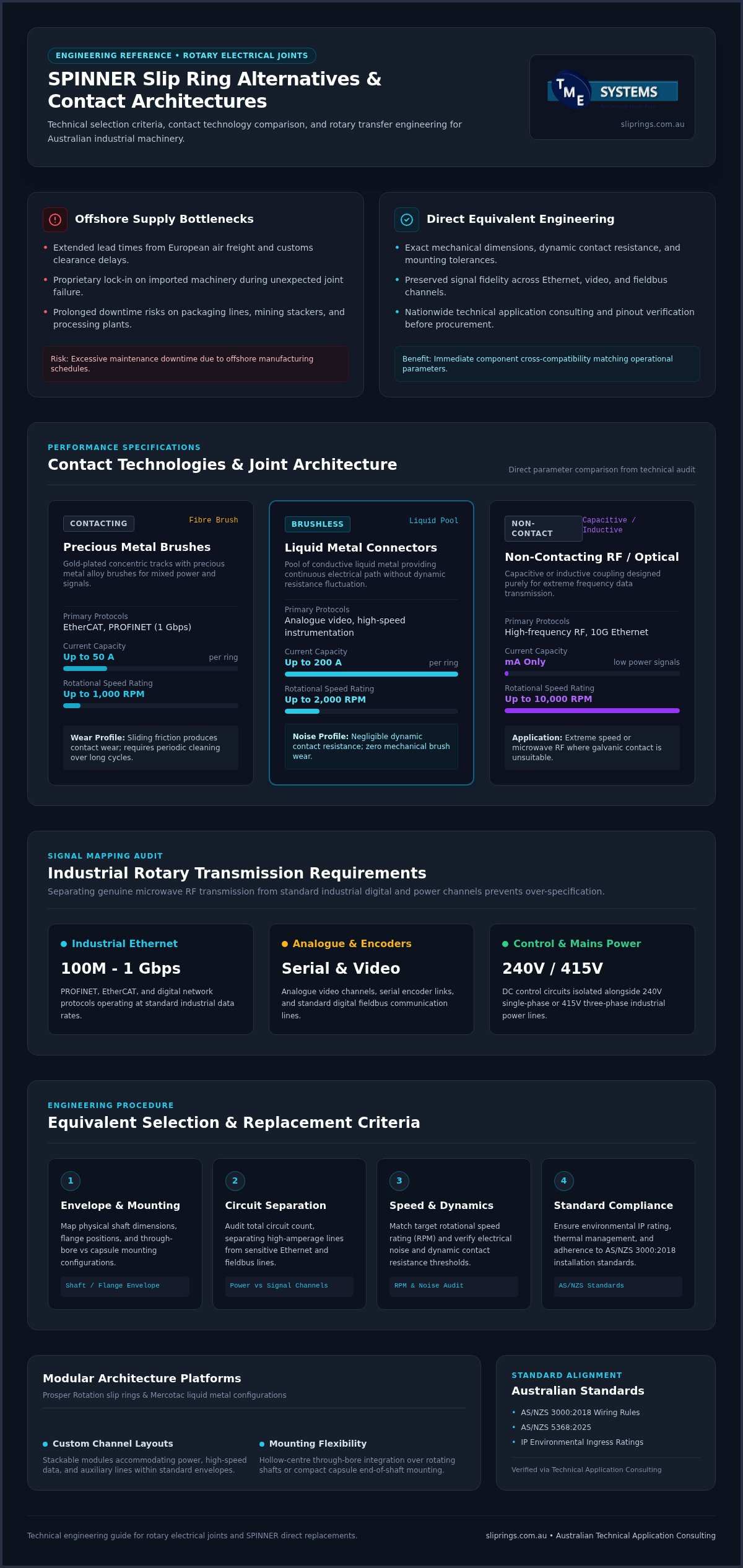
In automated production lines and rotating machinery, finding a direct equivalent rotary joint means matching mounting dimensions, dynamic contact resistance, and signal bandwidth without compromise. A conventional slip ring provides electrical continuity across a rotating boundary using sliding contacts, whereas specialised radio frequency (RF) units often employ non-contacting capacitive or inductive coupling. Many imported machines incorporate proprietary European RF joints where adaptable, commercial rotary electrical joints achieve identical operational results. During scheduled plant overhauls or sudden component failures, identifying an effective SPINNER slip ring alternative allows maintenance teams to bypass proprietary lock-in, streamline maintenance inventories, and maintain equipment uptime.
Supply Chain Delays and Machine Downtime Risks
Relying on specialized European imports exposes Australian facilities to volatile international supply chains. Custom manufacturing runs in offshore factories, combined with international air freight and customs clearance hold-ups, frequently extend delivery schedules past workable maintenance windows. When a critical rotary joint degrades on a packaging system, mining stacker, or processing plant, these delays turn manageable maintenance tasks into prolonged machine downtime. Working with an established Australian distributor gives engineering teams access to local technical application consulting, ensuring cross-compatible replacement hardware is verified and delivered without offshore production holdups.
Identifying Exact Rotary Transmission Requirements
Selecting a dependable SPINNER slip ring alternative begins with separating genuine microwave transmission from everyday high-speed data transmission. Original equipment manufacturers often install high-frequency rotary joints out of standard practice, even when the operational requirement is standard digital communication. Most automated industrial cells transmit data via standard protocols:
- Industrial Ethernet protocols, including PROFINET and EtherCAT, operating at 100 Mbit/s or 1 Gbit/s
- Analogue video, serial encoder links, and standard digital fieldbuses
- DC control signals paired alongside 240V or 415V three-phase power lines
Auditing the actual circuit count and electrical noise thresholds prevents expensive over-specification. Mapping the physical shaft envelope, dynamic rotational speed rating, and environmental ingress protection ensures the replacement joint matches the machine's exact operating conditions.
Technical Comparison: Contact Technologies and Joint Architecture
Selecting a viable SPINNER slip ring alternative requires balancing electrical contact resistance, noise thresholds, and mechanical operating life. While capacitive or inductive non-contacting rotary joints eliminate physical contact, contacting architectures deliver equal signal fidelity across standard industrial bandwidths. In specialized aerospace and defence sectors, Roll ring technology demonstrated that physical rolling contacts can reliably handle high currents alongside sensitive data. Modern industrial assemblies mirror these principles across three primary contact architectures:
| Technology Type | Primary Data Protocols | Current Capacity | Rotational Speed Rating |
|---|---|---|---|
| Precious Metal Brushes | EtherCAT, PROFINET (1 Gbps) | Up to 50 A per ring | Up to 1,000 RPM |
| Liquid Metal Rotary Connectors | Analogue video, high-speed instrumentation | Up to 200 A per ring | Up to 2,000 RPM |
| Non-Contacting RF / Optical | High-frequency RF, 10G Ethernet | Milliamperes (mA) only | Up to 10,000 RPM |
Brush-Based Assemblies vs Liquid Metal Technology
Precious metal alloy fibre brushes run along gold-plated concentric tracks to secure stable multi-channel continuity. This mechanical arrangement handles mixed power and control signals within a compact physical envelope. Over extended operating cycles, sliding mechanical friction produces contact wear and minor carbon or metallic debris, requiring periodic cleaning or brush replacement.
In applications demanding negligible electrical resistance fluctuations, Mercotac slip rings use liquid metal technology to establish a continuous conductive path. Because these brushless assemblies use a liquid conductor, they eliminate dynamic contact bounce, maintain micro-ohm contact resistance, and generate near-zero electrical noise. Their sealed construction prevents internal debris buildup, delivering sustained signal clarity across sensitive sensor loops and strain gauge arrays.
Fibre Optic and High-Frequency Signal Integrity
For data rates exceeding 1 Gbit/s or environments exposed to severe electromagnetic interference (EMI), fibre optic rotary joints (FORJs) provide passive optical transmission with zero electrical crosstalk. However, standard industrial Ethernet protocols rarely require pure optical paths. Properly shielded twisted-pair wiring inside a modular contacting slip ring effectively prevents packet loss across 100 Mbit/s and 1 Gbit/s networks.
Australian plant engineers evaluating a SPINNER slip ring alternative can consult our engineering specialists through technical application consulting to benchmark signal attenuation before finalizing hardware drawings.
Engineering Selection Criteria for Equivalent Rotary Joint Replacement
Replacing an incumbent unit requires a systematic engineering audit across electrical, mechanical, and regulatory criteria rather than trying to match ambiguous catalogue numbers. Integrating a reliable SPINNER slip ring alternative depends on verifying physical boundary dimensions, rotational dynamics, and circuit isolation within the host assembly. Across Australian facilities, every replacement rotary connector must also satisfy electrical installation requirements under AS/NZS 3000:2018.
Evaluating Electrical Loads and Channel Separation
Audit the machine schematic to isolate incoming power feeds from low-voltage signals. Calculate continuous running currents, peak inrush spikes, and voltage drops across each circuit to establish accurate thermal derating factors at high operating temperatures. Group your circuit count logically to prevent electromagnetic interference between high-voltage motor feeds and sensitive digital lines. For heavy industrial machinery operating in extraction or processing environments, alignment with AS/NZS 5368:2025 ensures electrical clearances and insulation ratings handle demanding site conditions.
Mechanical Fitment and Mounting Options
Physical machinery envelopes dictate the required enclosure architecture. A through-bore slip ring slides directly over a drive shaft or hydraulic line, whereas a compact capsule housing secures to an open shaft end where axial clearance is limited. When installing either design, verify the anti-rotation torque arm has adequate radial play. Fastening both the rotor and stator rigidly introduces unwanted side loads onto internal bearings, causing early mechanical failure. The selection review must also accommodate thermal expansion along the drive shaft during sustained operation at high rotational speed ratings.
Environmental Protection and Sealing Ratings
Harsh operating environments require matching enclosure materials to site hazards:
- IP65 housings: Prevent airborne dust ingress and resist low-pressure washdown sprays in factory automation cells.
- IP67 housings: Seal internal contacts against heavy rain and temporary liquid immersion on external machinery.
- Housing metallurgy: Machined aluminium alloys provide lightweight thermal conductivity, while 316 stainless steel resists corrosive minerals, coastal salt air, and aggressive industrial chemicals.
In enclosed equipment spaces lacking forced airflow, internal thermal management prevents accumulated contact heat from degrading bearings and track lubricants over continuous duty cycles.
Proven Alternative Manufacturers for Precision Rotary Transfer
Procuring a precision SPINNER slip ring alternative does not require relying on single-source offshore vendors. Multiple established manufacturers produce direct-match rotary assemblies that meet rigorous industrial specifications across Australian manufacturing, mining, and processing plants. TME Systems distributes these trusted brands nationally, ensuring engineers obtain verified replacements backed by local technical application consulting.
Modular Capsule and Through-Bore Replacements
For machinery requiring customized channel configurations within tight physical boundaries, Prosper Rotation slip rings provide adaptable solutions. Their modular system architecture allows engineers to combine high-speed data transmission lines with general 240V and 415V power circuits in a single unit. These designs are available in both compact capsule housings and through-bore slip ring formats that slide directly over existing drive shafts, making them ideal for rotary indexing tables, automated packaging machines, and multi-axis processing equipment.
Ultra-Low Electrical Noise for Instrumentation
Precision measurement loops and sensitive sensors cannot tolerate the dynamic resistance fluctuations typical of standard sliding contacts. In these demanding environments, Meridian Laboratory slip rings deliver brushless rotary performance with exceptionally low contact resistance. Using specialized liquid metal technology, these units eliminate contact bounce and internal signal distortion. They provide stable transmission for sensitive strain gauges, robotic feedback resolvers, and temperature sensor arrays where signal degradation compromises control system accuracy.
Heavy-Duty Power and Severe Environmental Units
High-power rotary applications require heavy-duty mechanical engineering rather than standard light-duty capsules. In slewing cranes and bulk materials handling equipment, comparing collector ring vs slip ring designs determines how well the assembly manages high thermal loads and large physical forces. For harsh operating conditions exposed to vibration, dust, and washdowns, BGB Innovation slip rings provide rugged enclosures with high IP ratings and replaceable brush gear.
Before purchasing replacement hardware, cross-reference your legacy unit's flange dimensions and electrical pinouts by contacting TME Systems for specialist technical application consulting.
Implementing a Replacement Strategy with Technical Support
Transitioning to a suitable SPINNER slip ring alternative requires disciplined verification before placing an order. Because rotating interfaces sit at the critical junction between stationary machinery frames and moving tooling, minor dimensional or pinout discrepancies cause immediate commissioning stoppages. Applying structured technical application consulting eliminates retrofit risks, giving plant engineers and maintenance planners complete certainty that replacement hardware integrates cleanly into existing assemblies.
Engineering Review and Drawing Verification
The replacement workflow begins by examining original component documentation. Australian engineering teams should supply equipment wiring schematics, operational duty cycles, and original dimension sheets for detailed cross-referencing. During this technical audit, engineers verify three primary criteria:
- Flange geometry: Cross-referencing exact pilot diameters, bolt-circle patterns, and housing lengths against mechanical drawings prevents physical interference with existing brackets.
- Electrical termination: Mapping flying leads, terminal blocks, or mil-spec circular plugs ensures direct pin-to-pin alignment without risky field splicing.
- Load profiles: Reviewing continuous voltage and current parameters validates that insulation ratings comply with AS/NZS 3000:2018 requirements.
Addressing these factors prior to delivery prevents costly mechanical modifications and keeps plant commissioning on schedule.
Securing Direct Sourcing and Technical Selection
Managing equipment upgrades through local technical channels avoids the friction of international procurement. Dealing with offshore sales offices across conflicting time zones often stalls straightforward engineering queries for days. Partnering with a domestic distributor gives engineering teams direct access to experienced application engineering reviews, fast nationwide delivery, and dependable stock holding across Australia.
Once installation parameters are confirmed, ongoing maintenance schedules should track contact wear patterns and seal integrity based on local operating conditions. Selecting a verified SPINNER slip ring alternative backed by nationwide technical application consulting ensures plant machinery maintains high operational availability across its full service life.
Securing Reliable Rotary Transfer Across Australian Operations
Selecting an engineered SPINNER slip ring alternative protects critical production schedules from extended offshore freight hold-ups and proprietary component lock-in. By auditing your machinery's true bandwidth demands, shaft envelope dimensions, and environmental sealing criteria, you can integrate dependable rotary hardware that matches original operational parameters without compromise.
TME Systems provides nationwide distribution and practical technical support across all Australian industries as the authorised distributor for Mercotac, Meridian Laboratory, BGB Innovation, and Prosper Rotation. Our application engineering team delivers detailed technical consulting to review mechanical drawings, map electrical circuit pinouts, and verify compliance with Australian installation standards before hardware ever leaves the warehouse.
Don't let international logistics bottlenecks stall your next maintenance overhaul or machinery build. Consult an engineering specialist at TME Systems to audit your rotary connection requirements, review CAD drawings, and secure the ideal replacement solution for your equipment.
Frequently Asked Questions
Can an alternative slip ring match SPINNER signal quality for high-speed data transmission?
Yes. High-grade contacting assemblies and liquid metal rotary connectors match signal fidelity across high-speed data transmission protocols, including 100 Mbit/s and 1 Gbit/s Industrial Ethernet such as EtherCAT and PROFINET. Precision brush geometries and shielded wiring preserve characteristic impedance while minimizing packet loss. Selecting an engineered SPINNER slip ring alternative ensures clean communication across standard automation frequencies without data interruptions.
How do I choose between a through-bore and a capsule slip ring design?
Base your decision on shaft geometry and available equipment space. A through-bore slip ring features an open centre, allowing direct installation over rotating drive shafts, hydraulic conduits, or pneumatic lines. Capsule slip rings are compact, solid units designed for end-of-shaft integration where radial space is limited. If your machine layout requires routing auxiliary services through the rotational axis, choose a through-bore model; otherwise, a capsule offers simpler mechanical mounting.
Are liquid metal rotary connectors safe and compliant with Australian standards?
Yes, modern liquid metal rotary connectors comply with Australian standards when correctly specified. Contemporary industrial units employ gallium-based liquid metal technology or hermetically sealed contact cavities rather than open hazardous mercury. These designs align with AS/NZS 3000:2018 wiring rules regarding electrical isolation, terminal enclosure, and continuous earth paths, providing micro-ohm contact resistance across sensitive control networks without site contamination risks.
What technical parameters must I provide to cross-reference an existing rotary joint?
Supply original mechanical drawings and electrical schematics. Specify your total circuit count, operating voltage, peak running current per channel, and data bus types. Mechanically, document outer housing diameter, total axial length, pilot spigot dimensions, and maximum rotational speed rating. Noting ambient temperature and required IP rating enables technical consultants to verify an exact SPINNER slip ring alternative that fits without on-site modifications.
What is the operational difference between a collector ring vs slip ring?
The distinction centres on current handling versus signal sensitivity. Collector rings are heavy-duty rotary connectors designed to transfer high electrical currents, delivering hundreds to thousands of amperes at up to 1 kV AC for crane slewing rings and stackers. Standard slip rings use refined contact alloys and compact ring tracks optimized for low-voltage sensor lines, digital fieldbuses, and minimal electrical noise.
How does thermal derating influence the selection of a replacement rotary connector?
Thermal derating dictates the maximum continuous current a rotary electrical joint can carry as internal and ambient temperatures rise. Slip rings generate internal resistive heat, which compounds with high ambient enclosure temperatures and bearing friction. In warm Australian operating environments, derating nominal current prevents premature brush wear, contact track damage, and insulation breakdown caused by unrestrained thermal expansion.
Can custom mounting flanges be supplied to match existing machinery housings?
Yes, modular slip ring systems accommodate custom mounting plates, flange adaptors, and anti-rotation torque brackets. When replacing proprietary imported rotary joints, bolt-circle diameters and spigot depths rarely align with off-the-shelf patterns. Application engineering reviews provide custom mechanical adaptors that match your machine's original bolt pattern, eliminating the need to modify machinery housings or weld brackets during changeover.