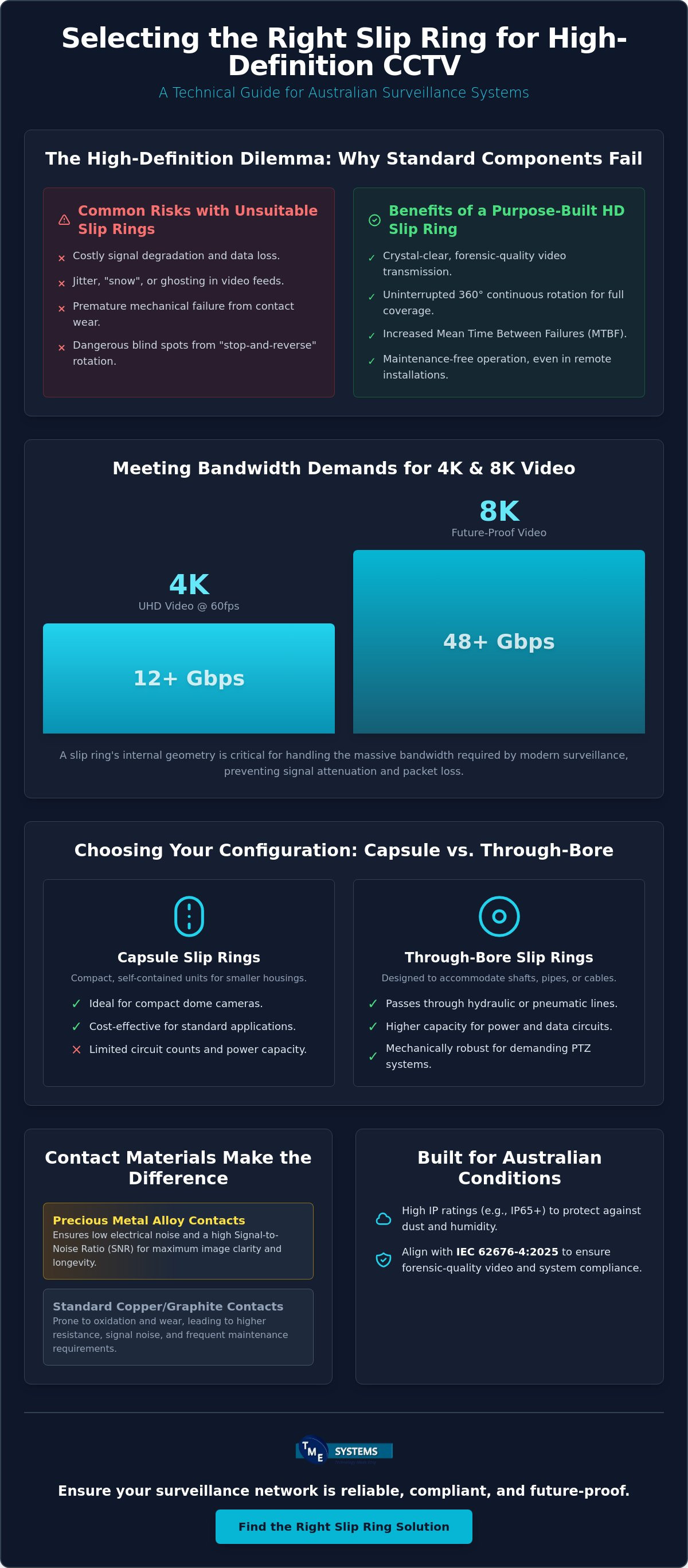
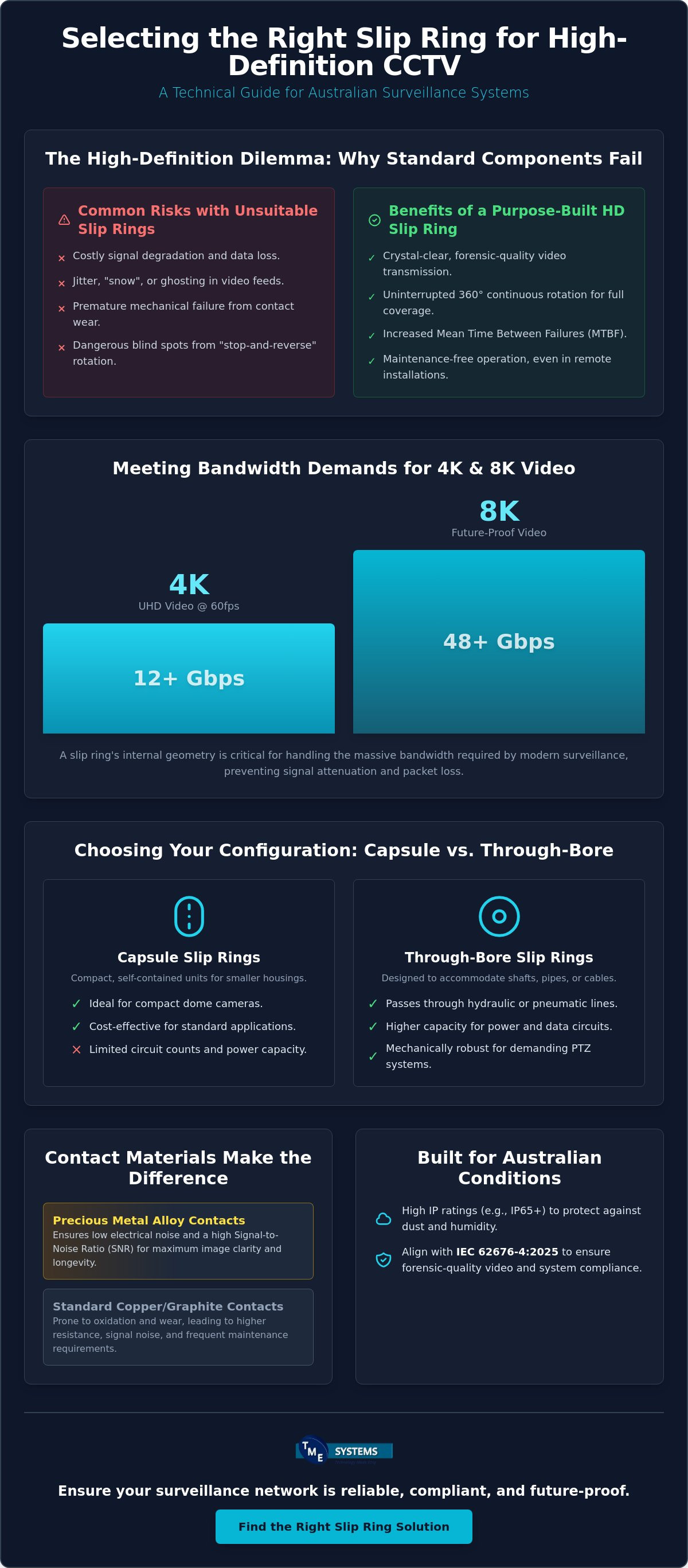
The assumption that any standard rotary joint can handle 4K video feeds is a risk that often results in costly signal degradation and premature mechanical failure. As an engineer or procurement manager, you've likely experienced how electromagnetic interference and contact wear can compromise the integrity of a high-definition surveillance network. Selecting the correct slip ring for CCTV camera applications in 2026 requires a precise balance of electrical specifications and environmental resilience.
This technical reference provides the data necessary for optimising maintenance-free operation in remote installations, ensuring your systems deliver crystal-clear video without jitter. We will evaluate the updated IEC 62676-4:2025 standards, compare gold-contact versus contactless technologies, and address Australian privacy and security requirements to ensure your hardware remains reliable and compliant. By applying technical rigour to your component selection, you can avoid the frequent maintenance cycles that often plague complex PTZ installations across Australia.
Key Takeaways
- Evaluate the specific electrical requirements for 4K and 8K data transmission to prevent signal degradation in modern high-definition surveillance networks.
- Compare capsule and through-bore configurations to identify the most efficient slip ring for CCTV camera housings and pedestals for your project.
- Understand how Australian environmental factors like humidity and dust impact long-term mechanical reliability and signal noise in remote installations.
- Align your hardware selection with the updated IEC 62676-4:2025 standards to ensure forensic-quality video transmission and system longevity.
- Utilise a structured technical checklist to define circuit counts and RPM limits, ensuring full compatibility with complex pan-tilt-zoom requirements.
The Role of Slip Rings in Modern CCTV and Surveillance Systems
A slip ring is an electromechanical device designed to permit the transmission of power and electrical signals from a stationary structure to a rotating one. To understand the foundational mechanics of these components, engineers often start by asking What is a Slip Ring? in the context of rotating interfaces. In a surveillance environment, a high-quality slip ring for CCTV camera systems acts as the critical bridge that allows a camera head to spin indefinitely. Without this component, internal wiring would quickly tangle, fatigue, and eventually snap under the mechanical stress of constant movement.
The technology has progressed significantly from simple analogue video transmission. Modern security requirements now demand the seamless transfer of high-bandwidth digital data streams. A contemporary rotary connector must maintain a stable, low-resistance connection for complex IP protocols and high-definition video while the camera is in motion. This ensures that the electrical path remains unbroken, regardless of the rotation speed or the number of revolutions completed.
Continuous Rotation and Mechanical Freedom
The primary advantage of a specialised slip ring for CCTV camera hardware is the elimination of the "stop-and-reverse" mechanical limitation found in older mounts. Previous generations of pan-tilt units had to hit a physical limit and spin back to the starting position to avoid cable damage. This reset phase created dangerous blind spots in security coverage.
- Automated Patrols: Modern systems utilise pre-programmed patrol patterns that require constant, multi-directional movement without interruption.
- Reduced Component Wear: Removing the tension on internal wiring significantly increases the mean time between failures (MTBF) for the entire camera unit.
- Tracking Continuity: Continuous rotation ensures that a moving target can be tracked across a full 360-degree field of view without the camera needing to reset its position.
For high-duty applications in industrial or commercial sectors, BGB Innovation Slip Rings provide the mechanical robustness needed for constant, 24/7 movement.
Integrating Power and Data in a Single Component
Space is a premium in modern surveillance design, particularly in compact dome cameras. A single slip ring must manage a diverse range of circuits within a very small footprint. This typically includes high-amperage power for the pan-and-tilt motors, lower voltage for the camera's internal logic, and high-frequency data lines for the video feed.
Effective circuit isolation is vital in these configurations. If the slip ring isn't properly shielded, the electromagnetic field from the power lines can cause crosstalk. This results in "ghosting" on analogue feeds or dropped packets in digital systems. High-performance options, such as Prosper Rotation Slip Rings, are engineered to maintain signal integrity even when circuits are tightly packed. This level of integration allows for smaller camera housings while maintaining the forensic video quality required by the latest Australian security standards.
Key Technical Specifications for High-Definition Video Transmission
High-definition video, particularly 4K and 8K, requires significantly higher bandwidth than standard analogue feeds. A standard slip ring for CCTV camera may struggle with signal attenuation that occurs at high frequencies. Ensuring signal integrity means selecting a component that can handle data rates exceeding 12 Gbps for 4K/60fps SDI or maintaining stable 1000BASE-T Ethernet connections. As 8K systems become more prevalent in 2026, the demand for low-capacitance rotary joints that can manage 48 Gbps bandwidth is increasing, making the internal geometry of the slip ring a critical design factor.
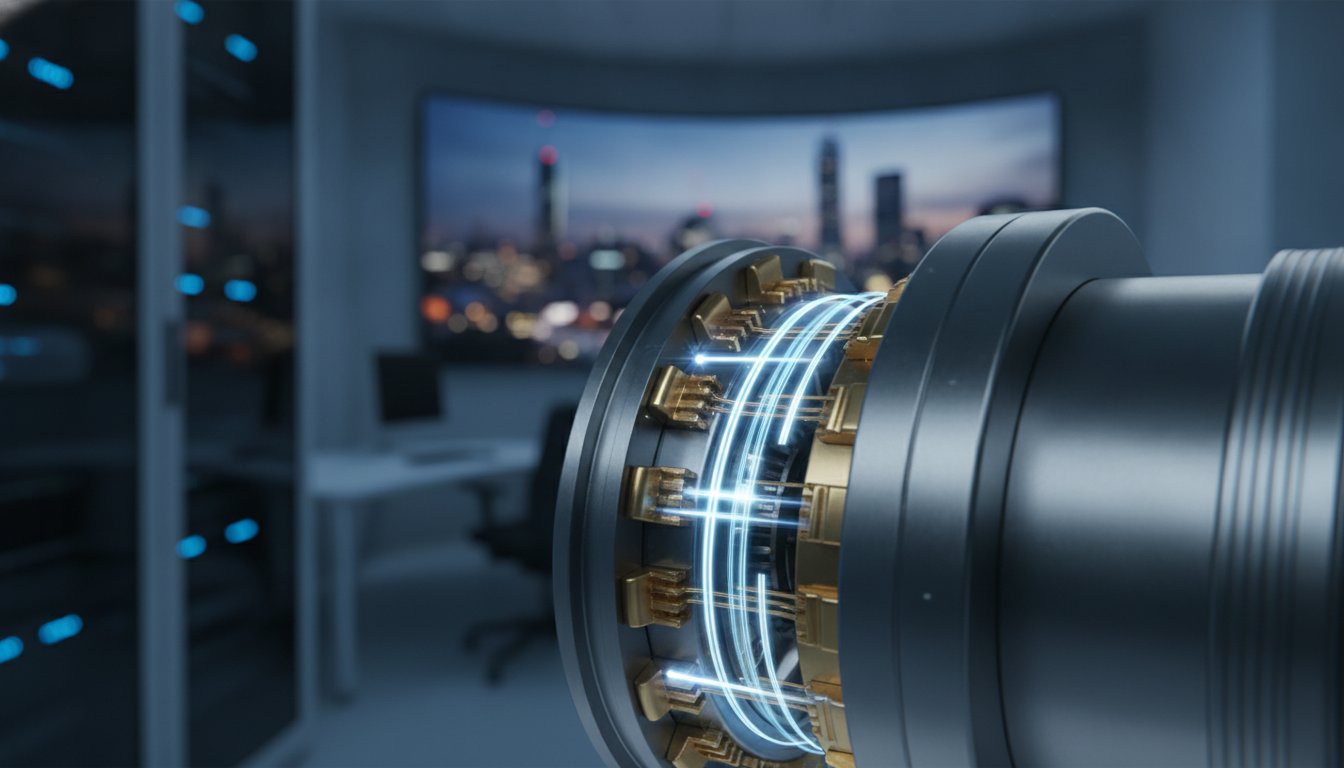
The Signal-to-Noise Ratio (SNR) is the primary metric for image clarity. In a rotary joint, noise is often generated by the mechanical friction of the brushes against the rings. High contact resistance leads to voltage drops and thermal noise, which manifests as "snow" or jitter in the video feed. To mitigate this, contact materials must be selected for their conductive properties and low wear rates. Using precious metal alloys instead of basic copper or graphite ensures that the electrical contact remains stable even after millions of revolutions, preserving the forensic quality required by IEC 62676-4:2025.
Digital Protocols: SDI, HDMI, and Ethernet
Professional surveillance often utilises Serial Digital Interface (SDI) due to its reliability over long distances. To maintain signal integrity in professional video circuits, the slip ring must provide a precise 75-ohm characteristic impedance to prevent signal reflections and data loss. In IP-based systems, the focus shifts to preventing packet loss and latency. Gigabit Ethernet (1000 Mbit) requires precision-matched pairs within the slip ring to support Cat5e or Cat6 standards. This prevents the "bottleneck" effect where a high-speed camera is limited by the physical connection in the mounting.
Minimising Electromagnetic Interference (EMI)
EMI is a constant threat in industrial environments where camera mounts are located near high-voltage motors or power lines. Effective shielding within the slip ring housing is essential to isolate sensitive data circuits from power interference. Selecting a shielded slip ring for CCTV camera units ensures that external electrical noise does not degrade the video signal. Differential signalling helps by using two complementary signals to reject common-mode noise across the rotating interface. For low-level signal circuits, gold-on-gold contacts are the industry standard because they provide the lowest contact resistance and highest corrosion resistance. This is especially important for maintaining data integrity in the high-humidity environments often found in coastal Australian installations.
If you need to ensure your system meets these rigorous data standards, exploring Meridian Laboratory Slip Rings can provide the high-performance connection required for 4K and 8K feeds.
Comparing Capsule and Through-Bore Slip Ring Configurations
The physical form factor of a rotary joint is often the first constraint an engineer must address during the design phase. While the electrical requirements define the internal contact technology, the mechanical housing determines how the component integrates into the camera assembly. Selecting the right slip ring for CCTV camera installations involves choosing between a compact capsule design or a versatile through-bore configuration. Each has distinct advantages based on the mounting environment and the complexity of the surveillance hardware.
Engineering teams must balance space constraints against circuit capacity. A smaller diameter reduces the rotational torque and allows for higher RPM limits, but it also limits the number of high-current or shielded data lines that can be housed within the unit. Conversely, larger units provide more room for complex wiring but require more robust mounting hardware to manage the increased mechanical load.
Capsule Designs for Compact Surveillance
Capsule slip rings are the standard choice for internal dome cameras and light commercial security systems. These units are typically designed with a small outer diameter (OD), often ranging from 22mm to 45mm. Their compact footprint makes them ideal for equipment where internal space is at a premium. Most capsule designs come pre-wired with colour-coded leads, which simplifies the installation process and reduces the risk of wiring errors during assembly.
These designs are particularly effective for indoor applications or controlled environments where the camera housing provides primary protection against the elements. Because they're fully enclosed, they offer a reliable, maintenance-free solution for high-speed PTZ cameras that require constant, fluid movement. Their low starting torque ensures that small, precision motors can drive the rotation without excessive power draw or mechanical jitter.
Through-Bore Advantages for Industrial Masts
When a surveillance system is mounted on a central shaft or requires the passage of other media, a through-bore slip ring is necessary. These components feature a hollow centre, allowing them to be mounted directly over a drive shaft or to accommodate pneumatic and hydraulic lines in hybrid systems. This configuration is common in heavy-duty industrial pedestals and defence-grade sensor masts where the camera is just one part of a larger rotating assembly.
Through-bore models provide significantly more internal volume, which is essential for managing high-circuit counts or integrating fibre optic rotary joints. For versatile mounting options in demanding environments, Prosper Rotation slip rings offer the mechanical flexibility needed for these larger-scale projects. They allow engineers to pass cooling lines or additional structural supports through the centre of the rotation axis without compromising electrical connectivity. This is a critical advantage for Australian industrial monitoring sites where hardware must be integrated into existing infrastructure or heavy machinery.
Addressing Signal Noise and Environmental Resilience
The reliability of a slip ring for CCTV camera systems in Australia is frequently challenged by extreme environmental variables. Unlike indoor installations, outdoor surveillance units must contend with fine silica dust in the outback and high salt-mist concentrations in coastal regions. Traditional mechanical brushes are susceptible to these particulates. As dust enters the housing, it acts as an abrasive, accelerating the wear of the contact rings. This mechanical degradation directly correlates with increased electrical resistance and signal noise, which can eventually render high-definition video feeds unusable.
Mechanical wear isn't just about physical breakdown; it's about electrical consistency. In a standard brush system, the contact point is constantly changing on a microscopic level. As the camera rotates, the brushes skip or vibrate, creating micro-arcs that introduce high-frequency noise into the data stream. Over time, the build-up of carbon or metal dust from the brushes creates a conductive path between circuits. This leads to crosstalk or short circuits, which is why a system that performs well during commissioning might fail six months later in a high-rotation environment.
Liquid Metal Technology for Near-Zero Noise
For applications requiring absolute signal fidelity, liquid metal rotary connectors offer a superior alternative to conventional brushes. Instead of a solid-to-solid sliding contact, these units use a pool of liquid metal to maintain the electrical path. This results in near-zero electrical noise and consistent resistance throughout the life of the component. Because there's no mechanical friction between solid parts, the signal remains stable even at higher rotational speeds.
When selecting a slip ring for CCTV camera systems used in professional broadcast or forensic monitoring, Mercotac slip rings provide the high-fidelity connection needed to eliminate the jitter associated with traditional contact wear. The lack of wear debris also means these units are effectively maintenance-free. It's a critical advantage for cameras mounted in inaccessible locations where regular servicing is logistically difficult or expensive.
Durability in Harsh Australian Climates
Australia's climate presents unique challenges, with ambient temperatures in remote mining or outback sites often exceeding 45°C. High-performance slip rings must be rated for these extremes to prevent the expansion of internal components from causing mechanical binding. In coastal areas, corrosion resistance is equally vital. Stainless steel or treated aluminium housings are necessary to prevent salt-air ingress from compromising the internal circuitry.
Sealing standards play a pivotal role in this resilience. While IP65 provides protection against low-pressure water jets, an IP67 rating is critical for wash-down or coastal environments because it ensures the internal electronics remain completely isolated from high-pressure moisture and corrosive salt-air ingress. To ensure your hardware is suitable for these specific conditions, you should consult our technical experts on BGB Innovation solutions for ruggedised applications.
Selecting the Right Slip Ring for Australian Surveillance Applications
The final stage of hardware procurement involves matching specific component capabilities to the operational environment. A slip ring for CCTV camera integration in a commercial retail centre requires a different technical profile than one destined for a coastal defence installation or a remote mining site. Defence applications often demand higher vibration resistance and superior electromagnetic shielding to protect against sophisticated interference. In contrast, industrial monitoring focuses on mechanical longevity in high-dust environments where the camera may operate 24/7 on an automated patrol loop.
To ensure the selected rotary joint meets these demands, engineers should compile a rigorous technical checklist before finalising a specification. This list must include:
- Circuit Count and Type: Distinguish between power circuits for pan-tilt motors and sensitive data lines for 4K or 8K video.
- Current and Voltage: Specify the maximum amperage for heaters or high-torque motors to prevent internal overheating.
- Rotational Speed (RPM): Define the typical and maximum operating speeds, as high-speed tracking requires lower friction contacts.
- Operating Environment: Account for the A$ costs associated with maintenance by selecting higher IP ratings for corrosive coastal sites.
Future-proofing is another critical consideration. As Australian surveillance networks migrate toward higher bandwidth requirements, selecting a slip ring that can handle 10Gbps Ethernet or 12G-SDI ensures the mounting hardware doesn't become obsolete when camera heads are upgraded.
Consultative Selection Process
Technical application consulting is essential for bridging the gap between theoretical specifications and real-world performance. TME Systems Pty Ltd assists in this process by auditing environmental variables, such as UV exposure and temperature fluctuations, which are unique to the Australian climate. This consultative approach helps balance the upfront investment against long-term operational reliability, ensuring the total cost of ownership remains low.
For applications requiring high-speed precision and near-zero maintenance, we recommend evaluating Meridian Laboratory slip rings. These components are engineered for environments where signal noise cannot be tolerated and mechanical downtime must be eliminated. By choosing a partner who understands the nuances of rotary interfaces, you can avoid the common pitfalls of signal jitter and premature contact failure.
Implementation and Procurement in Australia
Sourcing specialised components through local channels provides the advantage of technical backing and faster lead times. It's vital to ensure that all integrated hardware complies with Australian electrical safety standards and, where applicable, the Australian Privacy Principles (APP) as monitored by the OAIC. In 2026, cybersecurity best practices, including NDAA compliance, have become a standard requirement for many government and critical infrastructure projects across the country.
Selecting a high-performance slip ring for CCTV camera units isn't just about the physical connection; it's about the integrity of the entire surveillance network. For a professional technical audit of your rotary connection needs, contacting a specialist consultant ensures that your hardware selection is optimised for both current performance and future scalability.
Optimising Your Surveillance Network Reliability
Selecting a high-performance slip ring for CCTV camera systems is a critical decision that impacts signal integrity and long-term maintenance costs. By prioritising low contact resistance and advanced environmental sealing, you can eliminate the jitter and mechanical wear that frequently compromise high-definition feeds. Whether your project involves compact dome cameras or large-scale industrial pedestals, the technical specifications must align with both current bandwidth requirements and the updated IEC 62676-4:2025 standards.
TME Systems provides pragmatic, solution-oriented support for Australian industrial clients. As an authorised distributor for Mercotac and Meridian Laboratory, we offer expert technical assistance for circuit selection and environmental matching. This ensures your hardware remains reliable in harsh outback or coastal conditions. We invite you to Request a Technical Consultation for Your Surveillance Project to discuss your specific rotary connection requirements. Investing in precision-engineered components today ensures your surveillance infrastructure remains robust and future-proof.
Frequently Asked Questions
How do I choose between a capsule and a through-bore slip ring for my camera?
Choose a capsule design for compact dome cameras where internal space is limited and ease of installation is a priority. These units are typically pre-wired and self-contained. Opt for a through-bore configuration if your camera system is mounted on a central shaft or if you need to pass additional components, such as pneumatic lines or structural supports, through the centre of the rotation axis.
Can a CCTV slip ring transmit 4K video without signal loss?
A high-quality slip ring for CCTV camera systems can transmit 4K video without loss if it's engineered specifically for high-frequency data. You must ensure the component supports the required bandwidth for 12G-SDI or Gigabit Ethernet protocols. Using gold-on-gold contacts or liquid metal technology helps maintain the low electrical resistance and stable impedance necessary for forensic-quality image transmission without jitter.
What is the typical lifespan of a slip ring in a continuously rotating camera?
The lifespan varies significantly based on the contact technology and rotational speed. Traditional brush-based slip rings typically last for tens of millions of revolutions before requiring service or replacement. In contrast, liquid metal or high-precision precious metal options can operate for hundreds of millions of revolutions with negligible wear. This makes them the preferred choice for 24/7 automated patrol patterns in industrial environments.
Are there mercury-free options for rotary connectors in food-grade or sensitive environments?
Yes, there are numerous mercury-free rotary connectors available for sensitive Australian industrial applications. While some liquid metal options use gallium alloys, many high-performance slip rings utilise precious metal brushes, such as gold or silver. These provide excellent conductivity and reliability without the environmental risks associated with mercury, ensuring full compliance with food-grade or clean-room standards.
How does signal noise affect the performance of an IP-based security camera?
Signal noise in IP-based systems primarily manifests as dropped packets, increased latency, or noticeable video jitter. High contact resistance or electromagnetic interference within the slip ring can disrupt the digital data stream. This leads to a loss of forensic detail or intermittent feed dropouts, which is why maintaining a high signal-to-noise ratio is critical for modern IP surveillance networks.
What maintenance is required for slip rings used in outdoor surveillance?
Maintenance requirements depend entirely on the sealing and contact technology used. Standard brush-based units in dusty Australian environments may require periodic inspection for debris build-up and contact wear to prevent signal degradation. However, selecting a maintenance-free slip ring for CCTV camera applications, such as a sealed liquid metal unit, effectively eliminates the need for physical intervention in remote or inaccessible locations.
Can I combine power and Ethernet signals in the same slip ring unit?
You can combine power and Ethernet signals within a single multi-circuit slip ring unit. It's essential to select a design with robust internal shielding and circuit isolation to prevent the power lines from interfering with the sensitive data transmission. This integration saves significant space in compact housings while maintaining the data integrity required for high-speed IP cameras and PTZ control signals.
What IP rating do I need for a slip ring installed in a coastal area?
An IP67 rating is the recommended standard for slip rings installed in coastal Australian regions. This rating provides complete protection against dust ingress and ensures the internal electronics are shielded from high-pressure moisture and corrosive salt-mist. Using a lower rating, such as IP65, may leave the system vulnerable to moisture ingress over time, leading to premature electrical failure in maritime environments.