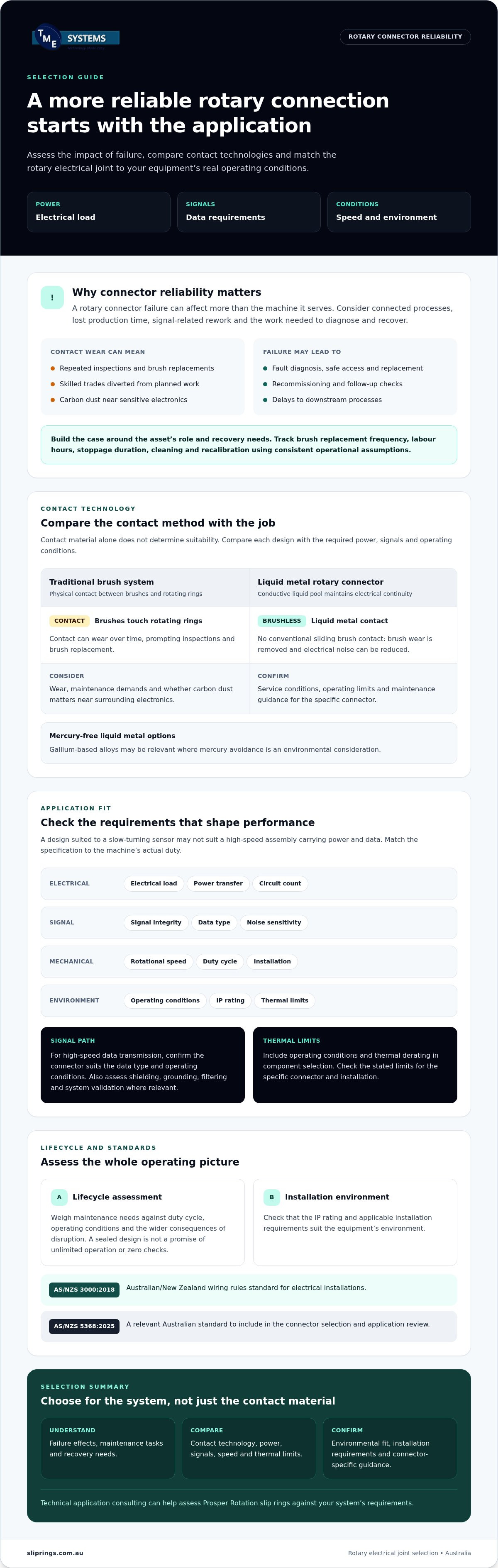
What if a rotary connector’s value is best measured by the failures it prevents? The business case for high-reliability rotary connectors starts with a familiar industrial challenge: brush wear can mean recurring maintenance, unplanned stoppages and signal noise that affects data quality. A connector that needs less intervention and maintains signal integrity can support more dependable operation over the life of the equipment.
It’s reasonable to ask whether a different connector design will make a practical difference. The answer depends on the application, including its electrical load, data requirements, rotational speed and operating environment. Brushless liquid metal rotary connectors may suit applications where reducing contact wear and electrical noise is a priority. Other systems may call for a different slip ring configuration.
This article explains how to assess reliability against maintenance demands and production disruption, and what to consider when selecting a rotary electrical joint. It also covers Prosper Rotation slip rings, mercury-free liquid metal options, application requirements and relevant Australian standards, including AS/NZS 5368:2025. The aim is to help you identify a connection suited to your equipment, with reliable power transfer and clear, consistent signals.
Key Takeaways
- Build the business case for high-reliability rotary connectors by assessing the wider effects of connector failure, including production interruption and signal-related rework.
- Compare contact technologies against your application’s power, signal and operating requirements, rather than choosing on contact material alone.
- Use a lifecycle assessment to weigh maintenance needs and operating conditions, including how thermal derating may affect component selection.
- Check that the connector’s IP rating and applicable installation requirements suit the equipment’s environment. AS/NZS 3000:2018 is the Australian/New Zealand wiring rules standard for electrical installations.
- Use technical application consulting to assess connector options from Mercotac, Meridian Laboratory and Prosper Rotation against your system’s requirements.
The Financial Impact: Building the Business Case for High-Reliability Rotary Connectors
A rotary connector failure can disrupt more than the machine it serves. In an automated production line, a stoppage may interrupt connected processes, delay output and require skilled staff to diagnose the fault before operations resume. The impact depends on the equipment’s role and recovery time, so assess the wider operational consequences alongside the component failure itself.
A slip ring is an electromechanical device that transfers power or signals between stationary and rotating parts. Contact wear can lead to repeated inspections and brush replacements, drawing skilled trades away from planned work. Carbon dust from traditional brushes may also settle near sensitive electronics, making inspection and cleaning relevant to surrounding equipment as well as the connector.
Direct and Indirect Maintenance Impacts
Separate the immediate maintenance task from its knock-on effects. The immediate work may include fault diagnosis, safe access, replacement and recommissioning. Indirect effects can include lost production time, delays to downstream processes and additional checks before the line returns to normal operation.
The business case for high-reliability rotary connectors should reflect the machine’s duty cycle and the consequences of interruption. Track brush replacement frequency, labour hours, stoppage duration and any follow-up cleaning or recalibration. These records help engineering and procurement teams compare connector designs using consistent operational assumptions.
Signal Integrity and Operational Accuracy
Changing contact resistance can affect the electrical signal passing through a rotary joint. In systems that depend on accurate feedback, noise or intermittent transmission may distort readings, prompt recalibration or complicate fault diagnosis. The effect depends on the signal, control system and how the equipment handles interference.
For safety-related systems, assess the complete signal path, including shielding, grounding, filtering and system validation. Don’t assume rotary connection noise alone will cause a false trigger. For high‑speed data transmission during continuous rotation, confirm that the connector suits the data type and operating conditions. Consistent signal transfer supports reliable information flow and helps maintain the accuracy of the wider rotating asset.
Risk assessment should account for the asset’s role and the steps needed to recover from failure. Matching connector technology to the mechanical, electrical and environmental demands can help reduce avoidable intervention and support dependable operation.
Performance Metrics of High-Reliability Technology
Reliability depends on how a rotary connector performs under the machine’s actual electrical, mechanical and environmental conditions. A design suited to a slow-turning sensor may not suit a high-speed assembly carrying power and data. Compare contact method, circuit count, rotational speed rating and thermal limits against the application, rather than treating “high-reliability” as a standalone specification. NASA’s work on slip ring performance in demanding space applications provides a useful reference for the engineering attention these components can require.
Liquid Metal and Traditional Brush Systems
Traditional brush systems transfer current through physical contact between brushes and rotating rings. That contact can wear over time. In liquid metal rotary connectors, a conductive liquid pool maintains electrical continuity without a conventional sliding brush contact. This removes brush wear and can reduce electrical noise. Mercury-free liquid metal options use gallium-based alloys, which may be relevant where mercury avoidance is an environmental consideration. The NASA report has demonstrated high-reliability slip ring performance in a demanding application, though each industrial installation still needs its own engineering assessment.
Read “sealed for life” as a design description, not a blanket promise of unlimited operation or zero checks. For procurement, confirm the stated service conditions, operating limits and maintenance guidance for the specific connector. A sealed design may reduce routine contact-related intervention, but suitability still depends on the duty cycle and installation.
Optimising Circuit Count and Configuration
Work out the required circuit count by listing each power and signal path, then check whether they can be combined in one assembly without compromising performance. A modular system can bring different circuit functions into a single unit, but electrical separation, signal type and thermal limits need consideration. Contact materials also matter: carbon brushes are subject to contact wear, while precious-metal contacts and liquid metal technology are used in designs aimed at consistent transmission. Performance depends on the connector construction and application, not material alone.
Form factor affects integration. A through-bore slip ring fits around a shaft and can leave space for other components. A capsule design may suit end-of-shaft mounting where space is limited. At higher speeds, confirm the rotational speed rating and allow for heat generated in operation. Thermal management, including appropriate thermal derating, helps account for ambient temperature and current load. Thermal expansion can also affect clearances and performance, so check the manufacturer’s limits for the intended operating conditions.
For an application-specific comparison, review the operating requirements against Prosper Rotation slip rings and consider technical application consulting. This helps make the business case for high-reliability rotary connectors based on fit and expected operating demands, rather than assumptions about a single technology.
Evaluating Total Cost of Ownership (TCO)
Assess a rotary connector across its expected service life, not only at the point of selection. Set a consistent review period and operating profile for each option, then compare installation requirements, energy use, inspection intervals, maintenance tasks, replacement planning and end-of-life handling. This gives engineering and procurement teams a clearer view of how connector performance may affect ongoing operations.
- Maintenance planning: Compare inspection guidance, service tasks and the staff time required to complete them.
- Operating performance: Review voltage drop at the expected current and consider how interface losses affect power delivery.
- Lifecycle assumptions: Record duty cycle, ambient temperature, rotational speed and expected operating hours so comparisons use the same conditions.
- Parts readiness: Assess expected replacement needs and how they influence spare-part holdings for critical machinery.
Longevity and Service Life Expectations
There isn’t one average MTBF that applies to every precision or commodity slip ring. Request reliability data for the specific model and check the conditions behind it, including load, speed, temperature and duty cycle. Treat MTBF as an estimate for a defined operating profile, not a guaranteed service life. Thermal expansion can affect clearances as components heat and cool, so review the manufacturer’s operating limits and inspection guidance for the intended application.
Thermal derating also informs long-term selection. As ambient temperature rises, the allowable current may need to be reduced to control temperature. Compare the manufacturer’s derating guidance with the installation’s expected load and conditions. Consider whether thermal management supports the required operating profile, and use the manufacturer’s maintenance recommendations to plan inspections around equipment operation.
Operational Resilience in Australian Industry
Accurate specification can simplify inventory planning. Confirm circuit count, current, voltage, speed, mounting arrangement and environmental conditions before selecting a connector. This helps avoid unnecessary part variations and clarifies which spares suit critical machinery. Technical application consulting can help resolve these requirements where an assembly combines power and signal circuits or has tight mounting constraints.
For one option to include in an application review, see Meridian Laboratory Slip Rings. Record the assumptions behind the selection and revisit them if operating conditions change. That keeps lifecycle planning grounded in the actual equipment profile and supports a dependable maintenance schedule.
Selecting for Environmental Resilience and Standards
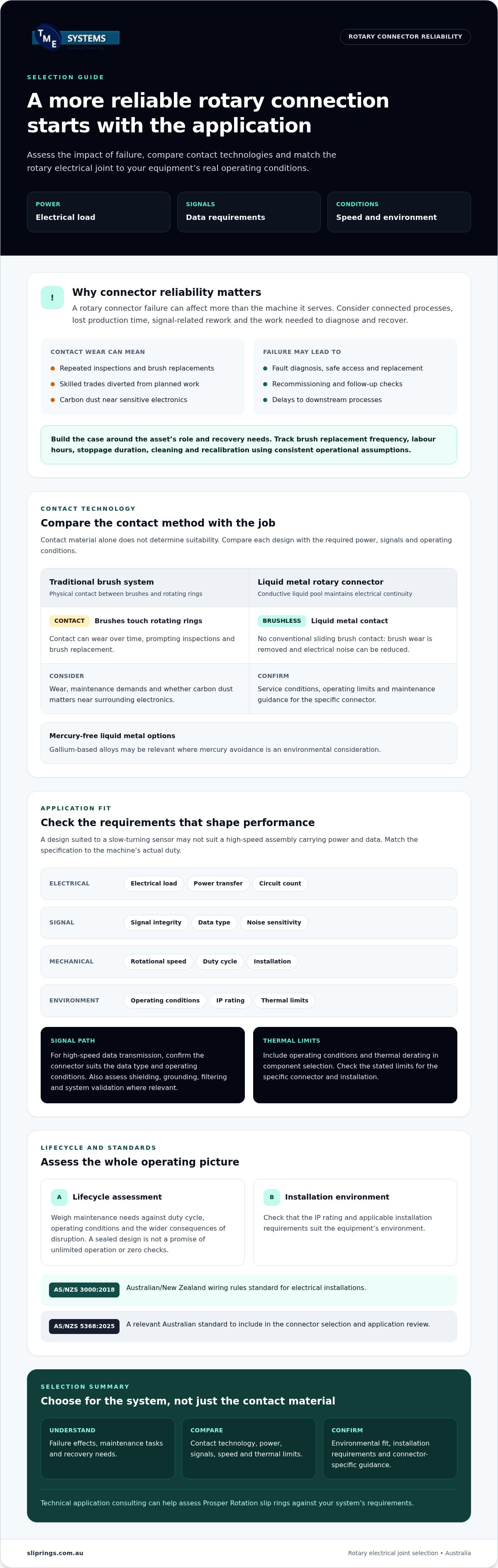
A rotary connector’s rating must suit the conditions at the point of installation. Dust, moisture, salt exposure, vibration and temperature can affect performance, so specify the environment as carefully as the electrical load. An IP rating describes protection against dust and water ingress, but it doesn’t address every environmental factor or guarantee suitability for a particular site.
Sealing and Corrosion Protection
Don’t select an IP rating by number alone. For washdown, marine or outdoor use, confirm the manufacturer’s test conditions and whether the connector is suitable for the actual exposure, including water pressure, duration and salt contamination. Check materials, finishes and sealing details for corrosion resistance in humid or coastal conditions. The BGB Innovation heavy duty solutions page is one option to review when assessing connector choices for demanding applications.
Include installation details in the specification: mounting orientation, cable entry, nearby chemicals and any maintenance access constraints. The business case for high-reliability rotary connectors depends partly on choosing a design that fits the operating environment, not simply one with a higher IP rating.
Safety and Regulatory Compliance
AS/NZS 3000:2018 is the Australian/New Zealand wiring rules standard for electrical installations. Confirm with the project’s electrical professionals how it applies to the installation, and check circuit count, voltage and connection details against the equipment design. The standard is not a substitute for reviewing the connector’s own ratings or the requirements of the complete machine.
For mining and quarry applications, assess whether AS/NZS 5368:2025 applies to the equipment and procurement specification. Don’t infer compliance from a component description alone. Request relevant documentation and have the responsible engineering team confirm the standard’s application to the site and assembly. A final review should consider the whole installation, including the rotary electrical joint, protection, wiring and operating environment.
Where equipment is intended for a hazardous area, verify that the complete connector assembly is suitable for the site’s classification and that supporting documentation meets project requirements. Don’t assume a standard slip ring is suitable for an explosive atmosphere. Similarly, mercury-free liquid metal options use gallium-based alloys instead of mercury, avoiding mercury’s toxicity concerns, but the material choice doesn’t replace a full WHS risk assessment.
For a specification that accounts for application conditions and product requirements, review BGB Innovation slip ring options alongside technical advice from a qualified project team.
Strategic Procurement with TME Systems
Connector selection works best when procurement and engineering assess the same application requirements. TME Systems distributes Mercotac, Meridian Laboratory, BGB Innovation and Prosper Rotation slip rings, and provides technical application consulting to help identify suitable options. Start with the assembly’s interfaces and constraints, then check that the proposed connector aligns with the equipment design and manufacturer documentation.
Prepare an application brief before comparing configurations. Include the connection points, circuit functions, cable routing, mounting space, shaft arrangement and any limits on access for installation or inspection. For modular designs, note which functions need to be combined and whether the assembly must allow for future changes. This makes it easier to identify unresolved requirements before specifying a connector.
High-Current and Specialist Applications
For a crane slewing application, specify the current and voltage requirements, duty cycle and mechanical arrangement for the high‑current slip ring for cranes. Confirm that the selected unit’s documented ratings match the actual operating conditions. A robotic arm may call for a different configuration, with its data protocol, cable routing, movement profile and available mounting space considered together.
Where liquid metal technology is being considered, review the application requirements against Mercotac liquid metal connectors. Selection should be based on documented suitability for the required circuits and operating conditions, not on the contact method alone.
The Value of Application Engineering
Technical application consulting helps turn machine requirements into a clear connector specification. For example, a mounting constraint may affect which form factor can be integrated, while a mixed power-and-signal requirement may influence the circuit arrangement. Confirming these details early can prevent design revisions and compatibility issues during integration.
TME Systems helps assess Australian project requirements against products from Mercotac, Meridian Laboratory, BGB Innovation and Prosper Rotation. Share the equipment’s operating profile, interface details and applicable documentation so options can be assessed against the actual application. This engineering-led process supports the business case for high-reliability rotary connectors by grounding selection in verified requirements and product information.
Make Reliability Part of Your Procurement Decision
The business case for high-reliability rotary connectors rests on matching connector performance to the machine’s electrical, mechanical and environmental demands. A lifecycle view helps teams account for maintenance and interruptions, while careful review of ratings and applicable standards supports informed specification.
TME Systems distributes Mercotac and Meridian Laboratory products and provides technical application consulting for engineering requirements. For standards-related considerations, confirm how AS/NZS 5368:2025 applies to your specific equipment and project.
Bring your operating conditions, circuit requirements and mounting constraints into the selection process early. Contact TME Systems for Technical Application Consulting to discuss suitable rotary connector options for your application. A well-informed specification is a practical step towards dependable operation.
Frequently Asked Questions
What is the difference between a collector ring and a standard slip ring?
A collector ring is generally designed for heavy-duty, high-current transfer, while a standard slip ring is often selected for lower currents or signal transmission. The distinction isn’t absolute, so compare the manufacturer’s ratings and intended use. For selection, check current, voltage, circuit count, signal type, rotational speed and operating environment. A connector suited to carrying power may not provide the signal performance your application requires.
How does liquid metal technology eliminate electrical noise in rotary connectors?
Liquid metal technology can reduce electrical noise by maintaining continuity through a conductive liquid pool rather than conventional sliding brush contacts. This avoids brush wear, but don’t assume it eliminates all noise in the complete system. Noise can also arise from wiring, grounding, electromagnetic interference or connected equipment. Confirm the connector’s signal performance against your data requirements, then assess the full electrical installation under operating conditions.
Are liquid metal rotary connectors safe for use in food grade environments?
Suitability for a food processing environment depends on the connector’s materials, enclosure, installation location and any applicable site hygiene requirements. Mercury-free liquid metal uses gallium-based alloys instead of mercury, but that fact alone doesn’t establish food-grade suitability. Ask the manufacturer for material and product documentation, and have the site’s food safety and engineering teams review it. Consider whether cleaning procedures, ingress protection and contamination controls are appropriate.
What IP rating is required for a slip ring used in an outdoor Australian mining site?
There isn’t one IP rating suitable for every outdoor mining installation. Specify the actual exposure to dust, rain, washdown, water pressure and possible immersion, then compare it with the connector’s tested IP rating and installation conditions. An IP rating addresses dust and water ingress, not every hazard, such as corrosion or vibration. Confirm the equipment requirements for the site, including whether AS/NZS 5368:2025 applies.
Can I mount a through-bore slip ring directly onto an existing rotating shaft?
Yes, a through-bore slip ring is designed to fit over a rotating shaft, provided its bore, mounting arrangement and operating ratings suit the equipment. Check shaft diameter, available clearance, alignment, rotational speed and how cables will be routed. Also confirm whether the design needs space for auxiliary components. Don’t force a fit or assume the existing shaft is compatible without checking the connector’s documentation and mechanical requirements.
How do I determine the correct circuit count for my rotary application?
Determine circuit count by listing every independent power and signal path that must cross the rotating interface. Include control signals, sensors, feedback and any spare circuits required by the design. Then record each circuit’s current, voltage and signal type, as these affect connector selection as well as the total count. Share the circuit schedule with the supplier or application consultant to check the proposed configuration against the equipment requirements.
What is thermal derating and how does it affect my slip ring selection?
Thermal derating is the reduction of allowable current as ambient temperature rises, helping prevent overheating. A slip ring’s current capacity may therefore be lower in a hot enclosure or demanding operating environment than under reference conditions. Check the manufacturer’s derating guidance alongside expected load, ambient temperature, rotational speed and duty cycle. If the application operates near its limits, assess thermal management and confirm suitability with the connector supplier.
Is it possible to combine power and high-speed Ethernet in a single slip ring?
Yes, some rotary connector configurations can carry power and high-speed Ethernet together, but compatibility depends on the connector design and data requirements. Confirm the Ethernet standard, bandwidth, circuit arrangement, power load and operating speed with the manufacturer. Electrical noise, shielding and grounding also need consideration. Don’t assume a general-purpose slip ring will maintain data integrity; check its documented performance for the intended signal and application.