Specifying a rotary connector based solely on its wire gauge is a calculated risk that often leads to thermal failure. In reality, a slip ring current rating is a thermal limit rather than a static electrical one; its performance depends entirely on your ability to manage heat across the rotating interface. You're likely aware that choosing an underspecified component leads to more than just a blown fuse. It results in significant downtime and safety hazards that can compromise your entire operation.
This guide helps you master the technical nuances of amperage specifications to ensure your machinery maintains peak performance under continuous load. We'll clarify the critical relationship between RPM and heat build-up while distinguishing between peak and continuous current limits. By the end of this article, you'll have a clear framework for specifying amperage and understanding the thermal limits of rotary connectors. This ensures your selections comply with Australian standards like AS/NZS 61439.1:2026 and provide the long-term reliability your industrial applications demand.
Key Takeaways
- Learn to define a slip ring current rating as a thermal threshold to prevent critical failures like contact welding or insulation breakdown.
- Understand how contact materials, such as silver-on-graphite or liquid metal, influence amperage capacity and electrical noise levels in rotating machinery.
- Master the distinction between continuous and peak current limits to safely manage transient loads and motor start-up surges without overheating.
- Apply a structured engineering framework to accurately specify the electrical requirements for every circuit in your rotating assembly.
- Identify high-performance solutions from specialist brands like Mercotac and Meridian Laboratory to ensure long-term reliability in demanding Australian industrial conditions.
What is a Slip Ring Current Rating? The Fundamentals
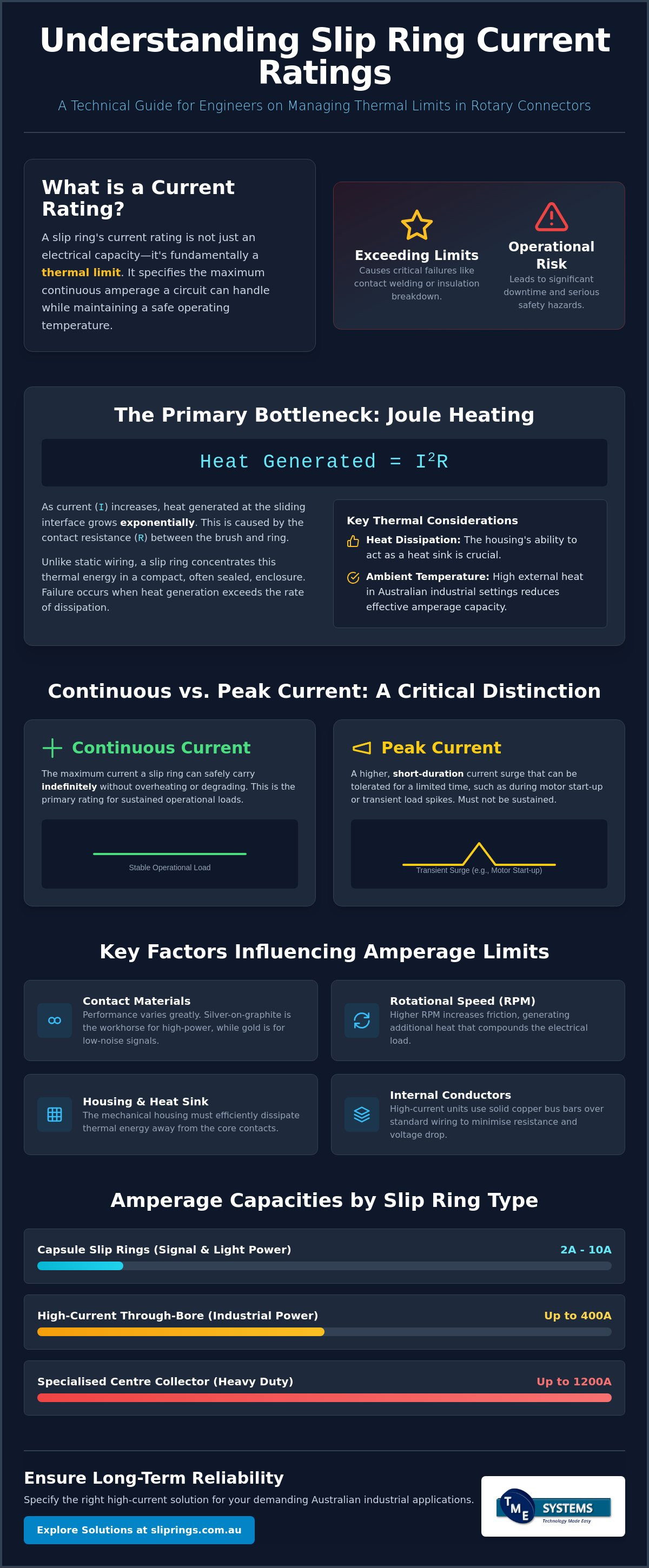
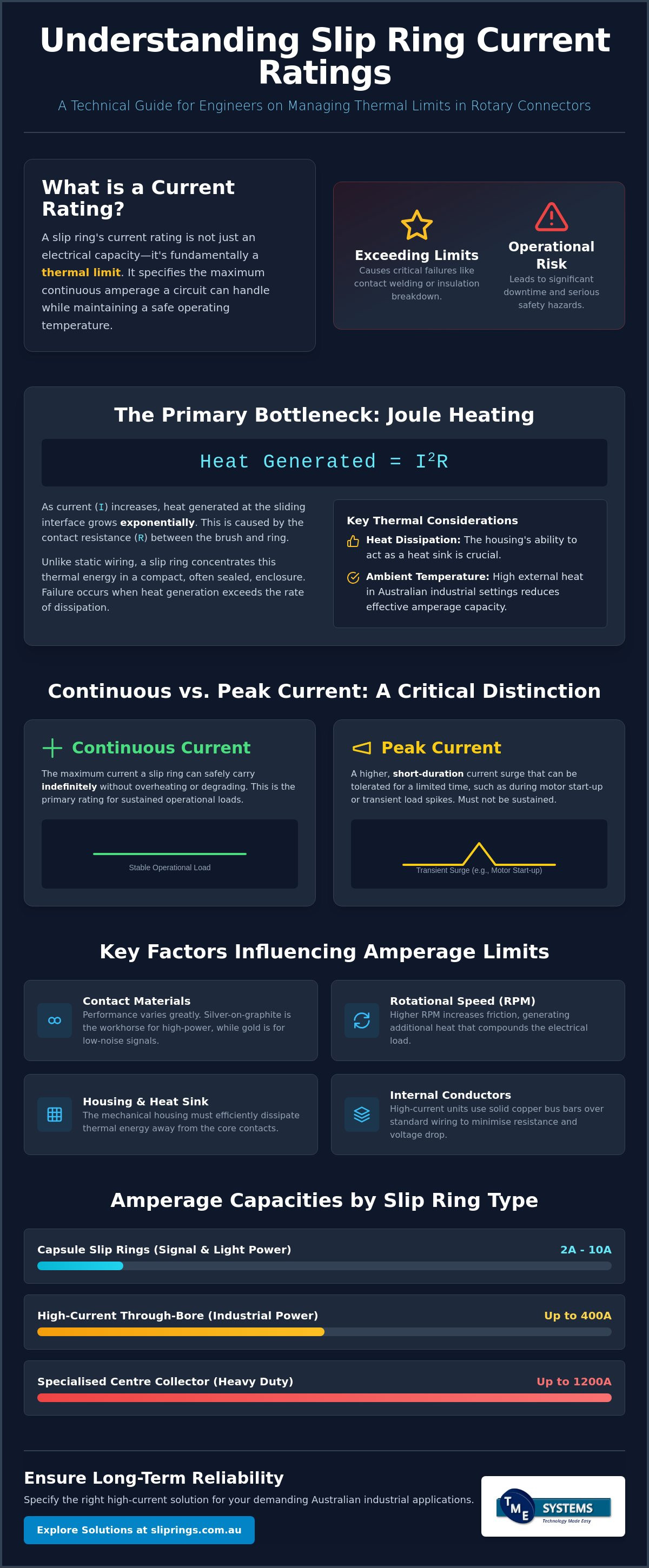
A slip ring current rating specifies the maximum continuous amperage an individual circuit can carry while maintaining a safe operating temperature. While many engineers view this as a simple electrical capacity, it's fundamentally a thermal limit. If a circuit carries current beyond its rated capacity, the resulting heat can degrade dielectric materials, lead to insulation breakdown, or cause the sliding contacts to weld together. This creates a cascade of mechanical failures that can stop a production line in seconds.
In a standard slip ring assembly, ratings are provided for both individual circuits and the unit as a whole. This distinction is vital. While a single circuit might be rated for 20A, the total thermal dissipation capacity of the housing might prevent all circuits from running at 20A simultaneously. Additionally, the relationship between voltage and current dictates the physical dimensions of the component. Higher voltages require greater spacing for insulation. Higher currents require larger contact surfaces to minimise resistance. Balancing these factors is the core of effective rotary connector specification.
Amperage and Thermal Energy
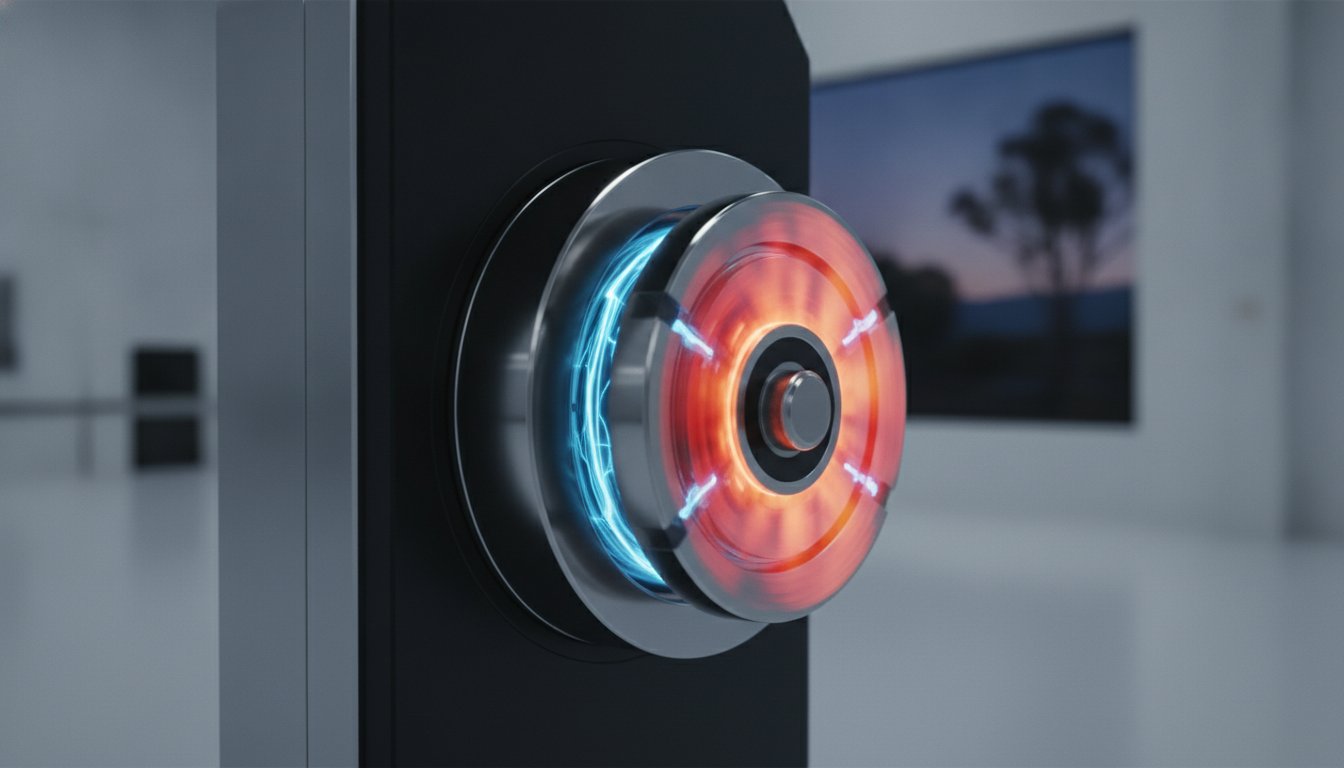
The primary challenge in specifying a slip ring current rating is managing Joule heating, expressed by the formula I²R. As current (I) increases, the heat generated at the sliding interface grows exponentially. This heat is a direct result of contact resistance (R) between the stationary brush and the rotating ring. During 360 degree rotation, this resistance can fluctuate. These fluctuations create localised hot spots that accelerate wear.
Heat dissipation remains the primary bottleneck for high current rotary connectors. Unlike static wiring, where heat can escape through long cable runs, a slip ring concentrates thermal energy within a compact, often sealed, enclosure. If the heat generated exceeds the rate of dissipation, the internal temperature will climb until the component fails. Engineers must consider the ambient temperature of the Australian industrial environment, as high external heat further reduces the effective amperage capacity of the unit.
Standard vs. Custom Current Specifications
Off-the-shelf capsule slip rings typically offer standardised ratings, such as 2A, 5A, or 10A per circuit. These are suitable for signal transmission or light power loads. However, industrial machinery often requires custom-engineered power rings when amperage exceeds these baseline limits. High current through-bore models can handle up to 400A, while specialised centre collector rings can reach 1200A for heavy duty applications.
Moving toward specialised high amperage solutions is necessary when dealing with heavy motor loads or high intensity heaters. The total circuit count also plays a role. A unit with 50 circuits generating even small amounts of heat will have a significantly different thermal profile than a 4 circuit power unit. You must account for this cumulative thermal load to ensure the selected solution remains durable over its intended service life.
Key Factors Influencing Slip Ring Amperage Limits
Determining a reliable slip ring current rating requires looking beyond the basic datasheet numbers. While the internal conductor sizing provides the foundation for capacity, the actual limit is a result of complex interactions between metallurgy, mechanical design, and rotational physics. High-current assemblies often utilise solid copper bus bars rather than standard wiring to minimise voltage drop. However, the cross-section of these internal conductors is only one part of the equation; the mechanical housing must also act as an efficient heat sink to move thermal energy away from the core.
Friction remains a critical, yet often overlooked, variable in this calculation. As the rotational speed (RPM) increases, the physical contact between the brush and the ring generates additional heat. This friction-generated energy compounds the electrical heat produced by the current flow. Consequently, a unit might handle 100A at 10 RPM with ease but face thermal failure at 500 RPM under the same load. Balancing these forces is essential for maintaining the integrity of the conductive path.
Contact Material Performance
Contact material selection is the most significant lever for performance and current density. Precious metal contacts, such as gold-on-gold, offer exceptional signal integrity and low noise, yet they typically have lower amperage limits compared to industrial alternatives. Silver-on-graphite brushes are the workhorse for high-power applications, providing a robust interface that can handle significant current loads, though they do require periodic maintenance to manage carbon dust build-up.
For applications demanding the absolute lowest contact resistance and maximum current stability, liquid metal technology is the superior choice. These connectors replace sliding brushes with a pool of conductive liquid metal, which creates a larger, more consistent contact area. If your application involves high-speed current transfer with minimal electrical noise, exploring Mercotac slip rings can provide a more durable solution than traditional brush-based systems.
Environmental Variables in Australian Applications
Australian industrial environments present unique challenges that necessitate the derating of a slip ring current rating. Ambient temperature is the most influential factor. A unit rated for 30A in a 20°C controlled environment will not perform the same when installed in a 45°C outdoor setting in Western Australia. This high ambient heat reduces the "thermal headroom" available for electrical heating, meaning the component must be specified with a higher nominal rating to compensate.
Similarly, the trade-off between protection and cooling must be managed. High IP ratings, such as IP65 or IP68, are vital for keeping out dust and moisture in mining or agricultural settings, but these seals also act as thermal insulators. They trap heat inside the housing, which can lead to premature insulation breakdown if the unit is pushed to its maximum limit. Consulting with a specialist can help you identify the right balance between environmental sealing and thermal performance for your specific site conditions.
Continuous vs. Peak Current: Avoiding Thermal Overload
A common misconception in the industry is that a slip ring current rating applies equally to all operating states. In practice, you must distinguish between continuous current, which a unit handles indefinitely, and peak current, which occurs during transient events like motor start-ups. Peak loads often reach five to seven times the nominal running current. While these surges are brief, they generate intense localised heat. If the assembly isn't engineered to absorb and dissipate this energy, the contact surfaces can suffer micro-welding or accelerated pitting.
Stationary periods under high load present a specific risk often overlooked by general specifications. When the slip ring is not rotating, the electrical load is concentrated on a single point of the conductive ring. Without the movement to distribute thermal energy across the entire circumference, "hot spots" develop rapidly. This can lead to localised deformation or damage to the contact lubricant. Unlike some claims that stationary units require no derating, we recommend assessing the stationary duty cycle to prevent heat-soak from damaging the internal insulation.
Thermal Equilibrium and Duty Cycles
Thermal equilibrium is the state where the heat generated by the electrical load equals the heat dissipated by the housing. Most industrial slip rings take between 30 and 60 minutes of continuous operation to reach this plateau. If your application involves short bursts of activity followed by long rest periods, you may be able to utilise a higher amperage than the continuous rating suggests. However, calculating these safe run-times requires precise data on the thermal mass of the unit and the ambient conditions of your site. Passive cooling through aluminium housings is standard, but active cooling may be necessary for high-duty cycles in restricted spaces.
Rotation Speed and Current Stability
High rotational speeds introduce dynamic variables that affect current stability. As RPM increases, mechanical vibrations can cause "brush bounce," where the contact momentarily lifts from the ring. This interruption creates micro-arcing, which degrades the contact surface and increases electrical noise. Consequently, the effective slip ring current rating may decrease at higher speeds to account for this increased resistance and arcing risk. When specifying a solution for high-speed machinery, you must ensure the RPM rating and the amperage limit are compatible to avoid premature component failure.
A Step-by-Step Selection Framework for Engineers
Selecting the correct component requires a methodical approach that moves beyond simple datasheet comparisons. To determine the appropriate slip ring current rating for your application, follow this structured five-step framework:
- Step 1: Identify the maximum continuous and peak amperage for every circuit. Don't forget to account for motor inrush currents that can spike significantly during start-up.
- Step 2: Determine the required voltage and the potential for cross-talk. Signal circuits must be shielded or physically separated from high-power rings to maintain data integrity.
- Step 3: Define mechanical constraints. Consider the mounting style, whether you need a through-bore for hydraulic lines, and the total housing dimensions available.
- Step 4: Factor in the operating environment and rotation speed. High RPM or dusty site conditions will necessitate a higher specification to manage friction and heat.
- Step 5: Apply a safety margin. We recommend a 20% buffer above your highest calculated load to account for unforeseen spikes or future system expansions.
Calculating Total System Requirements
Efficient design involves more than just sizing individual rings. You should group power and signal circuits strategically to minimise thermal interference. Placing high-current power rings at the ends of the assembly can help dissipate heat more effectively through the housing. You must also account for the voltage drop across the rotary interface, especially in applications with long cable runs where even a small increase in resistance can impact equipment performance. Finally, ensure that your earthing circuits are rated for the maximum fault current of the system. This provides a safe path to ground during an electrical failure and protects sensitive downstream electronics.
Safety Margins and Industrial Compliance
In Australia, industrial compliance is a non-negotiable requirement for operational safety. The AS/NZS 61439.1:2026 standard dictates safety and performance requirements for low-voltage assemblies, particularly when connected loads exceed 125A. Specifying a component "exactly to the limit" of its slip ring current rating is a high-risk strategy in critical infrastructure. If your machinery operates in a remote mining site or a high-output factory, the cost of a thermal failure far outweighs the investment in a conservatively specified unit. Consulting with technical application specialists allows you to verify your calculations against real-world performance data. If you're unsure about the thermal profile of your rotation, contact our engineering team for a detailed application review.
High-Current Solutions from TME Systems Pty Ltd
Specifying the correct slip ring current rating is only half the battle; sourcing hardware that meets those specifications in harsh Australian conditions is the second. TME Systems Pty Ltd partners with global leaders to provide a range of rotary connectors designed for everything from millivolt signals to 1200A power transfer. Our portfolio includes Mercotac slip rings for low-noise applications and Meridian Laboratory for precision high-speed current transfer. For heavy industry and large scale power requirements, BGB Innovation and Prosper Rotation provide robust collector rings that withstand extreme environmental stress.
Our approach focuses on modularity and compatibility. We recognise that Australian engineering often requires bespoke configurations where power, Ethernet, and hydraulic lines must pass through a single rotating centre. By combining specialised components from our partners, TME Systems Pty Ltd helps you build a system that maintains its electrical integrity without the risk of thermal overload. Whether you're upgrading a wastewater treatment plant or designing a new minerals processing line, we ensure the hardware matches the theoretical limits of your design.
Liquid Metal vs. Traditional Brushes
Traditional carbon or precious metal brushes rely on physical friction, which inevitably leads to wear and increased resistance over time. In contrast, Mercotac’s liquid metal interface provides a molecular bond between the rotating and stationary parts. This results in near-zero contact resistance and virtually no electrical noise. While traditional contacts require regular cleaning or brush replacement to maintain their slip ring current rating, liquid metal connectors are often maintenance-free for the duration of their service life. This technology is the only viable solution for high-current applications where signal integrity cannot be compromised by mechanical vibration or brush bounce.
Professional Technical Assistance
Selecting a durable solution requires a deep understanding of your machine's duty cycle and thermal environment. The team at TME Systems Pty Ltd provides more than just hardware; we offer Technical Application Consulting to ensure your hardware selection aligns with the realities of your site. We supply detailed technical data sheets and CAD drawings to assist your engineering team with seamless integration into existing designs. This reduces the risk of choosing an underspecified component that causes costly downtime.
Based in Ingleburn, TME Systems Pty Ltd provides national support across Australia. We ensure you have access to expert advice whether you're in a metropolitan hub or a remote mining site. Our specialists are available to review your application parameters and help you realise a design that prioritises safety and long-term reliability. If you're ready to specify a reliable rotary connector, reach out to our team to discuss your project requirements.
Optimising Your Rotating Machinery for Long-Term Reliability
Selecting the correct slip ring current rating is a critical engineering decision that directly impacts the safety and uptime of your equipment. By understanding that these ratings are thermal thresholds rather than static numbers, you can better manage the heat generated by your specific duty cycles and RPM requirements. It's essential to always distinguish between continuous and peak amperage while applying a 20% safety margin to protect against transient surges and comply with Australian standards.
As the authorised Australian distributor for Mercotac and Meridian Laboratory, TME Systems Pty Ltd provides specialised solutions tailored for the mining, defence, and manufacturing sectors. Our experienced application engineers are available to review your technical parameters and ensure your hardware selection is durable enough for the harshest industrial environments. We pride ourselves on delivering technical accuracy and dependable hardware that bridges the gap between complex requirements and operational success.
Consult with TME Systems Pty Ltd for expert slip ring selection to verify your specifications and secure a reliable rotary interface for your next project. We look forward to helping you achieve peak performance in your rotating machinery.
Frequently Asked Questions
What happens if I exceed the slip ring current rating?
Exceeding the rated amperage leads to excessive thermal energy that causes the internal insulation to melt or the sliding contacts to weld together. This often results in a permanent short circuit or mechanical seizure of the assembly. You'll likely observe increased electrical noise and significant voltage drops as the contact surfaces degrade before a total system failure occurs.
Do I need to derate my slip ring for high ambient temperatures in Australia?
You must derate your equipment when operating in ambient temperatures above the standard 20°C to 25°C baseline. High external heat reduces the unit's ability to dissipate internal energy, meaning the effective slip ring current rating is lower in a 45°C Western Australian mining site than in a climate-controlled factory. Failing to account for this reduced thermal headroom leads to premature component fatigue.
Can a slip ring handle different current ratings on different circuits?
Most industrial units are modular and can accommodate high-amperage power circuits alongside low-current signal channels within the same housing. This hybrid configuration allows you to transmit heavy motor power and sensitive sensor data through a single rotating interface. We ensure each circuit is physically separated by adequate dielectric barriers to prevent thermal interference and electrical cross-talk between the rings.
Is the current rating different for AC versus DC power?
The current rating is primarily a thermal limit based on the RMS value, so it generally remains the same for both AC and DC. However, DC circuits are more prone to sustained arcing if the contacts bounce, which can accelerate material transfer and surface wear. You should always verify the voltage rating alongside the amperage to ensure the internal insulation is sufficient for your specific power supply.
How does rotation speed (RPM) affect the current rating?
Higher rotation speeds generate friction heat that compounds the electrical heat produced by the current flow. As the RPM increases, the total thermal capacity of the unit is reached more quickly, which often necessitates a reduction in the allowable amperage. For high-speed machinery, selecting a liquid metal connector can help maintain a stable slip ring current rating by virtually eliminating the friction associated with traditional brushes.
Why is contact resistance important for high-current slip rings?
Contact resistance is the primary source of heat generation within a rotary connector. Even a few milliohms of resistance can generate significant thermal energy when carrying 100A or more. Minimising this resistance through superior metallurgy or liquid metal interfaces is the most effective way to increase current capacity while reducing the risk of thermal breakdown during continuous 360-degree rotation.
Can I parallel multiple circuits to achieve a higher current rating?
You can parallel multiple circuits to increase total capacity, but this requires identical resistance and path lengths for every parallel branch. If the resistance isn't perfectly balanced, one circuit will carry a disproportionate load, leading to localised overheating and failure. It's generally more reliable to specify a single high-current ring designed specifically for your total amperage requirements rather than splitting the load.
What is the difference between a power slip ring and a signal slip ring?
Power slip rings utilise larger contact surfaces and robust conductors to handle high amperage without exceeding thermal limits. Signal slip rings prioritise low electrical noise and data integrity, often using precious metal contacts that have much lower current capacities. When these are combined in a single unit, we use internal shielding to ensure the power load doesn't corrupt sensitive data transmissions.