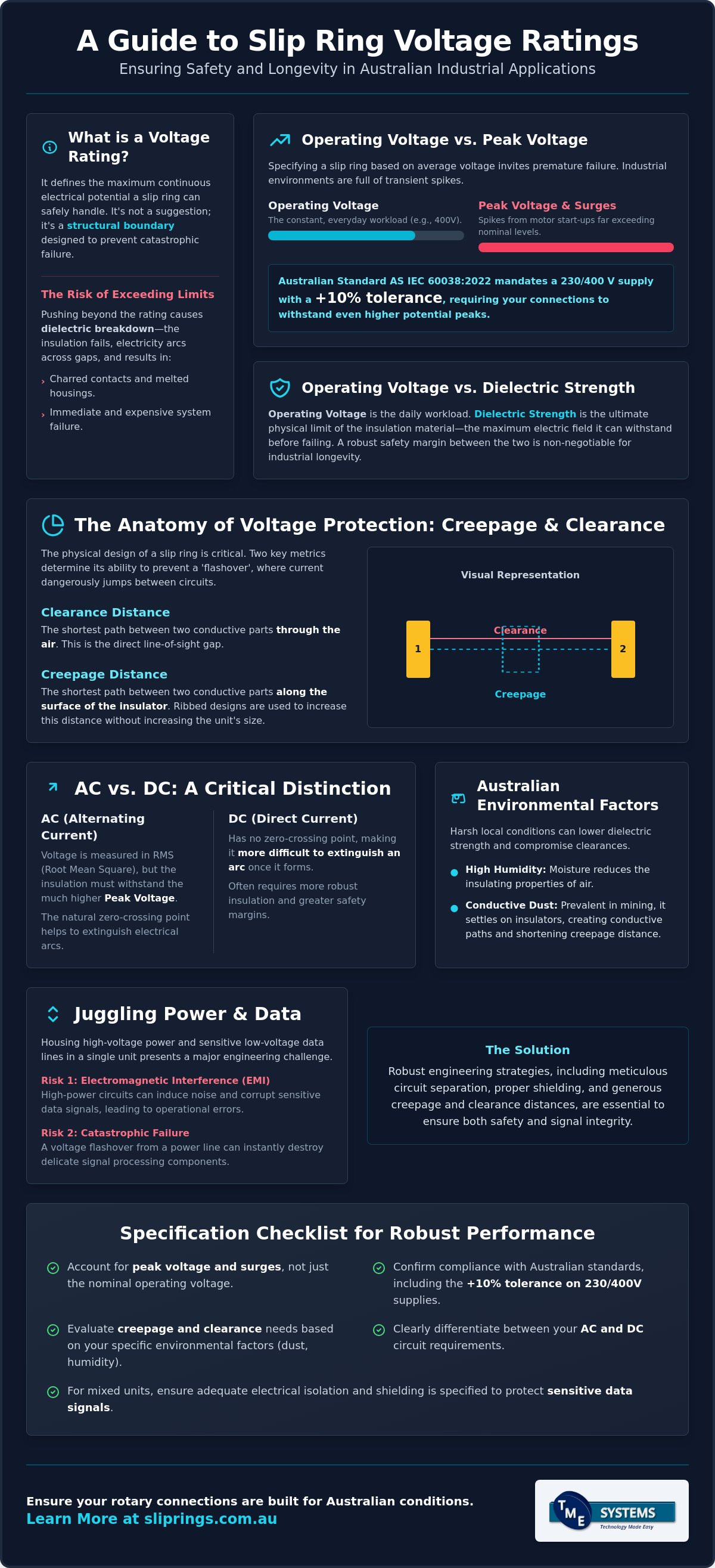
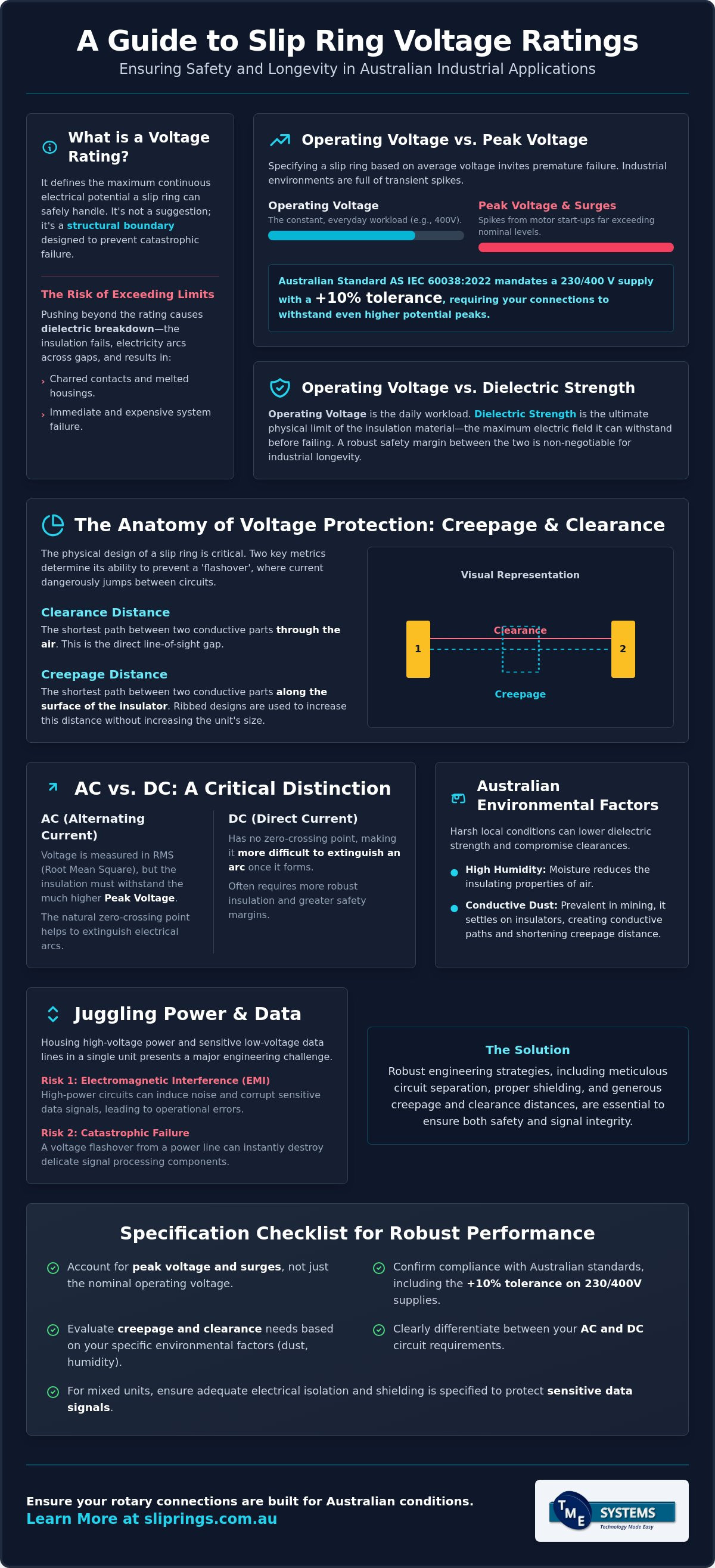
Selecting a slip ring based solely on its nominal voltage is a gamble that often results in insulation breakdown and expensive system downtime. With the Australian standard AS IEC 60038:2022 now mandating a nominal supply of 230/400 V with a +10% tolerance, your rotary connections must withstand higher potential peaks than previous standards required. Ensuring your slip ring voltage rating accounts for these fluctuations is not just a matter of compliance; it's a critical factor in preventing electrical flashovers that can destroy sensitive equipment.
You likely recognise the difficulty of balancing high-voltage power transmission alongside low-voltage signal circuits within a single compact assembly. It's a common frustration for engineers who must navigate the confusion between peak voltage limits and continuous operating requirements. This guide will help you master these technical nuances to ensure safety and optimise the service life of your machinery. We will explore how to specify precise safety margins for Australian industrial environments and provide the clarity needed to select a robust unit with absolute confidence, ensuring optimal performance from your TME Systems Pty Ltd solutions.
Key Takeaways
- Learn why the slip ring voltage rating is a structural constraint rather than just an electrical limit, and how to differentiate between AC and DC potential in rotary environments.
- Understand how insulation materials and creepage distances dictate the physical design and safety margins of high-performance rotary unions.
- Discover engineering strategies for housing high-voltage power circuits alongside sensitive data lines without risking electromagnetic interference or signal corruption.
- Identify how Australian environmental factors, such as high humidity and conductive mining dust, can lower dielectric strength and compromise electrical clearances.
- Access a technical checklist for specifying units from Mercotac or Meridian Laboratory that align with Australian standards and specific application requirements.
What is Slip Ring Voltage Rating and Why Does it Matter?
A slip ring voltage rating defines the maximum continuous electrical potential the unit can safely handle between its conductive circuits and the surrounding housing. It is not merely a suggestion; it is a structural boundary. When you push a component beyond this limit, you risk catastrophic dielectric breakdown. This occurs when the insulation fails, causing electricity to arc across gaps. In an industrial setting, this leads to charred contacts, melted housings, and immediate system failure. Proper specification ensures that your rotary connection remains a reliable conduit rather than a point of failure.
Understanding this rating requires a look at the base component. A slip ring functions by maintaining a physical connection between brushes and rotating rings. Because these parts are in close proximity, the air and solid insulation between them must resist the electrical pressure of the current. If the voltage is too high, the insulation's ability to isolate the circuits vanishes. This is particularly dangerous in mixed-circuit units where high-voltage power lines sit adjacent to sensitive data channels. Managing the slip ring voltage rating is therefore the first line of defence in protecting both your equipment and your operators from dangerous electrical faults.
The distinction between AC (Alternating Current) and DC (Direct Current) ratings is also critical. Most industrial specifications provide an AC rating, but DC requirements differ because DC does not have a zero-crossing point to help extinguish an arc. AC voltage is measured in Root Mean Square (RMS), yet the insulation must withstand the peak voltage, which is significantly higher. If your application involves high-frequency switching or variable speed drives, the stress on the insulation increases, making the choice of a high-quality unit even more vital.
Operating Voltage vs. Dielectric Strength
Operating voltage is your daily workload. It represents the 400V or 415V running through the system during standard Australian plant operations. Dielectric strength is the ultimate physical limit of the materials used. Dielectric strength is the maximum electric field a material can withstand without becoming a conductor. Manufacturers like Mercotac conduct rigorous insulation resistance tests to ensure their units exceed these operational demands, providing a necessary buffer against unforeseen spikes.
Peak Voltage and Surge Considerations
Industrial environments are rarely steady. Motor start-ups often create transient voltage spikes that far exceed nominal levels. If you specify a unit based on average voltage, you are inviting premature failure. In Australian electrical procurement, maintaining a healthy safety margin is standard practice. Specifying for peak voltage rather than the average ensures industrial longevity. This prevents the gradual degradation of internal polymers that eventually leads to a short circuit or a total unit burnout.
Key Factors Influencing Slip Ring Voltage Ratings
Designing for a specific slip ring voltage rating involves balancing material science with precise geometric constraints. It isn't just about the thickness of the insulation. Engineers must account for how electricity behaves across surfaces and through the air inside the housing. If these factors are overlooked, the unit will fail long before it reaches its theoretical electrical limit. This failure often manifests as a flashover, where current jumps between circuits, causing immediate damage.
Two critical metrics in this process are creepage and clearance distances. Creepage is the shortest path along the surface of an insulator between two conductive parts. Clearance is the shortest path through the air. In many Australian industrial settings, such as mining or heavy manufacturing, airborne contaminants can settle on internal surfaces. This dust creates a conductive bridge, effectively shortening the creepage distance and leading to a flashover. To combat this, high-voltage units often feature "ribbed" or "finned" insulators that increase the surface path without significantly increasing the unit's overall length.
Contact technology also dictates how a unit manages potential. Traditional brush-and-ring systems, such as those from BGB Innovation, generate fine carbon dust as the brushes wear. This dust is conductive. Over time, it accumulates on the insulators, increasing the risk of arcing. In contrast, Mercotac units use a liquid metal interface. This design eliminates wear debris, allowing for a more stable voltage rating throughout the unit's service life. If you are struggling to balance size constraints with high-voltage needs, our technical application consulting can help you specify the right geometry.
The Impact of Physical Spacing
Higher voltage ratings inevitably lead to larger slip ring diameters or lengths. This extra space is necessary to house internal barriers used to prevent cross-circuit arcing. These barriers act as physical shields that interrupt the path of a potential arc. While standard units might be compact, high-voltage variants require more volume to maintain safety. Meridian Laboratory achieves high ratings in compact footprints through advanced material science, utilizing high-dielectric polymers that provide superior insulation in thinner layers than traditional materials.
Insulation Resistance and Material Integrity
Insulation resistance is measured in Megohms and typically decreases as operating temperature rises. This degradation is a natural result of rotary friction and thermal stress. High-quality materials prevent tracking, which is the formation of conductive paths on the insulator surface caused by electrical stress. Over time, friction-induced heat can soften lower-grade plastics, making them more susceptible to this tracking. Selecting a unit with high-grade ceramic or specialized polymer insulation ensures that the resistance remains high even as the machinery reaches its peak operating temperature.
High Voltage vs. Signal Voltage: Managing Mixed-Circuit Units
Combining 415V power with 5V signals in a single rotary assembly is a significant engineering challenge. The primary risk is that the high-potential power lines will overcome the internal insulation, leading to a breakdown that destroys sensitive electronics. When you specify a slip ring voltage rating for a hybrid unit, you aren't just looking at the power side. You must also consider the dielectric isolation between the power and signal channels to prevent cross-circuit arcing. If the insulation fails, the high-voltage current will find the path of least resistance, which is often right through your low-voltage PLC or sensor network.
Electromagnetic Interference (EMI) is the second major hurdle in mixed-circuit units. High-voltage circuits generate magnetic fields that can corrupt low-voltage data packets. Without proper internal shielding, your sensors or Ethernet signals will suffer from packet loss or erratic readings. To mitigate this, manufacturers use metallic barriers or coaxial shielding within the housing to isolate electrical noise. Modular slip rings, such as those from Prosper Rotation, allow for physical separation by stacking independent modules. This creates a clear air break between high-potential and low-potential zones, which is a pragmatic solution for Australian industrial plants where equipment must operate reliably in harsh, vibrating environments.
Preventing Signal Noise and Cross-Talk
Managing differential spacing is essential in multi-channel units. Low-noise requirements for CCTV or precision sensors often conflict with the proximity of high-voltage rings. If the circuits are too close, capacitive coupling can introduce noise into the signal, leading to ghosting in video feeds or data errors in control systems. We often recommend gold-on-gold contact materials for the signal circuits. This combination ensures low contact resistance and stable transmission, even when housed within a high-voltage assembly. It's a reliable way to maintain signal integrity without sacrificing the power capacity of the unit.
Specifying Hybrid Rotary Unions
A successful hybrid specification requires a technical brief that clearly separates power and signal parameters. You should list the circuit count, current, and voltage for each channel individually. It is also vital to request individual circuit testing for insulation resistance. This verifies that each channel meets its specific slip ring voltage rating without compromising the adjacent circuits. Standard factory tests often group circuits together, but for critical infrastructure, we recommend per-circuit dielectric strength verification. This ensures that the 415V power supply won't find a path to the 5V PLC input during a transient surge. For complex hybrid requirements, our Technical Application Consulting provides the expertise needed to design a reliable, interference-free solution.
Environmental Impacts on Voltage Performance in Australia
A slip ring voltage rating is often calculated under ideal laboratory conditions, but the Australian climate presents variables that can quickly compromise these specifications. High humidity, extreme heat, and pervasive industrial dust all work to lower the dielectric strength of the air inside the housing. In Australia's more demanding environments, particularly those characterised by high heat and humidity, these factors aren't just maintenance concerns; they're direct threats to electrical safety. If you don't account for environmental derating, a unit rated for 600V may fail at much lower potentials due to the presence of conductive contaminants or moisture.
Temperature derating is another critical consideration for slip rings operating in hot Australian workshops or outdoor installations. As the ambient temperature rises, the electrical resistance of the internal insulation typically decreases. This makes the material more susceptible to dielectric breakdown. In environments where temperatures regularly exceed 40°C, you may need to specify a unit with a higher nominal slip ring voltage rating than the application strictly requires to provide a sufficient safety buffer. Maintaining electrical integrity in these harsh conditions requires robust housing with IP65 or IP67 ratings to prevent the ingress of the very elements that cause failure.
Humidity and Condensation Risks
High-humidity environments significantly increase the risk of a flashover. This occurs when moisture in the air allows electricity to arc across what should be a non-conductive gap. In coastal environments, salt-laden air further compounds this problem by increasing the conductivity of any condensation that forms. Hermetically sealed units, such as those from Mercotac, are superior in these tropical or coastal Australian settings because they isolate the electrical interface from the atmosphere. This prevents thermal expansion from "breathing" moist air into the unit, which is a common cause of failure in traditional vented designs.
Contamination and Dielectric Breakdown
The "Dust Effect" is a major cause of voltage failure in Australian mining and heavy industry. Conductive dust particles can settle on internal insulators, creating a bridge that reduces the effective creepage and clearance distances. While traditional brush-and-ring systems from BGB Innovation are designed for durability, they still generate internal carbon dust that can accumulate over time. Any ingress of moisture can reduce insulation resistance by several orders of magnitude, regardless of the factory rating. Brushless designs offer a distinct advantage here by eliminating the primary source of internal contamination. To find a unit that withstands your specific site conditions, contact us for technical advice.
Specifying the Correct Rating for Your Application
Selecting the right component requires a methodical approach that balances electrical capacity with mechanical reality. While it is tempting to simply choose the highest available slip ring voltage rating to ensure safety, this often leads to the over-engineering trap. Specifying a unit rated for 5,000V when your application only requires 415V results in unnecessary costs, increased weight, and a larger physical footprint. The goal is to specify a unit that provides a comfortable safety margin without compromising the efficiency of your machine's design. A professional technical audit by TME Systems Pty Ltd ensures that every parameter is accounted for before procurement begins.
Adherence to local regulations is the foundation of any industrial specification. In Australia, rotary electrical equipment must align with relevant AS/NZS standards to ensure it can handle standard supply fluctuations safely. Before finalising your selection, use this technical checklist to verify your requirements:
- Circuit Count: Total number of independent power and signal paths required.
- Current Capacity: The continuous and peak amperage for each individual circuit.
- Voltage Level: The nominal operating voltage and any expected transient spikes.
- Rotational Speed (RPM): The maximum operating speed, which affects thermal stability.
- Environmental Protection: The required IP rating based on site-specific exposure.
Information Required for an Accurate Quote
To provide a precise recommendation, we need to separate AC and DC requirements for every circuit. These currents behave differently under rotary conditions and require specific insulation strategies. You should also define the duty cycle of your machinery. Is the voltage constant, or is it intermittent? Knowing the mounting centre and any space constraints is equally vital. If the slip ring must fit within a hollow shaft or a compact housing, the choice of insulation material becomes the deciding factor in achieving the necessary slip ring voltage rating within those dimensions.
Why Technical Support is Critical
Buying an off-the-shelf unit without verifying voltage margins is a risk that rarely pays off in heavy industry. Standard units may not account for the specific harmonics or surges present in your local power grid. TME Systems Pty Ltd leverages the engineering capabilities of world-leading brands like Meridian Laboratory and BGB Innovation to provide bespoke solutions for high-voltage needs. Whether you require the brushless reliability of a liquid metal interface or the robust capacity of a traditional high-power unit, expert guidance ensures the component matches the application. You can organise a technical consultation with TME Systems Pty Ltd to ensure your slip ring is perfectly specified for long-term reliability.
Ensuring Long-Term Reliability in Rotary Systems
The selection of a slip ring voltage rating is a fundamental engineering decision that dictates the safety and longevity of your industrial equipment. By accounting for the physical constraints of creepage and clearance, as well as the unique environmental challenges of the Australian climate, you can prevent catastrophic dielectric failure. Maintaining a precise safety margin ensures that your rotary connections remain a stable conduit rather than a point of vulnerability. It's the most effective way to protect your infrastructure from unnecessary downtime.
As the authorised distributor for Mercotac and Meridian Laboratory, TME Systems Pty Ltd provides the specialised expertise required for high-reliability industrial applications. Our technical assistance team is based in New South Wales and serves clients across all of Australia, offering professional guidance on complex high-voltage and mixed-circuit units. We help you avoid the pitfalls of over-engineering while ensuring full compliance with local standards. Contact TME Systems Pty Ltd for Expert Technical Selection Advice to secure a solution tailored to your specific operational needs. We look forward to supporting your next project with precision and technical excellence.
Frequently Asked Questions
Can I use a slip ring rated for 240V on a 415V three-phase system?
No, you cannot safely use a 240V rated unit for a 415V system. A 240V rating is typically based on phase-to-neutral potential, whereas a 415V three-phase system involves a higher phase-to-phase potential. Using an under-rated component will likely lead to immediate insulation breakdown and poses a significant fire risk to your facility.
How does RPM affect the effective voltage rating of a slip ring?
High rotational speeds generate frictional heat that can degrade the dielectric strength of internal insulation materials over time. While the nominal slip ring voltage rating remains the same on the data sheet, the practical safety margin decreases as temperatures rise. For high-speed applications, we recommend brushless designs that minimise friction-induced thermal stress on the polymers.
What happens if a slip ring suffers a voltage flashover?
A voltage flashover creates an electrical arc that chars the internal contacts and leaves conductive carbon tracks on the insulators. This "tracking" creates a permanent path for electricity to follow, making future failures inevitable even at lower voltages. Once a flashover occurs, the unit generally requires immediate replacement to protect connected sensitive electronics like PLCs.
Is there a difference between AC and DC voltage ratings for rotary connectors?
Yes, DC voltage ratings are usually lower than AC ratings for the same physical unit. Because AC current crosses the zero point 100 times per second in Australia, any small arc that forms is naturally extinguished. DC current is continuous and maintains an arc much more effectively, requiring larger internal clearances to prevent a sustained electrical fault.
Do I need a higher voltage rating for slip rings used in marine environments?
Marine environments require superior environmental sealing, such as an IP67 rating, rather than just a higher nominal voltage. Salt-laden moisture is highly conductive; if it enters the housing, it reduces the dielectric strength of the air and surfaces inside. A hermetically sealed Mercotac unit is often the most pragmatic choice for preserving electrical integrity in coastal regions.
How often should I test the insulation resistance of my industrial slip ring?
You should perform insulation resistance testing at least once every twelve months during your scheduled maintenance shutdown. In harsh Australian industries like mining or chemical processing, six-monthly audits are preferred. Regular testing helps you identify the "Dust Effect" or moisture ingress before they lead to a catastrophic system failure.
Can high-voltage slip rings be used for sensitive signal transmission?
High-voltage units can handle signals only if they are engineered as hybrid rotary unions with internal shielding. Without metallic barriers to isolate the circuits, the magnetic fields from high-potential lines will induce noise into the signal lines. This results in corrupted data packets or erratic sensor readings that can compromise your entire control network.
What is the standard safety margin I should apply to my operating voltage?
A safety margin of at least 20% above your peak operating voltage is the industry standard for reliable procurement. This buffer accounts for the +10% supply tolerance mandated by AS IEC 60038:2022 and provides protection against transient spikes during motor start-ups. Maintaining this margin ensures the slip ring voltage rating is never challenged by routine power fluctuations.