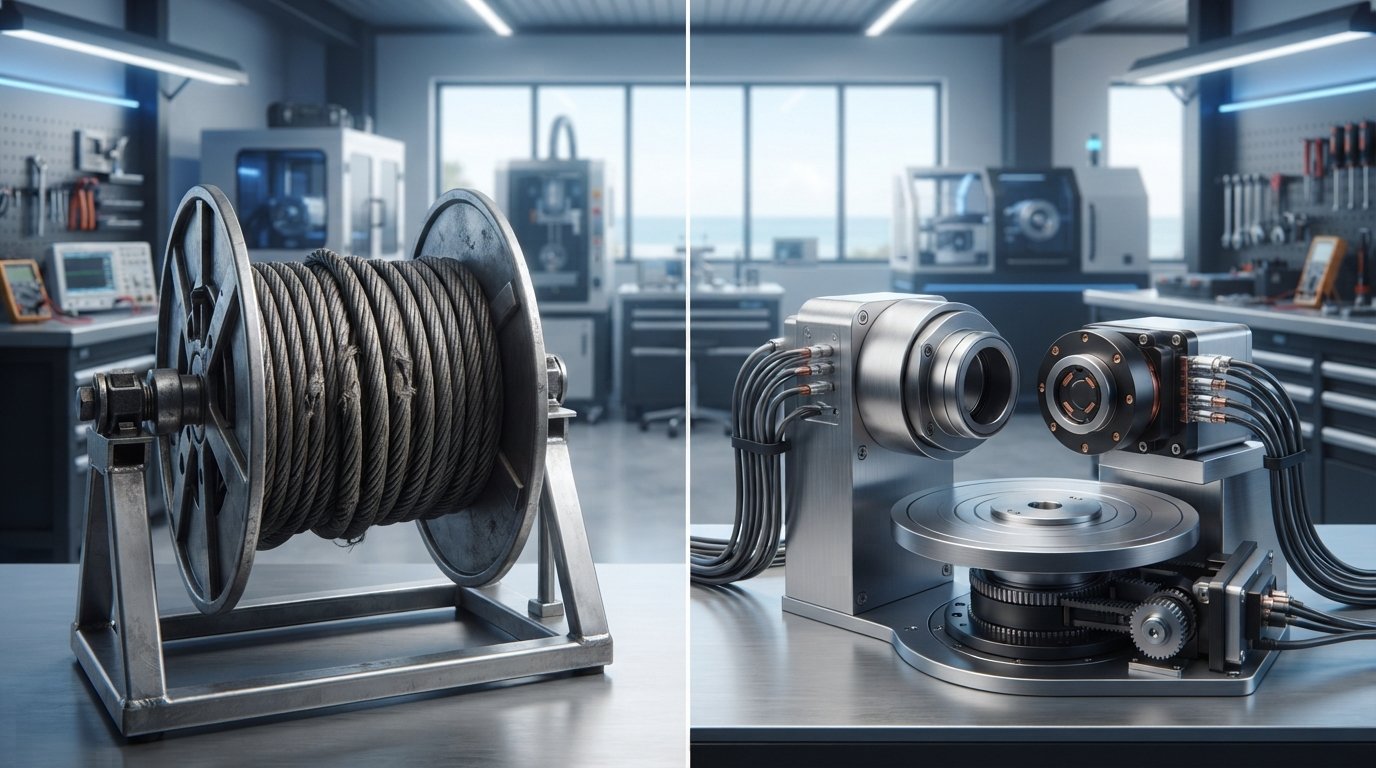
Subjecting a standard reeling cable to continuous axial rotation is a recipe for conductor shear and expensive downtime. While cable reels excel at linear payout for gantry cranes, they aren't designed for infinite 360-degree movement. If your application requires endless revolutions, seeking alternatives to cable reels for continuous rotation isn't just an upgrade; it's a technical necessity to prevent the "corkscrewing" and insulation abrasion that leads to total system failure.
You've likely experienced the frustration of signal noise disrupting critical data or the headache of fitting a massive cable drum into a compact housing. We understand that maintaining electrical continuity in a rotating joint shouldn't mean sacrificing reliability or data integrity. This guide shows you how slip rings and liquid metal rotary connectors outperform traditional reels in high-duty environments. We'll explore how advanced technologies compliant with AS/NZS 5368:2025 eliminate rotational limits, reduce maintenance intervals, and ensure your high-speed data remains clean across every revolution, regardless of the mechanical complexity of your project.
Key Takeaways
- Understand why mechanical wrap limits and cable fatigue make traditional reels unsuitable for high-duty cycles.
- Identify slip rings and liquid metal connectors as the primary alternatives to cable reels for continuous rotation to achieve infinite 360-degree motion.
- Compare the compact form factor of through-bore slip rings against bulky cable drums to optimise space in restricted industrial environments.
- Learn to assess circuit requirements and rotational speed ratings to match the correct contact technology to your specific application.
- Discover how technical application consulting ensures the seamless integration of power, data, and pneumatic paths within a single rotary interface.
Limitations of Cable Reels in Continuous Rotation Applications
Cable reels are a standard fixture in Australian workshops and ports, primarily designed for linear payout and retraction. They perform reliably on gantry cranes or overhead hoists where the travel is predictable and straight. However, applying this technology to a machine that must revolve around a central axis introduces immediate mechanical risks. When engineers search for alternatives to cable reels for continuous rotation, it's usually because the physical constraints of a winding drum have reached a breaking point.
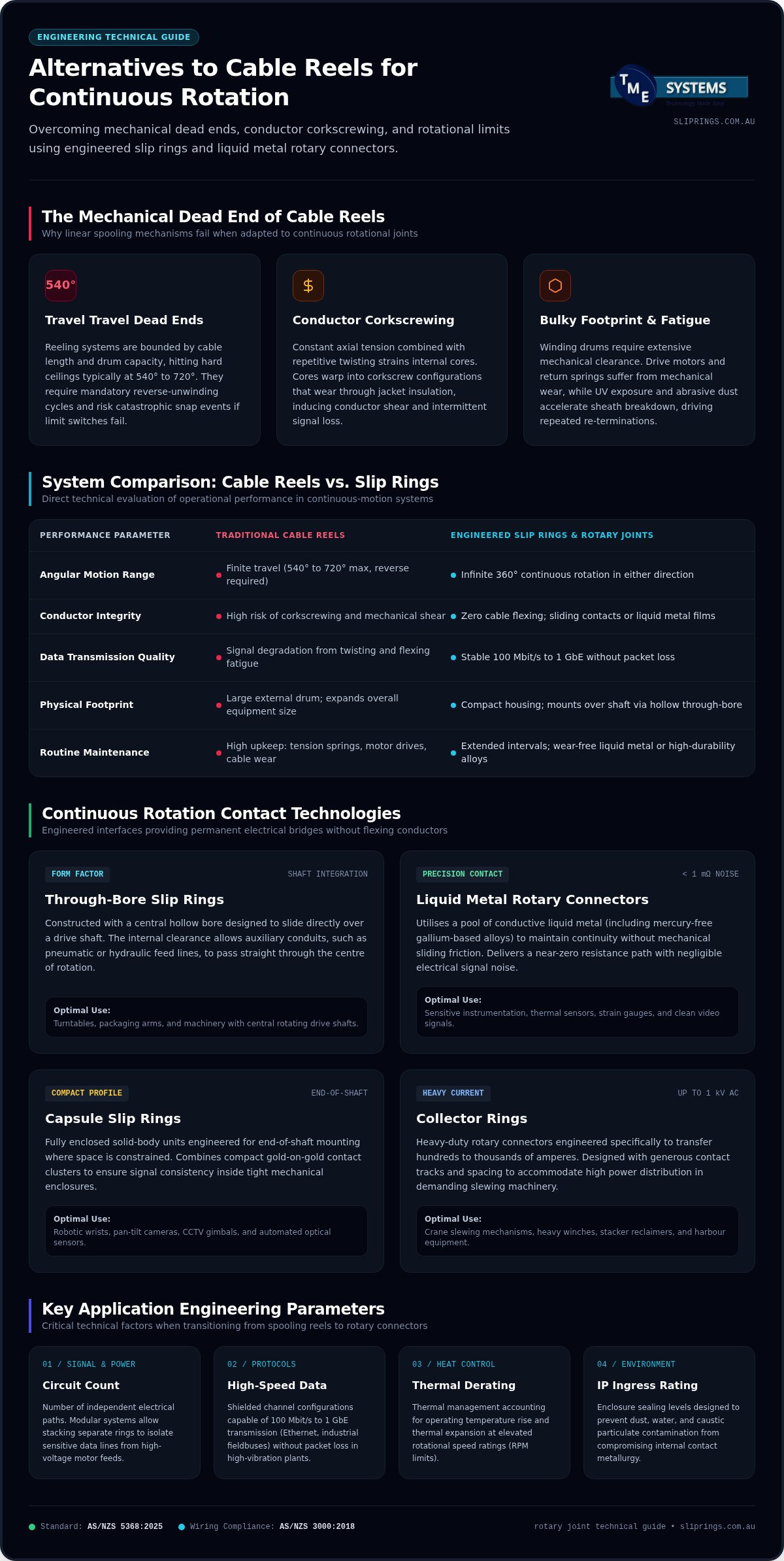
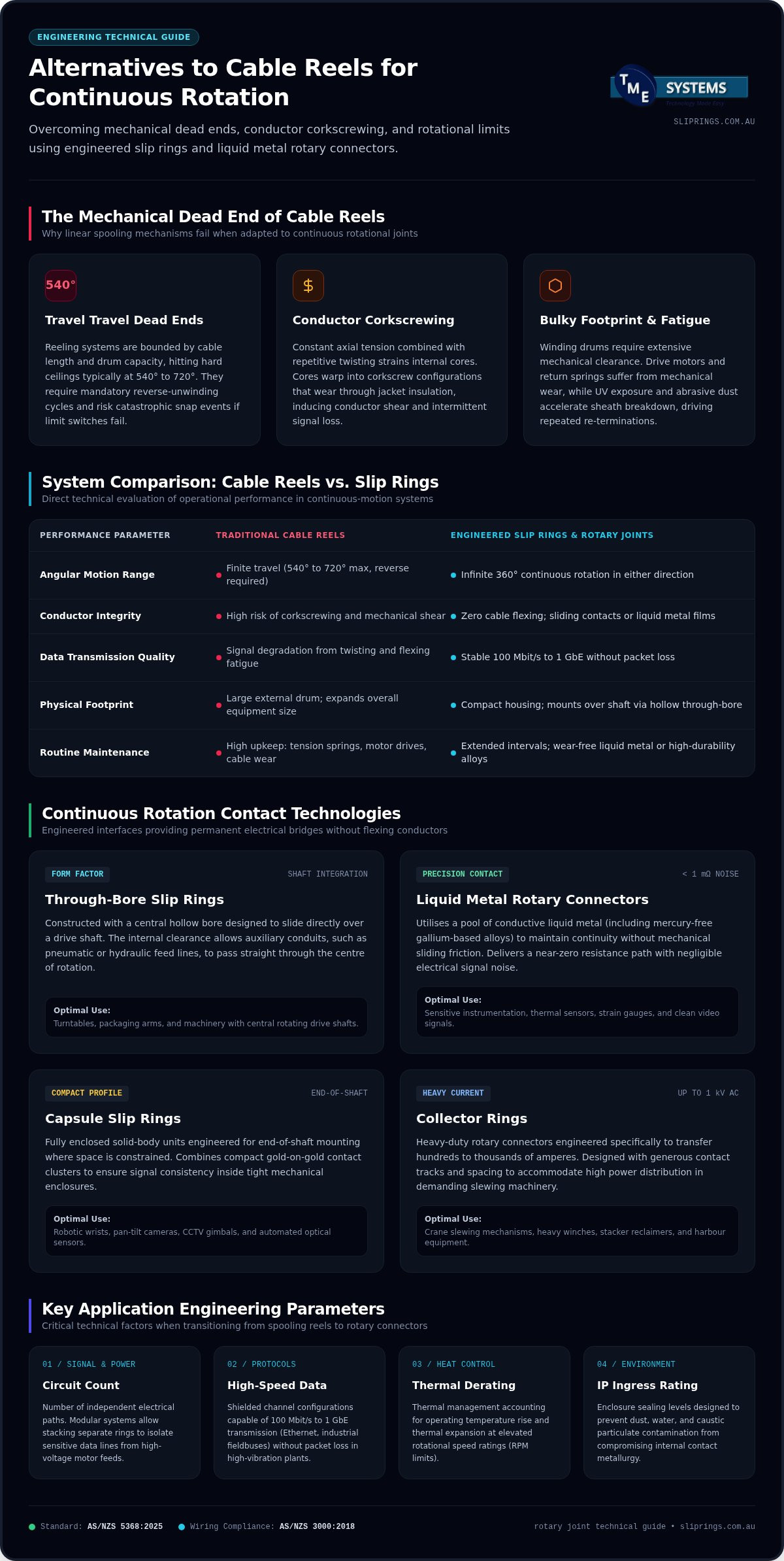
The core issue lies in the physical bulk and the inherent mechanical limits of the reeling mechanism. A standard drum requires significant space, often forcing designers to enlarge the machinery's footprint just to accommodate the cable management system. In compact industrial environments, this volume is a luxury most projects can't afford. Beyond size, the constant tension required to retract the cable places a permanent load on the conductors. This leads to "corkscrewing," where the internal wires twist and eventually shear through the outer jacket, causing intermittent signal loss or total electrical failure.
The Mechanical "Dead End" of Cable Reels
Every cable reel has a hard ceiling, often referred to as the "end of travel." Whether spring-driven or motorised, the system is constrained by the length of the cable and the capacity of the drum. This typically limits rotation to a specific number of degrees, such as 540 or 720, before the system must reverse to unwind. If a limit switch fails or an operator exceeds these bounds, the risk of the cable snapping or the drum housing tearing away is high. Contrast this with electromechanical slip rings, which facilitate infinite 360-degree motion by using sliding contacts rather than a fixed length of wire. This eliminates the need for reversing cycles and allows for true continuous operation.
Maintenance and Downtime Risks
In harsh Australian industrial settings, environmental degradation accelerates the failure of reeling systems. High UV exposure and abrasive dust perish cable jackets, while temperature fluctuations affect the tensioning springs. The primary failure points are often the internal springs or the motor drives, both of which require regular inspection and lubrication. When a multi-core cable fails due to fatigue, the cost of downtime is significant. Re-terminating dozens of circuits is a methodical, time-consuming process that halts production. For heavy-duty applications, choosing alternatives to cable reels for continuous rotation like BGB Innovation slip rings reduces these maintenance intervals by removing the primary source of failure: the moving cable itself.
Slip Rings: The Primary Alternative for 360-Degree Motion
Slip rings represent the most effective alternatives to cable reels for continuous rotation, providing a permanent electrical bridge between stationary and rotating components. While cable reels are restricted by the physical length of the conductor, a slip ring allows for infinite revolutions without the risk of tangling or mechanical strain. This technology eliminates the need for complex cable management systems, such as festoons or rotary chains, which often require excessive space and regular mechanical adjustment. By using sliding contacts, these devices maintain a stable circuit regardless of the number of rotations performed.
Selecting the appropriate contact method is critical for system longevity. Traditional precious metal brushes offer high reliability for standard control signals, while liquid metal technology provides a near-zero resistance path for sensitive data. According to research into continuous rotation slip ring engineering, the choice of metallurgy directly impacts electrical noise and thermal dissipation. For modern Australian industrial sites, ensuring signal integrity for high-speed Ethernet or industrial bus protocols is paramount. Modern slip ring configurations can now transmit 100 Mbit/s to 1 GbE data without packet loss, even in high-vibration environments.
Liquid Metal Rotary Connectors for Precision
Mercotac slip rings and Meridian Laboratory hardware utilise a liquid metal film to create a brushless connection. This design results in extremely low electrical noise, typically less than 1 milliohm, making it the preferred choice for transmitting sensitive sensor data or high-definition video. In the Australian food processing and medical sectors, mercury-free liquid metal options are available to meet strict safety regulations while maintaining the performance benefits of a liquid interface. These units are compact, often fitting into spaces where a cable reel drum simply couldn't exist.
Brush-Based Slip Rings for Heavy Industry
For heavy-duty applications such as port cranes, mining equipment, and large-scale automation, brush-based systems from BGB Innovation and Prosper Rotation are the industry standard. These units are engineered to manage high-current loads, often exceeding 200 Amps per circuit. To prevent overheating during high-duty cycles, these slip rings incorporate advanced thermal management strategies and robust housing designs. If you're managing a project with complex power and signal requirements, our team at TME Systems can provide technical application consulting to help you specify the ideal hardware for your specific environmental conditions.
Technical Comparison: Cable Reels vs. Slip Rings
Engineers evaluating alternatives to cable reels for continuous rotation must weigh mechanical simplicity against long-term electrical stability. The most striking difference lies in rotational freedom. While a cable reel operates on a finite length of conductor, necessitating a reversal once the "wrap limit" is reached, a slip ring allows for infinite 360-degree motion. This removes the need for complex control logic or limit switches designed to prevent cable snapping. While a continuous cable in a reel setup offers a path with zero contact resistance, modern slip ring engineering has closed the gap. High-performance units now deliver signal quality that rivals hard-wired connections, even at high RPM.
Installation complexity also differs significantly between these two technologies. A cable reel is typically an external, bulky component that requires substantial mounting brackets and clear space for the cable payout path. In contrast, a slip ring is often integrated directly into the machine's pivot point or drive shaft. This internal mounting protects the electrical interface from external debris and mechanical impact, though it requires precise alignment during the initial build to ensure signal stability. By maximizing slip ring lifecycle and performance through correct mounting and housing selection, the total cost of ownership often falls below that of reeling systems due to reduced cable replacement needs.
Space and Weight Considerations
Through-bore slip rings, such as those provided by Prosper Rotation, offer a distinct advantage for streamlined machine design. These units feature a hollow centre, allowing them to be mounted directly over a rotating shaft or to house pneumatic and hydraulic lines. This concentric arrangement reduces the physical footprint of the rotating assembly, which is a critical factor for mobile equipment like truck-mounted cranes or excavators. By centralising the power and data paths, designers can eliminate the large, off-centre weight of a traditional cable drum, improving the overall balance and energy efficiency of the machine.
Long-Term Reliability and AS/NZS Standards
Reliability in Australian industrial environments is measured in millions of revolutions rather than simple cycles. A reeling cable might survive several thousand extensions, but the torsional stress of rotation eventually causes internal conductor fatigue. Slip rings are rated for tens of millions of revolutions, provided they comply with relevant safety standards. In Australia, permanent electrical installations must adhere to AS/NZS 3000:2018 (the Wiring Rules). Additionally, specifying hardware that meets AS/NZS 5368:2025 ensures the rotary connector is fit for purpose regarding ingress protection and electrical isolation. These standards provide a benchmark for safety that reeling cables, prone to jacket abrasion and exposed conductors, often struggle to maintain over a long service life.
Selecting the Right Alternative for Your Application
Choosing alternatives to cable reels for continuous rotation requires a methodical audit of your machine's mechanical and electrical requirements. Unlike a reel, where you simply select a cable length and gauge, a slip ring requires precise matching of contact materials to your operational environment. The selection process begins by identifying the number of independent circuits and the nature of the signals being transmitted. High-power circuits for motors require different contact metallurgy than sensitive Ethernet or thermocouple paths to prevent electromagnetic interference and signal degradation.
Rotational speed is another critical differentiator. While a cable reel might only handle slow indexing or low-speed linear travel, slip rings are engineered for specific RPM ranges. Mercotac liquid metal connectors are often specified for high-speed applications where low torque and minimal electrical noise are required. Conversely, heavy-duty industrial pivots may only rotate at 10 to 50 RPM but require the robust current-carrying capacity of a BGB Innovation assembly. Matching the RPM rating to the contact technology prevents premature wear and ensures the device maintains its rated service life.
Electrical Specification Requirements
Determining the correct electrical capacity involves calculating the maximum voltage and peak current for each path. Circuit count is defined as the number of independent electrical paths required to pass through the rotating interface. In the Australian climate, thermal derating is essential. High ambient temperatures in mining or outdoor industrial sites can reduce the effective current capacity of the slip ring, necessitating a larger contact surface or specialized cooling. Properly separating power and control paths within the housing is vital to maintain data integrity and prevent cross-talk between circuits.
Environmental and Physical Constraints
The physical environment dictates the necessary ingress protection. For washdown areas in food processing or dust-heavy mining sites, selecting hardware with IP65 or IP67 ratings is mandatory to prevent internal contamination. Contact stability can also be compromised by extreme vibration or mechanical shock. In these scenarios, Meridian Laboratory slip rings provide the high-precision stability needed for consistent performance. Finally, designers must choose between a capsule mounting for compact spaces or a Prosper Rotation through-bore design to accommodate central drive shafts or pneumatic lines. To ensure your hardware matches these complex variables, request a technical application audit from our engineering team.
Optimising Rotation with Professional Application Engineering
Transitioning from reels to rotary connectors isn't just about swapping hardware. It requires a comprehensive review of the entire system architecture. Professional application engineering ensures that the chosen alternatives to cable reels for continuous rotation don't just solve the immediate wrap-limit problem but also enhance long-term system efficiency. This involves specifying hybrid assemblies that combine electrical circuits with fluid or pneumatic passages in a single through-bore unit. By integrating these modular systems, engineers can future-proof their designs, allowing for easier upgrades as data or power requirements evolve over the machine's lifecycle.
A final engineering review before procurement is essential to verify that the hardware is compatible with local electrical infrastructure and environmental variables. This proactive approach prevents common pitfalls, such as specifying a unit that lacks the necessary thermal headroom for a remote mining site or the precision required for sensitive medical instrumentation. TME Systems acts as a technical intermediary, bridging the gap between high-end manufacturing and the specific demands of the Australian industrial landscape. We specialise in helping clients navigate the nuances of Mercotac slip rings for high-speed data or Prosper Rotation for versatile industrial configurations.
The Value of Expert Technical Support
Our technical consulting process focuses on matching hardware to specific circuit counts and environmental needs. When evaluating alternatives to cable reels for continuous rotation, it's vital to consider how a slip ring will interface with existing control systems. We help engineers determine if a liquid metal connector or a traditional brush-based system is more appropriate for their signal integrity requirements. This steady, detail-oriented consultation ensures that the final assembly meets the rigorous demands of Australian industry while complying with all relevant safety standards.
Case Study: High-Current Crane Slewing
High-current crane slewing provides a clear example of where advanced rotary connectors outperform traditional reeling systems. In heavy lifting sectors, transferring high-voltage power across a slewing joint requires robust contact management to prevent arcing and heat build-up. Using BGB Innovation hardware, we've helped engineers manage these unique challenges, ensuring reliable power delivery without the mechanical fatigue associated with large-diameter reel drums. For a detailed breakdown of these design factors, refer to our guide on Slip Ring Application Engineering, which serves as a technical reference for Australian industry.
Advancing Your Rotary Engineering Projects
Transitioning to alternatives to cable reels for continuous rotation is a fundamental step toward eliminating mechanical fatigue and signal degradation in your machinery. By moving beyond the physical constraints of winding drums, you gain infinite 360-degree motion while drastically reducing the maintenance overhead associated with cable shear. Whether you require the high-speed precision of Mercotac liquid metal technology or the heavy-duty current capacity of BGB Innovation hardware, the right rotary joint ensures your system remains compliant with AS/NZS 5368:2025 standards.
Successful integration depends on precise technical alignment. TME Systems provides specialist technical consulting to ensure every circuit, from micro-volt sensor data to high-current power, performs reliably in harsh Australian conditions. As an authorised distributor for leading global brands, we're ready to help you bridge the gap between complex design requirements and high-performance hardware. Our team focuses on long-term stability, ensuring your rotating interfaces don't become the weak link in your operation.
Contact TME Systems for expert technical support on your rotary connection requirements. We look forward to helping you optimise your next project for maximum reliability and efficiency.
Frequently Asked Questions
Can a cable reel rotate 360 degrees indefinitely?
No. Cable reels are strictly limited by the physical length of the cable and the drum's wrap capacity. They eventually reach a mechanical "dead end" and must reverse to unwind, which prevents infinite rotation. For applications requiring endless revolutions in one direction, you'll need to use alternatives to cable reels for continuous rotation. Electromechanical slip rings facilitate these endless revolutions without stressing the conductor or requiring reversing cycles.
What is the main advantage of a slip ring over a cable reel?
The primary advantage is infinite rotational freedom within a significantly smaller footprint. Slip rings eliminate the need for large diameter reel drums and complex cable management systems. Because they use sliding contacts rather than a fixed cable length, they remove the risk of torsional fatigue and conductor shear. This results in longer maintenance intervals and allows for true 360-degree operation in compact industrial machinery where space is restricted.
Are slip rings more expensive to maintain than reels?
Generally, slip rings have lower long-term maintenance costs. While a reeling cable suffers from mechanical wear, jacket abrasion, and internal wire fatigue, a high-quality slip ring is rated for millions of revolutions. Maintenance typically involves simple brush inspections rather than the costly, time-consuming process of re-terminating and replacing multi-core cables. Units like those from BGB Innovation are specifically engineered for heavy-duty Australian industrial use to maximise operational uptime.
How do I transfer data signals through a rotating joint without noise?
Utilising liquid metal technology is the most effective way to eliminate electrical noise. Mercotac and Meridian Laboratory slip rings use a liquid metal film to create a brushless, low-resistance path. This technology reduces electrical noise to less than 1 milliohm, ensuring that sensitive data signals like Ethernet or high-definition video are transmitted without interference. This is a superior alternative to standard brush contacts for maintaining high-speed data integrity.
What is a through-bore slip ring and when should I use one?
A through-bore slip ring features a hollow centre, allowing it to be mounted directly over a rotating drive shaft. You should use this style when your application requires other components, such as pneumatic lines, hydraulic hoses, or mechanical shafts, to pass through the centre of the rotating joint. Prosper Rotation through-bore units are ideal for streamlining machine designs by centralising all power, data, and fluid paths into a single assembly.
Do I need a special licence to install a slip ring in Australia?
Installation of permanent electrical equipment must be performed by a licensed electrician in accordance with AS/NZS 3000:2018. While the slip ring itself is an industrial component, its integration into a machine's power system falls under specific state-based electrical safety regulations. It's also vital to ensure the hardware complies with AS/NZS 5368:2025 to meet the required standards for ingress protection and electrical isolation in various Australian industrial environments.
What is the difference between a collector ring and a standard slip ring?
These terms are often used interchangeably, but "collector ring" usually refers to heavy-duty, open-frame assemblies used for high-current power transfer in large machinery like cranes or excavators. A standard slip ring is typically a self-contained, housed unit that handles both power and sensitive signals. Both function as alternatives to cable reels for continuous rotation, but the choice depends on the current load and the need for environmental ingress protection.
How does thermal derating affect the choice of a rotary connector?
Thermal derating accounts for the reduction in current-carrying capacity as ambient temperatures increase. In high-temperature Australian environments, the electrical resistance of the contacts generates heat that must be dissipated. If the ambient temperature is high, you must specify a slip ring with a higher current rating than the actual load to prevent overheating. Technical application consulting is essential to calculate these requirements and ensure the connector maintains its rated service life.