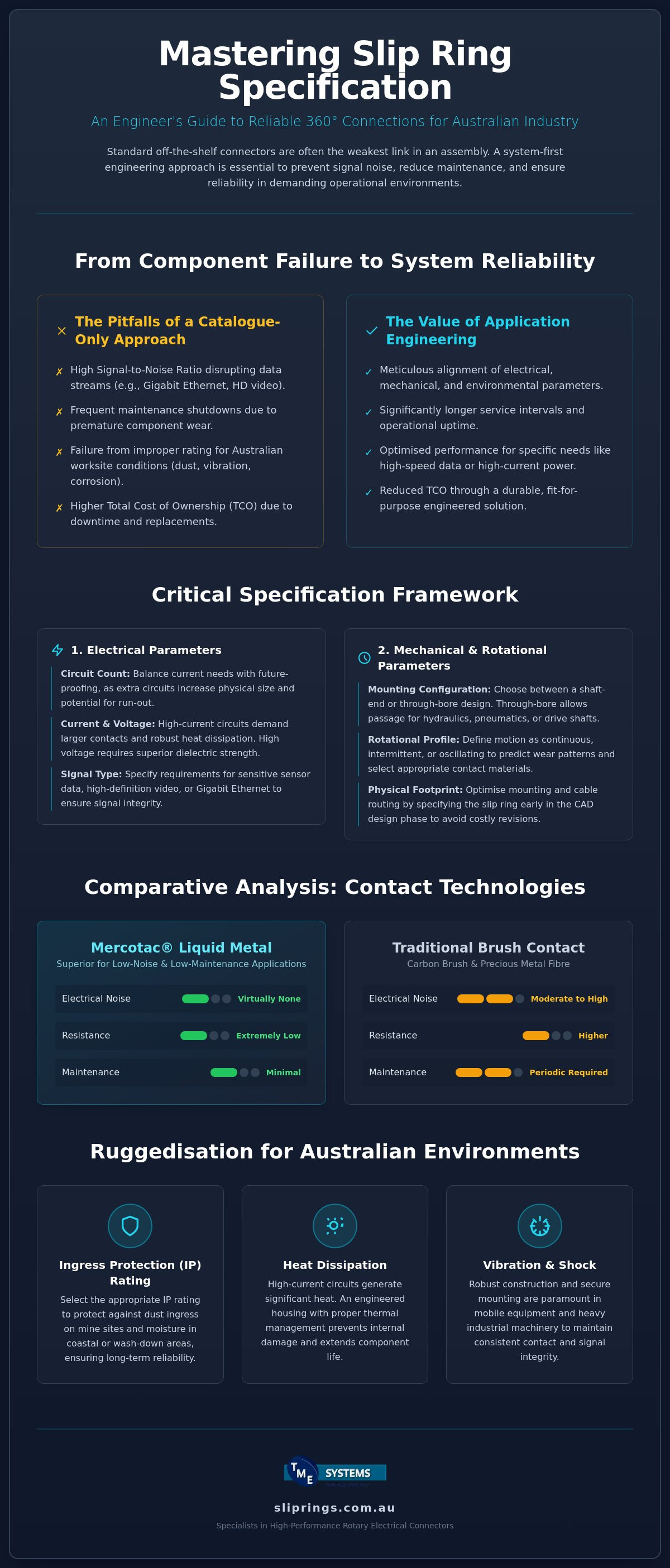
A standard off-the-shelf rotary connector is often the weakest link in an industrial assembly, yet it's frequently the last component considered during the design phase. You likely recognise the frustration of signal noise disrupting a high-speed data stream or the recurring cost of maintenance shutdowns because a component wasn't properly rated for the dust and vibration of a local worksite. When these failures occur, the issue is rarely the hardware alone; it's usually a gap in the initial technical specification.
This is where precise slip ring application engineering becomes a necessity rather than an afterthought. By focusing on a system-first approach, you can master the technical complexities of specifying rotary electrical connectors that deliver a reliable 360-degree connection. This guide provides the engineering framework needed to reduce signal-to-noise ratios and achieve significantly longer service intervals for your rotating equipment.
We'll examine the critical variables of circuit count, voltage, and environmental sealing, alongside mounting strategies that ensure compatibility with your existing machinery. From assessing specialised contact technologies to high-speed data requirements, this reference will help you select and integrate the right technology for the specific demands of Australian industry.
Key Takeaways
- Understand the evolution from basic power transfer to high-speed data transmission through precise slip ring application engineering.
- Learn to balance circuit count, current capacity, and dielectric strength to maintain electrical safety while minimising the physical footprint of rotary joints.
- Evaluate the performance advantages of liquid metal connectors from Mercotac against traditional carbon brush and precious metal fibre technologies for low-noise signals.
- Determine the appropriate Ingress Protection (IP) ratings and heat dissipation requirements to ensure long-term reliability in demanding Australian operating environments.
- Discover how a structured technical audit simplifies the selection of high-performance components from leading brands like BGB Innovation, Prosper Rotation, and Meridian Laboratory.
The Fundamentals of Slip Ring Application Engineering
At its core, slip ring application engineering is the process of synchronising a rotary interface with its specific operational environment. It's a discipline that moves beyond simple component procurement. A Slip ring is an electromechanical device that allows the transmission of power and electrical signals from a stationary to a rotating structure. While the basic principle is straightforward, the execution in a modern industrial setting requires a meticulous alignment of electrical, mechanical, and environmental parameters to ensure long-term reliability.
Historically, these components were primarily used for simple power transfer to motors or heaters. Modern Australian industry now demands far more. We've seen a decisive transition toward complex data and signal transmission, including Gigabit Ethernet, high-definition video, and delicate sensor data. This shift means that a rotary joint must maintain exceptionally low electrical noise and high signal integrity while spinning at high speeds or enduring constant vibration.
Relying on a catalogue-only approach often leads to premature component failure. A standard part might meet your circuit count but fail to account for the specific torque requirements of your drive system or the corrosive nature of a coastal processing plant. Technical consultants bridge the gap between manufacturing capabilities and site requirements, ensuring that every specification is a deliberate choice rather than a compromise.
Bridging the Stationary-Rotating Divide
Analysing the mechanical interface is the first step in any successful integration. You must decide between a shaft-end mounting or a through-bore configuration. A through-bore design allows for the passage of hydraulic lines, pneumatic pipes, or a central drive shaft, which is often essential in complex machinery. Determining the rotational requirements is equally critical. You need to know if the motion is continuous, intermittent, or oscillating, as this dictates the wear patterns on the contact surfaces. Identifying the primary objective, whether it's a high-current power transfer, a sensitive signal hybrid, or a high-speed data link, establishes the foundation for the entire selection process.
The Value of Early-Stage Technical Consultation
Early-stage slip ring application engineering during the CAD design phase prevents costly revisions later. By specifying the rotary joint before the surrounding machinery is finalised, you can optimise the mounting footprint and cable routing. This foresight often allows for the integration of Mercotac slip rings, which utilise a liquid metal contact technology. These units are ideal for low-maintenance requirements because they offer extremely low resistance and virtually no electrical noise compared to traditional brush designs.
Integrating engineering support reduces the total cost of ownership (TCO) by extending service intervals and reducing downtime. For example, a correctly specified unit for a mining conveyor system might cost more upfront but will outlast a generic alternative by several years. This consultative approach ensures that you aren't just buying a part; you're investing in a reliable, engineered solution that fits the exact needs of your project.
Critical Electrical and Mechanical Specification Parameters
Effective slip ring application engineering requires a deep understanding of how electrical requirements dictate mechanical design. These parameters don't exist in isolation; a change in current capacity often necessitates a change in physical dimensions, which in turn affects the maximum allowable rotational speed. Achieving a balance between these variables is the difference between a system that runs for years and one that fails within months. You must treat the slip ring as a dynamic component where electrical performance is directly tied to mechanical stability.
Circuit count and current capacity are the primary drivers of physical size. While it's tempting to specify extra circuits for "future-proofing," doing so increases the length of the unit and the potential for mechanical run-out. High-current circuits require larger contact surfaces and robust heat dissipation paths to prevent internal temperature spikes. Conversely, signal circuits must be shielded from these power lines to prevent electromagnetic interference (EMI) and crosstalk, which can corrupt sensitive data streams.
Electrical Load and Signal Requirements
Differentiating between power circuits and sensitive millivolt signals is vital for system reliability. In heavy industrial applications, such as managing high-current demands in cranes and heavy lifting equipment, the engineering focus is on minimising contact resistance and voltage drop. For data-heavy environments, the priority shifts to maintaining impedance for protocols like Ethernet, Profibus, or CAN bus. If you're managing complex data streams, our team can provide technical application consulting to ensure your signal integrity remains uncompromised.
Mechanical Constraints and Dynamics
Evaluating slip ring voltage ratings against system peaks is a critical safety step. You must ensure the dielectric strength is sufficient to prevent arcing between adjacent rings, especially in high-altitude or high-humidity environments. Rotational speed (RPM) also plays a decisive role in material selection. Higher speeds increase friction and wear, necessitating specialised contact materials to maintain a stable electrical connection. This level of precision is mirrored in NASA Slip Ring Engineering research, which highlights how extreme mechanical dynamics require rigorous testing of contact life and lubricant stability.
Torque requirements are another often-overlooked factor. The internal friction of a slip ring can significantly impact the performance of small motors or precision actuators. By selecting a unit with low starting torque, you ensure that the drive system doesn't have to overcome excessive resistance, which preserves the efficiency of the entire assembly and reduces wear on the mechanical drive components.
Comparative Analysis: Contact Technologies and Materials
The heart of any rotary interface is the contact technology. In the context of slip ring application engineering, choosing between liquid metal, carbon brushes, or precious metal fibres determines the unit's lifespan and signal clarity. While the electrical loads discussed in the previous section provide the requirements, the material selection provides the solution for achieving long-term reliability in Australian industrial environments. Each technology offers distinct advantages depending on whether you're prioritising high-current power transfer or high-fidelity data streams.
Material selection isn't just about conductivity. It involves a complex trade-off between friction coefficients, wear rates, and contact resistance. For instance, Meridian Laboratory utilises unique contact designs that ensure high-speed precision without the traditional degradation associated with sliding interfaces. These engineering choices directly impact the maintenance intervals and the total cost of ownership for the end user.
Liquid Metal Rotary Connectors
Liquid metal technology represents a significant departure from sliding contacts. The primary benefits of Mercotac technology include near-zero electrical noise and a constant resistance that does not fluctuate during rotation. Because the connection is maintained through a pool of liquid metal, there is no mechanical wear on the contact surfaces, which allows for exceptionally long service lives. These units are the ideal choice for sensitive sensors, thermocouples, and high-speed data links where even minor signal fluctuations can cause system errors.
Environmental considerations are paramount when deploying liquid metal units. While they offer superior performance, specific industries like food processing or medical manufacturing may require mercury-free alternatives to comply with strict safety regulations. Engineering these solutions involves assessing the thermal limits of the liquid metal to ensure it remains stable under the heat dissipation requirements of your specific application.
High-Performance Brush Systems
Traditional brush systems remain the standard for many heavy-duty applications. You should specify BGB Innovation components when your project involves heavy-duty industrial rotation, such as in wind turbines or large-scale packaging lines. These systems often use carbon or metallic brushes that can handle significant current surges. However, for sensitive electronics, the industry has moved toward precious metal fibre brushes. The role of gold-on-gold contacts is particularly critical in CCTV and defence applications, where low-voltage signals must remain clear despite constant panning and tilting.
Maintenance cycles are a necessary consideration for any brush-based assembly. Unlike liquid metal units, brushes eventually wear down and produce debris that can lead to shorts if not managed. Modern engineering designs include wear indicators and accessible housings to simplify inspection. By understanding the wear patterns of different brush materials, you can better predict service intervals and avoid the costs associated with unplanned machinery downtime.
Ruggedisation and Environmental Integration Factors
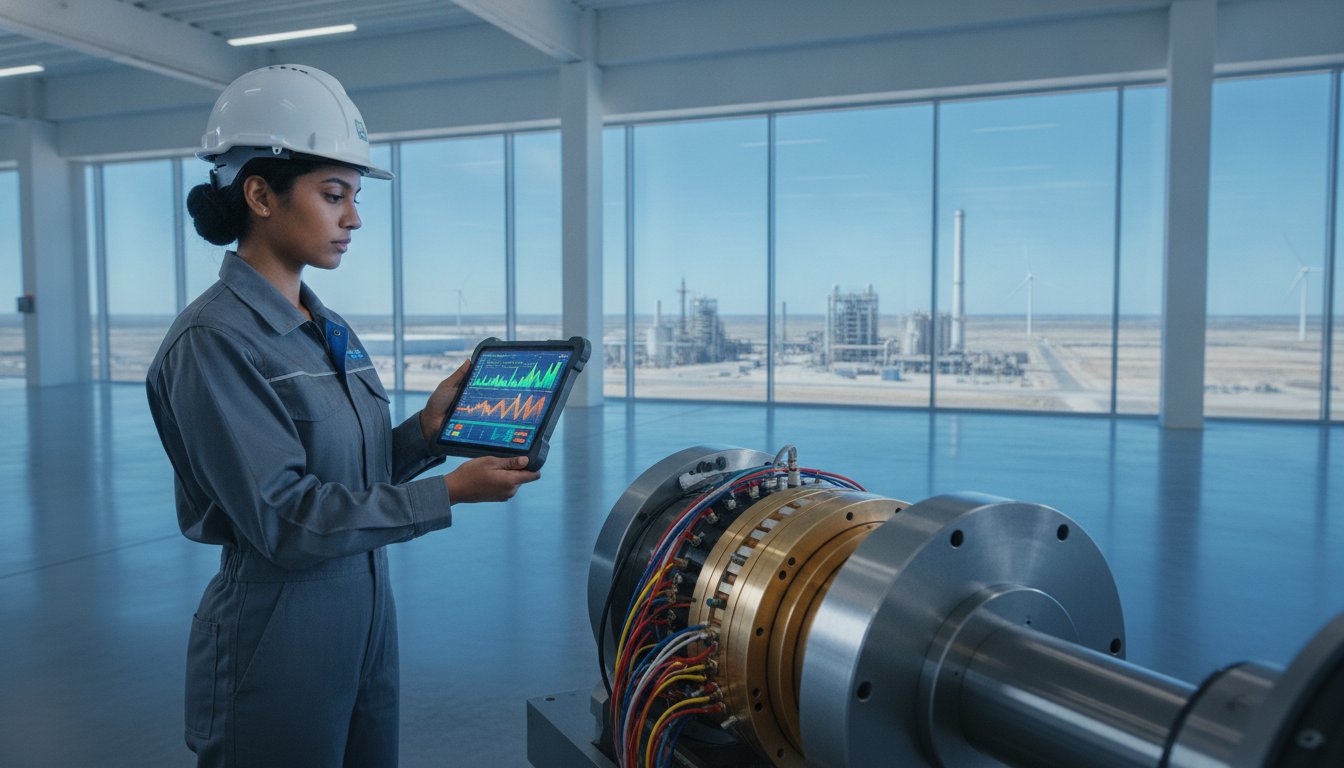
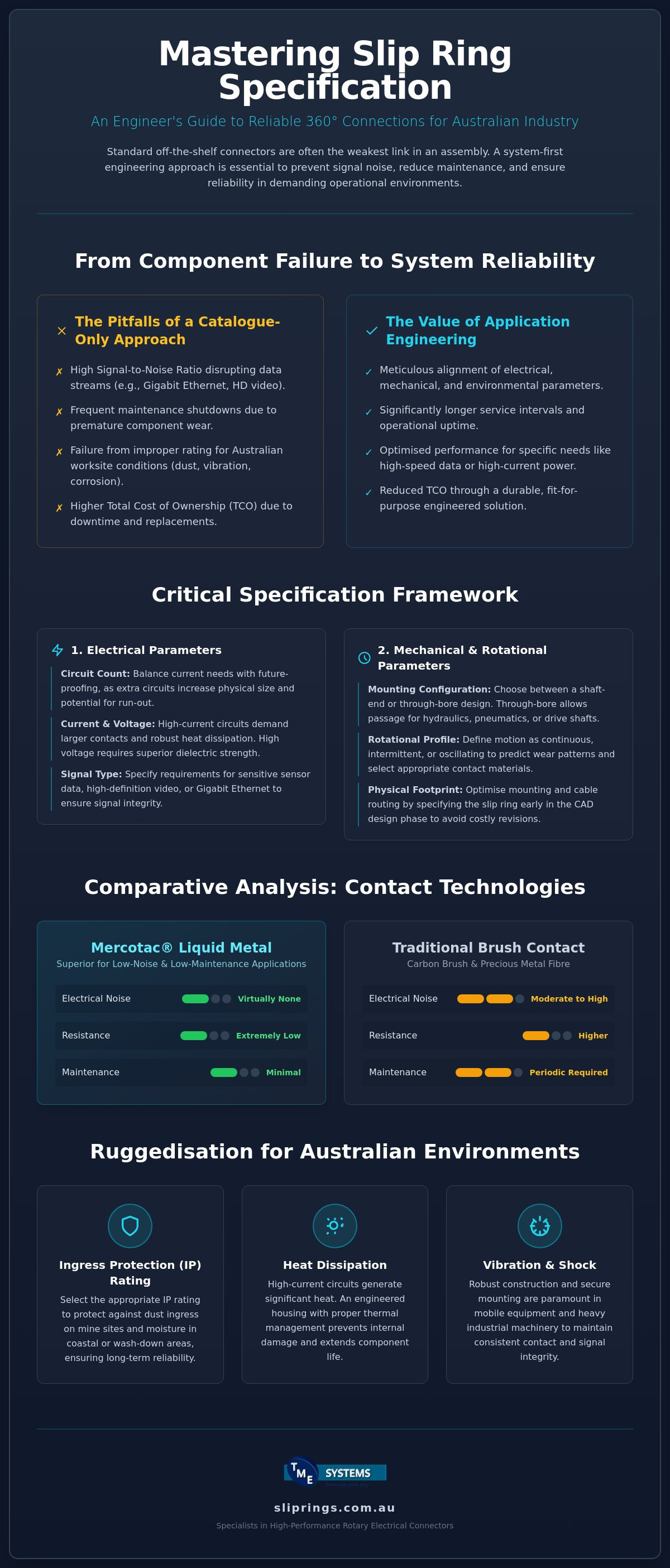
In the Australian industrial landscape, environmental variables are often the primary cause of premature component failure. Whether it's the abrasive dust of a Pilbara mine site or the corrosive salt spray of a coastal port, slip ring application engineering must account for these external threats from the outset. Standard units designed for cleanroom environments won't survive the vibration and temperature fluctuations of local mobile machinery. You need a solution that integrates robust sealing and mechanical protection without compromising electrical performance.
Managing heat dissipation is another critical factor, particularly in high-current units. As current flows, internal resistance generates heat that can degrade lubricants and contact materials if not properly managed. Engineering a unit for high-current loads involves selecting housing materials and internal configurations that facilitate thermal transfer to the surrounding environment. This ensures the unit remains within its rated operating temperature range even under peak loads, preventing the thermal runaway that leads to catastrophic insulation failure.
Sealing and Ingress Protection
Specifying the correct Ingress Protection (IP) rating is a balance between protection and cost. While an IP51 rating is sufficient for enclosed cabinets, Australian coastal or mining environments typically demand IP65 or IP67 protection to prevent the entry of fine particulates and moisture. In washdown environments, such as food processing plants, even higher ratings like IP69K may be necessary. It's not just about keeping water out; managing condensation and pressure equalisation is vital for sealed units to prevent internal moisture buildup. The choice of housing material also plays a role, with stainless steel offering superior corrosion resistance compared to aluminium in marine or chemical processing applications.
Mounting and Physical Configuration
The physical integration of a rotary joint is as important as its electrical specifications. When integrating slip rings into robotic arm designs, engineers must consider the dynamic cable stress and the limited spatial footprint available at each joint. Through-bore mounting allows for a central axis that can accommodate hydraulic or pneumatic lines, which simplifies the overall mechanical design and protects auxiliary services. If you're dealing with tight spatial constraints, customising Prosper Rotation units allows for a tailored fit that doesn't compromise on circuit density or signal integrity. If you need assistance with your specific site requirements, you can contact our technical team for a consultation.
The Engineering Consultation Process with TME Systems
The transition from identifying technical requirements to implementing a functional solution requires a structured approach. At TME Systems, the process begins with an initial technical audit. This step is designed to separate the "must-have" specifications, such as circuit count and voltage ratings, from "nice-to-have" features that might unnecessarily increase costs or lead times. By refining these parameters early, we ensure that the final slip ring application engineering solution is perfectly aligned with your machinery's operational profile.
Our role as a technical partner involves selecting the most appropriate hardware from a portfolio of world-leading brands. We distribute Mercotac, BGB Innovation, Prosper Rotation, and Meridian Laboratory, giving us a broad toolkit to solve complex rotary interface challenges. Whether your project requires the near-zero noise of a liquid metal connector or the rugged durability of a large-bore industrial unit, we provide the expertise to match the product to the application. This consultative method ensures that every component is selected based on its ability to perform in specific Australian site conditions.
A Solution-Oriented Partnership
Efficiency in procurement and design is achieved by organising technical data into a clear, compatible framework. We work closely with your design team to ensure that the chosen rotary joint fits within your physical and electrical constraints. For applications involving ultra-high-speed data or precision instrumentation, we often recommend Meridian Laboratory slip rings. These units are engineered for high-speed precision and minimal electrical noise, making them ideal for advanced testing and automation environments.
Navigating the procurement of specialised industrial hardware can be complex. We simplify this by providing ongoing technical support throughout the lifecycle of your equipment. From the initial CAD phase to long-term maintenance planning, our focus remains on reducing your total cost of ownership and ensuring system reliability. We bridge the gap between complex manufacturing capabilities and your specific end-user needs, acting as a dependable intermediary for your engineering projects.
Next Steps for Your Project
To move forward with your project, we recommend compiling a technical specification checklist. This should include your required circuit count, peak current, operating RPM, and the IP rating needed for your specific site conditions. Having this data ready allows for a more efficient technical review of your rotary joint design. It also helps in identifying whether a standard configuration or a custom Prosper Rotation unit is the most viable path forward.
Our Ingleburn-based team provides national support for Australian engineering projects. We invite you to request a technical review of your rotary joint design to discuss how slip ring application engineering can improve the performance of your rotating equipment. By engaging with a specialist early in the design cycle, you protect your machinery from premature failure and ensure a reliable, long-term electrical connection.
Optimising Your Rotary Interface for Long-Term Reliability
Successful rotary integration requires a deliberate alignment of electrical specifications, mechanical dynamics, and environmental protection. By moving beyond a catalogue-based approach and prioritising slip ring application engineering, you ensure your machinery maintains high signal integrity and operational stability. Whether you're managing high-current loads in mining equipment or sensitive data in defence systems, the right contact technology and IP rating are essential for reducing the total cost of ownership and preventing unplanned downtime.
As the authorised Australian distributor for Mercotac and Meridian Laboratory, TME Systems provides technical application consulting to help you navigate these complexities. Our team offers specialised solutions tailored for the mining, defence, and automation sectors, ensuring your equipment is built for the unique demands of the Australian environment. We bridge the gap between complex manufacturing capabilities and your specific site requirements with quiet competence and technical precision.
Contact TME Systems for Expert Slip Ring Application Engineering Support to review your rotary joint design and secure a reliable electrical connection for your next project. We look forward to helping you achieve a more efficient and dependable rotating system.
Frequently Asked Questions
What is the primary role of a slip ring in application engineering?
A slip ring provides a continuous electrical connection between a stationary and a rotating component. In slip ring application engineering, the objective is to ensure this transfer occurs without signal degradation or mechanical interference. It allows for unrestricted 360-degree rotation while reliably transmitting power, sensitive signals, or high-speed data across the interface.
How do I reduce electrical noise in a rotary connection?
You can reduce electrical noise by selecting high-performance contact materials like precious metal fibre brushes or liquid metal interfaces. Maintaining low contact resistance and ensuring proper shielding between power and signal circuits is also vital. Liquid metal units, such as those from Mercotac, offer near-zero noise levels and constant resistance compared to traditional carbon brushes.
Can slip rings transmit high-speed data like Ethernet or USB?
Yes, modern slip rings are engineered to handle high-speed data protocols including Gigabit Ethernet and USB 3.0. This requires precise impedance matching and specialised internal shielding to prevent crosstalk and signal loss. Brands like Meridian Laboratory and Prosper Rotation offer specific configurations designed to maintain signal integrity for these complex, high-bandwidth data streams.
What is the difference between a slip ring and a collector ring?
A slip ring typically refers to a complete electromechanical assembly used for transmitting both power and sensitive signals, often in a compact housing. A collector ring is generally a simpler, open component used primarily for high-current power transfer in large motors or generators. Slip rings are more versatile, accommodating multiple circuits and various signal types within one unit.
How do I choose between a through-bore and a capsule slip ring?
Choose a through-bore slip ring if your application requires a central hole to accommodate a drive shaft, hydraulic lines, or pneumatic pipes. Capsule slip rings are better suited for compact applications where space is at a premium and a central opening isn't necessary. Your choice depends on the physical mounting constraints and the mechanical integration requirements of your machinery.
What maintenance is required for industrial slip rings?
Maintenance requirements vary by technology; traditional brush-based units require periodic inspection for wear and the removal of conductive debris. Liquid metal units are virtually maintenance-free because they lack sliding mechanical contacts that produce dust. Regular checks of the housing seals and electrical continuity help prevent unplanned downtime in demanding Australian environments.
How does rotational speed (RPM) affect slip ring selection?
Higher rotational speeds increase friction and wear on mechanical contacts, which can lead to signal instability and a shorter component lifespan. Selecting a unit rated for your specific RPM ensures that the contact materials and bearings can handle the centrifugal forces and heat generated. Slip ring application engineering involves matching these material properties to the dynamic requirements of the rotation.
Are mercury-wetted slip rings safe for all industrial applications?
Mercury-wetted slip rings are highly effective for low-noise applications but aren't suitable for environments with strict safety regulations, such as food processing or medical manufacturing. You must consider the specific site disposal requirements and potential leak risks associated with hazardous materials. Mercury-free alternatives are available for industries where these substances are restricted or prohibited by safety standards.