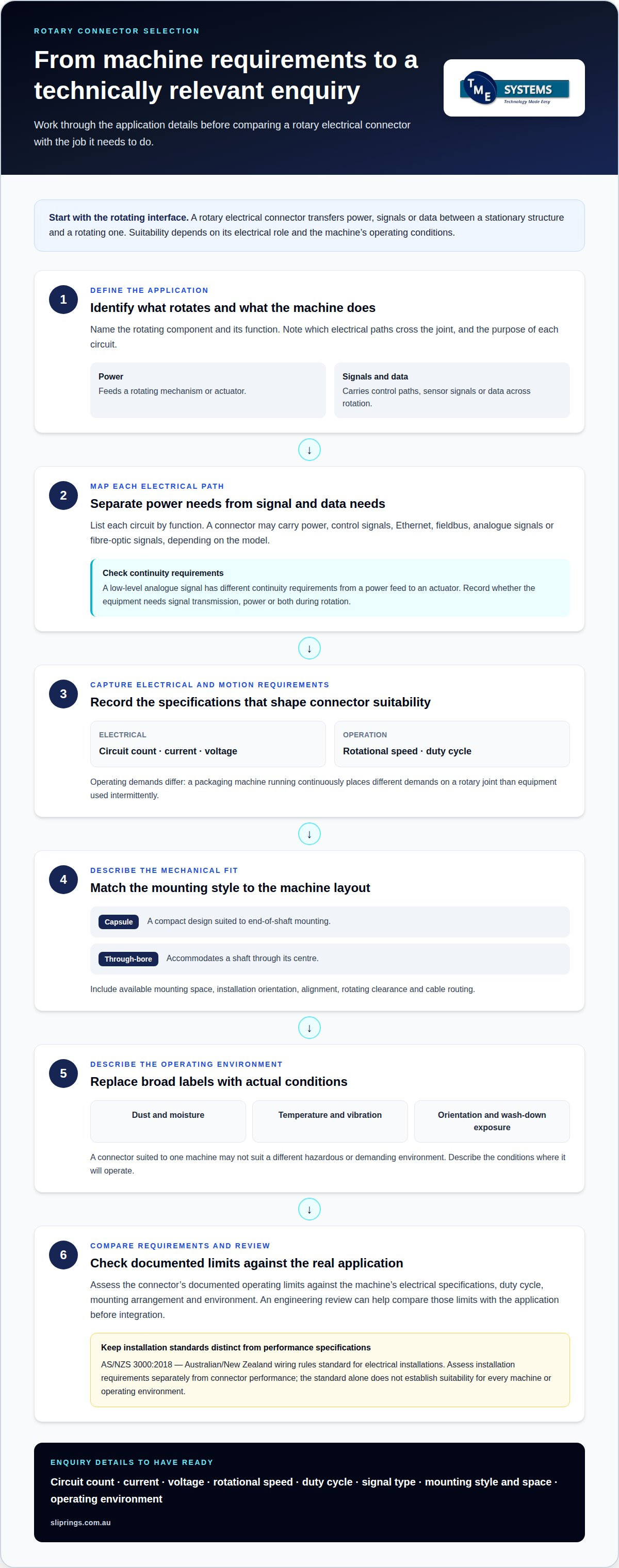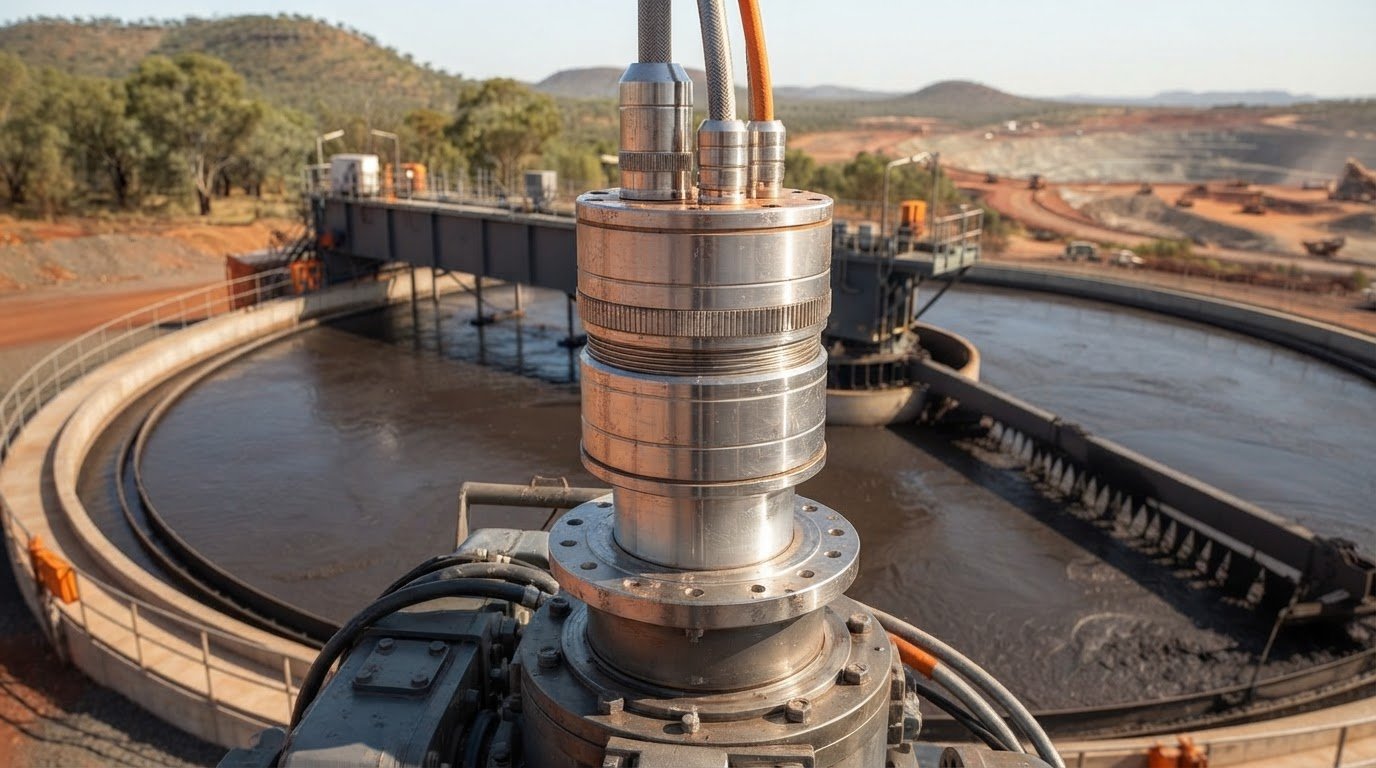
A supplier directory is only a starting point. To contact an Australian supplier for industrial rotary connectors, identify what the connector must do and share the application details. Include circuit count, current, voltage, rotational speed, mounting style, signal type and operating environment. This information helps assess product suitability and the continuity requirements of the application.
It is easier to find the right connector when you know what it must transfer and how it will be mounted. The key is matching those requirements to a suitable rotary connection, rather than making an enquiry with only a general product description.
This article explains how to approach Australian distributors, assess power and signal needs, and prepare a useful product enquiry. It covers the factors that affect slip ring suitability, including operating conditions and mounting space, so you can move from an initial enquiry towards a technically relevant solution.
Key Takeaways
- Prepare circuit count, current, voltage, rotational speed, mounting style and operating environment before contacting a distributor.
- Match the connector to the power, signal or data being transferred, as well as the rotating equipment and its conditions.
- Assess signal continuity alongside mechanical fit: contact technology and application requirements both influence suitability.
- Compare distributor locations with your project needs, but focus your enquiry on technical capability and the information needed to assess the application.
- TME Systems offers Meridian Laboratory, BGB Innovation and Prosper Rotation slip rings, with Technical Application Consulting to support product selection.
Rotary electrical connectors for signal and power transfer
A rotary electrical connector transfers power, signals or data between a stationary structure and a rotating one. For an Australian industrial application, first identify what must cross the rotating interface and the machine’s operating requirements.
Industrial connector types and specifications
A slip ring provides electrical paths across a rotating joint. Depending on the model, it can carry power, control signals, Ethernet, fieldbus, analogue signals or fibre-optic signals. Compare connector types by circuit count, current, voltage and rotational speed requirements. A capsule design suits end-of-shaft mounting, while a through-bore slip ring accommodates a shaft through its centre.
Industrial rotary connector prices vary by configuration, so there is no single figure for every application. To make a useful product comparison, define the required current, voltage, speed and circuit count first.
Australian suppliers, brands and availability
An Australian electrical connector distributor directory can help identify businesses to contact, but circular connector listings do not necessarily indicate rotary slip ring expertise. Directory results report 32 suitable circular connector service providers in Australia. Use those records as a starting point, then describe the rotating application and required electrical paths in your enquiry.
Supplier brands, lead times and stock availability vary with the selected model and configuration. Include your required specifications and project timing when contacting an Australian distributor, so the enquiry can be assessed against the product needed.
Industrial signal and power connections
Separate power circuits from signal and data requirements in your design notes. For example, an automated production system may need power for a rotating mechanism and control signals for sensors. The connector must support the required circuits while maintaining continuity as the connected structure rotates.
Renewable energy equipment and electric vehicle production machinery can include rotating assemblies. For either example, first identify the rotating component, then list the power, signal or data paths crossing its joint. Custom rotary connector manufacturers serving Australia can work from those application requirements to develop a suitable assembly; provide the mechanical layout and operating conditions alongside the electrical specifications.
Application suitability and safety considerations
Select a rotary connector based on the machine’s operating conditions, not just its product category. Record current, voltage, rotational speed, duty cycle, signal type, environment and available mounting space. Compare these requirements with the connector’s documented operating limits. For example, a packaging machine running continuously places different demands on a rotary joint than equipment used intermittently.
Australian standards and certifications for industrial rotary connectors depend on the installation and intended application. AS/NZS 3000:2018 is the Australian/New Zealand wiring rules standard for electrical installations; assess installation requirements separately from a connector’s performance specifications. Don’t assume that a general electrical standard alone establishes suitability for every machine or operating environment.
Industrial machinery and automation systems may need a rotary electrical connection for power, control signals or data. In a rotating table, for example, the connector must suit the table’s speed and mounting arrangement while providing the required electrical paths. Map which sensor and actuator signals cross the rotating interface, and note any power circuits sharing the assembly. This helps prevent an important control path from being overlooked.
Test, measurement and laboratory applications call for careful attention to the signals being transferred. A low-level analogue signal has different continuity requirements from a power feed to an actuator. List each circuit by function, then identify whether the equipment needs signal transmission, power or both during rotation. For a laboratory instrument, include its operating cycle and connection layout to help assess the application.
Environmental conditions matter too. Dust, moisture, temperature, vibration and installation orientation can affect whether a connector suits its location. If equipment operates near wash-down processes, describe the exposure clearly rather than relying on a general label such as “industrial”. Consider applicable safety requirements and regulatory restrictions: a connector suited to one machine may not suit a different hazardous or demanding environment.
Installation and maintenance requirements depend on the selected model and machine layout. During installation, check mounting alignment, rotating clearance, cable routing and connection security. Plan inspections around the operating conditions, and look for changes such as loose connections, contamination or physical damage. Before integration, an engineering review can compare the connector’s limits with the machine’s actual duty cycle and environment.
For product selection, prepare a short application record covering machine function, circuit purpose, operating conditions, installation orientation and mounting space. This gives an engineer the context to assess suitability, rather than relying on a broad description such as “for automation”.
Information needed for a product enquiry
A useful product enquiry describes both the connector’s electrical role and its mechanical setting. Prepare six core details: circuit count, current, voltage, rotational speed, mounting style and operating environment. For example, a rotating test rig carrying power and analogue signals needs a different assessment from a joint carrying power alone.
List each circuit by function instead of combining requirements into a broad description. This distinguishes power paths from control signals, analogue signals, Ethernet and other data. Record known operating values beside each circuit. If the machine has multiple operating modes, describe each relevant mode and when it occurs.
- Circuit count: State the number of independent paths and what each one carries.
- Current and voltage: Give the required values for each power circuit.
- Rotational speed: Describe the normal operating speed and any changes during the cycle.
- Mounting style: Note whether the unit fits at a shaft end or around a shaft.
- Environment: Describe exposure to dust, moisture, temperature changes or vibration.
- Signal type: Identify analogue, control, Ethernet, fieldbus or fibre optic transmission needs.
Mechanical information turns electrical details into a useful application description. Include a sketch or drawing showing the shaft, available installation space, cable entry direction and nearby components. Mark dimensions that constrain the assembly, such as clearance around a rotating shaft. A through-bore design needs a clear shaft path, while an end-mounted design has different space requirements.
Describe how the machine operates, not just what it is called. State whether rotation is continuous or intermittent, whether speed changes during a cycle, and whether the connector runs in a fixed orientation. For an automated production machine, explain when sensors or actuators need power or signals across the rotating joint. This connects circuit requirements to actual machine behaviour.
Include accessories and surrounding assemblies in the enquiry when they affect fit or cable routing. Examples include adjacent cable runs, hydraulic lines passing through a shaft, or a mounting bracket that limits clearance. These details help identify a connector that meets the electrical requirements and fits the equipment layout.
Before sending the enquiry, check that the six core specifications match the drawing and application description. Flag values that vary between operating modes, and identify which signals must remain continuous during rotation. A concise, consistent set of details gives the supplier a practical basis for assessing the connector configuration and its fit for the application.
Signal quality and low-resistance continuity
A rotary connection must preserve the electrical path as its contacts move during rotation. Resistance at the interface can affect voltage transfer and signal behaviour. Assess the connector against the actual circuit, such as an analogue measurement channel, a control signal or an Ethernet link. Each has different transmission requirements, so the general label “signal” is not enough to evaluate performance.
Low contact resistance is one factor in continuity, but it is not the only one. Circuit design, contact method, rotational conditions and connected equipment all affect the result. For example, a measurement system may be more sensitive to changes than a power circuit. Define the signal’s purpose first, then consider the connector’s specified performance for that transmission type.
Some rotary connectors use mercury-wetted contact technology to provide low-resistance, smooth electrical transfer during rotation. This differs from conventional brush contacts, so assess it against the application’s signal needs and operating conditions. Contact method alone does not establish suitability: voltage, current, circuit count and rotational speed also matter.
Signal quality also depends on how the rotary interface fits into the wider electrical system. Cable routing, secure connections and the equipment’s grounding arrangement can affect the path beyond the connector itself. For a rotating test instrument, map each signal from its source, across the rotating joint, to the receiving equipment. This helps identify where continuity or interference concerns may arise.
- Identify the signal: Record whether each path carries analogue, control, Ethernet, fieldbus or another signal.
- Separate circuit functions: Distinguish signal paths from power circuits in the assembly drawing.
- Describe operating conditions: Include rotation, speed changes and the equipment’s operating cycle.
- Review the complete path: Consider connectors, cables and grounding alongside the rotary interface.
For high-speed data transmission, confirm that the selected connector is designed for the signal type and data requirements. Ethernet and fibre-optic signals, for example, need different transmission paths. Do not assume that a connector suited to power or basic control signals will also carry high-bandwidth data effectively.
Relate continuity requirements to the consequences of signal interruption. A brief disturbance in a monitoring channel may affect recorded measurements; an interruption in a machine control path may disrupt operation. State which signals must remain continuous during rotation and how the equipment uses them. This context helps assess contact technology and electrical performance as part of the complete application.
Connector distributor locations and headquarters
Australian distributor directories can help locate electrical connector businesses, but a listing does not necessarily identify a company’s headquarters, warehouse or technical team. Treat directory locations as contact information, not proof of rotary connector expertise or product stock. For a nationwide project, first establish whether the business handles industrial rotary electrical connections and can address your application.
Directory categories also need careful interpretation. Australian listings report 81 circular connector manufacturers, while 66 are described as fitting manufacturers. These figures concern circular connectors, not necessarily industrial rotary connectors or slip rings. Before relying on a listing, identify whether the business works with rotary electrical assemblies and the application requirements you have.
A distributor’s listed location matters less than its contact route and technical scope. Look for a product enquiry channel, rotary connector specialisation and the manufacturers it represents. Then send a concise application summary, including the machine type and required electrical paths. A directory entry alone cannot establish product fit or stock availability.
The Australian electrical connector distributor dataset averages 11.2 tracked contacts per company as of 12 October 2026. That describes the dataset’s contact records, not the number of relevant engineers or product specialists at each business. Use the available contact information to direct your enquiry to the appropriate team, and state clearly that your requirement concerns a rotating electrical interface.
Company size is another directory detail to interpret cautiously. The median employee-size band for Australian electrical connector distributors in the same dataset is 11-50 employees as of 12 October 2026. This describes a broad distributor category; it doesn’t establish a company’s rotary connector expertise, engineering capability or geographic coverage. Your application requirements remain the more useful basis for a technical discussion.
For a practical search and enquiry process:
- Search Australian directories using terms such as “slip ring distributor” and “rotary electrical connector”.
- Separate manufacturers from distributors, since their roles in product supply differ.
- Review the listed contact channel and whether rotary connector applications are covered.
- Send your circuit requirements, mounting information and operating conditions in the first enquiry.
- Ask for the response to address product suitability and the relevant supply arrangement.
These steps turn a directory result into a focused product enquiry. A project team can provide the same application details wherever its equipment operates in Australia, allowing the technical discussion to start with the connector’s role. A directory can help locate a contact; the application information explains what needs assessing.
TME Systems: Meridian Laboratory Slip Rings
TME Systems can help match a rotary connector to the application details gathered for your enquiry. Its Meridian Laboratory Slip Rings are relevant when your project needs a rotary electrical connection for power or signal transfer. Technical Application Consulting can support product selection by considering the machine’s electrical requirements, mounting arrangement and operating conditions.
For other industrial requirements, TME Systems also supplies BGB Innovation Slip Rings and Prosper Rotation Slip Rings. Share your circuit requirements, operating conditions and equipment layout to give the product discussion a practical engineering basis.
Contact TME Systems to discuss your rotary connector application.
Move your rotary connector project forward
Use the next design review to connect component selection with the machine’s full operating requirements. Consider how power, signals and mechanical integration work together, then document constraints that could affect the final assembly. This gives your engineering team a clearer basis for assessing a suitable rotary connection.
If you’re assessing an Australian supplier for industrial rotary connectors, TME Systems supplies Mercotac Slip Rings, Meridian Laboratory Slip Rings and BGB Innovation Slip Rings. Its Technical Application Consulting helps relate product selection to your project requirements.
Bring your application details into the next conversation and take a considered step towards your design solution. Contact TME Systems about rotary connectors to discuss your application.
Frequently Asked Questions
How do I get contact information for these companies?
Use an official supplier website or directory listing to find its enquiry channels. TME Systems Pty Ltd can be contacted by phone on +61 (2) 9829 3055, by email at sales@sliprings.com.au, or through its website contact form. In your message, state your organisation and project stage, then attach relevant drawings or documents. This gives the enquiry useful context from the outset.
Australian suppliers of industrial rotary connectors and slip rings
TME Systems Pty Ltd supplies industrial slip rings and rotary electrical connectors to Australian customers. For procurement teams, identify whether the enquiry concerns a new machine build, an engineering project or a replacement assembly. Include the intended use and any procurement documentation your team needs addressed. This keeps the initial discussion focused on the project and purchasing process.
What types of industrial rotary connectors are available in Australia?
Available types include liquid metal rotary connectors, collector rings and fibre-optic rotary joints. They serve different transmission and equipment needs, so identify the signal or power path before comparing designs. Collector ring vs slip ring: Collector rings are heavy-duty rotary connectors designed for high current capacity, while standard slip rings are typically optimised for signal integrity and lower currents. Fibre-optic joints suit applications requiring optical signal transfer.
Australian distributors of electrical slip rings for industrial machinery
TME Systems Pty Ltd supplies industrial slip rings for Australian machinery projects. Machinery builders can include the equipment’s design stage and intended integration date in their enquiry. Maintenance teams can describe the existing assembly and reason for replacement. These details frame the supply discussion around procurement needs, whether specifying a new machine or sourcing a rotary electrical component.
How to select a rotary connector for an Australian industrial application
For a replacement project, start with the installed connector’s manufacturer and part identification, if available. Compare its wiring diagram and mechanical drawing with the equipment’s current design, noting changes made during previous modifications. For a new assembly, provide a drawing showing how the connector interfaces with the machine. These records help clarify any difference between the original design intent and the equipment as built.
Rotary connector failure risks and environmental protection ratings
Intermittent operation, unexpected signal loss or visible damage can indicate a problem with a rotary connector or its installation. Record when the fault occurs, such as during rotation or under a particular operating condition, and compare it with machine logs. An IP rating can help indicate how well equipment is protected from dust and water. Use the rating to assess protection against the equipment’s actual exposure.
Industrial rotary connector supplier comparison Australia
Compare suppliers by the quality of their application support and the documentation they provide for engineering review. Check whether product documentation, dimensional drawings and a clear description of the proposed configuration can support the enquiry. If your project needs a non-standard arrangement, consider whether the supplier works with manufacturers offering customised slip-ring solutions. These points help distinguish basic product supply from a technically supported project discussion.
Industrial rotary connector prices in Australia
Industrial rotary connector prices vary by configuration, so there is no single price for every application. Define the required current, voltage, speed and circuit count to make a useful product comparison.