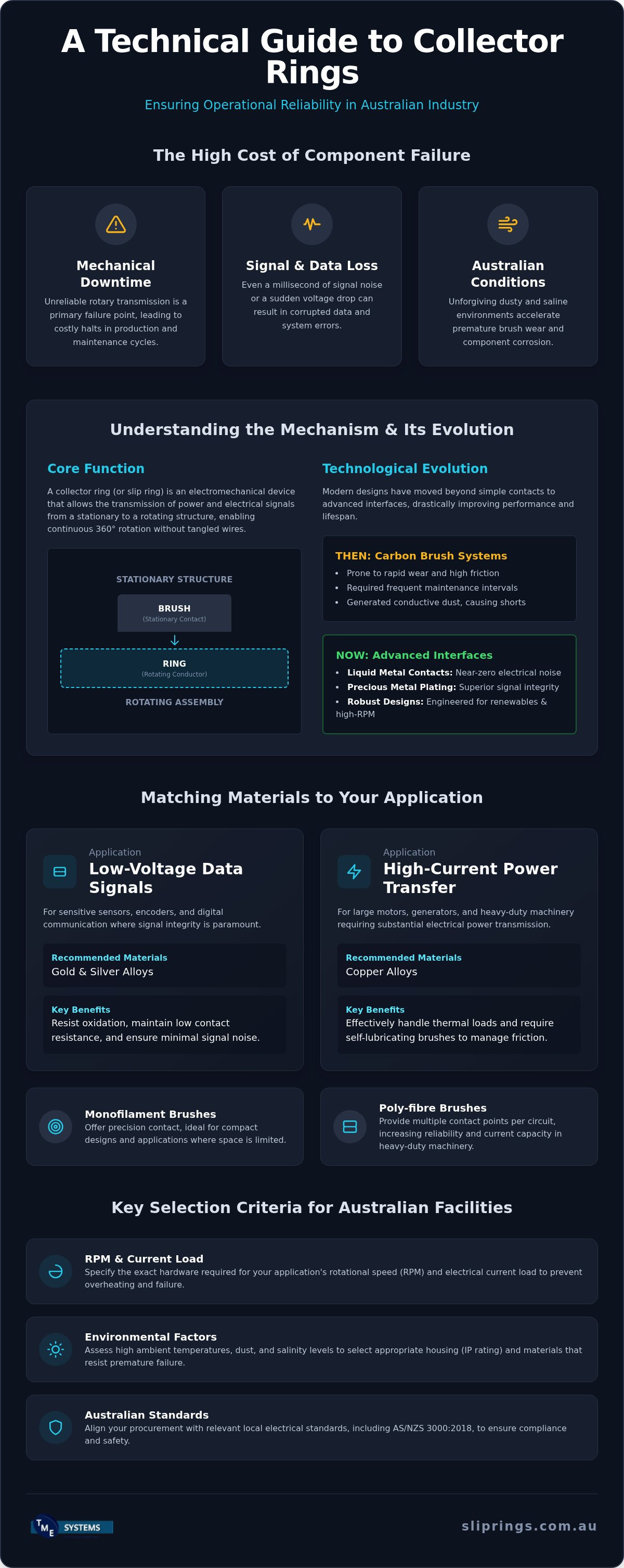
How much does a single millisecond of signal noise or a sudden voltage drop actually cost your facility in lost data and mechanical downtime? You likely recognise that while a collector ring is often a small component in a larger rotating assembly, it's frequently the primary failure point when operating in Australia's unforgiving dusty or saline environments. Whether you're dealing with premature brush wear or struggling to find local technical support for specialised international brands, the frustration of unreliable rotary transmission is a significant operational burden.
This technical guide clarifies the complexities of specifying industrial rotary connectors, ensuring you can identify the exact hardware required for your specific RPM and current load. You'll discover how to reduce maintenance intervals through better material selection and how to align your procurement with Australian electrical standards, including AS/NZS 3000:2018. We'll examine the performance profiles of leading technologies from brands like Mercotac and BGB Innovation, providing a clear pathway to establishing a resilient and technically sound supply chain for your critical machinery.
Key Takeaways
- Define the core mechanical role of a collector ring in maintaining electrical continuity across rotating interfaces.
- Compare contact materials and brush designs to optimise signal integrity and reduce wear in harsh industrial environments.
- Distinguish between regional terminology and specific applications to ensure you specify the correct hardware for power generation and large motors.
- Assess environmental factors such as high ambient temperatures and RPM constraints to prevent premature component failure in Australian facilities.
- Streamline your supply chain by integrating technical application consulting with high-performance solutions from brands like Mercotac and Meridian Laboratory.
Understanding Collector Rings and Their Industrial Role
A Slip ring (collector ring) is a specialised electromechanical device designed to transmit electrical power and data signals from a stationary structure to a continuously rotating one. In the Australian industrial sector, the term collector ring is frequently used to describe the heavy-duty variants found in power generation and large motor assemblies. Its primary purpose is to allow for unrestricted, 360-degree rotation while maintaining a constant electrical connection. This eliminates the physical limitations of hard-wired systems, which would otherwise tangle or snap under continuous circular motion.
While the basic concept remains consistent, you'll encounter various terms for this hardware across different industries. Engineers might refer to them as rotary electrical connectors, electrical swivels, or rotary joints. Regardless of the label, the functional requirement is identical: providing a reliable interface that bridges the gap between fixed and moving parts. In Australia, these components are critical to the operation of wind turbines, where they transfer pitch control signals, and in high-speed packaging lines found in the food and beverage industry.
How Collector Rings Facilitate Continuous Rotation
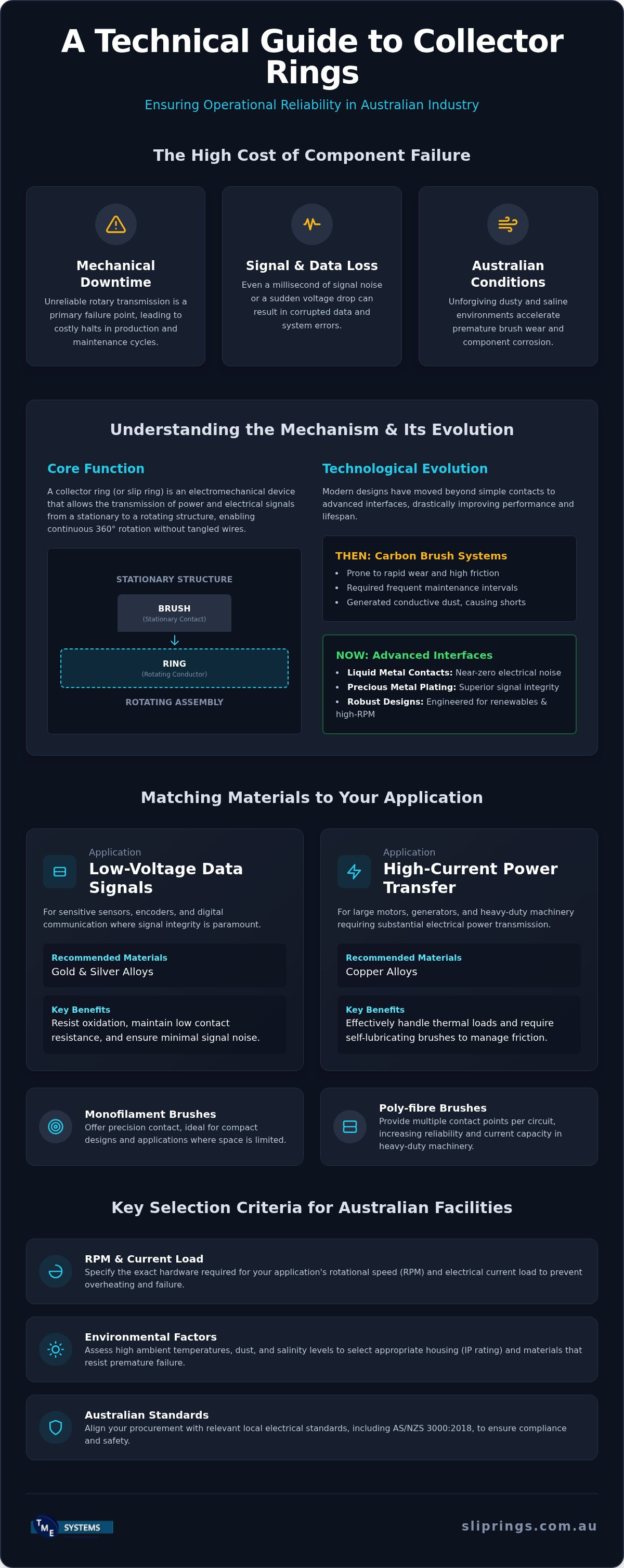
The operational logic of a collector ring relies on the interaction between a stationary contact, known as a brush, and a rotating conductive ring. As the machinery turns, the brush maintains constant physical contact with the ring, allowing current to flow without interruption. By removing the need for dangling cables, you significantly improve the mechanical reliability of the system. This setup is particularly vital in high-RPM applications where even a minor loss of continuity can lead to signal noise, data corruption, or catastrophic component failure. Correct specification ensures that the interface can handle the specific centrifugal forces and frictional heat generated during operation.
Historical Evolution of Rotary Connectors
Early designs relied heavily on simple carbon brush systems, which were prone to rapid wear and required frequent maintenance intervals to clear conductive dust. Modern engineering has seen a significant shift toward advanced materials and interfaces. Contemporary solutions, such as those provided by Mercotac Slip Rings, utilise liquid metal interfaces to provide near-zero electrical noise and extended service lives. Similarly, BGB Innovation Slip Rings have pioneered robust designs for the renewable energy sector. These advancements allow for the simultaneous transmission of high-current power and sensitive digital signals within a single, integrated unit, drastically reducing the physical footprint of the connector.
Technical Composition and Design Variants
Selecting a collector ring requires a precise understanding of the materials that facilitate electrical transfer. Every industrial application presents unique challenges regarding electrical noise and mechanical wear. For a foundational reference, the International Association of Marine Aids to Navigation and Lighthouse Authorities provides an authoritative definition of a collector ring, noting its interchangeability with the term slip ring in many technical contexts. The goal is always to match the metallurgy of the ring and brush to the specific electrical load and environmental conditions of the site.
Ring and Brush Material Science
The choice of conductive material determines the longevity and signal quality of the unit. Precious metals like gold and silver are standard for low-voltage data transmission. These metals resist oxidation and maintain low contact resistance, which ensures minimal signal noise for sensitive sensors. Conversely, high-current power transfer usually requires copper alloys. These materials handle thermal loads more effectively but necessitate self-lubricating brushes to manage friction. Monofilament brushes offer precision for compact designs. Poly-fibre brushes provide multiple contact points per circuit, which increases reliability and current capacity in heavy-duty machinery. For applications requiring extreme precision, Meridian Laboratory Slip Rings utilise specialised contact technologies to virtually eliminate maintenance.
Specifying the correct circuit count is a balancing act between functionality and physical footprint. As you add circuits for power, ground, and data, the housing size increases. You must also account for voltage and current ratings carefully. Industrial units in Australia often need to manage 415V three-phase power alongside low-voltage control signals. This requires robust internal insulation and physical separation between high and low-power tracks to prevent electromagnetic interference.
Housing and Sealing Specifications
Environmental protection is paramount for Australian operations. Plastic housings are lightweight and cost-effective for indoor packaging lines. Metal housings, typically aluminium or stainless steel, are necessary for mining or marine environments. Look for IP65 or IP67 ratings to protect internal components from dust ingress and moisture. The mounting style also dictates the design. Through-bore models allow for a central shaft or hydraulic lines to pass through the centre. Capsule designs are compact for tight spaces. Pancake models offer a low-profile solution when vertical height is restricted. Prosper Rotation Slip Rings offer a wide variety of these mounting configurations to suit diverse mechanical envelopes.
If you are unsure which configuration suits your RPM and current load, you can consult with a technical specialist to review your specific engineering drawings and environmental variables.
Collector Ring vs. Slip Ring: Clarifying the Terminology
Engineers and procurement officers often ask if a collector ring and a slip ring are functionally different. In the Australian electrical engineering sector, the answer is usually no. Both devices serve the same fundamental purpose: transmitting electrical signals and power across a rotating interface. However, the choice of terminology often signals the specific industrial context or the scale of the machinery involved. If you're working with high-capacity generators or large-scale induction motors, the term collector ring is the industry standard. Conversely, in the robotics and precision automation sectors, the term slip ring is the predominant designation.
Are they actually interchangeable? From a purely electromechanical standpoint, yes. However, from a procurement perspective, treating them as identical can lead to specification errors. A component marketed as a collector ring is typically designed for high-current power transmission and heavy-duty mechanical environments. A generic slip ring might only be rated for low-voltage data signals. Mistaking one for the other during a search can result in hardware that fails under the thermal or electrical stresses of your specific application.
Application-Specific Naming Conventions
In the energy sector, specifically within alternators and generators, the collector ring is a critical component for providing excitation current to the rotor. Similarly, slip ring induction motors are named for their specific use of these rings to allow external resistance to be connected to the rotor circuit. When searching for spares or new installations, ensure you specify the application clearly. Searching for a "slip ring" in a power generation context might lead you toward compact, low-current devices that aren't fit for purpose. For high-power requirements, BGB Innovation Slip Rings are often the preferred choice due to their heritage in wind energy and heavy industry.
Technical Nuances in High-Power Systems
High-current systems, which almost always use the collector ring designation, require significantly larger contact surfaces than signal-only variants. This increased surface area is necessary to manage the thermal loads generated by high amperage. Managing heat dissipation is a primary concern in heavy-duty assemblies. Excessive temperature can lead to ring warping or accelerated brush degradation. Brush pressure also plays a pivotal role. Insufficient pressure increases electrical resistance and creates arcing, while excessive pressure leads to rapid mechanical wear. Finding the correct balance is essential for reducing maintenance intervals. If your project involves complex mechanical envelopes, Prosper Rotation Slip Rings offer custom configurations that address these specific high-power challenges.
Critical Selection Criteria for Australian Industrial Environments
Operating a collector ring in Australia presents environmental challenges that standard off-the-shelf components often fail to meet. You must account for ambient temperatures that frequently exceed 40 degrees Celsius in regional areas, which drastically affects heat dissipation within the housing. High RPM requirements further complicate this by introducing significant centrifugal forces that can lift brushes from the ring surface, leading to arcing and localised pitting. Ensuring your selection is rated for these specific physical stresses is the first step toward long-term reliability in your plant.
Specifying for Mining and Heavy Industry
In the mining and quarrying sectors, dust ingress remains the primary cause of premature electromechanical failure. Fine, conductive dust can create internal short circuits or accelerate abrasive wear on the rings. You require housings with robust IP ratings, typically IP65 or higher, to maintain internal integrity against the elements. Vibration and shock are also constant factors in crushing and screening plants, where mechanical resonance can disrupt contact stability. Selecting BGB Innovation slip rings is a strategic choice for these heavy-duty settings. These components are specifically engineered to withstand the mechanical rigours of remote site operations and often feature maintenance-friendly designs that allow for rapid brush inspection without extensive downtime.
Signal Integrity and Noise Reduction
Maintaining signal integrity is critical when your machinery transmits sensitive data, such as Ethernet or thermocouple signals, alongside high-current power. Standard carbon brush systems can introduce electrical noise that corrupts PLC communication or video feeds. For these high-precision applications, liquid metal connectors are frequently the only viable solution. Technology from Mercotac Slip Rings utilises a molecularly bonded liquid metal interface to provide extremely low resistance and near-zero noise. This approach is essential for high-speed rotary connections where traditional mechanical friction would otherwise degrade the signal quality beyond acceptable limits. Combining this with proper shielding and grounding strategies ensures that multi-circuit assemblies operate without cross-talk or interference.
Coastal and marine industrial sites face the additional burden of saline corrosion. Salt air can quickly compromise conductive paths if the unit isn't properly sealed. Utilising stainless steel 316 housings and specialised gaskets is necessary to prevent oxidation in these zones. If you are currently experiencing signal drops or frequent maintenance cycles, you should contact a technical specialist to review your current hardware specifications against your environmental data.
Procuring High-Performance Collector Rings in Australia
Procuring a collector ring requires more than just matching a part number; it demands a thorough audit of your operational parameters. In the Australian market, where lead times and technical support can significantly impact project timelines, the value of technical application consulting cannot be overstated. Transitioning from a generic component to an engineered solution ensures that your rotating machinery maintains peak performance without the risk of premature failure. A reliable procurement process bridges the gap between complex manufacturing capabilities and your specific site requirements.
Leading Technologies in the Australian Market
Selecting the right brand depends on the primary performance driver of your application. For systems where electrical noise must be kept to an absolute minimum, Mercotac slip rings are the industry benchmark. Their liquid metal interface provides extremely low resistance and a maintenance-free service life that traditional brush systems cannot match. When your project demands the highest levels of precision engineering and high-speed data transmission, Meridian Laboratory solutions offer specialised contact technologies designed for zero-maintenance operation in demanding environments.
For applications requiring high circuit counts or unique mechanical configurations, Prosper Rotation provides exceptional versatility. Their modular designs allow for custom integration of power and signal circuits within various housing styles, including through-bore and pancake models. This adaptability is particularly useful for Australian packaging and manufacturing lines where space is often at a premium and off-the-shelf units may not fit the existing mechanical envelope.
The Procurement Checklist for Engineers
Before requesting a quote for a custom collector ring, you should prepare a detailed technical brief. This reduces ambiguity and ensures the hardware is fit for purpose. Your checklist should include:
- Electrical Load: Confirm the exact voltage and current ratings for every circuit, including grounding requirements.
- Circuit Configuration: Specify the number of power circuits versus sensitive data or signal tracks.
- Mechanical Constraints: Define the maximum RPM and the required mounting style (e.g., through-bore diameter).
- Environmental Sealing: Determine the necessary IP rating based on dust, moisture, or saline exposure.
Utilising a local Australian supplier provides the dual benefit of technical consulting and a more resilient supply chain. Having access to local expertise means you can verify specifications against Australian standards like AS/NZS 3000:2018 before the order is finalised. For a deeper dive into the specification process, refer to our Industrial Slip Rings Australia: The Technical Procurement Reference to ensure your next installation meets all safety and performance benchmarks.
Optimising Rotary Continuity in Harsh Environments
Achieving long-term mechanical reliability in rotating systems requires more than just a basic hardware match. You've seen that the success of a collector ring installation depends on a precise alignment between material science and the specific environmental stresses of your site. Whether you're managing high-current power in a remote mining facility or sensitive data in a high-speed packaging plant, the choice of contact technology and housing protection determines your maintenance intervals and signal integrity.
As an authorised distributor for world-leading rotary connector brands like Mercotac and BGB Innovation, we provide expert technical selection advice tailored to the unique demands of Australian industry. We help you move beyond the risks of generic components by delivering engineered solutions that account for RPM limits, thermal loads, and corrosive saline air. This consultative approach ensures your procurement process leads to a reliable, high-performance outcome.
If you're ready to stabilise your rotary transmissions and reduce operational downtime, consult with our technical team for your collector ring requirements. We look forward to helping you specify the most resilient hardware for your next project.
Frequently Asked Questions
Is there a difference between a collector ring and a slip ring?
Technically, there is no functional difference between a collector ring and a slip ring. The distinction is primarily semantic; the term "collector ring" is the preferred designation in the energy and heavy motor sectors, while "slip ring" is more common in robotics. Both devices serve the same purpose of maintaining electrical continuity across a 360-degree rotating interface.
How do I choose the right collector ring for my application?
You must specify four core parameters: voltage and current load, total circuit count, maximum operating RPM, and the physical installation environment. Choosing the correct hardware involves balancing these technical requirements against your budget and maintenance goals. Providing a detailed technical brief to an application consultant is the most reliable way to ensure compatibility with your specific machinery.
Can collector rings transmit both power and data simultaneously?
Yes, many industrial assemblies are designed to transmit high-current power and sensitive data signals simultaneously. This is achieved through internal shielding and physical separation between high-voltage tracks and low-voltage signal lines. Using advanced contact materials, such as those in a high-quality collector ring, helps prevent signal noise and data corruption during rotation.
What maintenance is required for industrial collector rings?
Maintenance requirements are dictated by the contact technology used in the assembly. Traditional carbon brush systems require regular inspections to clear conductive dust and check for brush wear. Conversely, advanced liquid metal or precious metal fibre brush systems are often designed as maintenance-free units, significantly reducing downtime in remote Australian industrial sites.
How does RPM affect the performance of a collector ring?
RPM directly impacts the centrifugal forces acting on the brushes and the amount of frictional heat generated at the contact point. If the RPM exceeds the unit's rated limit, you may experience brush bounce, arcing, or rapid degradation of the conductive rings. Always select a component with a speed rating that exceeds your maximum operational RPM to ensure consistent electrical performance.
Are there mercury-free alternatives for rotary connectors?
Yes, there are several mercury-free alternatives available for applications with strict environmental or safety regulations. Gallium-alloy liquid metal connectors and precious metal poly-fibre brush systems offer excellent signal integrity and low resistance without the risks associated with mercury. These alternatives are ideal for the food processing and medical sectors where contamination must be avoided.
What IP rating do I need for a collector ring in a mining environment?
For mining and quarrying environments, an IP65 rating is the standard requirement to prevent the ingress of fine, abrasive dust. If the equipment is subject to high-pressure water cleaning or operates in extremely wet conditions, you should specify an IP67-rated housing. This level of sealing protects the internal collector ring components from moisture and particulate contamination.
How long do collector rings typically last before needing replacement?
The operational lifespan depends on the contact materials, rotational speed, and the duty cycle of the machine. High-performance industrial units can often achieve over 100 million revolutions before requiring service or replacement. However, in harsh environments or high-load applications, standard brush systems may need replacement parts every two to five years to maintain electrical integrity.