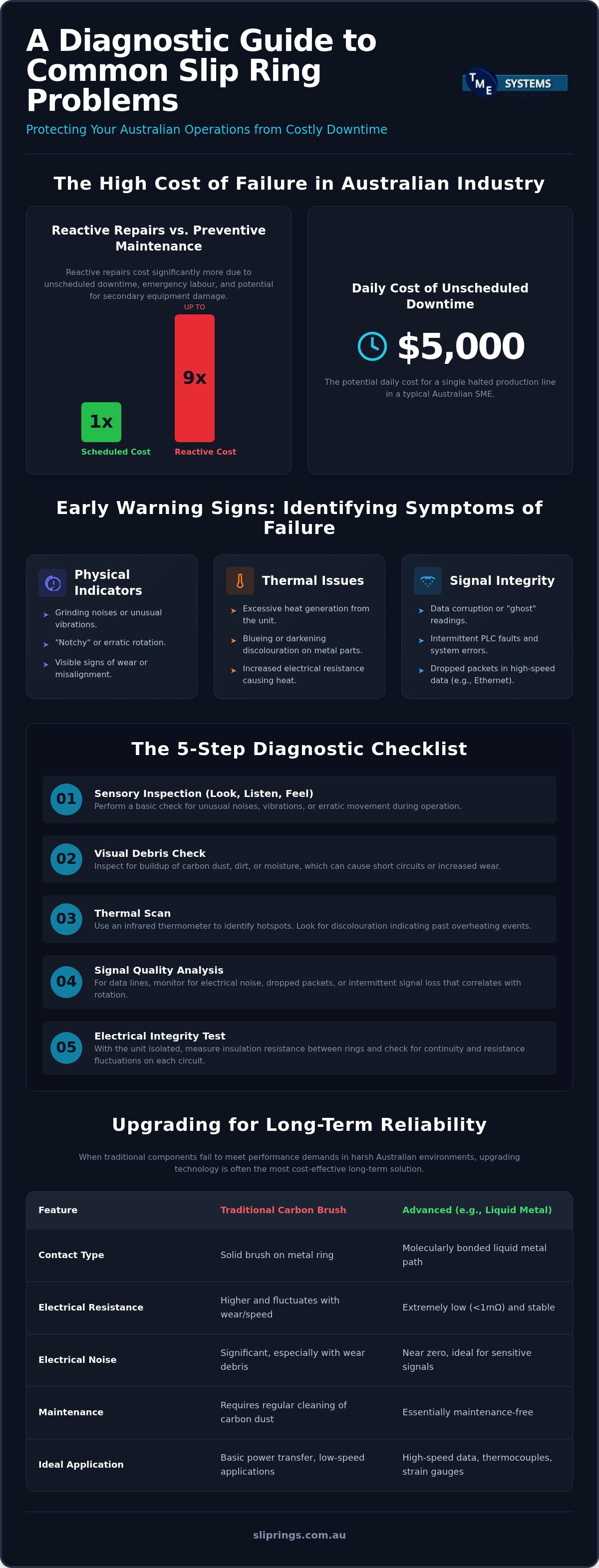
Did you know that reactive repairs on industrial machinery in Australia can cost up to nine times more than the same work performed as scheduled preventive maintenance? For maintenance managers and engineers, a sudden failure in a rotary connection isn't just a technical glitch; it's a costly disruption that halts production and drains resources. Whether you're dealing with intermittent signal loss in critical sensors or the high maintenance costs associated with traditional carbon brushes, identifying common slip ring problems quickly is essential to protecting your bottom line. We recognise that unscheduled downtime can cost Australian SMEs up to $5,000 per day, making a reactive approach unsustainable in a competitive market.
This diagnostic checklist provides a pragmatic pathway to identify, troubleshoot, and resolve the most frequent causes of slip ring failure. You'll learn how to pinpoint the root causes of signal noise and electrical interference while implementing strategies to minimise mechanical wear. By following these clear diagnostic steps, you can ensure a longer service life for your rotary connections and protect your high-value equipment from avoidable damage.
Key Takeaways
- Learn to recognise early indicators of failure, such as excessive heat and increased electrical resistance, to prevent costly unscheduled downtime.
- Utilise a systematic diagnostic checklist to isolate common slip ring problems, covering everything from visual debris checks to precise insulation resistance testing.
- Understand the impact of mechanical stressors like misalignment and vibration on contact surface wear and signal continuity in harsh environments.
- Identify why environmental factors accelerate bearing degradation and how to verify that ingress protection levels are appropriate for your specific site conditions.
- Evaluate the long-term reliability benefits of upgrading to brushless or liquid metal technologies when traditional components fail to meet performance demands.
Identifying the Symptoms of Slip Ring Failure
Recognising the onset of common slip ring problems before they lead to a total system shutdown is a critical skill for any maintenance professional. While these components are designed for durability, they aren't immune to the stressors of continuous operation. To understand the root causes, one must first understand the basic mechanics; What is a Slip Ring? Essentially, it is an electromechanical device that allows the transmission of power and electrical signals from a stationary to a rotating structure. When this interface begins to degrade, the symptoms are often subtle at first.
Physical indicators often provide the first warning. Grinding noises or unusual vibrations typically point to bearing failure or internal misalignment. If the rotation feels "notchy" or erratic, it's likely that debris has infiltrated the housing or the contact surfaces have become unevenly worn. In remote Australian mining or agricultural sites, the "tyranny of distance" means that a small mechanical rattle today can turn into a weeks-long wait for parts if not addressed immediately. Early detection through sensory inspection is your first line of defence against catastrophic failure.
Thermal Issues and Overheating
Heat is a primary indicator of electrical distress. As contact surfaces wear or oxidise, electrical resistance increases, generating heat that further accelerates oxidation in a destructive feedback loop. In the harsh Australian climate, where ambient temperatures in industrial sheds can exceed 40°C, the duty cycle of a slip ring may be compromised. During your inspection, look for discolouration on the rings or brush holders. Blueing or darkening of the metal often indicates the unit has exceeded its thermal limits. Specifying Mercotac Slip Rings can be an effective solution here, as their liquid metal interface offers significantly lower resistance than traditional brushes.
Signal Noise and Data Corruption
Signal integrity is paramount in automated systems. Data corruption often manifests as "ghost" readings or intermittent PLC faults. You must differentiate between external Electromagnetic Interference (EMI) and internal resistive noise when diagnosing common slip ring problems in digital environments. Internal noise is frequently caused by a buildup of brush dust or insufficient contact pressure. High-speed data transmissions, such as Ethernet, are particularly sensitive. If you're seeing dropped packets, the standard carbon brush interface might no longer be fit for purpose. Moving to a low-noise solution like Meridian Laboratory Slip Rings can eliminate these erratic signals by providing a more stable electrical path.
Electrical Issues: Signal Noise and Continuity Breaks
Electrical performance in a rotary joint depends entirely on the stability of the contact interface. When contact pressure is insufficient, the resulting increase in resistance leads to voltage drops and signal instability. This is often the root of common slip ring problems in power-heavy applications. Maintaining the correct tension between the brush and the ring is a delicate balance; too much pressure accelerates mechanical wear, while too little invites electrical noise.
Vibration is a significant factor in many Australian processing plants and mining sites. High-frequency vibration causes carbon brushes to "bounce" against the rotating ring. This creates rapid, intermittent breaks in continuity that can baffle standard diagnostic tools. Implementing a sophisticated condition monitoring method is often necessary to detect these micro-interruptions before they trigger a system-wide fault. Beyond vibration, conductive dust accumulation presents a serious risk. As brushes wear, the resulting carbon fines can bridge the gap between adjacent rings. This leads to short circuits or dielectric breakdown, where the insulation resistance fails under high voltage loads.
Resistive Noise in Brush-Style Connectors
Wear debris in traditional brush-style connectors creates fluctuating resistance across the contact point. For those using BGB Innovation slip rings, regular cleaning schedules are mandatory to manage this carbon buildup. Without consistent maintenance, the "wear-debris-resistance" cycle will inevitably lead to signal corruption or excessive heat generation. In high-current applications, even a minor voltage drop caused by resistive noise can lead to significant power loss and component overheating.
Continuity Failures in Liquid Metal Units
In contrast, Mercotac slip rings utilise a liquid metal pool that maintains constant contact during rotation. This design rarely suffers from the resistive noise seen in brush-based systems. However, they aren't indestructible. Symptoms of failure in these units usually involve seal leaks or internal contamination. Proper mounting orientation is also vital; incorrect installation can lead to erratic performance or premature seal failure. If you're struggling with persistent signal noise in your current setup, our team can provide technical application consulting to help you select the right contact technology for your specific environment.
Mechanical Wear and Environmental Degradation
Mechanical integrity is the foundation of any reliable rotary connection. While electrical symptoms often grab the attention of maintenance crews, the underlying cause is frequently mechanical in nature. Bearing failure remains the silent killer of these components. Once a bearing begins to seize or develops excessive play, the resulting shaft wobble destroys the precise contact alignment required for stable transmission. This mechanical instability is a primary driver of common slip ring problems across Australian industrial sites, from manufacturing plants in Melbourne to remote mines in the Pilbara.
Misalignment is another critical factor. If the stationary and rotating components aren't perfectly concentric, the contact surfaces experience uneven wear patterns. Over time, this leads to "grooving" on the rings, which makes it impossible for brushes to maintain consistent pressure. In Australia's harsh conditions, environmental stressors amplify these mechanical issues. Coastal facilities face corrosive salt spray, while inland operations contend with fine mineral dust that acts as an abrasive within the housing. A NASA analysis of slip ring failures highlights how even minute contaminants can lead to significant operational degradation, proving that environmental protection is just as vital as electrical specification.
Vibration also plays a destructive role. In heavy machinery applications, constant oscillation accelerates mechanical fatigue in mounting brackets and internal fasteners. If the housing isn't securely anchored, the resulting harmonic vibration can lead to micro-cracks in the conductive rings or the premature failure of internal wiring connections. Regular torque checks on mounting bolts are a simple yet effective preventative measure.
Contamination and IP Ratings
Ingress protection (IP) is non-negotiable for equipment exposed to the elements or industrial wash-downs. Oil mist, moisture, and conductive dust lead to tracking and arcing across the insulation. Selecting the correct IP rating, such as IP66 for deck-mounted marine equipment or IP67 for splash zones, is essential. Seals play a dual role; they keep contaminants out while retaining internal lubricants. If a seal fails, internal contact surfaces quickly succumb to oxidation or abrasive wear, leading to intermittent signal loss and eventual total failure.
RPM and Speed-Related Wear
Operating a unit beyond its rated speed introduces centrifugal forces that can cause brushes to lift or "chatter" against the rings. This not only causes electrical noise but also accelerates mechanical fatigue in the mounting brackets. Continuous rotation at high speeds generates significant frictional heat, which must be dissipated to prevent material warping. For applications requiring high-RPM precision without the risk of speed-related degradation, Meridian Laboratory slip rings are often the preferred choice. Their specialised designs handle the thermal and mechanical demands of rapid rotation while maintaining signal integrity that traditional brush systems cannot match.
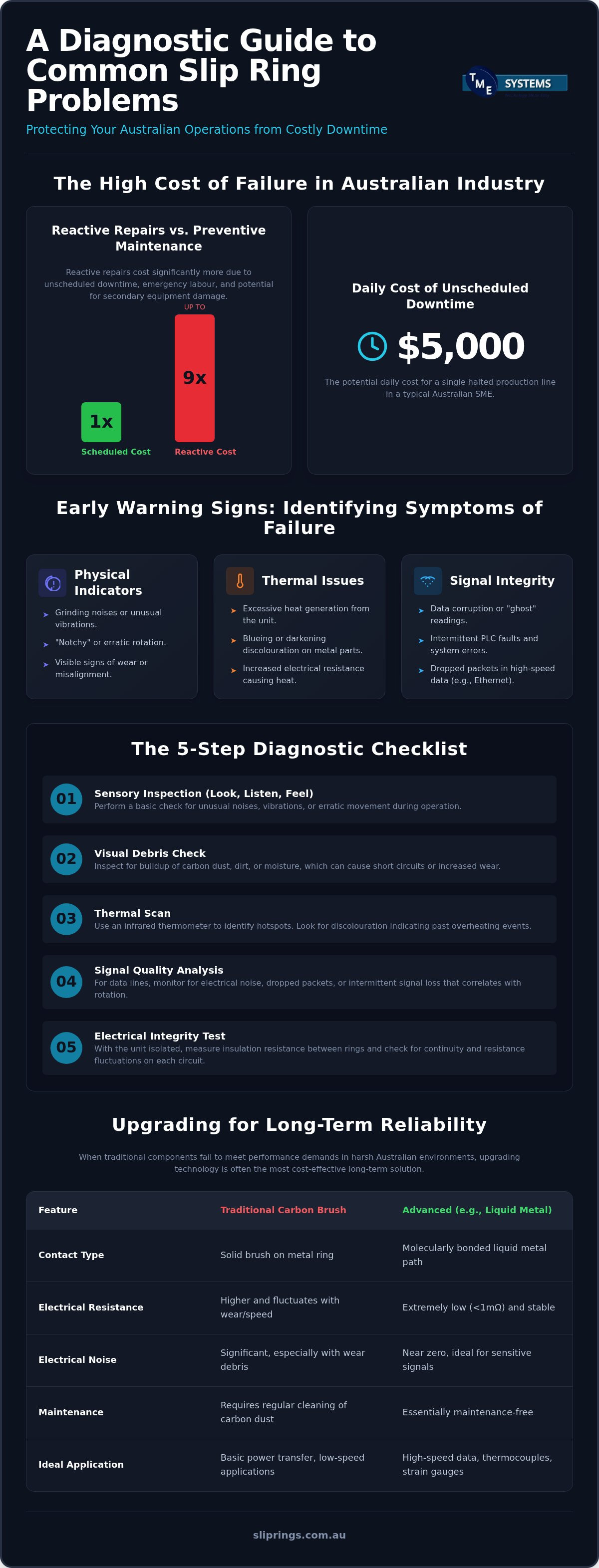
The Diagnostic Checklist for Industrial Slip Rings
When troubleshooting common slip ring problems, a systematic approach prevents the oversight of small mechanical issues that lead to major electrical failures. Technicians should move through these steps methodically to isolate the fault. Given that unplanned equipment downtime costs Australian SMEs between $1,000 and $5,000 per day, an efficient diagnostic process is a financial necessity. Use the following checklist to audit your rotary connections.
- Step 1: Visual Inspection. Open the housing and check for carbon dust accumulation, which often indicates excessive brush wear. Look for discolouration on the rings; blue or straw-coloured tints suggest the unit has overheated. Verify that the stationary mounting and the rotating shaft are perfectly aligned.
- Step 2: Electrical Testing. Use a megohmmeter to measure insulation resistance between circuits and between each circuit and the ground. Perform a continuity test while slowly rotating the shaft to identify intermittent "dead spots" or signal drops.
- Step 3: Mechanical Check. If possible, de-couple the slip ring from the drive motor. Rotate the shaft by hand to feel for bearing roughness, grittiness, or excessive play. Any mechanical resistance at this stage indicates internal bearing degradation.
- Step 4: Environmental Audit. Assess the unit for signs of moisture ingress, oil mist, or chemical exposure. Check that all seals are intact and haven't become brittle or cracked due to UV exposure or extreme temperatures.
- Step 5: Specification Review. Confirm that the current operating parameters, specifically the RPM and amperage, are within the original unit limits. Overloading a slip ring is a frequent cause of premature failure in repurposed machinery.
Tools Required for Field Diagnosis
A standard multimeter is essential for checking circuit cross-talk and basic continuity. However, for more complex common slip ring problems, a thermal imaging camera can quickly identify localised hot spots in brush holders or connectors. When data integrity is at stake, an oscilloscope is the preferred tool to visualise signal noise and identify high-frequency interference that a multimeter might miss.
Preventative Maintenance Schedule
Traditional brush-style units require regular cleaning to remove conductive debris. Monitoring brush wear limits is vital; allowing a brush to wear down to the holder will result in permanent scoring of the conductive rings. For heavy-duty mining slip rings operating in high-vibration environments, a comprehensive inspection should be performed every three months to ensure carbon dust levels haven't reached critical thresholds. If your current maintenance regime is failing to prevent downtime, you can request a technical consultation to review your equipment specifications.
Solving Recurring Problems Through Better Specification
When a component fails, the default response is often a "like-for-like" replacement. However, if the original unit failed prematurely, simply installing an identical part ensures the same failure cycle will repeat. Most recurring common slip ring problems are not the result of manufacturing defects but are symptoms of a fundamental mismatch between the hardware and the operating environment. If your machinery operates in the high-vibration or dust-heavy conditions typical of Australian mining and processing, the standard specification might be inadequate.
Solving these issues requires a shift from reactive maintenance to proactive specification. This involves reviewing the electrical load, duty cycle, and environmental stressors to determine if a different contact technology is required. For instance, moving from a traditional brush-style system to a brushless or liquid metal alternative can eliminate the maintenance overhead associated with carbon dust and contact wear. Detailed guidance on this process can be found in our technical reference for slip ring application engineering, which outlines how to match hardware to specific industrial demands.
Customisation is another powerful tool in reducing mechanical stress. By adjusting circuit counts or refining the mounting configuration, you can often reduce the physical load on internal bearings. This bespoke approach ensures the rotary connection is an integrated part of the system rather than a weak link that requires constant attention.
Transitioning to High-Performance Connectors
For applications where downtime is particularly costly, it's often worth moving away from carbon brushes entirely. Transitioning to Prosper Rotation capsule designs can provide a more compact and reliable interface for signal-sensitive equipment. Alternatively, Meridian Laboratory slip rings offer a significant long-term ROI by virtually eliminating the need for periodic cleaning and brush replacements. TME Systems Pty Ltd specialises in these high-performance upgrades, providing the technical expertise needed to integrate them into existing Australian industrial setups without extensive re-engineering.
Final Steps: Procurement and Support
To secure an accurate replacement quote, you'll need to provide precise data including circuit count, maximum RPM, operating voltage, and any IP rating requirements. Having this information ready allows for a more efficient consultation and ensures the replacement unit is fit for purpose. If you're dealing with complex common slip ring problems that standard troubleshooting can't resolve, accessing technical support from a specialist is the most direct path to a permanent solution. For a professional technical assessment of your rotary connection needs, contact the engineering team at TME Systems Pty Ltd to discuss your specific application requirements.
Optimising Rotary Performance for the Long Term
Maintaining the reliability of your rotary systems requires more than just reactive repairs. By implementing a systematic diagnostic checklist, you can catch common slip ring problems such as carbon dust accumulation or bearing degradation before they lead to expensive, unscheduled downtime. As established throughout this guide, aligning your hardware technology with the specific environmental stressors of your site is the only way to ensure lasting electrical and mechanical performance.
Whether you're operating in the extreme heat of the Pilbara or a corrosive marine environment, moving beyond like-for-like replacements is the most effective way to break the cycle of recurring failures. As an authorised Australian distributor for Mercotac and Meridian Laboratory, TME Systems Pty Ltd provides expert technical assistance for complex industrial specifications across the mining, defence, and marine sectors. We provide nationwide supply and consulting to help you identify the optimal contact technology for your specific operational needs.
Request a Technical Consultation with TME Systems Pty Ltd to receive a professional assessment of your rotary connection requirements. With the right diagnostic approach and a focus on high-reliability components, you can ensure your machinery remains a stable and efficient part of your operation.
Frequently Asked Questions
How do I know if my slip ring signal noise is internal or external?
Compare the signal noise levels while the shaft is stationary versus when it is rotating. If the interference persists while the unit is stopped, it is likely external Electromagnetic Interference (EMI) from nearby motors or variable frequency drives. If the noise fluctuates or increases in proportion to the rotation speed, the issue is internal resistive noise caused by contact wear or debris.
Can I repair a Mercotac slip ring if it starts leaking?
Mercotac units are factory-sealed components and cannot be repaired if the seals fail or if the liquid metal begins to leak. Attempting to open or service these units will compromise the internal interface and may lead to hazardous exposure. A leak is a definitive indicator that the unit has reached the end of its service life or has been operated beyond its mechanical specifications.
Why do my carbon brushes wear out faster than the manufacturer's rating?
Excessive vibration and incorrect contact pressure are the primary reasons brushes wear out prematurely in industrial environments. In many Australian applications, extremely low humidity can also prevent the necessary protective patina from forming on the rings, leading to abrasive wear. Ensure your current draw remains within the rated amperage to prevent thermal degradation of the brush material and subsequent rapid wear.
What are the most common causes of a short circuit in a slip ring?
Conductive dust accumulation and moisture ingress are the leading causes of short circuits in rotary connectors. As carbon brushes wear down, the resulting fine dust can bridge the insulation between adjacent rings. This is one of the most common slip ring problems in high-power applications where regular cleaning schedules aren't strictly maintained to prevent carbon buildup.
How does temperature affect the lifespan of a rotary electrical connector?
High temperatures accelerate the oxidation of contact surfaces and cause internal lubricants to break down prematurely. For every 10°C increase above the rated operating temperature, the lifespan of internal bearings and seals can be significantly reduced. In Australian industrial sheds, ambient heat often compounds the frictional heat generated during continuous rotation, leading to a faster rate of mechanical failure.
Is it possible to clean a slip ring without dismantling the entire assembly?
Some open-style brush units allow for basic cleaning using oil-free compressed air or specialised contact cleaners through designated inspection ports. However, for enclosed capsule units or liquid metal connectors, dismantling is usually required to ensure a thorough clean. Always consult the manufacturer's manual before attempting on-site cleaning to avoid pushing debris further into the bearing races or sensitive contact areas.
What IP rating do I need for a slip ring used in an Australian coastal environment?
A minimum rating of IP66 is recommended for coastal environments to provide protection against salt spray and high humidity. For equipment located in splash zones or areas subject to heavy wash-downs, an IP67 rating offers superior protection against temporary immersion. Alongside the IP rating, selecting 316 stainless steel housings is essential to prevent long-term corrosion in salt-heavy air.
How do I measure the resistive noise of an industrial slip ring on-site?
You can measure resistive noise by using an oscilloscope to monitor the voltage drop across the contacts while the unit rotates under a steady load. High-frequency fluctuations on the display indicate unstable contact resistance. This method is far more accurate for identifying common slip ring problems than using a standard multimeter, which typically averages out the rapid resistance spikes that cause signal corruption.