Industrial compact slip rings are not merely scaled-down versions of their larger counterparts; they are precision-engineered components that must manage significantly higher heat and signal density within restricted envelopes. You likely understand the frustration of designing a sophisticated rotary system only to find that standard connectors introduce unacceptable signal noise or fail prematurely due to mechanical stress in tight housings. Finding an industrial-grade compact slip ring in the Australian market can be equally challenging, especially when your application requires specific technical support to ensure long-term reliability.
This guide provides a technical framework for specifying compact rotary solutions that maintain high-signal integrity and power density without compromising on service life. We'll examine the critical differences between capsule and pancake configurations to help you identify the correct geometry for your spatial constraints. You'll also learn how to optimise high RPM and current density in small frames while ensuring your components meet rigorous international standards. By the end, you'll be able to identify the right hardware and locate a reliable Australian supplier capable of providing the necessary application consulting for your project.
Key Takeaways
- Distinguish between consumer-grade miniature components and industrial-grade hardware to ensure long-term reliability in demanding environments.
- Evaluate the mechanical advantages of capsule versus pancake designs to effectively optimise your system's axial or radial footprint.
- Learn how to specify a compact slip ring that manages electrical noise and maintains signal integrity despite reduced contact surface areas.
- Identify high-performance applications in robotics and defence where miniaturisation is critical for achieving complex rotary movement.
- Utilise a structured technical framework to audit your electrical and mechanical requirements before selecting a specialised rotary solution.
Defining the Compact Slip Ring: More Than Just Small Scale
A compact slip ring is defined as a rotary electrical interface engineered to occupy the absolute minimum axial or radial footprint possible. While the term is often applied to any small connector, true industrial miniaturisation requires maintaining high signal integrity and power density within these tight envelopes. In the Australian context, this demand is driven by the rapid adoption of autonomous mining vehicles, remote sensing equipment, and precision robotics. These applications require components that can withstand harsh environmental variables while fitting into housings where every millimetre of space is contested.
Engineers must recognise that shrinking the housing does not reduce the electrical load. In fact, reducing the physical size of a connector often increases the thermal challenges. High-quality compact designs manage this by using advanced materials that maintain low contact resistance even when surface area is limited. You should view these components not as compromised versions of larger rings, but as specialised hardware designed to deliver full-scale performance in a fraction of the space.
Industrial vs Hobbyist Compact Designs
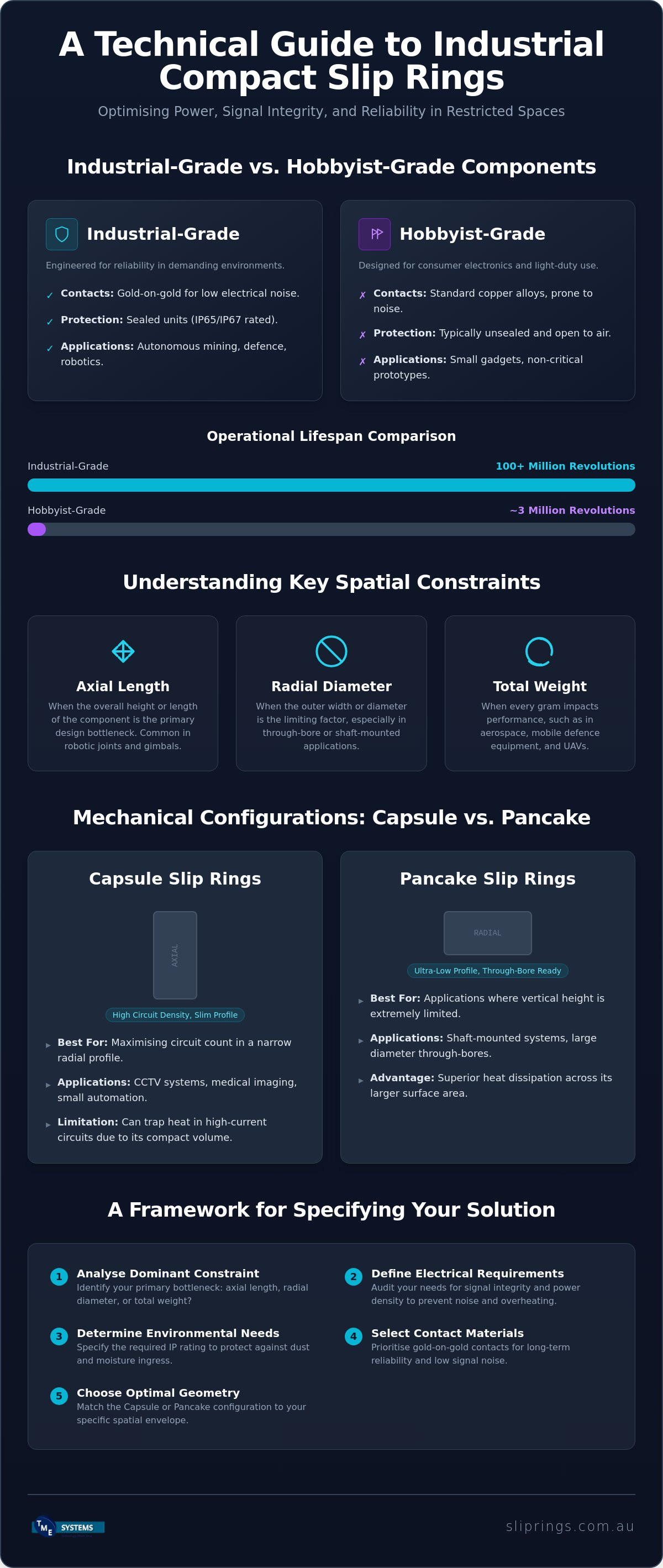
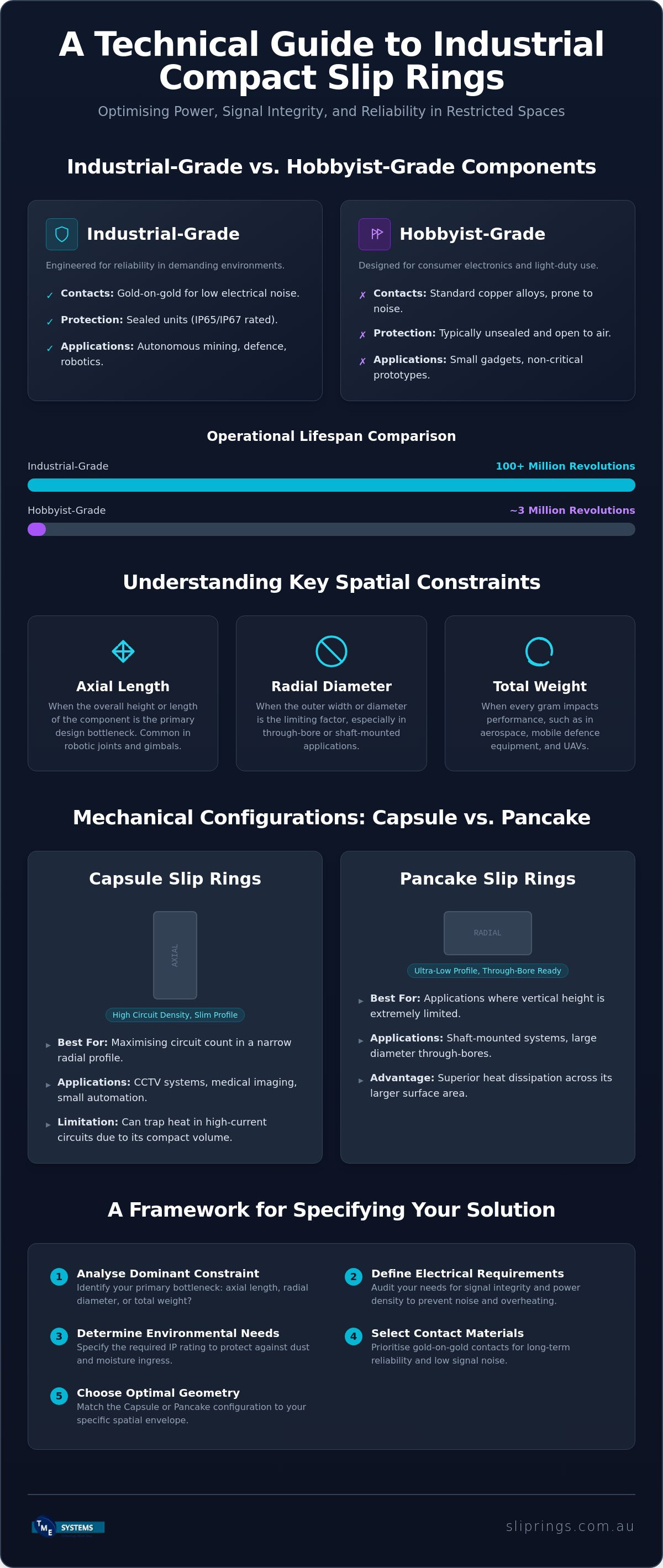
Selecting a compact slip ring based on size alone often leads to system failure. Hobbyist-grade miniature rings, frequently found in consumer electronics, typically use standard copper alloys and have a limited operational lifespan of perhaps 3 million revolutions. Industrial-grade solutions, such as those from Prosper Rotation Slip Rings, utilise gold-on-gold contact technology. This material choice is vital for reducing electrical noise and ensuring a lifespan that can exceed 100 million revolutions.
Environmental protection is another critical differentiator. While a hobbyist ring might be open to the air, industrial compact units often carry IP65 or IP67 ratings. This sealing protects sensitive contacts from the dust and moisture common in Australian industrial sites. You shouldn't have to sacrifice this protection just because your housing is small. Reliable sealing ensures that signal integrity remains consistent over the entire life of the component.
Common Spatial Constraints in Rotating Machinery
Mechanical boundaries usually fall into three categories: axial length, radial diameter, and total mass. Understanding which constraint is your primary "bottleneck" will dictate the configuration you require.
- Axial Length: In robotic joints or camera gimbals, the height of the slip ring is the primary constraint. Capsule designs are typically used here to stack circuits vertically, though this increases the overall length.
- Radial Diameter: For shaft-mounted applications or through-bore requirements, the outer diameter is the limiting factor. This often necessitates a pancake configuration to keep the profile slim against the mounting surface.
- Weight: For aerospace and mobile defence equipment, every gram affects battery life and flight dynamics. High-grade compact rings use lightweight, high-strength alloys to maintain structural integrity without adding unnecessary bulk to the assembly.
Mechanical Configurations: Capsule vs Pancake Designs
Selecting the correct geometry for a compact slip ring is as critical as the electrical specifications themselves. Most industrial applications fall into one of two mechanical categories: those restricted by axial length and those restricted by vertical height. Choosing the wrong configuration can lead to mechanical interference or premature failure due to improper contact alignment during operation. You must evaluate your mounting centre and spatial envelope before committing to a specific design.
Capsule Slip Rings: Maximising Circuit Count
Capsule designs are the standard for achieving high circuit density in a slim radial profile. These units stack the rings vertically along the central axis, allowing for multiple signal and power channels within a narrow cylinder. You'll commonly find them in CCTV systems, medical imaging devices, and small-scale automation joints where the diameter of the rotating shaft is small. The fully enclosed housing provides excellent protection for the internal gold-on-gold contacts, and the integrated lead wires simplify the installation process.
One primary limitation of the capsule design is heat dissipation. Because the internal components are tightly packed, the compact volume can trap heat generated by high-current circuits. If your application requires significant power transfer, you must account for this thermal build-up to prevent insulation degradation. For signal-heavy applications, however, the capsule remains the most efficient way to manage a high number of circuits in a limited radial space.
Pancake Slip Rings: Solving Vertical Height Issues
When vertical clearance is at a premium, a pancake-style compact slip ring is the logical solution. These rings utilise a flat-plate design where the circuits are arranged concentrically on a disc rather than stacked vertically. This drastically reduces the axial height, making them ideal for turret rotations, medical tables, or shaft-mounted sensors where space above the mounting surface is non-existent. We offer several Prosper Rotation slip rings in pancake configurations to address these specific spatial challenges.
While they solve height issues, pancake designs involve specific trade-offs. The radial diameter increases proportionally to the circuit count, which may conflict with other mechanical components. Additionally, the outer tracks experience higher linear speeds than the inner ones, which can lead to uneven wear patterns and increased electrical noise over time. If you are unsure which configuration will provide the longest service life for your specific RPM, consulting with a technical expert can help you balance these mechanical requirements against your operational goals.
Engineering Trade-offs: Balancing Size, Signal, and Power
Designing a compact slip ring involves a constant battle against the laws of physics. As the physical dimensions shrink, the electrical demands often remain static or increase. This creates a high-density environment where signal noise and heat dissipation become primary engineering hurdles. You must balance the need for a small footprint against the requirement for stable electrical resistance, which is typically measured in milliohms (mΩ). Smaller contact surfaces are more susceptible to resistance fluctuations caused by vibration or microscopic debris, making material selection paramount.
Thermal management is particularly difficult in compact, enclosed housings. Without the surface area of larger units to radiate heat, internal temperatures can rise quickly, especially when carrying power loads alongside sensitive data. This heat can degrade insulation resistance and affect the mechanical properties of the contact springs. Engineers must specify materials that maintain dielectric strength at elevated temperatures to prevent circuit-to-circuit shorting in high-density configurations. If you don't account for this thermal build-up, the lifespan of the internal lubricants and contact surfaces will be significantly reduced.
Signal Integrity and Data Transmission
Modern industrial systems require more than just simple power transfer; they demand the transmission of complex data protocols like Ethernet, USB, and various Fieldbus signals. In a compact frame, the proximity of these signal lines increases the risk of electromagnetic interference and cross-talk. Effective shielding and the use of twisted-pair lead wires are essential to maintain data integrity within the restricted internal volume. Gold-on-gold contacts provide the stable, low-resistance interface required to maintain packet integrity for 2026-standard high-speed data protocols while minimising electrical noise.
Contact Metallurgy and Lifespan
When mechanical brushes are too bulky or introduce too much friction heat, brushless technology offers a superior alternative. Mercotac slip rings utilise a liquid metal pool to create a continuous electrical path, offering the ultimate compact low-noise solution for sensitive instrumentation. This design eliminates the wear and tear associated with traditional brushes, which is a major factor in high-RPM applications where mechanical friction would otherwise lead to rapid failure.
The impact of rotational speed on wear rates is magnified in miniature components. While traditional miniature brushes might wear rapidly at high speeds due to mechanical bounce and arcing, liquid metal interfaces maintain consistent performance regardless of rotational velocity. If your application requires high RPMs within a small housing, you should prioritise brushless or high-grade gold-alloy contacts to avoid frequent maintenance intervals. Choosing the right metallurgy ensures that the compact slip ring meets the durability expectations of industrial machinery rather than the limited lifespan of consumer-grade electronics.
Application Profiles: Where Compact Slip Rings Excel
Compact slip rings are the enabling technology behind modern industrial miniaturisation. While previous sections detailed the mechanical geometries and metallurgical trade-offs, their true value is realised in specific high-stakes environments. From the surgical theatre to the automated warehouse, these connectors provide the necessary bridge between static and rotating components where every millimetre is accounted for. The transition from standard to compact hardware is often the deciding factor in whether a complex rotary system can fit within its intended housing.
Robotic Integration and Cobots
Collaborative robots (cobots) and multi-axis robotic arms require continuous 360-degree rotation at each joint to achieve maximum dexterity. A compact slip ring allows these machines to transmit both high-current power for motors and sensitive data protocols such as IO-Link or EtherCAT through a single, small-form-factor unit. This integration is critical for end-of-arm tooling, where weight must be minimised to maintain the robot's payload capacity and precision. If you're currently sourcing components for local manufacturing, our Industrial Slip Ring Supplier Australia: A Professional Procurement Guide provides further insights into selecting reliable hardware for these systems.
Defence and Remote Sensing
In the defence sector, compact rotary solutions are vital for gimbal systems, unmanned aerial vehicles (UAVs), and remote sensor platforms. These applications demand high-frequency signal transfer for radar and optical data while operating in the extreme temperatures and dust levels of the Australian outback. Ruggedisation is non-negotiable; units must meet stringent vibration and shock standards to ensure the sensor platform remains operational during high-velocity movement or rough-terrain transport. The ability to maintain signal integrity under these conditions is what separates industrial-grade compact rings from consumer alternatives.
Medical technology relies on these components for rotating surgical lights and diagnostic equipment. In these settings, electrical noise must be virtually non-existent to avoid interfering with sensitive imaging data. Similarly, in the packaging and labelling industry, high-speed carousels utilise compact configurations to manage complex wiring within limited mounting spaces. These carousels often operate at high cycles, requiring the durability of industrial-grade contacts to prevent frequent downtime and maintenance costs. If you require assistance selecting the appropriate hardware for these high-performance applications, contact our technical team for application consulting to ensure your specifications align with your operational requirements.
Specifying Your Compact Solution: A Technical Framework
To successfully integrate a compact slip ring into your machinery, you must follow a methodical specification process. This prevents the common mistake of selecting a component based purely on its physical dimensions while overlooking the electrical and environmental variables that dictate its operational lifespan. A structured audit of your requirements ensures that the chosen hardware can handle the intended load without introducing signal degradation or thermal failure.
The first step involves defining your absolute mechanical boundaries, including the maximum outer diameter, inner diameter (if a through-bore is required), and the available axial length. Once the spatial envelope is set, you must audit your electrical requirements. This includes identifying the number of circuits, the required current and voltage for power lines, and the specific signal types, such as high-speed data or sensitive analogue feeds. Finally, evaluate the operating environment by considering the maximum RPM, expected temperature fluctuations, and the necessary IP rating according to the EN 60529 standard.
The Importance of Technical Consultation
Off-the-shelf compact rings often fail in industrial Australian settings because they aren't configured for the specific duty cycles or environmental stressors of local applications. TME Systems Pty Ltd provides the technical expertise to match the correct technology to your footprint, whether your project requires the brushless precision of Meridian Laboratory slip rings for high-speed data or the rugged durability of Prosper and Mercotac designs. Consulting with a specialist during the design phase allows you to identify potential bottlenecks, such as heat build-up in enclosed housings, before they lead to system downtime. This consultative approach ensures that the compact solution you select is a reliable industrial component rather than a weak link in your assembly.
Ordering Checklist for Australian Procurement
When you're ready to procure your rotary solution, use this checklist to ensure the hardware is ready for immediate integration into your system. Verifying these details early prevents costly delays during the installation phase.
- Lead Specifications: Verify the required lead lengths and connector types to ensure they reach your internal terminals without tension.
- Mounting Configuration: Confirm whether you require a rotor or stator mounting flange and ensure the mounting holes align with your existing centre.
- Environmental Sealing: Ensure the housing meets the IP rating required for your specific site conditions, particularly if the unit is exposed to dust or moisture.
- Local Support: Confirm that you have access to local technical support for installation guidance and long-term maintenance advice.
If you're currently managing a project that requires high-performance rotation within tight spatial constraints, contact TME Systems Pty Ltd today for a technical review of your compact slip ring requirements. Our team will help you navigate the trade-offs between size, signal integrity, and power density to find the optimal configuration for your application.
Optimising Your Rotary Systems for Industrial Miniaturisation
Achieving precision in a constrained envelope requires a balance between mechanical geometry and electrical performance. You've seen that specifying a compact slip ring involves more than just measuring an outer diameter; it requires an audit of signal protocols, thermal dissipation, and contact metallurgy to ensure long-term reliability. Whether your application demands the brushless performance of Meridian or the versatile configurations of Prosper, selecting the right technology is the only way to avoid the premature failure common with consumer-grade components.
TME Systems Pty Ltd provides national supply from our NSW facility, serving as authorised distributors for industry leaders including Mercotac, Meridian, BGB, and Prosper. We offer expert technical assistance for Australian engineering projects to help you navigate these complex specifications and environmental variables. Consult with TME Systems Pty Ltd for your Compact Slip Ring Specification to ensure your next project benefits from high-signal integrity and reliable power density. We look forward to helping you solve your most challenging spatial constraints with quiet competence and technical excellence.
Frequently Asked Questions
What is the smallest diameter available for an industrial compact slip ring?
Industrial compact slip rings are available in diameters as small as 5.0 mm for specialised miniature applications. However, standard industrial capsule designs typically range between 12 mm and 22 mm to ensure sufficient mechanical strength and circuit density. Selecting the smallest possible diameter must be balanced against the required number of circuits and the current-carrying capacity of the internal leads to prevent overheating.
Can compact slip rings handle high-speed data like Ethernet or USB?
Yes, a modern compact slip ring can handle high-speed data protocols including Ethernet (10/100/1000 Base-T) and USB 2.0 or 3.0. This is achieved through specialised internal shielding and twisted-pair wiring that minimises cross-talk and electromagnetic interference. For reliable data transmission in a small frame, gold-on-gold contacts are essential to maintain the low electrical noise levels required by these sensitive protocols.
How does a pancake slip ring differ from a capsule slip ring in terms of space?
Capsule slip rings are designed for applications where radial diameter is limited, stacking circuits vertically to create a longer axial footprint. In contrast, pancake slip rings are used when vertical height is the primary constraint, arranging circuits concentrically on a flat disc. While pancake designs solve height issues, they typically require a larger radial diameter and may experience higher wear on the outer tracks compared to the compact capsule configuration.
Do compact slip rings require regular maintenance or lubrication?
Most high-quality industrial compact slip rings are designed to be maintenance-free for the duration of their operational life. These units are typically factory-sealed and utilise self-lubricating contact materials or liquid metal interfaces that don't require additional grease or oil. Attempting to lubricate a sealed unit can actually introduce contaminants that increase electrical noise and lead to premature failure of the sensitive internal components.
Are there mercury-free compact slip rings available for food or medical use?
Yes, there are numerous mercury-free compact slip rings available that utilise gold-on-gold or silver-on-silver contact technology. These options are specifically designed for the food, beverage, and medical industries where hazardous materials are strictly prohibited. While liquid metal options offer excellent performance, our solid-contact configurations from Prosper Rotation provide a reliable, compliant alternative that meets all relevant health and safety standards for sensitive environments.
What is the typical lifespan of a miniature industrial slip ring?
The typical lifespan of a compact slip ring varies significantly based on contact metallurgy and rotational speed. Industrial-grade units with gold-on-gold contacts often achieve between 50 million and 100 million revolutions under optimal conditions. For applications requiring extreme longevity, brushless or liquid metal designs can exceed these figures, whereas lower-cost hobbyist components may only last for approximately 3 million revolutions before signal degradation occurs.
Can I get a compact slip ring with a through-bore for shaft mounting?
Yes, compact slip rings can be configured with a through-bore to allow for mounting directly onto a rotating shaft or to pass hydraulic or pneumatic lines through the centre. While a through-bore naturally increases the outer diameter of the unit, many compact designs maintain a slim profile suitable for tight industrial housings. You should define your required inner diameter clearly during the specification phase to ensure the mechanical fit is precise.
How do I protect a compact slip ring from dust and moisture in harsh environments?
Protection from dust and moisture is achieved by specifying an appropriate Ingress Protection rating, such as IP65 or IP67. These ratings signify that the compact slip ring is housed in a sealed enclosure that prevents the entry of foreign bodies and water. For harsh Australian industrial environments, ensuring your component has robust O-ring seals and ruggedised housing materials is critical for maintaining electrical integrity and preventing internal corrosion.