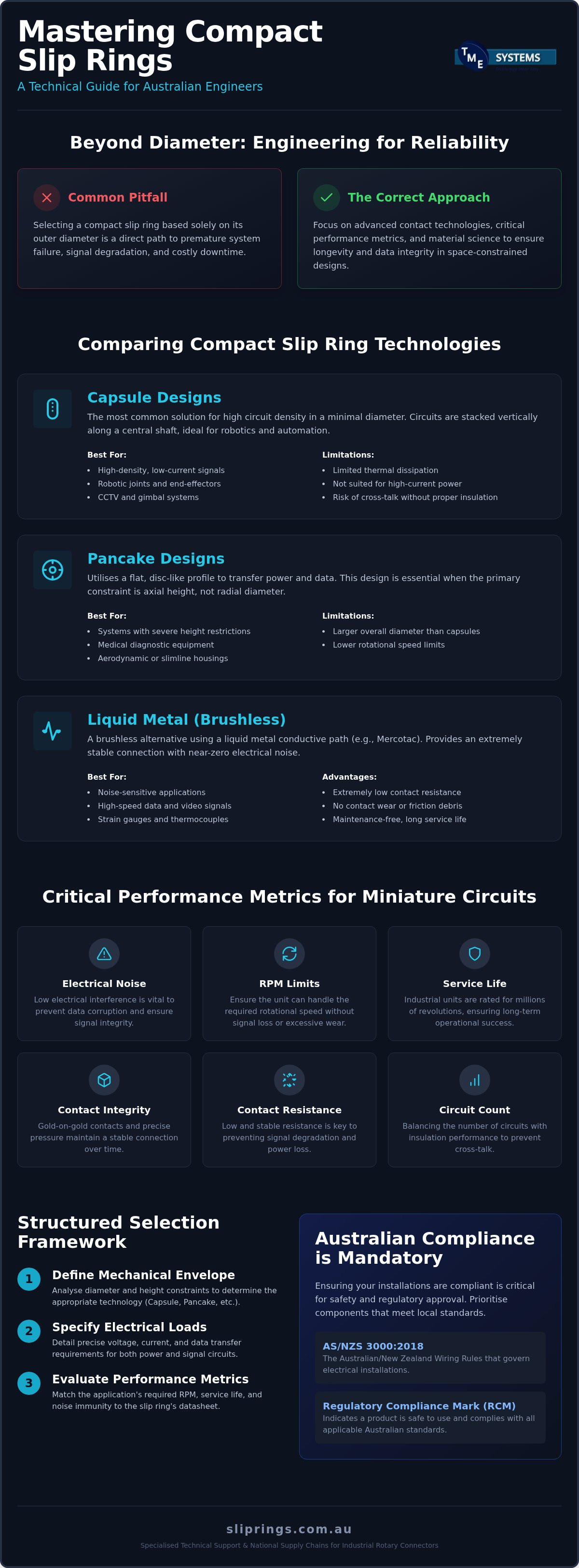
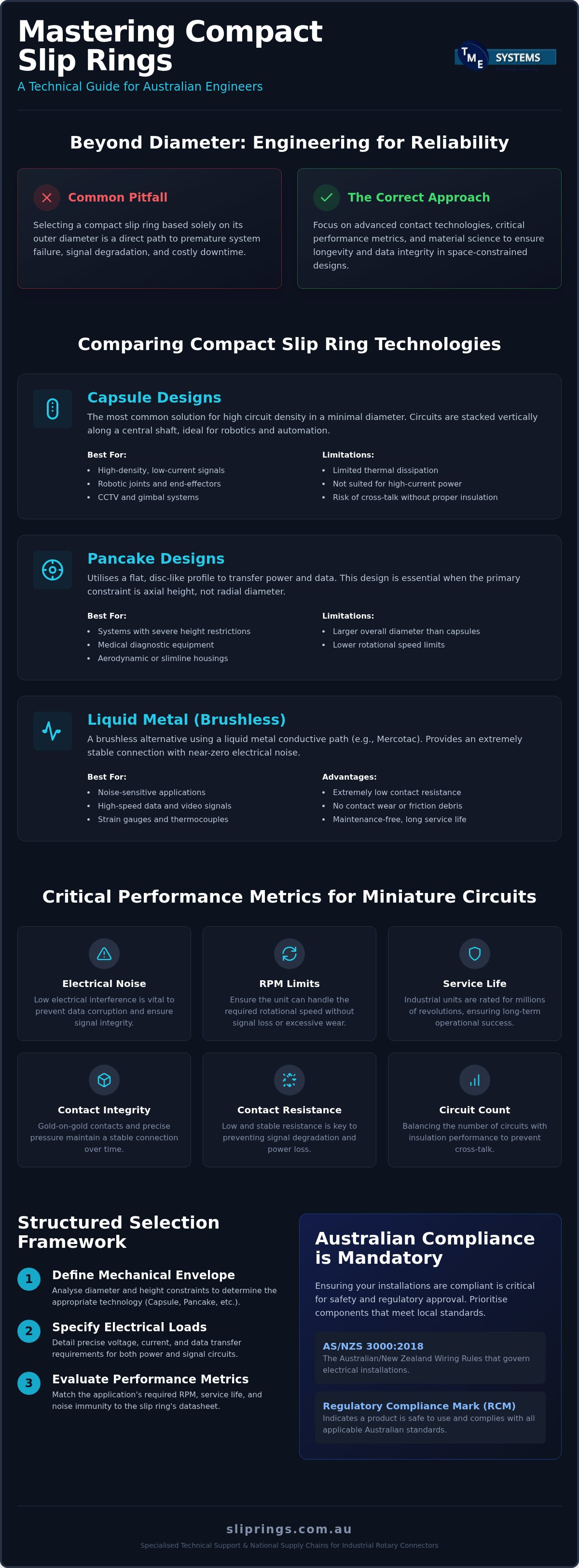
Selecting a compact slip ring based solely on its outer diameter is often the first step toward premature system failure. While the pressure to minimise footprint in robotics or medical devices is immense, sacrificing contact integrity for millimetres usually results in significant signal degradation. You probably recognise the frustration of sourcing a miniature component only to find that electrical noise is corrupting your data or that the unit requires replacement far sooner than its service manual suggested. Finding specialised industrial stock with local Australian support can be equally challenging.
This guide helps you master the technical requirements of small-form-factor rotary connectors to ensure reliable power and signal transfer in your most space-constrained applications. We'll show you how to identify a compact slip ring that meets long-life requirements while adhering to Australian standards like AS/NZS 3000:2018 and RCM compliance. By focusing on advanced contact technologies over basic physical dimensions, you can reduce electrical noise and secure a dependable supply chain. We will examine the specific mechanical properties and electrical specifications necessary to bridge the gap between complex manufacturing needs and long-term operational success.
Key Takeaways
- Differentiate between capsule, pancake, and liquid metal technologies to effectively manage height and diameter constraints in tight housings.
- Implement a structured selection framework to specify a compact slip ring that aligns with both mechanical envelopes and precise electrical load requirements.
- Identify the critical performance metrics, such as RPM limits and contact resistance, that prevent signal degradation in miniature circuits.
- Ensure all installations remain compliant with Australian AS/NZS 3000:2018 standards and mandatory Regulatory Compliance Mark (RCM) protocols.
- Access specialised technical support and national supply chains for global industrial brands to reduce lead times and engineering risks.
Engineering for Tight Spaces: The Role of Compact Slip Rings
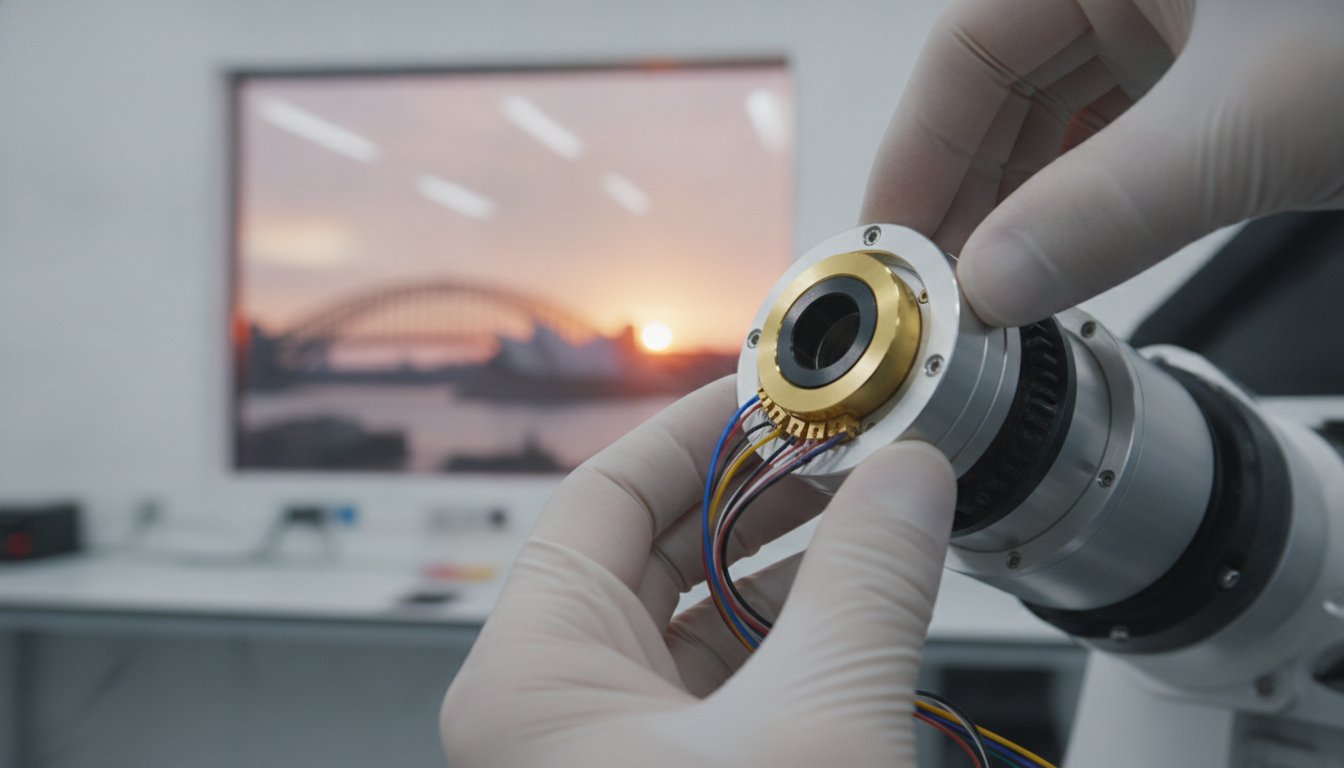
A compact slip ring is a precision-engineered rotary interface designed for high circuit density within a restricted mechanical envelope. Within the Australian automation sector, the demand for space-optimised components is growing as manufacturers seek to increase the efficiency and sophistication of their production lines. Slip ring technology provides the essential link for power and data between stationary and rotating platforms. However, as the mechanical footprint decreases, the margin for error in electrical performance disappears. It's vital to distinguish between entry-level hobbyist capsules and industrial-grade compact units. While low-cost alternatives might appear suitable on a datasheet, they often lack the gold-on-gold contact sets or precision-machined housings found in professional solutions like Prosper Rotation slip rings. These industrial units are designed for longevity, ensuring that a compact slip ring can operate for millions of revolutions without the signal degradation common in cheaper components.
When to Specify a Compact Form Factor
Specifying a reduced form factor is necessary when the physical footprint of the assembly is the primary constraint. Robotic joints and end-effectors represent a primary use case, where excess mass and volume directly degrade the dynamic performance and payload capacity of the system. CCTV and gimbal systems also require these connectors to facilitate 360-degree continuous rotation within slim mounting poles or aerodynamic housings. In the medical sector, laboratory instrumentation and diagnostic equipment often have internal cavities that are highly restricted. In these environments, the connector must deliver high-speed data and power without adding bulk to the sterile, streamlined design of the device.
The Mechanical Challenges of Miniaturisation
Miniaturisation introduces complex trade-offs. Managing contact pressure is a significant hurdle; as the internal components shrink, the spring force required to maintain a stable electrical connection must be precisely calibrated to avoid excessive wear. Small diameters do offer the advantage of lower peripheral speeds at the contact point, which can extend life, yet the reduced distance between circuits increases the risk of electrical interference. Engineers must balance circuit count with high-performance insulation to prevent cross-talk in sensitive data lines. This often involves using advanced polymers and precious metal alloys to ensure that the compact slip ring remains reliable over its entire service life.
Comparing Compact Technologies: Capsules, Pancakes, and Liquid Metal
Selecting an industrial-grade compact slip ring requires a departure from the basic capsule models often found in consumer electronics. While hobbyist components might share similar dimensions, they lack the material science necessary for consistent performance in Australian industrial environments. Engineers must choose between cylindrical, flat, or brushless architectures based on whether the primary constraint is radial space, axial height, or electrical noise. Each technology offers distinct advantages for specific rotational challenges.
Capsule Designs for Signal Density
Capsule units are the most common solution for transmitting low-current signals within a small diameter. By stacking circuits vertically along a central shaft, these units achieve high circuit counts without increasing the footprint. Prosper Rotation slip rings are frequently specified for automation tasks where signal integrity is paramount. These components are critical in high-precision hardware, such as a medical imaging device, where reliable data transfer must occur within a tiny mechanical envelope. However, their compact nature limits thermal dissipation, so they aren't typically suited for high-current power transfer applications.
Liquid Metal Connectors: The Mercotac Advantage
For applications demanding near-zero electrical noise, Mercotac slip rings provide a brushless alternative to traditional sliding contacts. By using a liquid metal conductive path, these connectors maintain constant contact without the friction and wear associated with gold-on-gold brushes. This technology is particularly effective for high-speed data transmission and sensitive sensor circuits. Because there's no mechanical brush bounce, the signal-to-noise ratio remains exceptionally high, even at elevated rotational speeds. If your project involves sensitive telemetry or high-definition video, a brushless liquid metal unit is often the only viable compact slip ring solution.
Space-Saving Pancake Configurations
Pancake slip rings solve the problem of restricted vertical height by arranging circuits in a flat, concentric pattern. This disc-like profile is ideal for integration into rotating platters or shallow housings where a cylindrical capsule won't fit. While they save axial space, pancake designs introduce specific mechanical trade-offs. The outer rings have a higher surface speed than the inner rings, which can lead to uneven brush wear and increased electrical noise over time. Careful consideration of rotational speed and maintenance intervals is required when specifying these flat configurations. If you're struggling to balance these technical trade-offs, you can consult with our engineering team to find the most durable configuration for your specific housing.
Critical Performance Metrics for Small-Scale Slip Rings
Miniaturisation forces engineers to confront physical limitations that are less pronounced in larger assemblies. When you specify a compact slip ring, the reduced surface area of the contacts means that even minor environmental contaminants or vibration can cause significant signal instability. Stability in contact resistance is paramount. It must remain consistent across the entire rotational range to prevent data packets from dropping or power levels from fluctuating. In high-precision Australian manufacturing, these small deviations often represent the difference between a reliable system and one plagued by intermittent faults.
Signal Noise and Data Integrity
Maintaining signal integrity in miniature circuits is a complex task, particularly when running high-frequency Ethernet or Fieldbus protocols. Electrical noise often stems from the mechanical friction between the brush and the ring. This is exacerbated in small housings where internal shielding is difficult to implement. Meridian Laboratory slip rings address this by using advanced contact materials that eliminate the "noise" typical of standard sliding contacts. This level of performance is why such high-specification components are often classified as dual-use goods, given their critical role in sensitive aerospace and defence applications where data failure is not an option. For compact multi-circuit assemblies, we recommend integrated shielding to isolate power lines from sensitive data paths within the restricted mechanical envelope.
Rotational Speed and Duty Cycle
The RPM rating of a slip ring is not a static number. It's a function of the peripheral speed at the contact point. In a compact slip ring, the smaller diameter results in lower surface speeds at a given RPM compared to larger units, which can theoretically extend brush life. However, these small units often run at significantly higher rotational speeds in robotic or gimbal applications. You must calculate the required RPM based on your peak operational duty cycle rather than just the average speed. For high-speed compact requirements exceeding 500 RPM, brushless or liquid metal designs are non-negotiable. Traditional brushes at these speeds within a confined, unventilated housing will inevitably lead to thermal runaway. Heat dissipation is a major risk in Australian industrial settings where ambient temperatures are already high. Without a path for thermal energy to escape, the internal lubricants can degrade, leading to rapid mechanical failure.
Selection Framework: Specifying a Compact Slip Ring in Australia
Specifying a compact slip ring for Australian industrial applications requires a structured technical audit. You must move beyond basic dimensions to ensure the component survives the operational stresses of its specific environment. A logical selection framework prevents the common mistake of choosing a unit that fits the space but fails the load. Every millimetre of space saved must be weighed against the electrical and mechanical requirements of the system.
- Step 1: Define the exact mechanical envelope. Confirm the maximum outer diameter and total axial length. In some robotic gimbals, the length is more restrictive than the diameter.
- Step 2: Audit electrical requirements. Document the total circuit count, peak current per circuit, and operating voltage. Mixing power and data requires careful attention to potential interference.
- Step 3: Evaluate the operating environment. Consider ambient temperatures, vibration profiles, and potential exposure to dust or moisture.
- Step 4: Determine the required service life. Calculate the expected total revolutions and assess how often the assembly can be accessed for maintenance.
Consulting with a slip ring application engineering specialist during this phase helps identify potential bottlenecks before procurement. This ensures the chosen unit aligns with Australian standards like AS/NZS 3000:2018.
Environmental Protection (IP Ratings)
Achieving IP65 or IP67 ratings in small-scale enclosures is technically demanding. Standard seals add significant rotational friction and can increase the overall housing size. For compact units, you might need to consider labyrinth seals or specialised gaskets that prevent ingress without compromising the mechanical footprint. In harsh Australian settings, such as coastal or mining sites, material selection is critical. Stainless steel or anodised aluminium housings offer the necessary corrosion resistance for long-term reliability in corrosive atmospheres.
Circuit and Load Density
Managing high-current power alongside low-voltage signals within the same compact slip ring presents thermal and electrical challenges. High-current circuits generate heat that can affect the insulation of adjacent data lines. BGB Innovation slip rings are engineered to handle these heavy-duty requirements in space-restricted applications. To avoid cross-talk, ensure the unit features robust internal insulation and appropriate shielding for sensitive circuits. Proper separation within the internal architecture is essential for maintaining signal clarity when power loads are high. If you're unsure about the thermal limits of your design, you can request a technical review to verify your specifications.
Technical Procurement and Support from TME Systems
Procuring a high-performance compact slip ring in the Australian market involves more than just selecting a part number from a catalogue. The technical complexity of miniature rotary interfaces means that small miscalculations in current density or rotational speed lead to rapid system degradation. TME Systems Pty Ltd acts as a specialised technical bridge, ensuring that engineers have access to world-leading brands like Mercotac slip rings and Meridian Laboratory slip rings. This partnership provides Australian industry with the same level of technical application consulting available to global aerospace and medical manufacturers.
Local support is essential for reducing project risk. When you work with an Australian distributor, you gain a partner who understands the domestic regulatory landscape, including RCM compliance and AS/NZS 3000:2018 standards. For projects requiring bespoke solutions, such as those involving Prosper Rotation slip rings, we manage the technical communication with the manufacturer to ensure the final product meets your exact mechanical and electrical specifications. This methodical approach to procurement ensures that your rotary connection is a point of stability rather than a point of failure.
Solving Complex Rotation Problems
Our experience with industrial slip rings in Australia spans diverse sectors, from high-speed packaging lines to precision medical gimbals. In many cases, the challenge isn't just finding a unit that fits, but finding one that maintains signal integrity under specific vibration or thermal profiles. We've assisted local firms in replacing generic capsule units with industrial-grade brushless designs that offer significantly longer service lives. By matching the specific contact technology to your application's duty cycle, we help you avoid the high costs associated with unplanned maintenance and component replacement.
Next Steps for Your Project
To begin a technical audit of your rotary connection, you'll need to provide several key data points. We require the peak current per circuit, the maximum operating RPM, and the total circuit count. Additionally, please specify the signal types being transmitted, such as Ethernet, Fieldbus, or low-voltage sensor data. Having this information ready allows our team to provide an accurate recommendation that balances performance with longevity.
Gather your CAD constraints and mechanical envelope dimensions before contacting our engineering team for a consultation. Having your 3D models or space limitations clearly defined ensures that the proposed compact slip ring will integrate seamlessly into your assembly. Our focus remains on technical excellence and the long-term success of your engineering project.
Optimising Your Rotary Connection for Long-Term Reliability
Successfully integrating a compact slip ring requires balancing physical dimensions with electrical performance. Choosing the correct technology, whether it's a brushless liquid metal unit for sensitive data or a robust capsule for signal density, prevents the premature failures that often plague under-specified systems. By following a structured selection framework and auditing your environmental variables, you ensure your equipment remains compliant with Australian standards like AS/NZS 3000:2018 while maintaining peak signal integrity throughout its service life.
TME Systems serves as an authorised Australian distributor for Mercotac and Meridian Laboratory, providing the expert technical consulting required for specialised industrial applications. We offer a comprehensive range of brushless and traditional slip ring technologies to solve your most complex rotation challenges. Our national supply chain and application engineering support help you move from initial CAD constraints to a fully operational, reliable rotary interface. Don't let space constraints compromise the durability of your engineering project.
Discuss your compact slip ring requirements with TME Systems today to secure a dependable, high-performance solution for your application. We look forward to helping you achieve technical excellence in your next design.
Frequently Asked Questions
What is the smallest diameter available for an industrial compact slip ring?
Industrial-grade miniature slip rings typically feature an outer diameter starting from approximately 6.5mm to 12.5mm. While smaller consumer-grade components exist, an industrial compact slip ring maintains these dimensions to ensure structural integrity and reliable electrical insulation. These sizes allow for high circuit density while remaining compatible with standard mounting hardware. Selecting the smallest possible diameter helps reduce peripheral speed and extends the service life of the internal contact sets.
Can compact slip rings transmit high-speed data like Ethernet?
Yes, specialised models are engineered to transmit Ethernet, Fieldbus, and other high-speed data protocols without packet loss. To achieve this, the internal architecture must include specific impedance matching and electromagnetic shielding to prevent cross-talk. For reliable data transfer at 100Mbps or 1Gbps, we recommend brushless or liquid metal options that eliminate the mechanical noise associated with traditional sliding contacts. This ensures consistent signal integrity in space-constrained automation environments.
Are brushless compact slip rings better than traditional brush designs?
Brushless designs, such as liquid metal rotary connectors, are superior for sensitive data transmission and high-speed applications due to their near-zero electrical noise. They also offer significantly longer service lives because there is no mechanical friction or wear. However, traditional gold-on-gold brush designs remain a pragmatic and cost-effective choice for low-speed power transfer or simple signal applications where extreme longevity is not the primary requirement. Your choice should depend on the specific duty cycle.
How do I choose between a capsule and a pancake slip ring?
Choose a capsule design if your primary constraint is the radial footprint or outer diameter. These cylindrical units stack circuits along the length of the shaft, making them ideal for slim housings. Conversely, specify a pancake slip ring if you have ample radial space but are severely restricted in vertical or axial height. Note that pancake designs generally exhibit more electrical noise and uneven wear because the peripheral speed varies across the concentric rings of the disc.
What is the typical lifespan of a compact industrial slip ring?
The lifespan depends on the contact technology and operating environment, but a high-quality compact slip ring typically achieves between 50 million and 100 million revolutions. High-end brushless models often exceed these figures because they lack wearing parts. In contrast, traditional brush units will require replacement once the precious metal plating or brush tension degrades. Operating at the upper limit of the rated RPM or in high-vibration Australian industrial settings will naturally reduce these service intervals.
Can I get a compact slip ring with an IP67 rating for outdoor use?
Yes, these units can be manufactured with IP67 ratings to protect against dust and temporary immersion in water. However, achieving this level of environmental protection in a small form factor is complex, as seals increase rotational torque and can generate additional heat. It is essential to verify that the housing material, such as stainless steel or anodised aluminium, is suitable for the specific corrosive conditions of your Australian installation site before finalising procurement.
Do compact slip rings require regular maintenance?
Maintenance requirements vary based on the internal design. Traditional brush-based models may require periodic inspection for wear and the removal of conductive debris to prevent short circuits. Brushless and liquid metal units are generally considered maintenance-free for the duration of their service life. Regardless of the technology, ensure that the unit is operated within its specified electrical and mechanical limits to avoid premature failure. Consulting the technical datasheet for specific duty cycle limits is highly recommended.