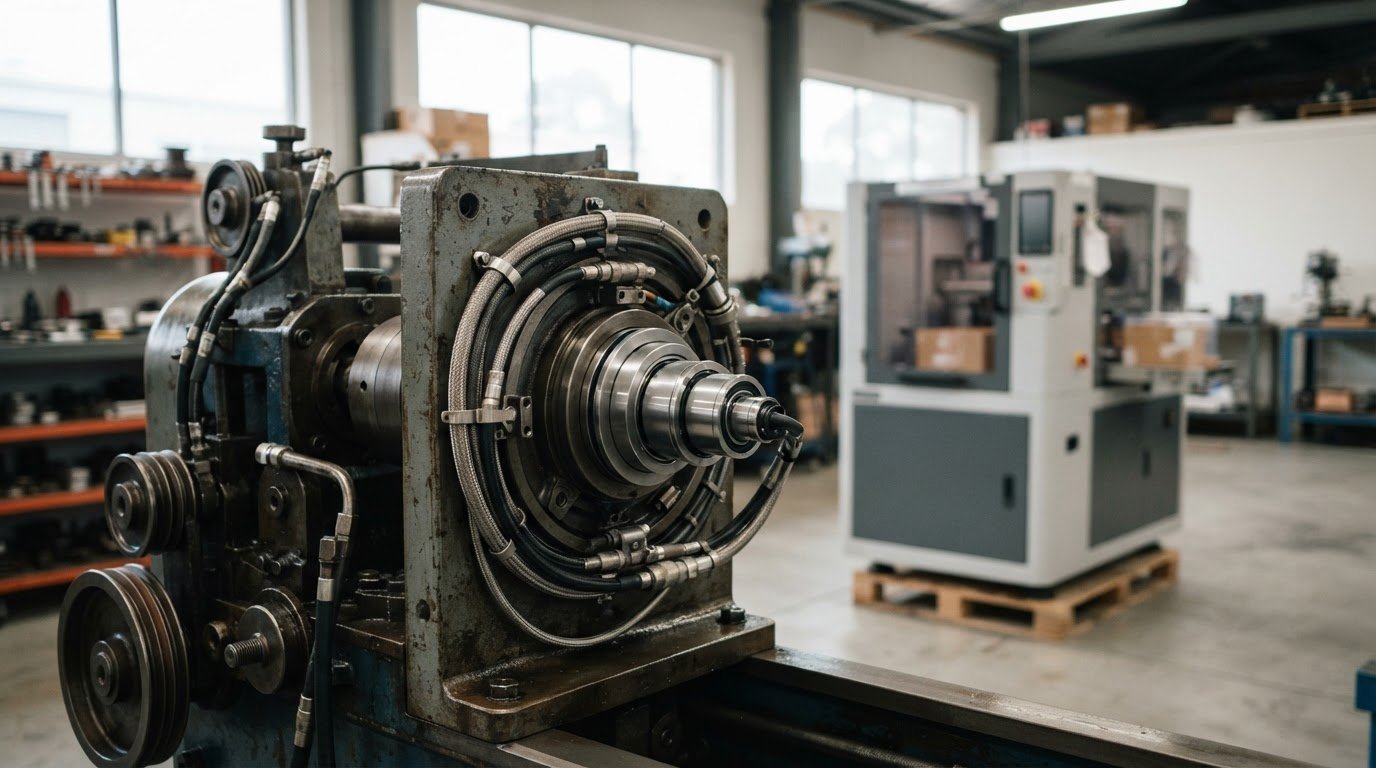
Replacing legacy machinery isn’t always the best option. Upgrading legacy equipment with modern rotary connectors can keep a sound machine in service if its mechanical condition and capacity still meet operational needs. A retrofit is less suitable when the machine can no longer meet production or reliability requirements. The decision depends on the equipment’s condition, the changes required and whether the new connector will work with the existing system.
It’s understandable to favour familiar machinery that still performs its core task. But adding modern components can create compatibility challenges, especially when electrical circuits, signals, mounting arrangements or operating conditions differ from the original design. A connector mismatch can complicate integration, so assess compatibility alongside the machine’s mechanical condition.
This article explains how to weigh a retrofit against replacement, identify the specifications that matter when selecting a rotary electrical connection, and plan integration with existing equipment. It also covers how mounting options and application engineering can address fit and performance requirements, and how a phased upgrade can limit disruption while teams assess the results.
Key Takeaways
- Compare the machine’s mechanical condition and production needs before deciding whether to retrofit or replace it.
- Retrofitting can retain useful equipment, but plan changes in stages and account for maintenance and security needs.
- Assess circuit count, current, voltage, speed, mounting and environmental conditions to identify compatibility issues early.
- Integration can support better monitoring and operational performance when upgrades have clear goals and measurable outcomes.
- Match the rotary connector type to the power, signal, data or fluid transfer requirements of the application.
1. Deciding whether to upgrade or replace legacy machinery
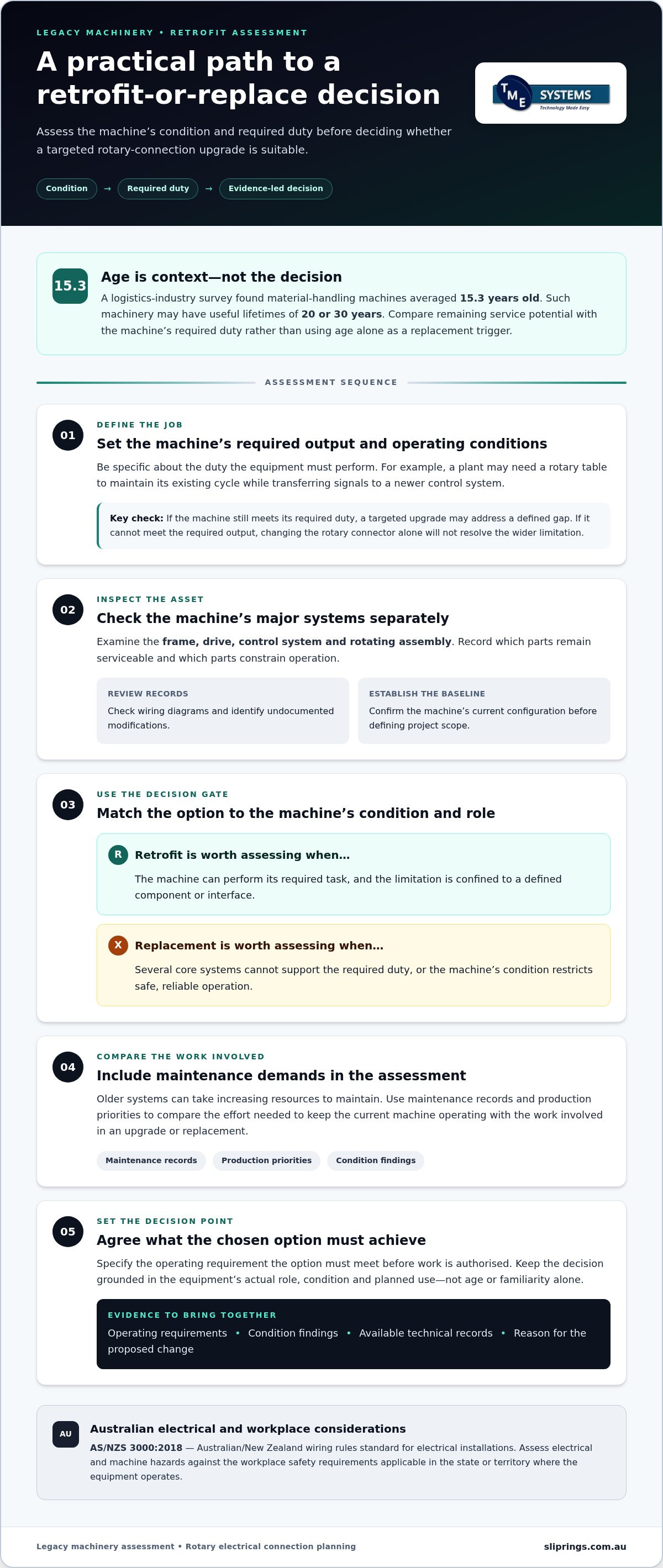
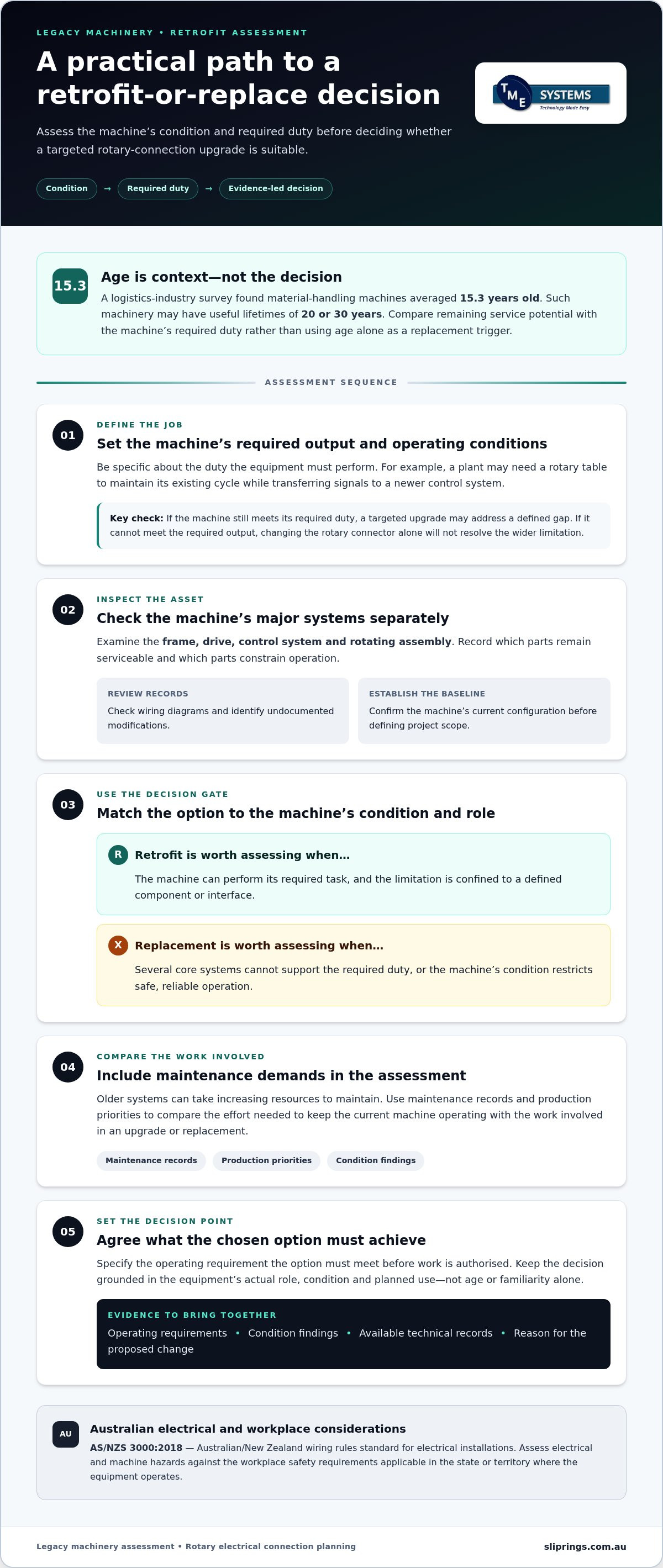
Machine age alone does not settle the retrofit-versus-replacement decision. A logistics-industry survey found material-handling machines averaged 15.3 years old, while such machinery may have useful lifetimes of 20 or 30 years. Compare the equipment’s remaining service potential with its required duty, rather than treating age as a replacement trigger.
For Australian electrical installations, AS/NZS 3000:2018 is the Australian/New Zealand wiring rules standard for electrical installations. Assess electrical and machine hazards against the workplace safety requirements applicable in the state or territory where the equipment operates.
Start by defining the machine’s required output and operating conditions. For example, a plant may need a rotary table to maintain its existing cycle while transferring signals to a newer control system. If the machinery can still meet that duty, a targeted upgrade may address the gap. If it cannot meet the required output, changing the rotary connector alone will not resolve the wider limitation.
Next, examine the asset’s condition and design records. Check the frame, drive, control system and rotating assembly separately, noting which parts remain serviceable and which constrain operation. Incomplete wiring diagrams or undocumented modifications can complicate either option, so establish the machine’s current configuration before defining the project scope.
- Retrofit is worth assessing: the machine can perform its required task, and the limitation is confined to a defined component or interface.
- Replacement is worth assessing: several core systems cannot support the required duty, or the machine’s condition restricts safe, reliable operation.
- Gather evidence: record operating requirements, condition findings, available technical records and the reason for the proposed change.
Include maintenance demands in the assessment. Older systems can take increasing resources to maintain, diverting funding from innovation and modernisation. Compare the effort needed to keep the current machine operating with the work involved in an upgrade or replacement, using maintenance records and production priorities.
Set a decision point before authorising work. Specify the operating requirement the chosen option must meet, then assess the machine against it. This keeps the decision grounded in the equipment’s actual role, condition and planned use, rather than age or familiarity alone.
2. Reasons to retain and retrofit legacy equipment
Retaining legacy machinery can preserve production methods that rely on established tooling, machine geometry or operator knowledge. For example, a forming machine may still produce parts to the required dimensions, while its rotating interface limits a monitoring function. A focused retrofit can address that interface without changing the tooling and setup that support production.
The cost of rotary connectors and retrofit installation in Australia depends on the project scope. Connector requirements, access to the rotating assembly, mounting changes, wiring and integration with existing controls all affect the work involved.
Process continuity is another reason to retain equipment. A machine may be integrated with upstream material handling and downstream inspection, so replacing it could require changes beyond the machine itself. If the established production sequence remains suitable, modifying a specific interface can preserve those connections and reduce the process changes operators must adapt to.
Legacy machinery can also embody practical knowledge that is difficult to capture in drawings. Experienced operators may understand how a machine responds to particular materials or settings. Before making changes, document those adjustments and the production conditions they support. This helps preserve useful operating knowledge during engineering work.
A retrofit can support gradual capability improvements without changing every machine function at once. For instance, a rotating inspection fixture may retain its established mechanical sequence while gaining an interface for an additional measurement or control signal. Define how the new function fits the existing workflow and how operators will use its output.
- Protect established production: record tooling, settings and process steps that remain essential to product quality.
- Preserve connected workflows: identify interfaces with material handling, inspection and control systems beyond the machine.
- Capture operator knowledge: document adjustments and operating practices that are not fully represented in technical drawings.
- Define the added function: explain how a new signal or measurement will be used in the existing workflow.
Retaining a machine can also support continuity in the spare parts and maintenance practices already used at the site. Before making changes, identify which components and procedures remain relevant, and update technical records to reflect the modified assembly. Clear records help maintenance teams understand what has changed and distinguish new interfaces from original machine functions.
A retrofit is most useful when it preserves valuable production capability while adding a clearly defined function. The decision should account for the machine’s role in the wider process, the knowledge needed to operate it and the installation work involved. These factors help determine whether retaining the equipment supports the plant’s production plans.
3. Legacy-system compatibility challenges
A legacy machine can run reliably yet struggle to exchange information with newer controls. Compatibility depends on the signal path, controller interface and communications protocol, not just whether a connector fits. A system may transfer a signal electrically while the receiving application still cannot interpret its format or meaning.
Slip rings use physical contacts to transfer electrical power or signals between stationary and rotating parts. Contactless rotary connectors transfer power or data without electrical contacts. The right approach depends on the machine’s transmission needs and existing architecture. Neither type is automatically compatible with legacy controls.
Start with the control-system documentation. Identify the signal type, the controller’s input format and any conversion already in use. For example, an encoder connected to an older controller may produce an output that a replacement interface cannot read directly. Map each signal from its source, through the rotary connection, to the receiving control input.
Legacy communication protocols can create a separate integration barrier. A manufacturing plant example used a SCADA system installed in the early 1990s. If a newer application cannot interpret that system’s protocol, middleware or a protocol converter can bridge the communication. This can allow a legacy SCADA system to exchange information with a newer IoT platform.
Make the data map specific. For each connected function, record the signal name, source, destination and expected response. A rotating sensor might report a position value, while the control system expects a particular format. This map helps identify where conversion is needed and gives commissioning teams a clear way to trace unexpected or missing data.
- Trace the signal path: document the source device, rotary interface, controller input and application receiving the data.
- Compare protocol requirements: identify whether the legacy control system and new application can exchange the required information directly.
- Plan conversion: specify where middleware or a protocol converter belongs in the communications path.
- Test the complete chain: confirm that the receiving system interprets the transferred signal as intended.
Mechanical integration can create less obvious incompatibilities, too. A legacy assembly may have a mounting arrangement or cable route that leaves little room for a different connector body or termination. Compare interface drawings with the actual machine layout, including how cables move or are restrained during rotation. This can reveal clashes that a wiring diagram alone won’t show.
Finally, document the installed configuration. Keep the signal map, protocol settings and conversion details with the machine records. If data later goes missing, those records help isolate the fault to the rotating interface, controller or communications bridge, rather than prompting unnecessary changes elsewhere.
4. Operational benefits of integration
Integrating rotary connections with monitoring and control systems can make machine data available during operation. For example, a rotating assembly can pass sensor signals to stationary controls, helping teams observe equipment without interrupting its movement. Industry 4.0 data mobility can also support machine monitoring, with companies potentially saving up to 40% on upkeep.
Monitoring is useful when its data leads to a defined maintenance action. A temperature trend, signal interruption or change in operating behaviour can prompt an inspection before a small issue affects production. Link each data point to a response, such as reviewing a component or scheduling maintenance. Otherwise, monitoring can add information without improving decisions.
McKinsey research indicates that manufacturing and distribution companies can reduce downtime by 30%-50% through Industry 4.0 technology. It also indicates potential improvements in product throughput of 10%-30%, and reductions in the cost of quality of 10%-20%. These figures describe potential outcomes from Industry 4.0 technology, not a guaranteed result from installing a rotary connector.
A rotary interface supports integration by maintaining power or signal transfer between stationary and rotating equipment. This can serve applications such as automated inspection on a turntable or sensor feedback from a moving production arm. The operational benefit depends on correct signal transmission, control-system compatibility and how teams use the resulting information.
Set a baseline before changing the system. Choose measures that reflect the machine’s role, then record its current performance. A packaging line, for instance, might track unplanned stoppages, completed output and rejected product. After integration, compare the same measures under comparable operating conditions. This helps separate the upgrade’s effects from changes in workload or production schedules.
- Define the objective: connect the upgrade to a specific operational need, such as monitoring a rotating assembly.
- Choose useful data: identify which signals support an operator or maintenance decision.
- Set a baseline: record existing downtime, throughput or quality measures before commissioning.
- Review results: compare post-integration performance using the same measures and operating context.
Integration can also improve information flow between equipment and newer applications. If older controls cannot communicate directly, middleware or protocol conversion can bridge the systems. A phased rollout allows teams to test data quality and operational responses on one asset before extending the approach across a production area.
Cybersecurity remains part of the operating plan. Adding a network connection can create new routes to machine data and controls. Define authorised access, use suitable encryption and authentication, and document system interfaces. These steps help make connected monitoring useful while accounting for security risks associated with legacy systems.
Measure operational benefits across the full chain: rotary signal transfer, control-system interpretation, monitoring and action. This distinction helps teams identify whether an issue lies in the connector, integration or maintenance process.
5. Which rotary connector types suit power, signal, data, and fluid transfer?
Match the rotary connector to what it must transfer. Electrical power, control signals, high-speed data and fluid each have different requirements. A rotating crane joint, for example, has different transfer needs from a turntable carrying sensor signals or a machine passing hydraulic lines through its shaft.
For electrical power, assess current, voltage, circuit count and operating duty. Collector rings and slip rings are distinct types of rotary connector. Collector rings are heavy-duty connectors designed for high current capacity, while standard slip rings are typically optimised for signal integrity and lower currents. Select according to the electrical load and the machine’s operating conditions.
Signals need a suitable electrical path and circuit arrangement. For a rotating inspection platform, identify each sensor signal and its receiving control input. Then check whether power and signals can share the required connector arrangement without compromising the signal’s intended function. Include circuit count, wiring layout and control-system requirements in the specification.
For data, specify the protocol and required transmission performance. Ethernet and HDMI are examples of signals that may need high-speed data transmission through a rotating interface. Confirm that the connector is intended for the required data type and that the cable termination and system interfaces match. A connector’s ability to transfer electrical power alone does not establish its suitability for data.
Liquid metal rotary connectors are brushless rotary connectors that use a pool of conductive liquid metal to maintain electrical continuity, eliminating wear and reducing noise. This contact method may suit applications where signal continuity and contact behaviour are key selection factors. Compare its operating requirements with the machine’s electrical duty and environment.
Fluid transfer requires a rotary union, not an electrical slip ring. For a rotating assembly carrying hydraulic fluid, assess the fluid path, pressure requirements, connection arrangement and available shaft space. If a machine needs both electrical transfer and fluid passage, plan the electrical connector and rotary union together, with each component matched to its own duty.
Mounting affects the choice. A through-bore slip ring has a hollow centre for shaft integration or auxiliary components such as hydraulic lines. A capsule slip ring is compact and mounts at the end of a shaft. Compare available space, shaft access, cable routing and alignment before choosing either form.
- Power: match current, voltage and circuit count to the machine’s load.
- Signals: map sensor paths to control inputs and preserve the required signal function.
- Data: state the protocol, such as Ethernet, and required transmission performance.
- Fluids: specify the fluid path and assess a rotary union alongside electrical components.
Build the specification around transfer type, mounting and operating conditions. This gives engineers a clear basis for selecting a rotary connector arrangement for a legacy machine.
TME Systems: Mercotac Slip Rings
TME Systems can help assess rotary connector options for legacy equipment, using the machine’s electrical and mechanical requirements to guide selection. Consider Mercotac Slip Rings for a retrofit that needs an electrical connection across rotating and stationary components. Meridian Laboratory Slip Rings, BGB Innovation Slip Rings and Prosper Rotation Slip Rings are also options to assess against the application’s circuit count, current, voltage, speed, mounting style and operating environment.
Bring the specifications together before selecting a connector. This gives the assessment a clear basis and helps identify what the rotary interface must do. For help considering options for your application, contact TME Systems or visit sliprings.com.au.
Turn the assessment into an upgrade brief
Make the next step a concise engineering brief that turns the retrofit decision into a workable project. Record the machine’s intended duty, the connection’s required function, available installation space and the interfaces that must remain unchanged. Add an acceptance test describing how the upgraded assembly should perform during commissioning.
For upgrading legacy equipment with modern rotary connectors, this brief gives engineering and operations teams a shared reference before equipment is modified. It also keeps the scope focused: address the identified limitation without introducing unrelated changes that could complicate integration.
TME Systems can help assess rotary connector requirements for your application. Share the machine’s operating details and connection requirements to start a practical discussion about suitable options. Contact TME Systems to discuss your upgrade and take the next step towards a clearly defined retrofit plan.
Frequently Asked Questions
Why Upgrade Legacy Equipment?
Upgrade legacy equipment when a targeted change can help the machine meet an operational requirement without replacing systems that still perform their function. For example, upgrading legacy equipment with modern rotary connectors can support a new sensing or control requirement on a machine whose existing mechanical arrangement remains suitable. Set a clear objective before starting, such as enabling a particular measurement or transferring a control signal during rotation, then assess whether the proposed change supports that objective.
How to assess legacy equipment compatibility with modern rotary connectors?
Start with the machine’s wiring diagrams, connector labels and controller documentation, then compare them with the proposed interface requirements. Check termination types and cable routing, as well as circuit count, electrical ratings, speed, mounting and environmental conditions. Include operating modes such as acceleration, stopping and reversing. A commissioning test should confirm the required signals and functions across these modes, rather than relying only on physical fit or a static electrical check.
What are the risks of upgrading legacy equipment, including downtime and compatibility issues?
Unplanned downtime can occur if installation reveals differences between the machine’s drawings and its actual wiring or mounting arrangement. Changes can also introduce faults if control signals, terminations or operating sequences don’t match. Reduce disruption by preparing an installation plan, documenting existing connections and arranging a controlled commissioning window. Define how to return the machine to its previous configuration if testing identifies an integration issue.
Where can Australian businesses source rotary connectors and retrofit services?
Australian businesses can source industrial slip rings and rotary electrical connectors from TME Systems, which also provides technical application consulting to support product selection. Share the machine’s application requirements, including electrical duty, mounting arrangement and operating environment, so the connector can be matched to the retrofit needs. TME Systems supplies the rotary connector and selection assistance, rather than carrying out the machinery retrofit installation.
How to retrofit a rotary connector into existing machinery step by step?
Define the machine’s required output, inspect its condition and document its current configuration. Then assess connector compatibility, including circuit, signal, mounting and operating requirements. Plan wiring and integration changes, and carry out the upgrade in stages while assessing the results.