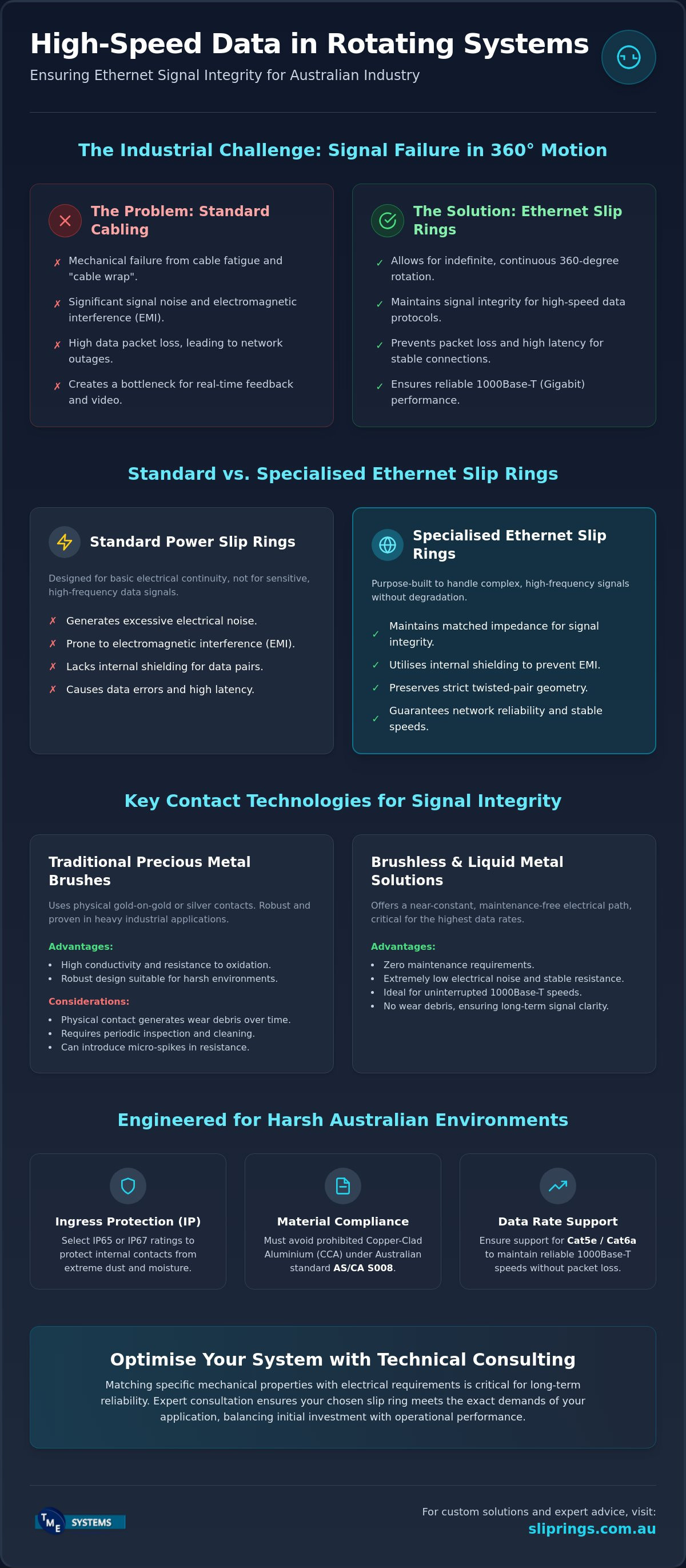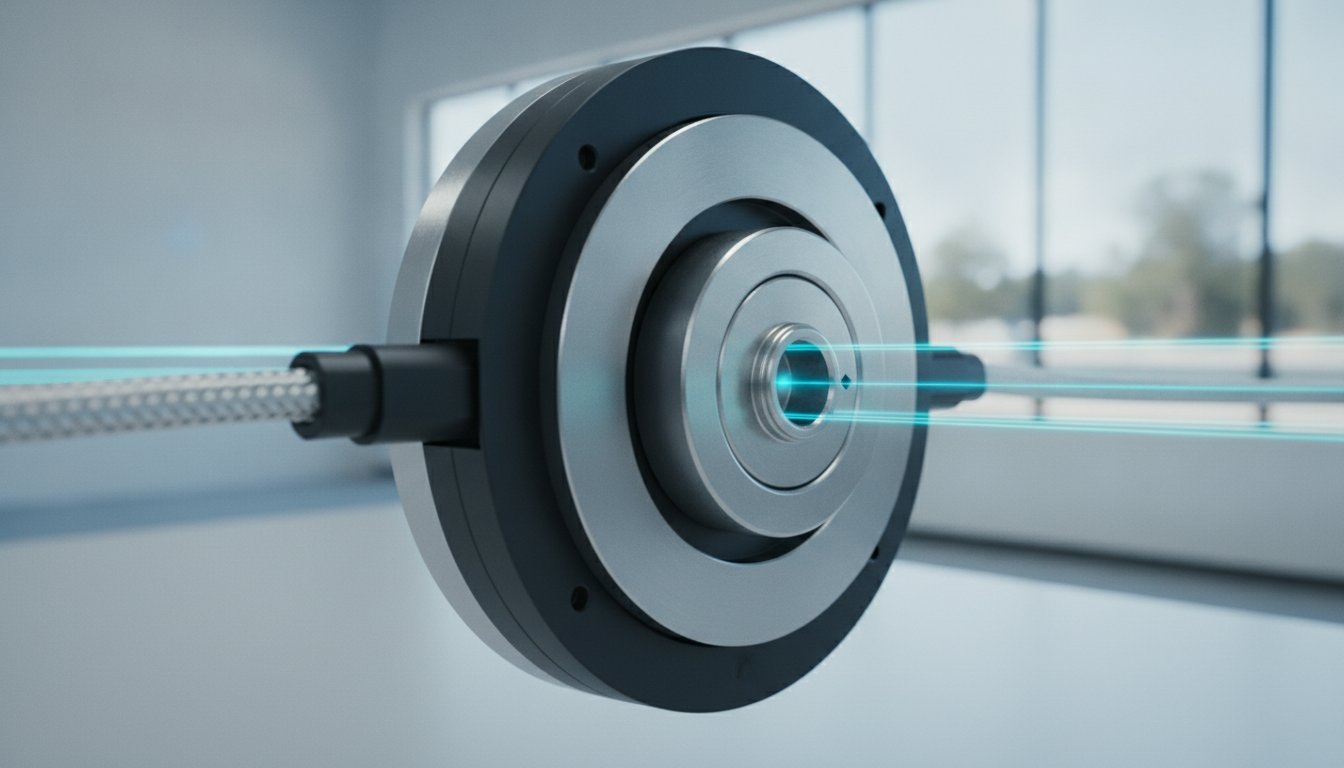
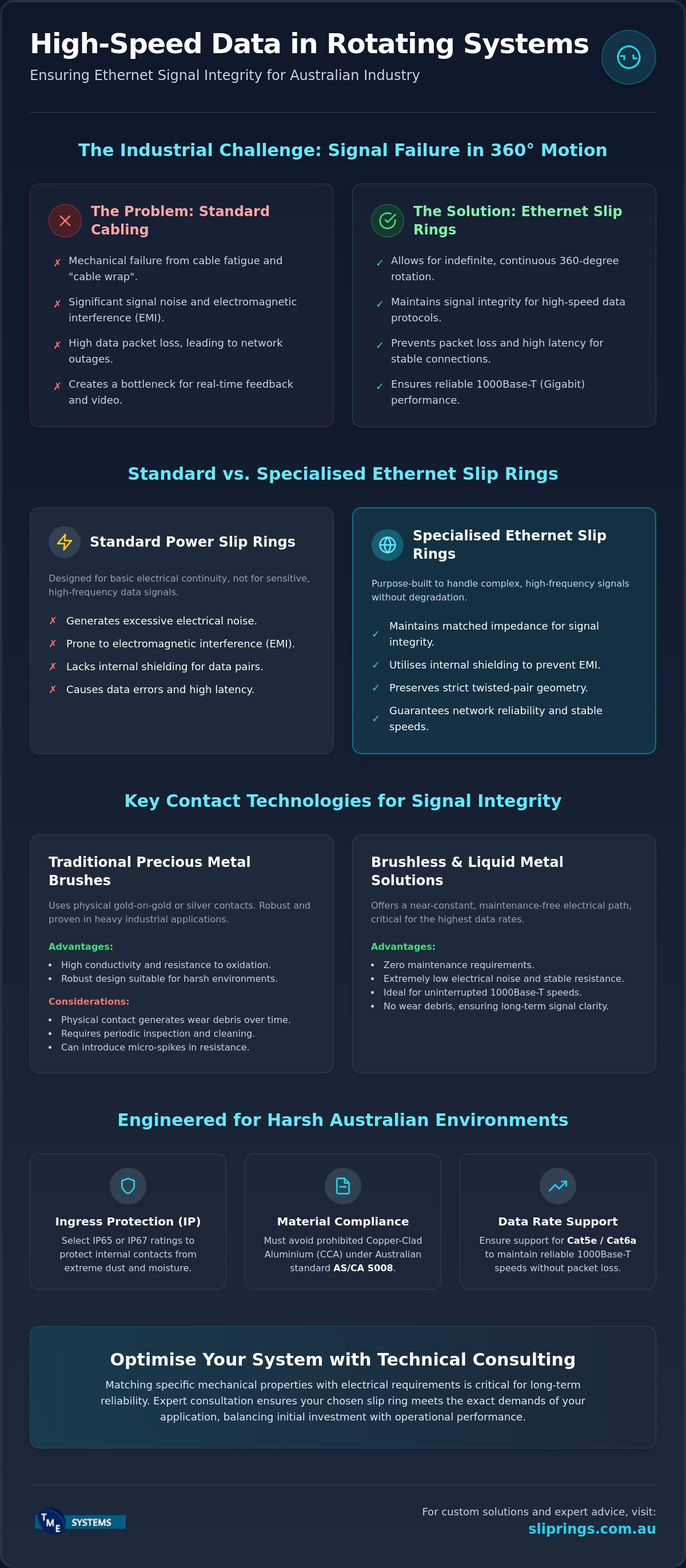
If your rotating assembly relies on standard cabling to handle high-speed data, you're essentially waiting for a mechanical failure to trigger a network outage. It's a common frustration in Australian industrial environments where constant 360-degree motion leads to cable fatigue, signal noise, and significant packet loss. When you need to maintain 1000Base-T speeds across a rotary joint, a high-quality ethernet slip ring becomes a critical component rather than just an optional accessory.
We understand that downtime in harsh conditions is costly and that finding a maintenance-free solution is a priority for your engineering team. This guide details how to maintain high-speed Ethernet signal integrity in rotating systems without data loss. We'll explore selecting connectors that meet IP65 or IP67 standards, the importance of avoiding prohibited copper-clad aluminium (CCA) materials under AS/CA S008, and how to ensure your configuration supports modern Cat6a performance requirements for reliable, long-term operation.
Key Takeaways
- Understand how to eliminate cable wrap and mechanical fatigue in 360-degree rotating systems using specialised connectors.
- Compare the performance benefits of traditional precious metal brushes versus brushless contact technologies for maintaining signal integrity.
- Identify the critical specifications required for an ethernet slip ring to support Cat5e or Cat6 data rates without packet loss.
- Learn how to select appropriate IP65 or IP67 ratings to protect internal contacts from the extreme dust and moisture found in Australian industrial environments.
- Discover why technical application consulting is essential for matching specific mechanical properties with electrical requirements for long-term reliability.
What is an Ethernet Slip Ring?
An ethernet slip ring is a specialised electrical interface designed to transmit high-speed data protocols across a rotating assembly. While a standard What is a slip ring provides basic electrical continuity for power or simple low-frequency signals, data-centric versions must handle complex high-frequency signals without degradation. In 360-degree systems, standard cables would normally twist and eventually snap, a phenomenon known as "cable wrap." These components eliminate that mechanical failure point, allowing for indefinite rotation in applications like robotic arms, rotating CCTV platforms, and automated packaging lines.
Most modern units are equipped with standard RJ45 connectors or specialised high-speed data cabling. This ensures plug-and-play compatibility with existing network infrastructure. For Australian industrial operators, this means a simplified installation process where the rotating joint doesn't become a bottleneck for real-time feedback or high-definition video streams. It's an essential component for any system requiring both physical movement and high-bandwidth connectivity.
The Mechanics of Rotating Data Continuity
The device functions through a precision-engineered rotor and stator assembly. As the rotor turns, it maintains a constant electrical bridge with the stator, ensuring the data stream isn't interrupted. Maintaining matched impedance throughout this joint is essential; any variation can cause signal reflections that lead to data errors. An Ethernet slip ring serves as a bridge that maintains signal integrity during indefinite 360-degree rotation.
Ethernet vs. Standard Power Slip Rings
Standard slip rings are often unsuitable for data because they generate excessive electrical noise. High-speed Ethernet packets are sensitive to the micro-interruptions and electromagnetic interference (EMI) found in basic rotating contacts. To combat this, specialised data units utilise internal shielding and maintain strict twisted-pair geometry within the assembly. This design prevents packet loss and high latency, ensuring that 1000Base-T speeds remain stable even in electrically noisy environments.
When selecting a solution, it's vital to consider the specific requirements of the data protocol. High-quality options from manufacturers like Prosper Rotation Slip Rings or Mercotac Slip Rings are designed to meet these exact electrical tolerances. By prioritising signal-to-noise ratios, these units ensure that your automation or surveillance system operates without the intermittent dropouts common in lower-grade hardware. Choosing a purpose-built data connector is the only way to guarantee network reliability in a rotating system.
Contact Technologies: Ensuring Signal Integrity
The internal contact technology of an ethernet slip ring is the single most important factor in determining signal reliability. Unlike power transmission, where minor fluctuations in resistance are negligible, high-bandwidth data requires a near-constant electrical path. Any variation in contact resistance, often referred to as electrical noise, can lead to packet loss or signal attenuation. Choosing between traditional mechanical brushes and brushless alternatives depends on your specific data rate, rotational speed, and maintenance capacity.
Engineering teams must decide if their application can tolerate the periodic maintenance associated with physical contact wear. While some systems thrive on the simplicity of mechanical brushes, others require the precision of liquid metal to maintain 1000Base-T speeds without interruption. If you're unsure which path fits your project, technical application consulting can provide a detailed analysis of your operational variables to balance initial investment with long-term reliability.
Traditional Precious Metal Brush Contacts
Traditional designs often utilise gold-on-gold or silver-on-silver contacts to ensure reliable transmission. These precious metals are selected for their high conductivity and resistance to oxidation. Manufacturers like BGB Innovation slip rings have perfected these systems for heavy industrial use where robustness is paramount. However, physical brushes naturally generate fine wear debris over millions of rotations. In high-speed data applications, this debris can introduce micro-spikes in resistance. For standard Ethernet speeds, this is often manageable; for higher-frequency signals, it necessitates a strict cleaning and inspection schedule to prevent data clarity from degrading over time.
Brushless and Liquid Metal Solutions
When the priority is zero maintenance and the lowest possible electrical noise, brushless technologies are the superior choice. Mercotac slip rings have become the industry standard for these applications by using a liquid metal contact path. Because the connection is made through a fluid conductive medium rather than a sliding brush, the resistance remains remarkably constant during rotation. This eliminates the "chatter" or noise that can plague mechanical systems, making it ideal for sensitive Ethernet packets.
For high-RPM precision engineering, Meridian Laboratory slip rings offer advanced contact films and brushless designs that excel in demanding environments. These systems provide a stable path for data, ensuring that signal integrity remains consistent from the first rotation to the last. By removing the physical wear component, these connectors significantly reduce downtime in automated facilities across Australia. Selecting the right contact medium ensures your network remains stable regardless of how fast or how long the system rotates.
Performance Specifications for High-Speed Data
Selecting the correct performance specifications for an ethernet slip ring is a precise engineering requirement that ensures your network remains stable under load. It isn't enough to simply match the physical dimensions; you must align the electrical properties of the rotary joint with your specific data protocol. For many Australian industrial applications, this involves choosing between Cat5e and Cat6 configurations. While Cat5e is sufficient for standard 1Gbps speeds, Cat6 is increasingly preferred for 10Gbps environments or systems requiring superior headroom against interference.
Power over Ethernet (PoE) adds another layer of complexity to these specifications. The internal contacts must handle the DC power load without generating thermal stress or electrical noise that could corrupt the data stream. If your system requires significant power alongside data, refer to our guide on understanding slip ring current ratings for power-heavy applications. Ensuring your hardware meets the AS/CA S008 standard is also essential, especially as the use of prohibited copper-clad aluminium (CCA) can lead to safety risks and signal failure in PoE setups.
Bandwidth and Protocol Compatibility
Specifying the correct category rating ensures your network infrastructure operates at its intended speed. Many modern assemblies are modular, allowing an ethernet slip ring to sit alongside channels for Profinet, EtherCAT, or even fibre optics. Crosstalk in a rotating contact can lead to significant data retransmission and latency. This becomes a critical issue when multiple high-frequency streams are packed into a single compact housing. A well-designed unit maintains strict twisted-pair geometry through the rotating interface to preserve bandwidth and minimise these timing errors.
Managing Electrical Noise and Resistance
Low contact resistance is vital for maintaining a high signal-to-noise ratio. As the rotational speed (RPM) increases, the risk of signal jitter and intermittent resistance spikes also rises. High-quality connectors use specialised shielding to prevent electromagnetic interference (EMI) from adjacent high-voltage power circuits. This is particularly important in heavy machinery where large motors generate significant magnetic fields. By isolating the data channels within a grounded metallic shield, the system prevents external noise from penetrating the sensitive data packets, ensuring error-free transmission even at high speeds.
Selecting Ethernet Connectors for Australian Industrial Environments
Australian industrial sites present a unique set of environmental challenges that can quickly compromise sensitive data connections. From the fine dust of mining operations to the high humidity of manufacturing centres across the continent, selecting an ethernet slip ring requires more than just electrical compatibility. Environmental factors like ambient heat and moisture ingress are the primary causes of premature failure in rotating assemblies. Without robust physical protection, even the most advanced contact technology will eventually succumb to internal contamination and signal degradation.
The housing material plays a central role in this resilience. While lightweight aluminium is suitable for many standard automation tasks, stainless steel is often required for corrosive environments or food-grade wash-down areas. Specialised plastics may be used in applications where weight is a critical constraint, provided they offer sufficient thermal stability. To ensure your hardware is rated for your specific site conditions, contact our specialists for a technical review of your environmental requirements.
Ingress Protection (IP) Ratings for Harsh Sites
Specifying the correct IP rating is vital for maintaining the integrity of the internal contact environment. For sites with high dust concentrations, an IP65 rating provides a dust-tight seal that prevents particles from interfering with the sliding contacts. In areas prone to heavy splashing or temporary immersion, IP67-rated housings offer a higher level of security. Prosper Rotation slip rings offer versatile sealing options that accommodate various mounting styles, ensuring that contaminants cannot penetrate the housing regardless of the orientation. Preventing this internal contamination is the only way to avoid catastrophic signal failure in the field.
Temperature and Vibration Resilience
Many Australian industrial environments experience ambient temperatures that frequently exceed 45 degrees Celsius, which can cause standard lubricants to thin or degrade. It's essential to select an ethernet slip ring featuring high-temperature lubricants and contact materials that maintain their mechanical properties under thermal stress. Mechanical vibration also poses a risk, particularly in mining or heavy manufacturing equipment. Excessive vibration can lead to contact "chatter," which manifests as intermittent data loss. Choosing a mounting configuration, such as a through-bore design for larger shafts or a compact capsule for space-constrained units, ensures the assembly remains stable and the signal remains clear despite the physical rigours of the machinery.
Optimising Systems with Technical Consulting
Sourcing an ethernet slip ring is a technical specification task, not just a commodity purchase. Because these components sit at the intersection of mechanical motion and high-speed data, a slight misalignment in specifications can lead to systemic failures. Engineering teams must look beyond the initial price tag and evaluate the total cost of ownership. High-quality components reduce maintenance downtime and prevent the premature wear common in under-specified units. Local Australian technical support is essential for ensuring that the selected hardware integrates seamlessly with your existing infrastructure and meets regional standards.
Many complex assemblies require more than just data continuity. You may need to integrate Ethernet transfer with other rotary requirements, such as fluid or pneumatic unions. These hybrid systems require careful engineering to ensure that the proximity of different media doesn't compromise signal integrity. By consulting with specialists during the design phase, you can ensure that your rotary joint is a reliable link rather than a point of failure.
The Value of Application Engineering
TME Systems Pty Ltd assists engineers in matching mechanical constraints to electrical requirements. This consultative approach helps avoid common pitfalls like under-specifying the maximum RPM or over-specifying circuit counts, both of which can lead to unnecessary costs or mechanical instability. For Australian projects, the benefit of local stock and rapid access to technical data sheets cannot be overstated. Having an expert who understands the physical and functional realities of industrial hardware ensures that your system is optimised for long-term reliability from the first rotation.
Direct Access to Global Leading Brands
Working with an authorised Australian distributor provides direct access to industry-leading technology from Mercotac, Meridian Laboratory, and BGB Innovation. This relationship ensures warranty support and technical continuity for critical infrastructure projects across the country. It also guarantees that your components comply with mandatory standards like AS/CA S008, particularly for Power over Ethernet applications where safety and performance are paramount. Precision matters in high-speed data transfer, and professional consulting is the most effective way to achieve it.
Contact TME Systems Pty Ltd for expert technical assistance with your Ethernet slip ring requirements to ensure your rotating systems maintain peak performance without compromise.
Securing Long-Term Reliability for Your Rotating Data Systems
Ensuring high-speed data continuity in rotating assemblies requires a precise balance of electrical performance and mechanical durability. By selecting an ethernet slip ring with the appropriate contact technology and IP rating, you eliminate the risk of cable fatigue and signal noise in demanding environments. Whether you're managing robotic platforms in packaging or heavy machinery in the mining sector, the integrity of your network depends on matching hardware to your specific operational stress.
As an authorised Australian distributor for Mercotac and Meridian Laboratory, our Ingleburn-based technical team provides pragmatic, solution-oriented advice to engineers across the country. We specialise in supporting the defence, mining, and packaging industries with expert technical assistance to ensure every installation meets the highest standards of reliability. Long-term success in rotating systems starts with a component that is engineered for the task at hand.
Request a Technical Consultation for Your Rotary Data Connection to ensure your system remains operational and efficient. We look forward to helping you solve your most complex rotation challenges.
Frequently Asked Questions
Can a standard slip ring handle Ethernet signals?
Standard slip rings are generally unsuitable for Ethernet because they lack the shielding and impedance matching required for high-frequency data. While they may provide basic continuity, the electrical noise generated by sliding contacts usually results in significant packet loss and latency. A dedicated ethernet slip ring is engineered to maintain twisted-pair geometry and shielding, ensuring data integrity is preserved during rotation.
What is the difference between Cat5e and Cat6 Ethernet slip rings?
The primary difference lies in bandwidth capacity and the internal management of crosstalk. Cat5e supports up to 1Gbps, whereas Cat6 is designed for more robust 1Gbps performance and potentially 10Gbps in specific configurations. For new commercial installations in Australia, Cat6a is the recommended standard because it supports 10Gbps and effectively handles high-power PoE++ applications without the signal degradation common in lower categories.
Do Ethernet slip rings support Power over Ethernet (PoE)?
Yes, many units are specifically designed to support PoE, allowing data and power to be transmitted through a single channel. It's critical that these units comply with the AS/CA S008 standard to ensure safety and performance. In Australia, the use of copper-clad aluminium (CCA) is prohibited for these applications due to heating risks, so we only recommend connectors using high-quality solid copper paths.
Are there mercury-free continuous rotation connectors for food-grade environments?
Mercury-free options are widely available for the Australian food and beverage sector. While liquid mercury provides excellent conductivity, precious metal brush systems or advanced gold-on-gold contacts from manufacturers like BGB Innovation provide a clean, reliable alternative. These designs meet strict hygiene requirements while maintaining the high-speed data continuity needed for modern automated packaging lines.
How does rotational speed (RPM) affect Ethernet data transfer?
High rotational speeds can increase "contact chatter," which introduces electrical noise into the data stream. As RPM increases, traditional brush contacts may struggle to maintain the constant resistance required for error-free Ethernet. Brushless liquid metal connectors are typically preferred for high-RPM applications because they provide a stable, fluid conductive path that remains unaffected by the mechanical stresses of high-speed rotation.
What maintenance is required for a brushless Ethernet slip ring?
Brushless systems, such as those utilising liquid metal or advanced contact films, are virtually maintenance-free. Unlike traditional brush types that require periodic cleaning to remove conductive wear debris, these units are typically sealed for life. Maintenance is generally limited to external inspections of the housing and seals to ensure the IP rating remains intact despite exposure to harsh industrial environments.
Can I combine Ethernet, power, and fluid lines in one rotating joint?
Hybrid assemblies can combine an ethernet slip ring with high-voltage power, signal lines, and even fluid or pneumatic unions in a single modular unit. These integrated designs reduce system complexity and save significant space in robotic arms or rotating platforms. To prevent interference, the data channels are internally shielded from adjacent power circuits to maintain a high signal-to-noise ratio.
How do IP67 ratings protect Ethernet signals in Australian mining applications?
An IP67 rating ensures the internal contacts are completely protected against the ingress of fine dust and temporary immersion in water. In Australian mining environments, iron ore dust is highly conductive and can cause catastrophic shorts or signal failure if it penetrates the housing. The robust sealing of an IP67 unit keeps the internal contact environment clean, ensuring long-term data reliability in extreme conditions.