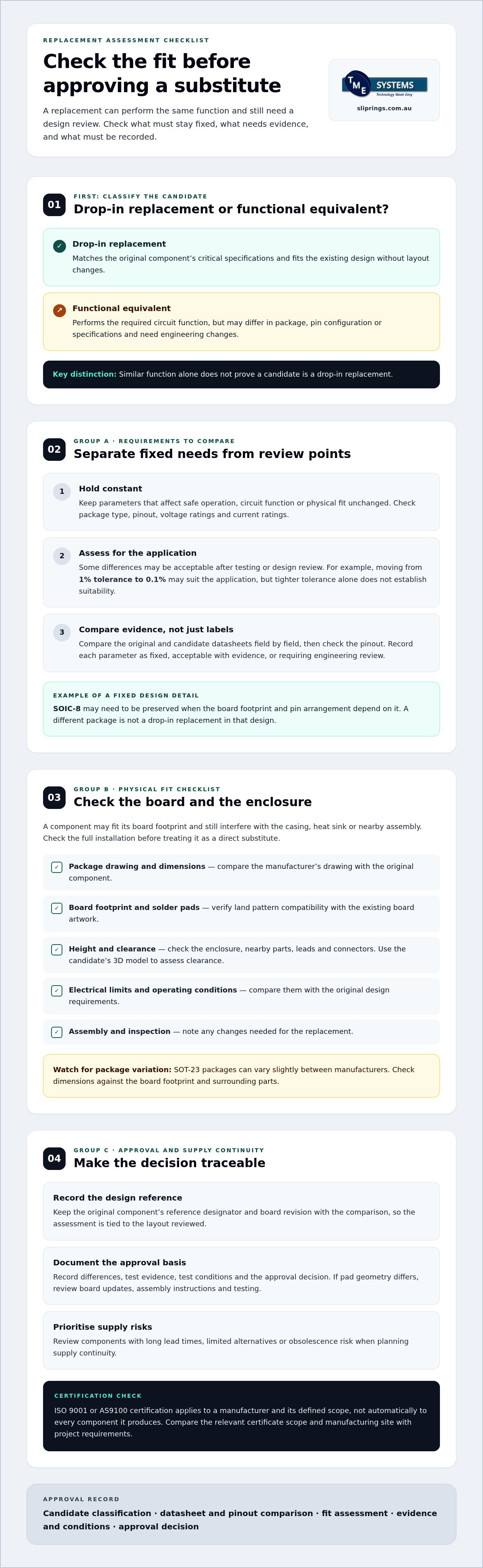
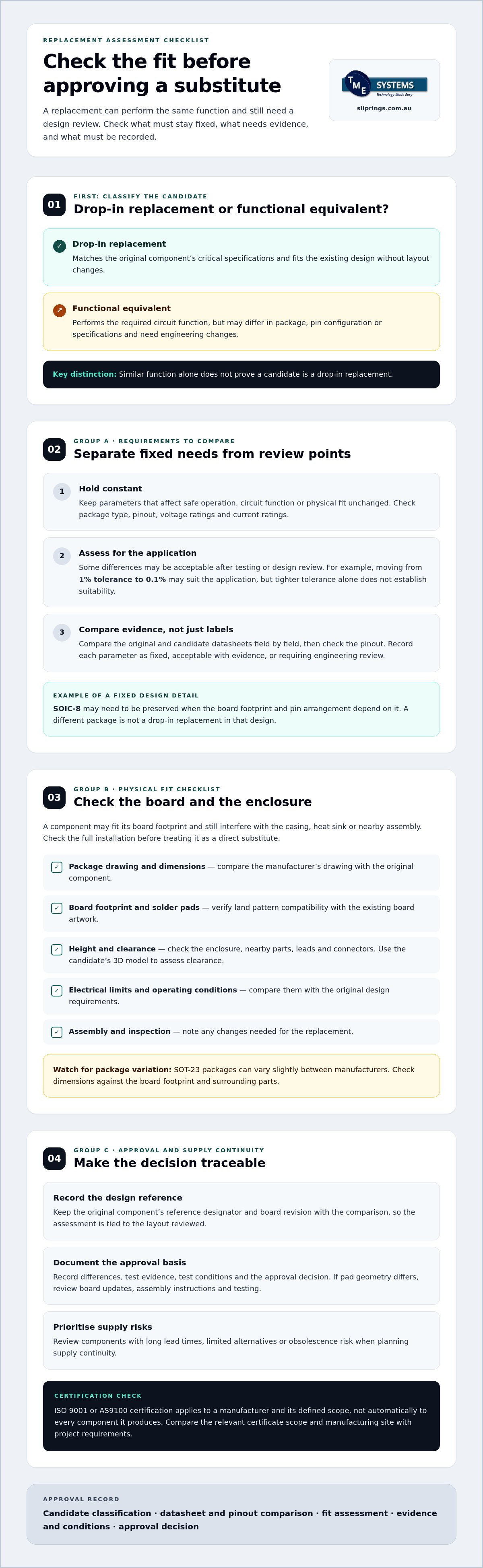
A suitable alternative preserves the component’s critical electrical and mechanical requirements, even if some specifications differ. When assessing alternatives to Pandect Precision Components, treat package and pin configuration as fixed when the existing layout depends on them: SOIC-8 is one package detail to preserve, while moving from 1% tolerance to 0.1% may be acceptable if the application allows it. Compare the substitute’s datasheet and pinout with the original before approval.
That distinction matters because a part that performs the same function may still have a different body size, pin arrangement or specification. A close match can simplify replacement, but availability and lead-time risks also affect whether it is practical for production.
This article explains how to distinguish drop-in replacements from functional equivalents, assess fit and operating requirements, and weigh supply risks. It also outlines a practical way to build a pipeline of approved alternatives, so engineering and procurement teams can decide before a shortage forces a rushed change.
Key Takeaways
- Separate drop-in replacements from functional equivalents by identifying which electrical and mechanical specifications must remain unchanged.
- Compare datasheets, pinouts and physical footprints before approving a substitute; use a 3D model to assess enclosure clearance.
- Prioritise components with long lead times, limited alternatives or obsolescence risk when reviewing supply continuity.
- Record the approved alternatives, test evidence and conditions for use so procurement and engineering can act from the same plan.
- For rotary electrical connector selection, match the application’s circuit count, current, voltage, speed, mounting style and environment to the product requirements.
Drop-in replacements versus functional equivalents
A drop-in replacement matches the original component’s critical specifications and fits the existing design without layout changes. A functional equivalent performs the required circuit function but may need engineering changes. For an engineer managing manufacturing continuity, this distinction determines whether approval is a direct substitution or requires a design review.
A disciplined assessment of alternatives to pandect precision components starts by separating fixed requirements from negotiable ones. For example, an SOIC-8 package may be essential when the board footprint and pin arrangement depend on it. A component with the same function but a different package is not a drop-in replacement, even if its electrical performance appears suitable. Check package type, pinout, voltage ratings and current ratings.
An equivalent component has identical or closely matched specifications. It may come from another manufacturer, be an updated version or have altered features. An alternative can differ more substantially and still perform the circuit’s required function. The application determines which differences matter.
Consider a circuit where the original component has 1% tolerance. Moving to 0.1% tolerance may be acceptable, depending on project requirements. The tighter tolerance alone doesn’t establish suitability. Compare operating limits and circuit behaviour, then record any differences that need testing or review.
Identifying alternatives to Pandect Precision Components can involve assessing many parameters, although only some may be critical to a specific design. Compare the original and candidate datasheets field by field. Record each parameter as fixed, acceptable with evidence, or requiring engineering review. This creates a traceable basis for procurement and manufacturing decisions.
- Hold constant: parameters affecting safe operation, circuit function or physical fit.
- Assess for the application: differences that may be acceptable after testing or design review.
- Document: evidence, test conditions and the approval decision for each candidate.
Situation: A supply-chain disruption makes the original part difficult to source. Action: An engineer filters candidates by voltage range and package, then compares datasheets and pinouts. Result: The shortlist distinguishes drop-in replacements from functional equivalents that need design assessment.
How do Pandect alternatives compare on quality certifications such as ISO 9001 and AS9100? Certification applies to a manufacturer and its defined scope, not automatically to every component it produces. Compare the relevant certificate scope and manufacturing site with project requirements; functional equivalence alone doesn’t establish certification equivalence.
Keep these categories distinct during evaluation. A functional equivalent may have a different body size or pin configuration from the original. An alternative electronic component can also differ in specifications or features while still performing the product’s required function. An equivalent electronic component has identical or closely matched specifications to the unavailable component. It may come from the same manufacturer, be an upgraded version, or have altered features.
When replacing an electronic component, check its voltage and current ratings, package type and pin configuration. Parametric search tools can help identify components with similar specifications by filtering properties such as voltage range and package type. Use filters to find candidates, then compare their specifications with the design requirements. Classification depends on how closely the specifications match the unavailable component and whether the candidate can perform the required function.
Drop-in replacements
A drop-in replacement must suit the existing board layout as well as the circuit. In electronics, a matching part number category doesn’t prove that the component will fit. SOT-23 packages, for example, can vary slightly between manufacturers. Compare the candidate’s dimensions with the board footprint, solder pads and nearby components before treating it as a direct substitute.
Physical clearance matters beyond the circuit board. A component can fit its footprint yet collide with a casing, heat sink or adjacent assembly. Use the candidate’s 3D model to check the full enclosure, including space around leads and connectors. This simple design review helps identify interference before manufacturing changes or production testing begin.
Use a repeatable comparison rather than relying on a catalogue description. For each candidate, record:
- The manufacturer’s package drawing and component dimensions.
- Land pattern compatibility with the existing board artwork.
- Height and clearance against the enclosure and nearby parts.
- Electrical limits and operating conditions against the original design.
- Any assembly or inspection changes needed for the replacement.
Keep the original component’s reference designator and board revision with the comparison. This lets an engineer trace which replacement was assessed against which layout. If the candidate needs different pad geometry, it may still be usable, but it is no longer a simple drop-in change. Board updates, assembly instructions and testing may need review.
Illustrative situation: A manufacturing team finds a possible SOT-23 replacement for an unavailable electronics component. Action: The engineer compares the package drawing, overlays the footprint and checks the 3D model against the enclosure. Result: The review reveals whether the candidate can use the existing board design or needs a layout change.
Apply the same discipline to mechanical interfaces, but don’t assume electronic components and rotary connectors share the same approval checks. For a slip ring, mounting dimensions and shaft clearance affect fit, while the electrical paths must also suit the application. A candidate that fits mechanically may still fail its intended function if its circuit arrangement differs.
For either component type, define acceptance criteria before choosing a replacement. Mark dimensions and operating limits as pass, fail or requiring engineering review. This makes the decision traceable and gives procurement a clear distinction between a direct fit and a candidate that needs further design work.
Treat the enclosure check as part of the substitute assessment, not an optional follow-up. Use the substitute’s three-dimensional model to compare its shape and position with the product enclosure, checking for collisions that would prevent it from occupying the intended space. A catalogue description alone cannot establish fit. The model lets you examine the candidate in the context of the product.
If the model indicates a collision, don’t record the candidate as a confirmed drop-in replacement. Keep clearance open for engineering review and resolve it before accepting the substitute for the existing design. If no collision is indicated, retain the model-based check with the rest of the assessment to document the basis for the fit decision. This keeps enclosure compatibility visible alongside electrical and board-layout reviews.
Availability, lead times and risk
A substitute can meet the design requirements and still fail as a supply option. Availability changes with manufacturing capacity, component lifecycle and demand. A critical integrated circuit with a 52-week lead time, for example, can delay a device even when its design remains unchanged. Record supply constraints alongside technical suitability.
Component type affects the available choices. Passive electronic components are commonly available and easier to replace or substitute. Complex integrated circuits often have fewer readily available alternatives because their functions and specifications are harder to match. Prioritise parts whose shortage could stop production, rather than treating every item as an equal risk.
Electronics sourcing has shifted in emphasis. Cost management was once the primary focus; availability now receives greater consideration. Design and manufacturing teams should review lead-time exposure during design decisions, not only when a purchase order is due. A technically suitable component with uncertain supply creates a different risk from one that is readily sourced.
Component lifecycles add another constraint. Electronic parts can have shorter lifecycles than the products they serve. A part may become obsolete when its manufacturer stops production, leaving supply dependent on remaining stock or an approved replacement. Include lifecycle status in design reviews and record components with no practical substitute.
Use a consistent risk review for each critical part:
- Supply: record current lead-time information and whether a single source supports production.
- Impact: identify the device, assembly or production step affected by a shortage.
- Substitution: note whether a passive component has a suitable alternative or an integrated circuit needs deeper evaluation.
- Lifecycle: track manufacturer end-of-life notices and the design revisions using the part.
- Response: assign an owner to review the supply position and update the approved alternatives record.
Situation: A complex integrated circuit has a 52-week lead time, while production depends on that device. Action: The team assesses functionally suitable candidates, checks their design impact and records supply risks. Result: Procurement and engineering can plan around a reviewed option instead of discovering the constraint during a production run.
For an Australian manufacturer, this method connects purchasing decisions with local production schedules without assuming overseas stock will resolve a shortage. Track the source, lead-time changes and replacement status in one record. When a candidate requires design changes, include review and validation work in the production plan. A supply-risk register makes component availability a managed engineering input.
Building a pipeline of approved alternatives
An approved alternatives pipeline turns substitution into planned engineering work rather than a response to a shortage. Start with parts that could stop production, then identify candidates before supply becomes urgent. Component manufacturers may publish alternative-part lists, including options for obsolete components. Treat these lists as a shortlist, not automatic approval. Each candidate still needs review against the design and its intended application.
For each critical component, create a record linking the original part, candidate alternatives, design revision and approval status. Add the datasheet comparison, test evidence, known differences and any conditions for use. Assign an engineering owner and a procurement owner. Production teams can then see which candidates are approved, which need assessment and which are unsuitable for a particular assembly.
Use a repeatable sequence to build the pipeline:
- Prioritise: rank parts by production impact, supply exposure and lifecycle risk.
- Find candidates: review manufacturer alternative lists and search by essential function and specifications.
- Screen: compare operating limits, package, pinout and physical fit against the design.
- Validate: test candidates under relevant operating conditions and document results.
- Approve: record the authorised design revisions and any limits on use.
- Maintain: revisit the record when specifications, sourcing conditions or production designs change.
Situation: A component reaches end of life, but only one part is approved for production. Action: The manufacturer identifies candidate alternatives, completes engineering review and records accepted options before existing stock runs out. Result: Production has a documented route beyond the original part. Without an approved alternative, manufacturers may need to buy a year’s supply to avoid stopping production.
Approval depth should match application risk. For aerospace applications, for example, teams can route proposed changes through relevant design, quality and customer approval processes before release. A similar function alone does not establish that a candidate meets the application’s documentation or verification needs. Keep those requirements visible in the approval record.
The same planning principle applies to a slip ring, although its selection criteria differ from those for a circuit-board component. Record the application’s electrical requirements, mechanical interface, operating environment and mounting arrangement, then assess candidates against them. A pipeline is useful only when each approved option is tied to a defined design and application.
Review the pipeline during design and supply reviews, rather than waiting for a shortage notice. An engineer can close obsolete candidates, update test evidence and flag parts with no approved alternative. Regular maintenance keeps the register actionable for procurement and manufacturing, and makes the approval basis traceable when a replacement is proposed.
Competitive developments
Pandect Precision Components Ltd is identified as a member of ADS Group Limited, but membership alone doesn’t establish which Australian companies compete directly with it. The comparison depends on the component category: precision manufacturing, electronic parts and rotary electrical connectors serve different requirements and shouldn’t be treated as interchangeable markets.
For an Australian buyer, start by defining the work required. Compare a precision-machined part against its drawing, material and manufacturing tolerances. An electronic component needs electrical and package matching. A slip ring needs assessment against its rotary electrical application. This classification narrows the field before supplier names enter a sourcing review.
Technology changes can also alter what counts as a practical alternative. An integrated component may combine functions previously handled by separate parts, changing board space, interfaces and validation work. An updated version may retain the original function but change specifications. Compare the complete part and system requirements rather than treating a newer design as an automatic replacement.
Manufacturer alternative lists and parametric search tools can help identify candidate parts. Search filters can narrow electronic components by properties such as voltage range and package type, but they don’t establish whether a candidate suits the application. Next, compare its datasheet, interface and performance requirements with the design record.
Illustrative situation: An Australian manufacturer needs a replacement component for an existing assembly. Action: The engineer classifies the part, uses relevant specifications to identify candidates, then assesses them against the production design and documents the differences. Result: The shortlist reflects the application’s needs, rather than a broad label such as “precision components”.
Assess competition by capability fit, not company names alone. For each candidate, compare:
- Product category: Does the supplier’s component match the function and interface?
- Engineering evidence: Are specifications and drawings available for evaluation?
- Manufacturing fit: Can the design accommodate the component without unassessed changes?
- Supply relevance: Does the candidate address the availability risk identified for the original part?
For a rotary electrical connector, selection criteria differ from those for an electronic component or machined part. Compare circuit requirements, mechanical integration and operating conditions for the application. For an electronic replacement, focus on datasheet parameters and compatibility with the existing design. Keeping these assessments separate makes comparisons more useful and prevents a category mismatch from driving a poor decision.
TME Systems: Mercotac Slip Rings
TME Systems Pty Ltd supplies Mercotac Slip Rings for applications that need electrical continuity across a rotating interface. Electronic-component substitutes and slip rings serve different functions, so start by assessing the equipment’s rotary connection requirements. Consider circuit count, current, voltage, rotational speed, mounting style and operating environment when comparing slip ring options.
For other rotary applications, TME Systems Pty Ltd also supplies Meridian Laboratory Slip Rings, BGB Innovation Slip Rings and Prosper Rotation Slip Rings. Assess each range against the equipment’s mechanical and electrical requirements.
If you’re specifying a rotary electrical connector or reviewing options for an application, contact TME Systems Pty Ltd to discuss your requirements.
Turn the shortlist into an engineering decision
Make each proposed substitution actionable by setting out the design revision, application requirements, approval owner and evidence needed before a replacement enters production. This gives engineering and procurement a shared basis for assessing changes as designs or supply conditions evolve.
For rotary electrical connector requirements, centre the assessment on the equipment’s operating conditions and interface. Alternatives to Pandect Precision Components may involve different component categories, so define the function first and choose criteria that match it. TME Systems Pty Ltd’s technical application consulting can help match slip ring requirements to the application.
Bring the relevant design details and operating requirements into the discussion, then decide what needs further engineering review. Discuss your application with TME Systems Pty Ltd and take the next step with a clearly defined assessment.