If you assume an ATEX label alone makes your rotating equipment compliant for a Queensland mine or a Western Australian refinery, you're overlooking a critical regulatory hurdle that could stall your entire operation. Engineering teams often struggle to reconcile international hardware with local expectations, especially when sourcing ATEX certified slip rings Australia wide. It's a high-stakes environment where a single certification oversight can lead to costly non-compliance or catastrophic equipment failure in volatile atmospheres.
We understand that navigating the nuances between IECEx, ANZEx, and ATEX requires more than just a basic datasheet. This technical guide will help you master the specific standards and protection concepts required to select explosion-proof slip rings for Australian industrial environments. We'll provide a clear breakdown of the AS/NZS 60079.14:2022 requirements, the necessity of Conformity Assessment Documents (CAD), and the mechanical specifications that ensure zero-spark operation and long-term reliability in harsh conditions.
Key Takeaways
- Understand why IECEx is the primary standard for Australian hazardous zones and how to manage the mandatory Conformity Assessment Document (CAD) process for international hardware.
- Learn the critical steps for specifying ATEX certified slip rings Australia wide to ensure full compliance with the updated AS/NZS 60079.14:2022 regulations.
- Identify how to balance high-capacity electrical requirements, such as circuit count and voltage, with the physical safety constraints of explosion-proof enclosures.
- Evaluate the impact of local environmental factors, including high ambient temperatures and conductive dust, on T-class ratings and long-term mechanical reliability.
- Discover the specific technical parameters you need to define before engaging in a professional consultation to ensure your slip ring matches your site's zone classification.
What is an Explosion Proof Slip Ring?
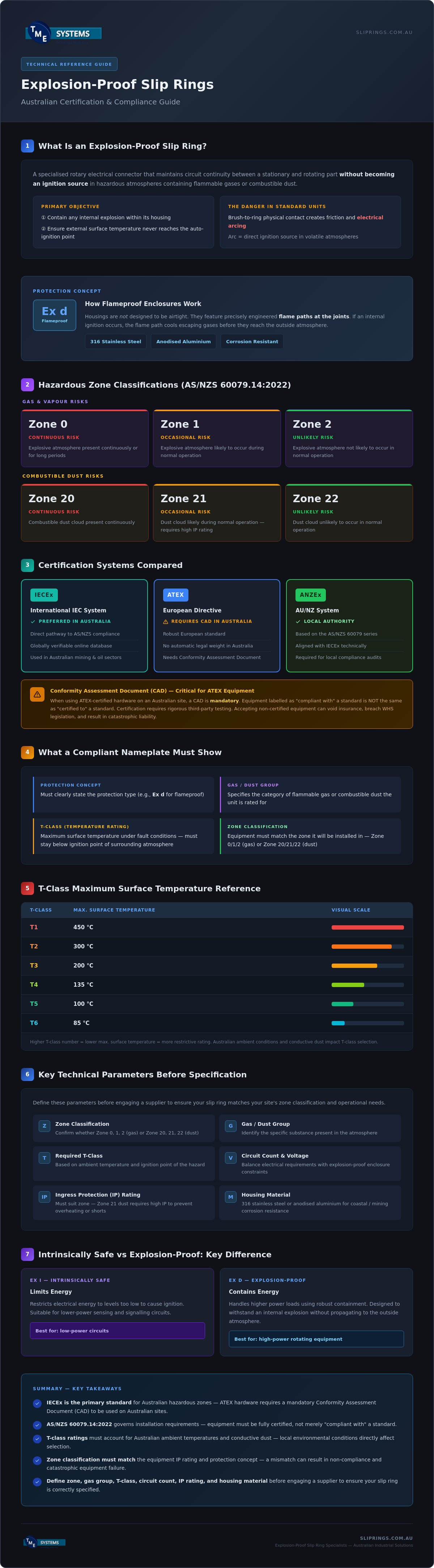
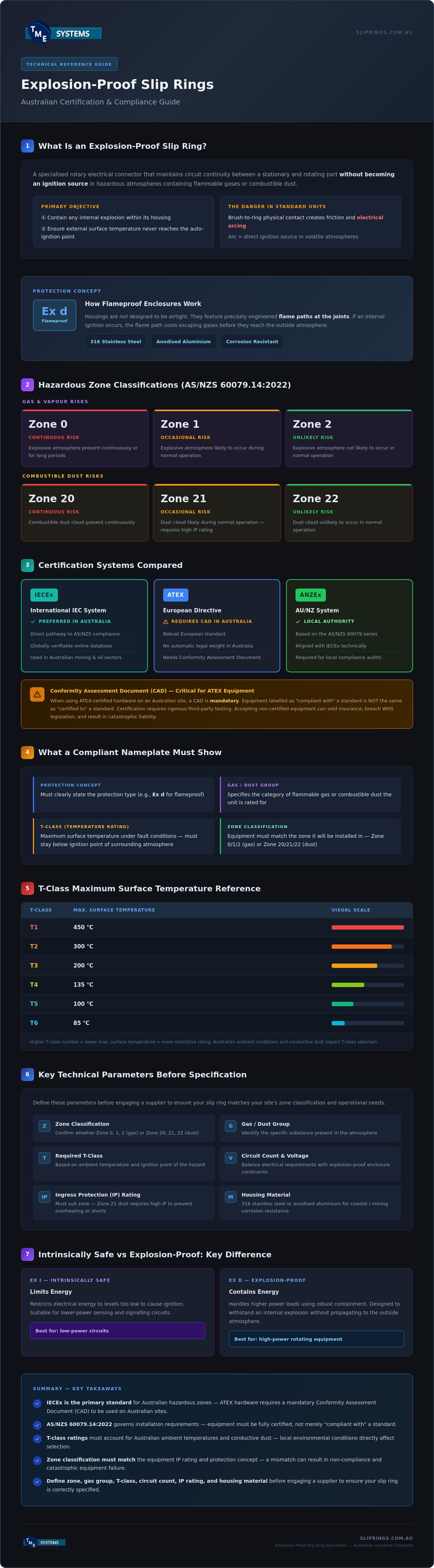
An explosion-proof slip ring is a specialised rotary electrical connector designed to maintain circuit continuity between a stationary and a rotating part without becoming an ignition source. In hazardous industrial environments, such as offshore oil rigs or underground mines, the surrounding air often contains flammable concentrations of gases or combustible dust. Standard slip rings are inherently dangerous in these settings. They rely on physical contact between brushes and rings, which creates friction and electrical arcing. This arc is a direct ignition source that can trigger a catastrophic event.
The primary objective of an Ex-rated unit is twofold: it must contain any internal explosion within its housing and ensure the external surface temperature never reaches the auto-ignition point of the surrounding atmosphere. This differs significantly from intrinsically safe designs. While intrinsically safe equipment limits electrical energy to levels too low to cause ignition, explosion-proof slip rings are built to handle higher power loads by utilising robust containment strategies. For those procuring ATEX certified slip rings Australia based projects require, understanding this distinction is the first step toward regulatory compliance.
The Mechanics of Containment
To achieve safety in volatile areas, manufacturers use flameproof enclosures, technically known as "Ex d" protection. These housings aren't designed to be airtight. Instead, they feature precisely engineered flame paths at the joints. If an internal ignition occurs, the flame path cools the escaping gases before they reach the outside atmosphere. When evaluating ATEX certified slip rings Australia suppliers offer, engineers should prioritise materials like 316 stainless steel or anodised aluminium to resist the corrosive conditions found in coastal or mining sectors. These heavy-duty housings manage internal pressure and prevent structural failure during a thermal event, ensuring the spark never leaves the enclosure.
Hazardous Zone Classifications
Australian standards categorise environments based on the frequency and duration of the explosive risk. Gas and vapour risks are split into Zone 0, where the risk is continuous; Zone 1, where it's occasional; and Zone 2, where it's unlikely. Dust environments follow a similar pattern with Zones 20, 21, and 22. The ATEX directive provides a comprehensive framework for these classifications, though Australian sites must strictly adhere to AS/NZS 60079.14:2022. It's vital to match the slip ring's Ingress Protection (IP) rating to the specific zone. For example, a Zone 21 environment requires a high IP rating to prevent fine combustible dust from entering the housing and settling on internal electrical components, which could lead to overheating or short circuits.
Understanding Certification: IECEx, ATEX, and AS/NZS Standards
Australia's regulatory framework for hazardous areas is governed primarily by the AS/NZS 60079 series. While international manufacturers often focus on the European ATEX directive, the Australian market prioritises the IECEx system for its direct pathway to compliance. It's a common point of confusion for engineers importing machinery from overseas. Identifying valid markings is crucial when procuring ATEX certified slip rings Australia based projects require. A compliant nameplate will clearly state the protection concept, the gas or dust group, and the temperature class. The T-class rating specifies the maximum surface temperature the equipment can reach under fault conditions to ensure it remains below the ignition temperature of the surrounding gas or dust.
IECEx vs ATEX: The Australian Perspective
The preference for IECEx in the Australian mining and oil sectors stems from its global transparency. It allows for easier verification of certificates through an online database. While ATEX is a robust European standard, it doesn't hold automatic legal weight here. To use ATEX-certified hardware on an Australian site, you generally need a Conformity Assessment Document (CAD). Following the WorkSafe Victoria EEHA guidance is a reliable way to ensure your safety management systems align with local occupational health and safety laws.
Documentation and Compliance Audits
A frequent pitfall in procurement is accepting equipment labelled as "compliant with" a standard rather than "certified to" it. Certification involves rigorous third-party testing and ongoing factory audits, whereas a claim of compliance might only reflect the manufacturer's internal testing. For your safety audit trail, you must maintain the original Certificate of Conformity (CoC) and ensure the serial numbers on the slip rings match the documentation exactly. Traceability is non-negotiable during a site audit.
If you're unsure how a specific certificate applies to your local site requirements, our team provides technical application consulting to help bridge the gap between international hardware and Australian regulations. This proactive approach prevents project delays during final site inspections and ensures your installation meets the high safety standards expected in Australian industry.
Selecting the Right Slip Ring for Hazardous Environments
Selecting a slip ring for a hazardous zone requires a careful balance between your application's electrical demands and the physical limitations of an Ex-rated enclosure. Unlike standard assemblies, explosion-proof units must account for the heat generated by electrical resistance and mechanical friction within a sealed space. If you're sourcing ATEX certified slip rings Australia based projects demand, you must verify that the total power dissipation doesn't exceed the enclosure's thermal rating. This involves a precise evaluation of circuit count, current (measured in Amps), and voltage (measured in Volts) to ensure the assembly remains within its T-class limits.
High-speed rotation presents a specific challenge. In a sealed housing, heat cannot dissipate as easily as in open-frame designs. For applications exceeding 500 RPM, the mechanical design must minimise friction to prevent the internal temperature from rising. Integrating sensitive data signals alongside high-power circuits in a single certified assembly adds another layer of complexity. You'll need to ensure adequate shielding to prevent electromagnetic interference (EMI) while maintaining the structural integrity of the flameproof path.
Certified Brand Solutions
Different industrial challenges require specific engineering approaches. For heavy-duty mining or offshore equipment, BGB Innovation slip rings offer robust solutions that are often utilised in wind turbines and large-scale industrial machinery. When your project demands high-speed precision and minimal electrical noise, Meridian Laboratory slip rings provide maintenance-free operation using unique brushless technology. For compact hazardous zone applications where space is at a premium, Prosper Rotation options deliver reliable performance in smaller footprints without compromising on safety standards.
Signal Integrity in Ex-Housings
Maintaining signal integrity inside a heavy-duty enclosure is difficult because the thick metal walls can trap interference. Low-noise requirements for data and sensor signal transfer are critical for the accuracy of automated systems. The choice of contact materials plays a vital role here. While silver-graphite is common for power, gold-on-gold contacts are preferred for low-level signals due to their superior conductivity and corrosion resistance. When verifying these specifications, referring to the IECEx System for Certification ensures that the components meet the stringent international standards required for safe operation. Choosing the right ATEX certified slip rings Australia wide means looking beyond the label to the specific contact metallurgy and shielding techniques used.
Operational Reliability in Australian Industrial Conditions
Australian industrial sites present some of the harshest operating conditions globally. From the intense heat of the Pilbara to the corrosive salt spray of the Bass Strait, hardware must be engineered for more than just a certificate. High ambient temperatures are a primary concern for engineering teams. Most explosion-proof ratings are calculated based on a standard 40°C ambient environment. If your site regularly exceeds this, the thermal headroom of your ATEX certified slip rings Australia project relies on is significantly reduced. This requires a derating of the electrical load to ensure the surface temperature remains within the specified T-class limits.
Dust ingress is another significant risk factor. Fine iron ore and coal dust are not only abrasive but often conductive. If these particulates bypass the primary seals, they can settle on internal rings and brushes, causing tracking, short circuits, or excessive heat build-up. Managing these variables requires a housing with a high Ingress Protection (IP) rating, typically IP65 or higher, to maintain the integrity of the internal electrical environment. Moisture management is equally critical. Rapid diurnal temperature changes can cause condensation to form inside sealed explosion-proof housings, leading to corrosion and insulation breakdown over time.
Mining and Material Handling Applications
The mechanical demands of the mining sector are extreme. Equipment such as stacker-reclaimers and conveyor systems subject rotary connectors to constant vibration and significant mechanical shock. When selecting slip rings for mining equipment, the assembly must be ruggedised to prevent these forces from compromising the flameproof paths. We often recommend Prosper Rotation slip rings for these environments because their compact, robust designs are specifically built to withstand the physical rigours of material handling while maintaining strict hazardous zone compliance.
Maintenance Protocols for Ex-Rated Units
Maintaining the validity of an explosion-proof certification requires strict adherence to authorised service protocols. It's vital to remember that any unauthorised repair or modification immediately voids the unit's Ex-rating and creates a major liability for the site operator. Routine inspections should focus on the condition of the flamepaths and the integrity of the specialised seals. Monitoring electrical noise is a practical way to predict component wear before a failure occurs. If you notice an increase in signal interference, it's often a sign that the brush-to-ring contact is degrading and requires professional assessment.
Ensuring your equipment remains compliant and operational requires a proactive approach to hardware selection. If you're currently auditing your site's rotary requirements, our team offers technical application consulting to help you match the right hardware to your specific environmental challenges.
Procurement and Technical Consultation for Ex-Slip Rings
Procuring explosion-proof hardware for a hazardous zone is an engineering collaboration rather than a simple commercial transaction. The complexity of Australian regulatory standards means that selecting a unit based on electrical capacity alone is insufficient. You must define your hazardous zone parameters with absolute precision before engaging a supplier. This includes identifying the specific gas or dust groups present, the zone classification (0, 1, or 2), and the required temperature class. When sourcing ATEX certified slip rings Australia projects rely on, providing inaccurate data at the outset can result in hardware that fails a site audit or, worse, compromises site safety.
Lead times for custom-certified rotary connectors are a significant factor in project planning. Because every modification to a certified design must be documented and often verified by a third-party body, these units cannot be delivered with the same speed as standard industrial components. Early engagement with a technical consultant allows you to account for these timelines during the design phase. Local Australian technical support is critical during this process. Having a partner who can interpret AS/NZS 60079 requirements ensures that the documentation provided with the hardware meets the specific expectations of local site inspectors and electrical auditors.
Partnering with a Specialised Distributor
Working with TME Systems Pty Ltd provides access to a deep pool of technical expertise and a direct line to world-leading manufacturers. We assist engineers in matching complex applications to certified hardware, ensuring every operational variable is considered. Whether you require the high-speed precision of Meridian Laboratory slip rings, the robust industrial performance of BGB Innovation, or the unique brushless advantages of Mercotac slip rings, our consultative approach prioritises technical accuracy. TME Systems Pty Ltd provides the necessary technical data and certification paperwork required to build a robust safety case for your installation.
Final Checklist for Procurement Managers
Before finalising the procurement of ATEX certified slip rings Australia wide, ensure the following parameters have been verified and documented:
- Certification Validity: Ensure the unit carries a current IECEx or ANZEx Certificate of Conformity that matches the nameplate.
- Thermal Matching: Confirm the T-class rating is suitable for the lowest auto-ignition temperature of the gases or dusts in the area.
- Environmental Protection: Verify the IP rating is sufficient for local conditions, such as fine coal dust or salt-laden air.
- Electrical Headroom: Confirm the unit has been derated appropriately if the ambient site temperature exceeds 40°C.
If your project involves heavy-duty power transmission that may exceed the capacity of a standard enclosed slip ring, consult our collector ring guide for a professional comparison of high-current rotary solutions. Taking the time to verify these technical details during procurement is the most effective way to ensure long-term reliability and regulatory compliance in Australian hazardous zones.
Securing Your Rotary Operations in Hazardous Zones
Compliance in Australian hazardous zones requires a methodical approach that reconciles international hardware with local AS/NZS standards. Successful installation depends on matching specific gas or dust groups with the correct T-class ratings and ensuring enclosures can withstand the unique thermal and abrasive challenges of the Australian landscape. By prioritising certified documentation and precise environmental derating, you protect both your personnel and your long-term operational uptime.
When you're ready to source ATEX certified slip rings Australia based projects require, technical accuracy is your strongest asset. TME Systems Pty Ltd acts as a dependable partner, serving as the authorised Australian distributor for BGB Innovation and Meridian Laboratory. We specialise in Australian industrial and mining requirements, providing the expert technical consulting necessary to bridge the gap between complex engineering needs and strict regulatory compliance. Our focus remains on delivering zero-spark operation and mechanical reliability in the most volatile environments.
Contact TME Systems Pty Ltd for Technical Assistance with Explosion Proof Slip Rings to ensure your next project meets the highest safety and reliability standards. We look forward to helping you solve your most challenging rotation requirements with precision and expertise.
Frequently Asked Questions
What is the difference between Ex d and Ex i slip rings?
Ex d ratings refer to flameproof protection where the enclosure is designed to contain an internal explosion and cool escaping gases. Ex i refers to intrinsic safety, which limits the electrical energy to levels that cannot trigger an ignition. Most industrial slip rings are Ex d because they handle power levels that exceed the low-energy thresholds required for intrinsic safety.
Can I use an ATEX-certified slip ring on an Australian mine site?
You can only use ATEX-certified hardware on Australian mine sites if it also carries IECEx or ANZEx certification, or if you have a site-specific Conformity Assessment Document (CAD). While many manufacturers offer ATEX certified slip rings Australia wide, local mining regulations strictly prioritise the IECEx system. Using equipment without the correct Australian-recognised paperwork can lead to immediate site shutdowns during a safety audit.
How does an explosion-proof housing affect the maximum RPM of a slip ring?
Explosion-proof housings generally reduce the maximum RPM because the sealed environment traps heat generated by friction and electrical resistance. The heavy-duty seals and flamepaths also add mechanical drag compared to open-frame designs. If your application requires high-speed rotation, you must select a unit with specialised bearings and high-thermal-conductivity materials to prevent the internal temperature from exceeding the T-class limit.
What temperature class (T-rating) do I need for my application?
Your required T-rating must be lower than the auto-ignition temperature of the most volatile gas or dust present in your hazardous zone. For example, if a gas ignites at 180°C, you would typically need a T4 rating, which limits surface temperatures to 135°C. Selecting a T6 rating offers the highest safety margin by limiting temperatures to 85°C, though this often requires derating the electrical capacity.
Are there mercury-free explosion-proof slip rings available?
Yes, mercury-free explosion-proof slip rings are the standard for most modern Australian industrial applications. Brands like Meridian Laboratory and BGB Innovation provide high-performance alternatives that avoid the environmental and health risks associated with mercury. These designs are particularly important for food processing or environmentally sensitive mining areas where hazardous material leaks must be prevented at all costs.
How often do explosion-proof slip rings require inspection?
Australian standards, specifically AS/NZS 60079.17, require an initial inspection followed by periodic inspections at intervals typically ranging from one to three years. The exact frequency depends on the site's environmental conditions and the equipment's duty cycle. Harsh mining environments with high vibration or corrosive salt spray often require more frequent "close" or "detailed" inspections to ensure the flamepaths remain uncompromised.
What happens if the IP rating of an Ex-rated slip ring is breached?
A breach in the IP rating allows dust and moisture to enter the enclosure, which can lead to internal tracking, corrosion, or short circuits. In a hazardous zone, this is critical because internal electrical faults can increase the surface temperature beyond the certified T-class limit. If ingress is detected, the unit must be decommissioned and inspected by a qualified technician to restore its explosion-proof integrity.
Can signal and power be combined in a single explosion-proof slip ring?
Combining signal and power in a single explosion-proof slip ring is possible and common in automated industrial machinery. However, the internal design must include robust electromagnetic shielding to prevent power circuits from interfering with sensitive data signals. When procuring ATEX certified slip rings Australia based projects require, engineers should specify the exact data protocols, such as Ethernet or Profibus, to ensure the internal metallurgy is optimised for signal integrity.