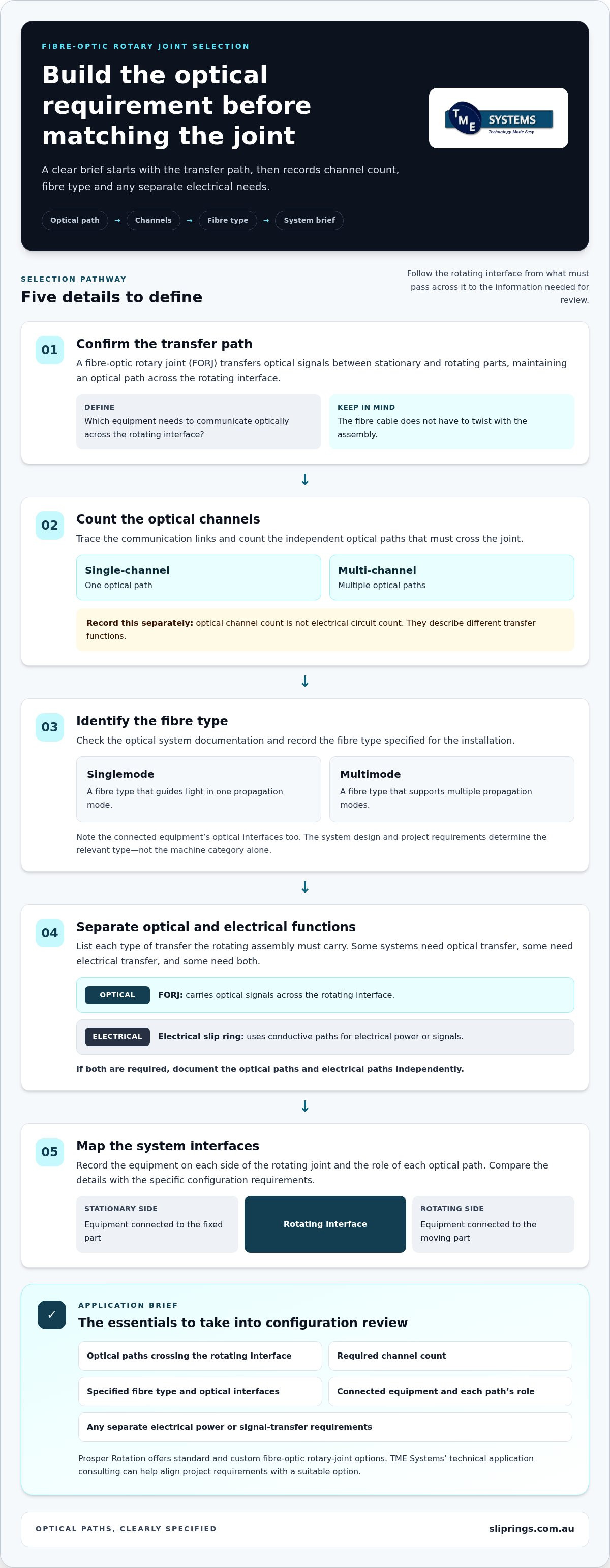
Choosing a fibre-optic rotary joint starts with the optical architecture, not the rotating assembly. For a fiber optic rotary joint Australia project, clarify the channel count, fibre type and difference between optical and electrical transfer before selecting a configuration. These requirements give you a practical basis for comparing options with the system design.
This guide explains how to describe the required optical channels and fibre type, identify the rotating system’s requirements, and distinguish optical transfer from the work of a rotary electrical joint. A fibre-optic rotary joint, or FORJ, transfers optical data across a rotating interface. Electrical power or signals require a separate rotary-connection function.
Prosper Rotation offers standard and custom fibre-optic rotary-joint options. TME Systems’ technical application consulting can help match the project requirements with a suitable option. The sections below explain what to include in an application brief so the configuration review can focus on your rotating system’s actual needs.
Key Takeaways
- For a fiber optic rotary joint Australia application, define the optical-transfer requirement before matching a joint to the rotating assembly.
- Record optical channel count and fibre type separately from electrical circuit count. They describe different requirements.
- Identify whether the system needs optical transfer, electrical transfer or both to clarify the rotary-connection configuration.
- Prepare an application brief with the system interfaces and operating environment to support a focused technical review.
- Prosper Rotation offers standard and custom options, with TME Systems’ technical application consulting to help align a FORJ with project requirements.
What a fibre-optic rotary joint does in an Australian rotating system
A fibre-optic rotary joint (FORJ) transfers optical signals between stationary and rotating parts of a system. It maintains an optical path across the rotating interface, so a fibre cable does not have to twist with the assembly. A FORJ is relevant when the system needs optical communication across that interface.
For a fiber optic rotary joint Australia project, define the transfer medium as well as the movement. A FORJ carries optical signals. It does not provide a conductive path for electrical power or signals. Separating these functions makes it easier to describe what the rotary connection must do.
When does a rotating system need optical signal transfer?
Optical transfer may be needed when a rotating assembly communicates with stationary equipment over a fibre-optic path. Possible application contexts include cable reels, robotics and wind energy systems. The specific system design determines whether a FORJ is required and what its configuration needs to support.
Consider the communication path and rotating interface together. For a cable reel, identify whether optical signals must pass between the reel and fixed equipment. For robotics, map the components on either side of the rotating joint and determine whether they need to communicate optically. For a wind energy system, check whether the design calls for optical transfer across a rotating assembly. These examples help frame the requirement, but the machine type alone does not determine the right configuration.
How does a FORJ differ from an electrical slip ring?
The difference is the transfer medium. A FORJ passes optical signals across the rotating interface. An electrical slip ring uses conductive paths to transfer electrical power or signals between stationary and rotating components. Optical channel count and electrical circuit count describe different functions and should be recorded separately.
Some systems need optical transfer, others need electrical transfer, and some need both. List the power and signal paths the assembly must carry, then identify the rotary-connection function for each. For example, Mercotac® connectors are compact, brush-less, mercury-wetted rotary electrical connectors that provide low-resistance, low-noise power and signal transfer. They use conductive transfer, which is distinct from optical transfer through a FORJ.
This distinction gives engineers a clear starting point for a fiber optic rotary joint Australia requirement. Define the optical path, then document any electrical transfer the same rotating system also needs. The configuration review can then consider each function within the wider rotary-connection project.
How to match fibre-optic rotary joint channels and fibre type
Start by listing the optical paths the system needs, then identify the fibre type specified for the installation. These are separate selection details: channel count is the number of independent optical paths the joint must support, while fibre type describes the fibre used by those paths. Recording both helps you compare configurations with the system requirement rather than relying on the machine type alone.
| Selection point | Application question | What to record |
|---|---|---|
| Channel count | How many independent optical paths must cross the rotating interface? | Single-channel or multi-channel requirement, based on the system design |
| Fibre type | Does the existing optical system specify singlemode or multimode fibre? | The stated fibre type and any relevant interface details |
| Application requirement | What equipment communicates across the rotating connection? | Connected components and the role of each optical path |
How many optical channels does the application require?
Count the independent optical paths that need to cross the joint. A single-channel arrangement provides one optical path; a multi-channel arrangement supports multiple paths. Trace the communications links through the system and record which ones cross the rotating interface. Don’t estimate the count from the machine type or add channels without a system requirement for them.
Keep this figure distinct from circuit count, the number of independent electrical paths in a slip ring. Optical channels and electrical circuits serve different transfer functions, so one count cannot replace the other. The Fiber Optic Industry Standards and Education resources from the Fiber Optic Association provide background on fibre-optic technology and terminology.
Should the system use singlemode or multimode fibre?
Singlemode and multimode are different fibre types, not alternative names for channel count. Singlemode fibre guides light in one propagation mode, while multimode fibre supports multiple modes. The right type for a rotating system depends on the optical design already in use and the project requirements.
Use the system documentation to identify the specified fibre type and note the connected equipment’s optical interfaces. Avoid choosing a type based only on a broad application category. Compare the requirements with the relevant product information for the specific configuration.
These details provide a practical starting point for technical review. TME Systems’ technical application consulting helps align project requirements with a suitable standard or custom option. Prosper Rotation slip ring options include fibre-optic rotary-joint configurations.
Compare FORJ configurations with the rotating system’s requirements
Compare configurations against the required signals, available space and operating conditions at the rotating interface. This keeps optical requirements separate from conductive electrical transfer and avoids treating a FORJ as a universal rotary connector. If the application needs both optical and electrical functions, document each one for review as a distinct requirement.
| System requirement | Transfer to consider | What to document |
|---|---|---|
| Optical communication across rotation | Fibre-optic rotary joint | Optical channel count, fibre type and connected equipment |
| Electrical power or signals across rotation | Electrical rotary-transfer component | Electrical paths and the power or signal requirements |
| Both optical and electrical communication | Separate functional requirements for review | Each transfer type, its interfaces and its place in the assembly |
When is an optical rotary joint the relevant choice?
A FORJ is relevant when the system design requires optical signals to pass between stationary and rotating components. If the project specifies high‑speed data transmission, record the required data format and equipment interfaces as application inputs. These are system requirements to include in the review, not assumptions about a particular joint’s capabilities.
Application examples help frame the selection, but they do not determine product suitability. A robotics or wind energy use case, for example, does not establish the required channel count, fibre type or model configuration. Compare Prosper Rotation options with the documented requirements for the project.
How should mechanical layout affect the comparison?
Record the shaft arrangement, mounting space, connection interfaces and physical constraints around the rotating assembly. Through-bore and capsule describe general slip ring forms. A through-bore slip ring has a hollow centre for shaft integration, while a capsule slip ring is a compact solid unit for end-of-shaft mounting. These terms describe form factors, so use the product information for the specific rotary joint to assess its dimensions and mounting arrangement.
Document the operating environment too, including relevant exposure to dust, moisture, temperature changes or vibration. Treat these as conditions the configuration must address. Include project data and compare it with the relevant product information.
Separate must-have requirements from background information. Record the transfer paths, how the unit fits the assembly and the conditions it will operate in. TME Systems’ technical application consulting can help align these inputs with a suitable standard or custom option. Include the system layout and interfaces when reviewing Prosper Rotation slip ring options.
Build a fibre-optic rotary joint selection brief before purchase
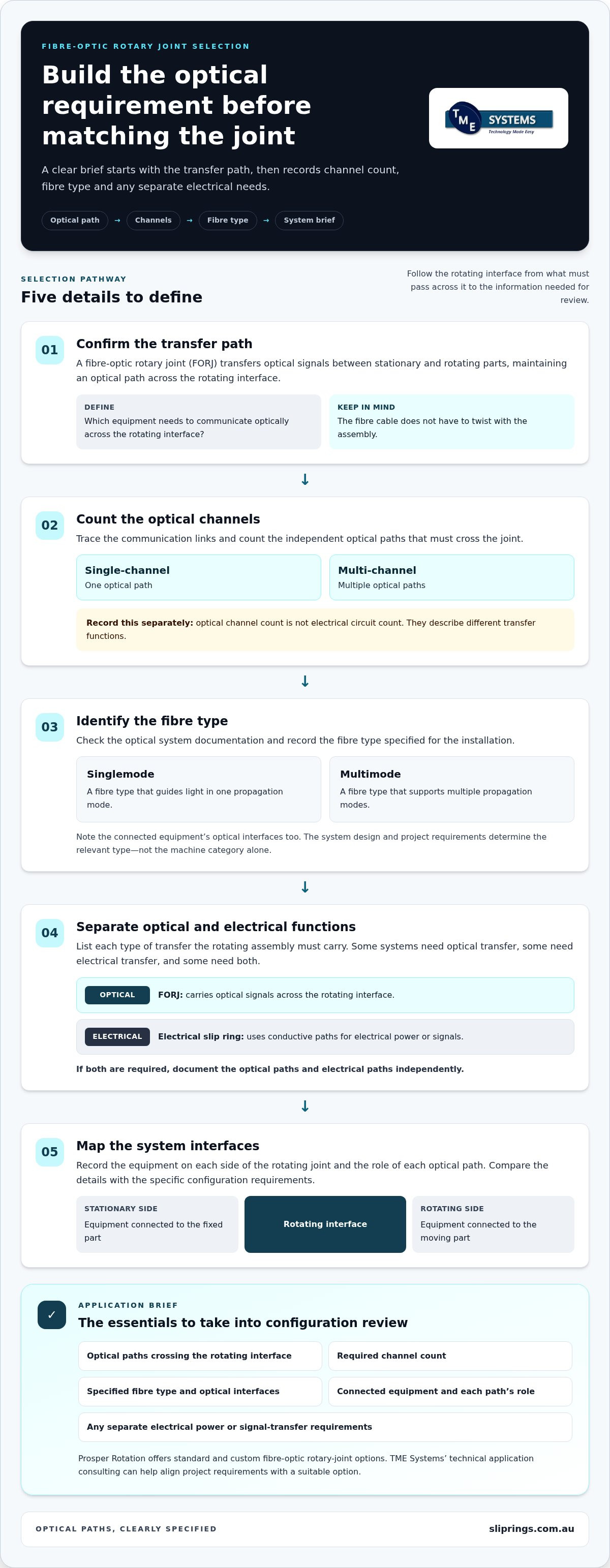
A clear application brief gives technical review a defined starting point. Bring together the optical requirements, mechanical layout and operating conditions, while keeping electrical-transfer needs separate. For a fiber optic rotary joint Australia project, prepare the information below before comparing configurations. Use measured dimensions and documented requirements where available, rather than estimates.
Which technical details belong in the application brief?
Describe what the rotating system needs to transfer and how the joint fits into the assembly. List optical and electrical requirements separately. Include drawings or interface details that explain the layout, along with environmental conditions drawn from project data.
- Define the optical paths. Record the required optical channel count and what each path connects across the rotating interface.
- Specify the fibre type. Note whether the system uses singlemode or multimode fibre, based on its existing design and documentation.
- Describe signal requirements. Identify the connected equipment and the role of the optical signals. Include relevant system-level requirements.
- Document interfaces and layout. Provide the shaft arrangement, connection details, available mounting space and any constraints that affect installation.
- Record electrical transfer separately. List required electrical power or signal paths as their own requirements. Don’t use electrical circuit count as a substitute for optical channel count.
- Describe the operating environment. Note relevant conditions such as dust, moisture, temperature or vibration when they form part of the application data.
For broader procurement context, Australian slip ring procurement guidance can help place the technical brief within the wider selection process.
What should happen during technical application review?
During a technical application review, the supplied requirements are compared with possible standard or custom configurations. The brief shows which details guide the comparison, where the system interfaces sit and what information needs to be assessed against product documentation. This helps focus the configuration selection on the project’s documented requirements.
Keep the requirements current. If the optical channel count or mounting arrangement changes, update the brief so the configuration assessment reflects the latest design. TME Systems provides technical application consulting to help align project requirements with a suitable rotary-connector option.
Prepare your application brief and discuss your rotary-connection requirements with TME Systems as part of the technical review.
Fibre-optic rotary joints from Prosper Rotation: standard and custom options
Once the application brief is ready, compare its requirements with suitable product configurations. Prosper Rotation offers standard and custom fibre-optic rotary-joint options. TME Systems supplies these options to Australian customers and provides technical application consulting to help align rotary-connector technology with the project.
A standard option may suit an application when its documented requirements align with an available configuration. A custom option provides another route when the project calls for a tailored solution. Base the choice on the application brief and relevant product information, rather than assumptions about the machine type or a general description of a FORJ.
When should a buyer consider a standard or custom option?
Compare the optical and mechanical requirements with the configuration information for the relevant option. If the documented requirements align, a standard configuration may be suitable. Prosper Rotation also offers custom options for projects that call for a tailored solution. Keep the selection tied to the technical assessment and the requirements recorded in the brief.
For a focused comparison, include the optical paths, fibre type, interfaces, mounting constraints and operating conditions. Prosper Rotation’s fibre-optic rotary-joint options sit within a broader rotary-connector range. Treat the FORJ as the optical-transfer component of the system, not as a substitute for every rotary-connection function.
How can TME Systems support Australian project selection?
TME Systems’ technical application consulting helps match rotary-connector technology to application requirements. For projects with optical transfer alongside other rotary-connection functions, set out each requirement separately so it can be considered on its own terms. This gives the technical review a clear set of project inputs.
TME Systems supplies industrial rotary connectors from Mercotac®, Meridian Laboratory (ROTOCON), BGB Innovation and Prosper Rotation. The range supports an application-led comparison of relevant manufacturer options. Product lines serve different functions, so compare each option against the requirements rather than assuming they are interchangeable.
For a fiber optic rotary joint Australia application, provide the optical, mechanical and environmental requirements in a clear brief. This gives the review a practical basis for considering a standard or custom Prosper Rotation option and its place in the overall rotary-connection project.
Discuss a fibre-optic rotary joint for your application and provide your technical brief for review.
Move your rotary-interface design towards review
As a rotating assembly develops, its interfaces and operating conditions can change. Keep the latest requirements with the current system drawings, and record design assumptions that could affect the rotary connection. This gives the technical review a clear reference and helps ensure the configuration assessment reflects the current application.
For a fiber optic rotary joint Australia project, base the next step on the application rather than the product label alone. Share the brief, relevant interface information and open design questions so the options can be considered in context.
Start a technical discussion about your fibre-optic rotary joint with TME Systems. Share your application brief to begin a focused review.
Frequently Asked Questions
What is a fibre-optic rotary joint, and what does it transfer?
A fibre-optic rotary joint carries optical signals across the point where rotating and stationary parts meet. Treat it as one component in the communications path and check how it connects to the equipment at each end. Compare the intended connection details with the relevant product information before finalising the design.
Can a fibre-optic rotary joint transmit data while the equipment rotates?
Yes. A FORJ transfers optical data across a rotating interface. To assess a configuration, describe the equipment’s movement pattern, such as whether it turns continuously or indexes between positions, and include that information in the technical review. Compare the application requirements with the relevant product information.
How do single-channel and multi-channel fibre-optic rotary joints differ?
A single-channel joint provides one optical path, while a multi-channel joint provides multiple paths. Map the endpoints that need independent optical links and identify any links that must remain separate. Consider future system changes as a design requirement, rather than an automatic reason to select more channels. Compare the required configuration with the relevant product information.
What is the difference between singlemode and multimode fibre in a FORJ?
Match the joint’s fibre specification to the fibre and optical equipment already used in the system. Review the transceiver documentation and project fibre schedule rather than choosing based on a general assumption about the application. If system records are incomplete, note that in the design review and include the fibre specification in the configuration assessment.
Can a fibre-optic rotary joint transfer electrical power as well as optical signals?
A FORJ transfers optical signals. If the equipment also needs electrical power or signals, assess that as a separate design requirement and document both functions in the rotary-connection arrangement. The equipment’s electrical design and relevant product information should guide the assessment.
What information should I provide when requesting a fibre-optic rotary joint?
Alongside the application details, include a system schematic, relevant equipment datasheets and the current fibre schedule if available. Identify which documents reflect the latest design revision and flag unresolved assumptions. This gives the technical review useful context for checking interfaces and comparing a proposed configuration with the system design. A clear, current brief can help focus a fiber optic rotary joint Australia project review.
Does Prosper Rotation offer standard and custom fibre-optic rotary-joint options?
Yes. Prosper Rotation offers standard and custom fibre-optic rotary-joint options. Compare the project’s documented interfaces and requirements with the information for the relevant configuration. For a tailored option, keep design inputs and changes clearly recorded so the configuration review reflects the current project requirements.