If you believe an IP65 rating alone guarantees your rotary connectors will survive the corrosive salt spray of a coastal jetty or the relentless humidity of a tropical processing plant, your equipment is already on borrowed time. Reliability in these conditions requires more than a standard seal; it demands a precise alignment of housing metallurgy and contact science. Most Australian maintenance managers have faced the frustration of frequent downtime caused by signal noise or contact corrosion in what was supposed to be a protected unit. It's a costly cycle that disrupts production and compromises data integrity.
This guide helps you break that cycle. You'll discover how to specify and procure harsh environment slip rings that withstand extreme temperatures, moisture, and corrosive industrial environments. We'll outline the technical requirements for extended service life and maintenance-free operation in remote locations, ensuring reliable power and data transfer. By focusing on specialised brands like Mercotac and BGB Innovation, we'll preview the engineering choices that eliminate signal degradation and keep your rotating equipment operational in Australia's most demanding sectors.
Key Takeaways
- Identify the specific thermal, chemical, and mechanical stressors that dictate the necessary specifications for harsh environment slip rings in Australian industrial applications.
- Understand the nuances of housing metallurgy and Ingress Protection (IP) ratings to ensure long-term resilience against corrosion and moisture ingress.
- Evaluate advanced contact technologies, including fibre brush and liquid metal connectors, to maintain high-fidelity signal transmission in high-vibration environments.
- Apply a professional selection framework that combines a thorough environmental audit with precise electrical parameter mapping to eliminate procurement errors.
- Learn how to leverage local technical consulting to access specialised global hardware from manufacturers such as Meridian Laboratory and BGB Innovation.
Defining Harsh Environments for Industrial Slip Rings
A harsh environment isn't merely an outdoor setting. In an industrial context, it's an operational state where variables like extreme thermal cycles, abrasive particulates, and corrosive agents converge. An electrical slip ring designed for a controlled factory floor will inevitably fail when exposed to these cumulative pressures. In Australia, this often means managing the dual threat of intense UV radiation and high-salinity coastal air, which accelerates the degradation of standard polymers and non-treated metals. Standard units lack the sealing and material integrity required for these extremes, leading to rapid component failure.
Thermal and Mechanical Stress Factors
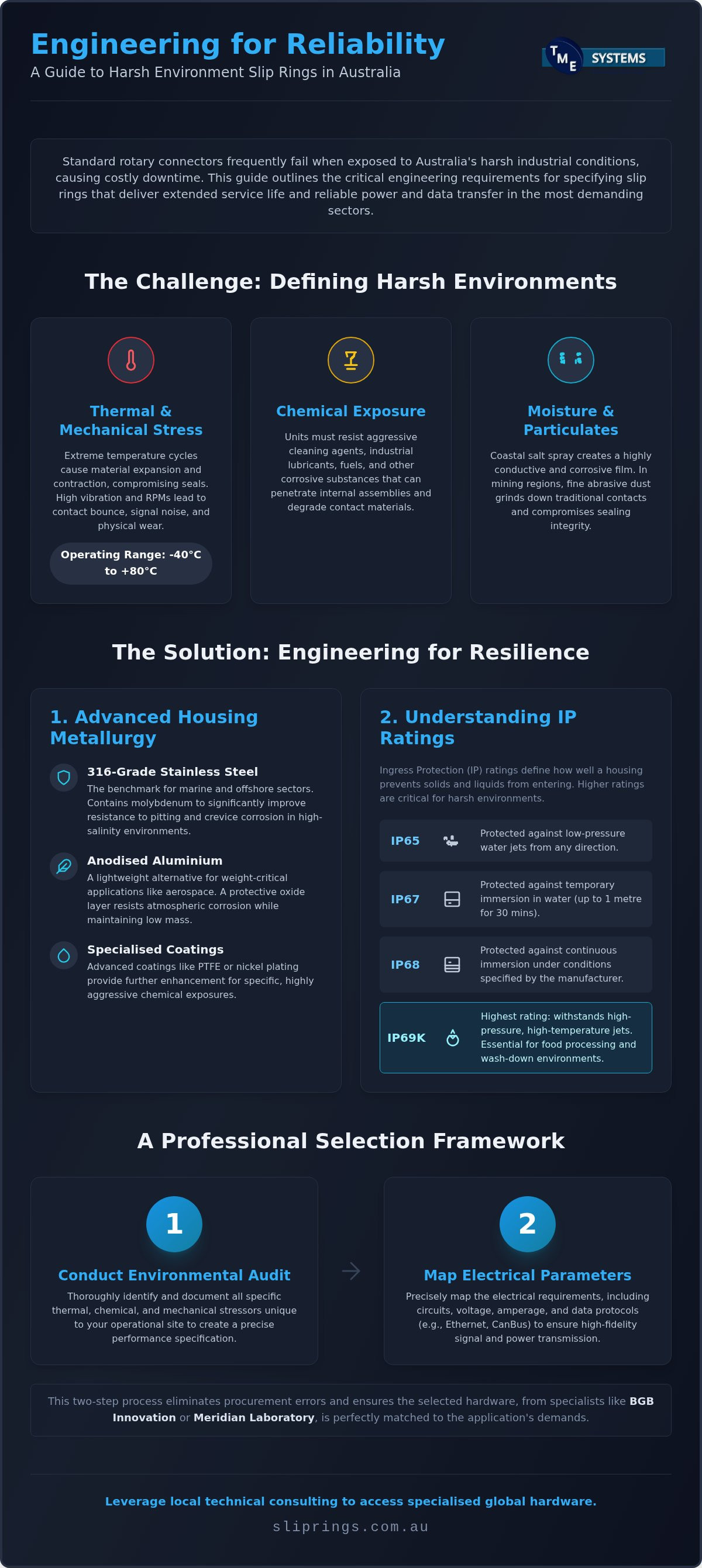
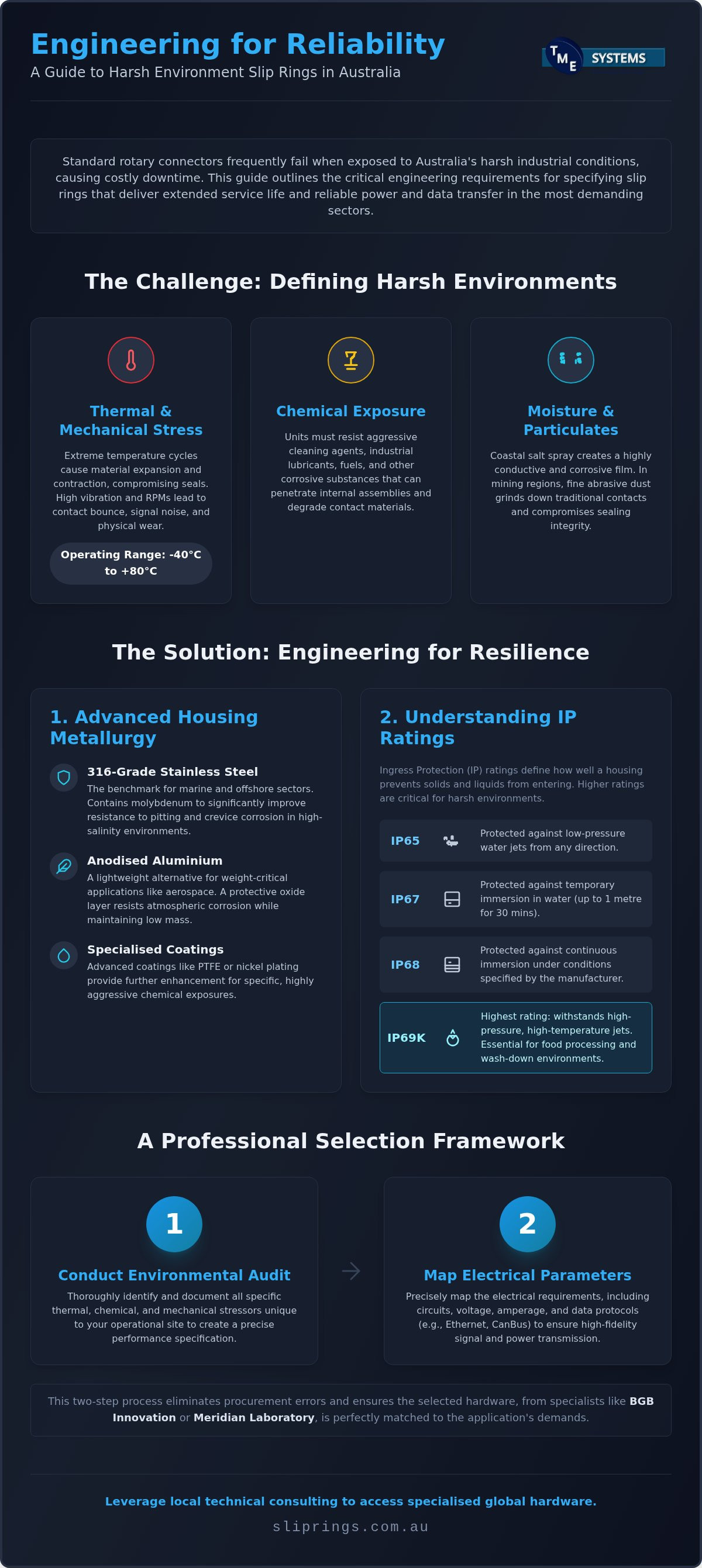
Australian mining and heavy manufacturing sites often operate in extreme temperatures ranging from -40°C in refrigerated processing to +80°C in sun-exposed outback machinery. These thermal shifts cause material expansion and contraction, which can compromise internal seals. Mechanical stress is equally critical. High-vibration environments, typical in crushing plants or drilling rigs, can cause contact bounce. This leads to signal noise and physical wear. At high RPM, centrifugal forces further challenge contact stability, requiring specialised engineering to maintain a consistent electrical path. Components from Meridian Laboratory are often specified here for their ability to maintain contact integrity under such mechanical loads.
Chemical Exposure and Ingress Challenges
Ingress protection is a baseline, but the nature of the contaminant determines the housing's survival. In marine applications, salt spray creates a highly conductive and corrosive film. Without marine-grade metallurgy, housings pit and contacts fail. In the Pilbara or Central Highlands, fine particulate dust acts as an abrasive, grinding down traditional carbon brushes. Chemical resilience is also vital. Slip rings in food processing or chemical plants must resist aggressive cleaning agents, industrial lubricants, and fuels. Selecting harsh environment slip rings ensures these substances don't penetrate the internal assembly or react with the contact materials. Brands like BGB Innovation focus on these sealing nuances to prevent premature failure.
The role of the rotary connector is often overlooked until it fails. When a slip ring stops, the entire system stops. Reliable power and data transfer are the foundation of system uptime. Specifying hardware that accounts for the specific chemical and mechanical stressors of your site is the only way to ensure an extended service life and avoid the high costs of unplanned maintenance in remote Australian locations.
Engineering Resilience: Housing Materials and Sealing Standards
The housing of a rotary connector serves as the primary barrier between volatile external conditions and delicate internal components. While the previous section identified the environmental stressors, engineering resilience relies on selecting a housing material that won't degrade under those specific loads. For harsh environment slip rings, this selection is a calculated balance of chemical compatibility, mechanical strength, and mass.
Metallurgy for Corrosion Resistance
In Australian marine and offshore sectors, 316-grade stainless steel is the benchmark for durability. Unlike 304-grade, 316 contains molybdenum, which significantly improves resistance to pitting and crevice corrosion in high-salinity environments. For applications where weight is a critical constraint, such as aerospace or high-speed robotics, anodised aluminium offers a viable alternative. It provides a protective oxide layer that resists atmospheric corrosion while maintaining a low mass. Advanced coatings like PTFE or nickel plating can further enhance these properties for specific chemical exposures. The reliability of these materials is well-documented; NASA’s research into long duration space applications confirms that correct metallurgy is the foundation of hardware longevity in the most extreme environments known to engineering.
Understanding IP Ratings: IP65 to IP69K
Ingress Protection (IP) ratings define how well a housing prevents solids and liquids from entering the assembly. IP65 is often sufficient for general outdoor use, providing protection against dust and low-pressure water splashes. However, if equipment faces heavy rain or temporary flooding, IP67 is required to ensure the unit survives brief submersion. In the food and beverage industry, the standard is often IP69K. This rating ensures the unit can withstand high-pressure, high-temperature steam cleaning without seal failure.
Achieving these ratings in rotary components is more complex than in static enclosures. A static seal only needs to remain seated; a rotary seal must maintain its integrity while the shaft is in motion. This requires high-performance elastomers and precise machining to prevent ingress during rotation. Furthermore, the cable entry points are frequently the weakest link in the chain. High-quality cable glands must be matched to the housing's IP rating to prevent "wicking," where moisture travels down the cable jacket and into the internal assembly. Manufacturers like BGB Innovation and Prosper Rotation offer various housing configurations to meet these specific sealing demands. If you're designing a system for a high-contamination zone, seeking technical application consulting ensures your housing and sealing choices align with your operational reality.
Comparing Contact Technologies for Rugged Performance
While the housing protects the unit from external ingress, the internal contact technology dictates the fidelity of power and data transmission. In harsh environment slip rings, the choice between traditional carbon brushes, advanced fibre brushes, or liquid metal connectors directly impacts the maintenance cycle and signal-to-noise ratio (SNR). Selecting the wrong contact material for a high-vibration mining site or a remote wind turbine can lead to rapid signal degradation and premature equipment failure.
Liquid Metal Connectors: The Mercotac Advantage
Liquid metal rotary connectors represent the pinnacle of low-noise performance. Unlike mechanical brushes that "bounce" during rotation, Mercotac slip rings utilise a pool of liquid metal to maintain a continuous, molecularly bonded electrical path. This results in near-zero electrical noise, making them ideal for sensitive sensors and high-speed data transmissions. These units are essentially maintenance-free because there are no physical brushes to wear down or replace. However, they are typically limited by mounting orientation and specific temperature ranges, making them most effective in fixed-position industrial rotations where data integrity is the primary concern.
Fibre Brush and Traditional Systems
For applications requiring high current or operation in extreme temperatures, fibre brush technology is the industry standard. These systems use multiple strands of precious metal or specialised alloys to create several points of contact per circuit. This redundancy ensures that even under significant vibration, the connection remains stable. BGB Innovation slip rings are frequently specified for large-scale projects like wind turbines and water treatment plants due to their exceptional durability and long service life. Traditional carbon brushes, while cost-effective for heavy-duty power transfer, require more frequent maintenance due to the conductive dust they generate, which can lead to internal short circuits if not managed.
The science of slip ring-brush design and materials is a critical factor in reducing the total cost of ownership. In remote Australian locations, the cost of sending a technician for routine brush replacement often exceeds the initial price of a premium, low-wear unit. By matching the contact technology to the vibration profile and data requirements of the site, engineers can ensure harsh environment slip rings provide reliable service for millions of revolutions without intervention. This strategic selection is what separates a standard component from a solution engineered for industrial resilience.
The Professional Selection Framework for Australian Projects
Selecting harsh environment slip rings requires a methodical approach that prioritises site conditions over initial hardware cost. A common mistake in procurement is selecting a unit based solely on a product catalogue's circuit count. In the Australian industrial landscape, a successful specification starts with a comprehensive environmental audit. This audit must account for extreme UV exposure and high-salinity coastal air, factors that often degrade standard industrial plastics and non-treated metals within months of installation. Only after these external variables are mapped should engineers move to electrical and mechanical parameters.
Step 1: Electrical and Data Specifications
Engineers must first distinguish between high-current power circuits and sensitive data lines. While power circuits require robust contact surfaces to handle thermal loads, data protocols like Ethernet or Profibus demand shielded circuits and low-noise contact technology to prevent cross-talk. Voltage drop is another critical factor, particularly in the long-run cabling common on expansive Australian mine sites or processing facilities. Accurate calculations of current draw and voltage tolerance ensure the internal conductor sizes are sufficient for the duty cycle. The total circuit count directly determines the physical length and diameter of the slip ring assembly.
Step 2: Mechanical and Environmental Integration
The physical interface of the rotary connector depends on the existing machinery's architecture. Through-bore designs are essential when hydraulic or pneumatic lines must pass through the centre of the rotation. Conversely, capsule designs offer a compact footprint for tight enclosures where space is at a premium. RPM ratings must reflect the actual operational duty cycle; a unit rated for 1000 RPM may wear prematurely if operated continuously at that limit without adequate cooling or specialised contact lubrication. Integrating Prosper Rotation slip rings provides engineers with versatile mounting options, including pancake designs for applications with height restrictions.
A catalogue search is rarely sufficient for complex industrial projects where downtime costs can reach thousands of dollars per hour. Consulting with an application engineer ensures that the specified hardware is compatible with both the electrical load and the physical environment. This collaborative approach reduces procurement risk and ensures the component provides a reliable service life in remote or inaccessible locations. To ensure your specifications meet the rigorous demands of your site, contact TME Systems for technical application consulting.
Specialist Procurement and Technical Support in Australia
Procuring components for remote industrial sites involves more than just selecting a part number. The geographical and environmental challenges of Australia require a procurement strategy that includes local technical validation. By partnering with a specialised distributor, technical managers can access globally recognised brands like Meridian Laboratory and BGB Innovation while receiving local support that understands the nuances of the local market. This presence is essential for ensuring that harsh environment slip rings meet the specific operational demands of a site, from the heat of the Pilbara to the corrosive coastal air of the eastern seaboard.
Technical Application Consulting
Professional consulting bridges the gap between complex engineering requirements and manufacturer capabilities. It involves translating a site’s vibration profile or data throughput needs into a hardware configuration that remains stable over millions of revolutions. For instance, when optimising high speed slip rings for precision machinery, factors like contact wear and heat dissipation become critical. A consultant can advise on whether a standard through-bore unit or a customised fibre brush assembly is the most pragmatic choice for a long-term installation. This process reduces the risk of specifying a component that meets electrical needs but fails under mechanical or environmental stress.
Reliable Distribution and National Supply
A stable supply chain is the backbone of industrial maintenance. Waiting weeks for a critical rotary connector from overseas can lead to unacceptable downtime and lost production revenue. TME Systems acts as the primary intermediary, managing the distribution of products from Mercotac distributors Australia wide. This ensures that technical managers have a reliable point of contact for both new projects and replacement parts. Beyond simple delivery, this relationship ensures that all hardware complies with relevant Australian industrial standards, including the AS/NZS 3000 series for electrical installations in industrial environments.
For procurement officers, the goal is to reduce the total cost of ownership through reliability. Accessing an industrial slip rings in Australia reference guide or consulting directly with an application engineer provides the technical assurance needed for high-stakes projects. By selecting harsh environment slip rings through a verified local partner, you ensure that the hardware is not only specified correctly but supported throughout its operational life. This methodical approach to procurement ensures that your rotating equipment continues to perform in the most demanding conditions without the threat of unexpected failure.
Optimising Rotary Reliability in Extreme Industrial Conditions
Specifying harsh environment slip rings is a calculated engineering decision that dictates the long-term uptime of your rotating equipment. Success in the Australian market relies on more than just high IP ratings; it requires a precise match between housing metallurgy and the specific chemical or mechanical stressors of your site. Selecting the correct contact technology, whether fibre brush or liquid metal, is essential for reducing maintenance intervals and preserving signal integrity in high-vibration zones.
TME Systems acts as a dedicated technical partner, providing the expertise needed to navigate these complex specifications. We are authorised distributors for Mercotac and BGB Innovation, offering specialised solutions for the mining, marine, and defence sectors. Our technical consulting ensures that every component is specified for resilience and longevity, reducing procurement risk for critical Australian projects. Consult with TME Systems for your harsh environment slip ring requirements to secure a durable solution for your next installation. With the right hardware and technical support, your systems can achieve reliable performance in even the most unforgiving environments.
Frequently Asked Questions
What is the difference between IP65 and IP67 for slip rings?
IP65 protects against dust and low-pressure water splashes, making it suitable for general outdoor industrial use. IP67 provides a higher level of protection, allowing the unit to withstand temporary submersion in water for up to 30 minutes at a depth of one metre. Achieving IP67 in rotary components is complex because the seal must maintain its integrity during motion. Engineers should specify IP67 if the equipment faces heavy flooding or periodic washdowns.
Can harsh environment slip rings handle high-speed data like Ethernet?
Yes, specialised rotary connectors are engineered to transmit high-speed data protocols including Ethernet, Profibus, and CAN bus. To maintain data integrity in harsh environment slip rings, the assembly must include shielded circuits and low-resistance contacts to minimise cross-talk. Fibre brush technology or liquid metal interfaces are often preferred for these applications. They provide the stable connection required to prevent packet loss in high-vibration or high-EMI industrial settings.
Are liquid metal slip rings safe for use in food processing?
Standard liquid metal slip rings containing mercury are generally avoided in food and beverage processing due to the risk of contamination if a seal fails. While these units offer superior signal fidelity, food-grade applications typically require dry-contact fibre brush systems or specialised inductive connectors. It's essential to consult with an application engineer to evaluate your specific washdown requirements and ensure the housing metallurgy is resistant to the aggressive cleaning chemicals used in the sector.
How does extreme temperature affect slip ring life expectancy?
Extreme temperatures accelerate the degradation of internal lubricants and elastomers. High heat can cause material expansion that increases contact friction, while extreme cold may make seals brittle and prone to cracking. Both scenarios lead to premature ingress or electrical failure. Specifying units with a wide operating temperature range ensures that internal components are matched to the thermal cycles of the Australian outback or refrigerated industrial environments, extending the overall life expectancy.
What housing material is best for offshore marine applications?
316-grade stainless steel is the benchmark for offshore and marine environments. This material contains molybdenum, which provides critical resistance to pitting and crevice corrosion caused by high-salinity air and salt spray. While anodised aluminium is lighter, it lacks the long-term chemical resilience required for continuous exposure to seawater. For maximum longevity, these housings should be paired with high-performance rotary seals and marine-grade cable glands to prevent moisture wicking into the internal assembly.
Do harsh environment slip rings require regular maintenance?
Maintenance requirements depend on the contact technology used. Traditional carbon brush systems require periodic inspection and cleaning to remove conductive dust that can cause internal shorts. Conversely, Mercotac liquid metal connectors are virtually maintenance-free because they have no physical brushes to wear down. Regardless of the technology, regular visual inspections of the external seals and cable glands are recommended to ensure the ingress protection remains intact throughout the unit’s operational service life.
How do I prevent signal noise in a high-vibration environment?
Signal noise in high-vibration zones is often caused by contact "bounce" where the brush momentarily loses connection with the ring. To prevent this, engineers should specify multi-contact fibre brush technology, which provides redundant points of contact per circuit. Alternatively, liquid metal connectors offer a molecularly bonded electrical path that is immune to vibration-induced noise. Ensuring the slip ring is not used as a load-bearing component also helps maintain a stable, low-noise signal.
What is the maximum RPM for a sealed industrial slip ring?
Maximum RPM varies significantly based on the unit's diameter and sealing technology. Small capsule slip rings can often reach 1000 RPM or higher, while larger through-bore units may be limited to lower speeds to manage heat generation and seal wear. Mercotac units have specific speed limits based on their internal liquid metal volume and mounting orientation. It's vital to match the RPM rating to your equipment's duty cycle; continuous high-speed operation requires specialised technical consultation.