If your rotating machinery relies on standard wiring to bridge the gap between stationary and moving parts, it isn't a matter of if the cables will fail, but when. You likely understand the frustration of unplanned downtime caused by cable fatigue or signal interference in complex industrial assemblies. To ensure your systems remain operational without the risk of twisted leads, you must first understand the fundamental question: how does a slip ring work? This guide explains the mechanical and electrical principles that allow these devices to maintain a continuous connection across a rotating interface.
By understanding the internal mechanics of these rotary connectors, you can better manage power and data transfer in demanding environments. We will examine the core components of the technology, compare traditional brush-based systems with modern liquid metal alternatives, and outline the critical specifications you need to identify for your specific application. Whether you are dealing with electrical noise or frequent maintenance cycles, this technical overview provides the clarity required to optimise your rotary equipment's performance and reliability.
Key Takeaways
- Understand exactly how does a slip ring work to maintain electrical continuity across rotating interfaces without the risk of cable fatigue.
- Identify the core functions of the stator and rotor and how material choice for conductive rings impacts electrical performance and signal integrity.
- Compare the technical advantages of traditional brush-based systems against advanced liquid metal connectors for high-speed or low-noise applications.
- Learn how to specify critical electrical and mechanical parameters, such as circuit count and mounting style, to meet Australian industrial requirements.
- Recognise the early indicators of component wear to implement effective maintenance strategies and prevent costly unplanned operational downtime.
The Fundamental Mechanics: How a Slip Ring Enables Continuous Rotation
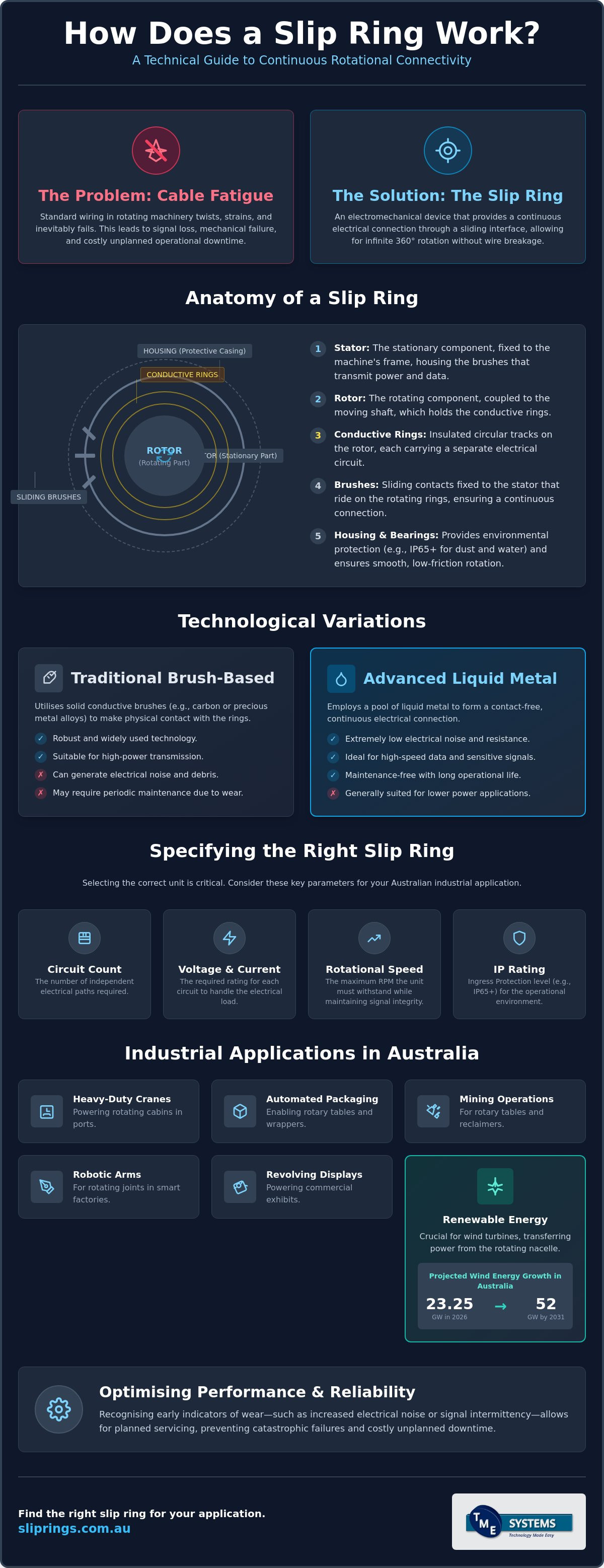
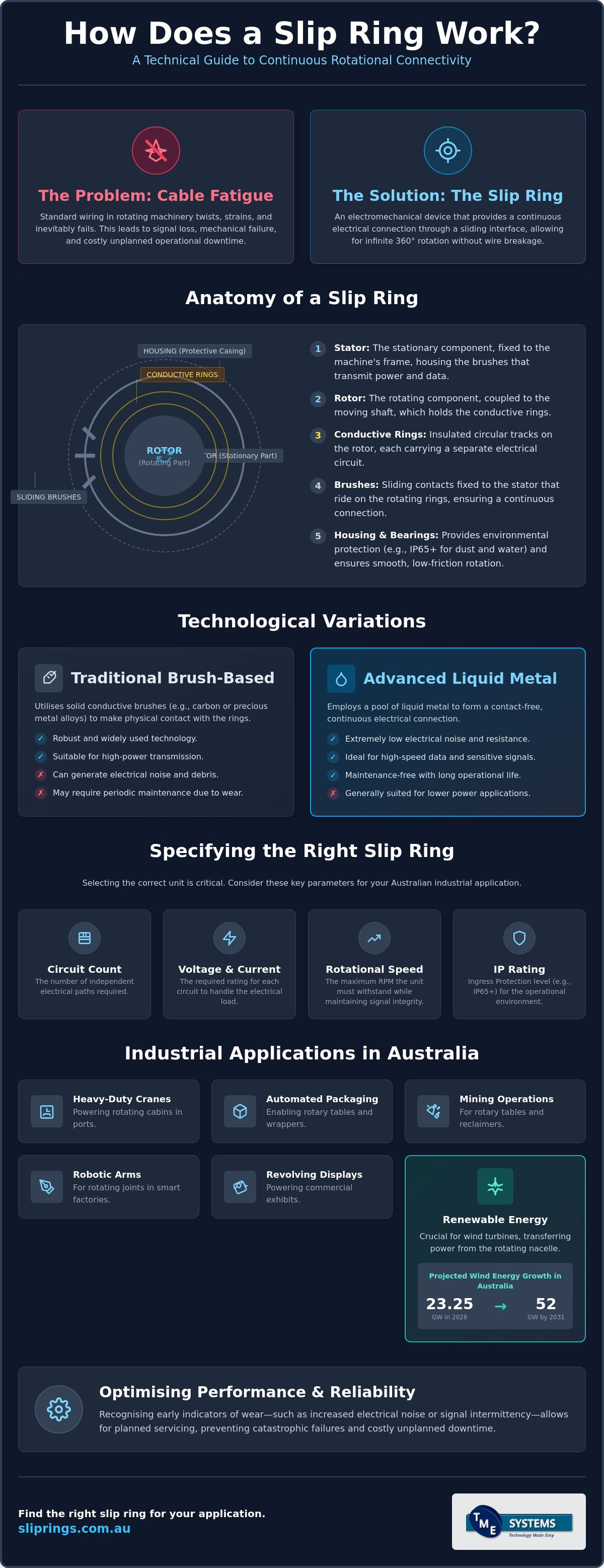
A slip ring is a specialised electromechanical device designed to facilitate the transmission of power and electrical signals from a stationary structure to a rotating one. You can think of it as a sophisticated electrical swivel. Without this component, any machine requiring 360-degree rotation would be physically restricted by its own wiring. To understand How a Slip Ring Works, you must first consider the mechanical limitations of traditional cabling. If you attempt to hard-wire a rotating assembly, the leads will eventually twist, strain, and snap. This "tangled wire" problem is a primary cause of mechanical failure and costly operational downtime in industrial settings.
By providing a continuous electrical connection through a sliding interface, slip rings allow for infinite rotation without the risk of conductor breakage. This basic mechanical principle is what enables complex machinery to function reliably over long periods. It's the difference between a machine that needs to "unwind" every few rotations and one that can operate at high speeds indefinitely. Understanding how does a slip ring work involves looking at how it maintains this connection while the physical parts are in motion.
Solving the Cable Fatigue Problem
Constant rotation places immense physical stress on copper conductors and their protective insulation. While cable tracks or drag chains provide a partial solution for limited movement, they cannot support infinite rotation. Slip rings eliminate this fatigue by providing a sliding contact interface. This ensures an uninterrupted flow of electricity and data, regardless of how many revolutions the component completes. It's a critical distinction for high-duty cycle machinery where reliability is non-negotiable. By removing the physical tether of a cable, you eliminate the single most common point of failure in rotating systems.
Broad Industrial Applications in Australia
In the Australian industrial landscape, these connectors are ubiquitous. You'll find them in heavy-duty cranes at major ports, automated packaging lines in manufacturing hubs, and massive rotary tables used in mining operations. They are particularly vital in the renewable energy sector. With Australia's wind energy market forecasted to grow from an installed base of 23.25 gigawatts in 2026 to 52 gigawatts by 2031, the demand for reliable power transfer in turbine nacelles is increasing rapidly.
Beyond high-voltage power, slip rings are essential for transmitting sensitive sensor data and control signals from moving parts back to a stationary control centre. This capability allows for real-time monitoring and precise automation in environments where hard-wiring is physically impossible. Whether it's a robotic arm in a smart factory or a revolving display in a commercial setting, the slip ring provides the necessary bridge for both energy and information.
Anatomy of a Slip Ring: The Core Components and Their Roles
To grasp how does a slip ring work at a granular level, you have to look past the external casing. The device is an assembly of several critical parts: the stator, the rotor, conductive rings, and the sliding brushes. The housing encloses these elements, while high-grade bearings ensure the rotor spins with minimal friction. For Australian industries like mining or marine engineering, the housing also provides essential environmental sealing. These units are often rated to IP65 or higher to protect internal contacts from the pervasive dust of the Pilbara or corrosive salt spray on the coast. Without this ruggedised protection, the electrical interface would quickly degrade.
The Stator and Rotor Relationship
The stator is the stationary portion of the unit, typically fixed to the machine's frame or stationary mounting point. In contrast, the rotor is coupled to the rotating shaft. Precision alignment between these two is vital. If the centre of rotation is even slightly off, it creates uneven pressure on the internal contacts, leading to premature wear and electrical noise. The number of individual paths for power or data within this assembly is referred to as the circuit count. High-capacity units, such as BGB Innovation slip rings, can accommodate dozens of circuits in a single compact footprint, allowing for complex control signals alongside high-voltage power.
Contact Materials and Electrical Integrity
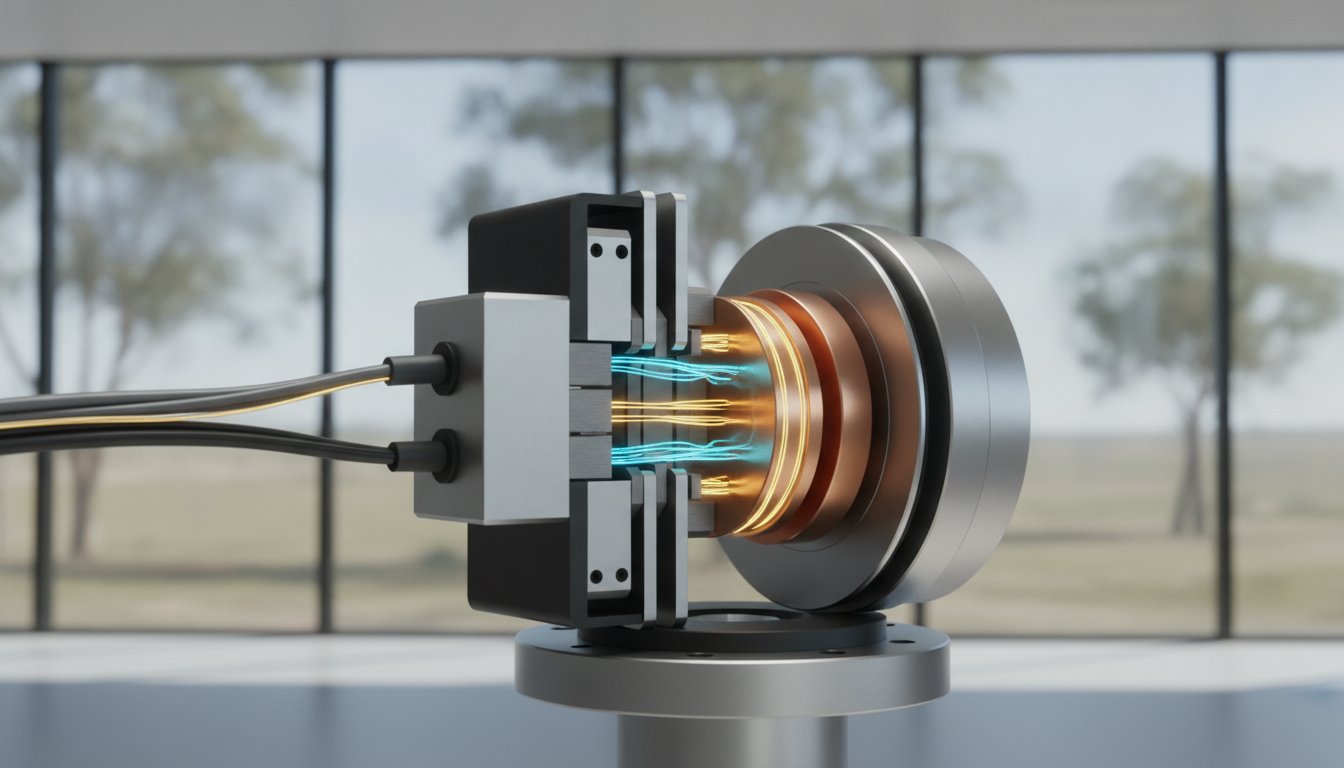
The electrical bridge is formed where the brushes meet the conductive rings. These rings are generally manufactured from copper, brass, or silver-plated alloys to ensure high conductivity. The brushes, often made of carbon graphite or precious metal wires, slide against the rings as they rotate. This constant friction maintains the circuit. However, it also introduces contact resistance, which is the electrical resistance at the interface of the two surfaces. High contact resistance leads to heat generation and signal degradation, which is why material selection is the most important factor in slip ring design.
While traditional brushes are common, some high-performance applications utilise liquid metal slip ring technology to eliminate mechanical wear entirely. In these designs, a conductive fluid replaces the solid brush, providing a nearly seamless electrical path with significantly lower noise. Regardless of the technology used, the goal remains the same: ensuring that electricity flows reliably while the mechanical parts move freely. If you are currently experiencing signal flickering or overheating in your rotary joints, it's often a sign that these internal contact materials have reached the end of their service life.
Technological Variations: Traditional Brushes vs. Liquid Metal Connectors
While the basic concept of a slip ring remains constant, the specific contact technology used dictates the performance limits of the device. Most industrial professionals are familiar with traditional brush-based systems, but these are not always the optimal choice for modern, data-intensive applications. Understanding the difference is central to answering the question of how does a slip ring work in a high-speed or sensitive environment. The choice between solid contacts and liquid interfaces will determine both the maintenance requirements and the reliability of your signals.
Traditional Brush Technology
Traditional connectors rely on mechanical friction. Carbon or silver brushes are held against the rotating ring by spring tension. As the ring turns, the brush "scrubs" the surface to maintain the circuit. This physical contact inevitably creates "brush dust" as the materials wear down over thousands of revolutions. If you don't manage this residue, it can accumulate inside the housing and cause short circuits or intermittent signal loss. High-duty cycle equipment requires a strict maintenance schedule to clean these assemblies and adjust brush tension to ensure constant electrical contact. While cost-effective for simple power transmission, these systems have inherent mechanical limits.
The Liquid Metal Advantage
For applications requiring superior signal integrity, Mercotac slip rings utilise a different approach. Instead of solid brushes, they use a pool of liquid metal to create a molecular bond between the stationary and rotating parts. This design eliminates the mechanical wear and friction associated with traditional scrubbing contacts. A major technical benefit of this approach is the near-zero slip ring contact resistance, which drastically reduces electrical noise. Because the contact is fluid rather than solid, it stays consistent even at extremely high RPMs.
This stability is why liquid metal is the preferred choice for sensitive data like Ethernet or PLC signals. In a traditional brush system, "contact bounce" can occur at high speeds, leading to signal flickering and data errors. Liquid metal connectors provide a seamless, low-resistance path that maintains high signal clarity. This makes them ideal for sophisticated automation where even a millisecond of interference can disrupt a production line. When considering how does a slip ring work for your specific project, you must weigh the simplicity of brushes against the precision of liquid metal technology. The latter is often the only viable solution for high-speed rotation where data integrity is non-negotiable.
Specifying the Right Slip Ring: Key Parameters for Australian Industry
Choosing the right hardware requires a thorough audit of your operational parameters. While understanding how does a slip ring work is the first step, applying that knowledge to a specific industrial application involves looking at electrical, mechanical, and environmental variables. In Australia, where equipment often operates in extreme heat or dusty conditions, these specifications are the difference between long-term reliability and frequent component failure. You must ensure that every parameter aligns with the physical and electrical demands of your system.
Electrical and Data Requirements
You must distinguish between power circuits, which carry high current, and signal circuits, which handle low current and high-frequency data. Mixing these two in a single rotary connector requires specialised internal shielding to prevent electromagnetic interference. Without proper isolation, the electrical noise from power lines can corrupt sensitive PLC or Ethernet signals. You also need to account for voltage drops. Even the most efficient sliding contacts introduce a small amount of resistance; this can impact the performance of low-voltage sensors if not properly specified during the design phase.
Mechanical and Environmental Fit
The physical configuration of the unit must match your machinery's architecture. For instance, through-bore slip rings are designed to slide directly onto a rotating shaft, providing a clear centre hole for hydraulic or pneumatic lines. In contrast, compact capsule designs are better suited for space-constrained applications like CCTV or small robotics. The choice of housing material often depends on the operating temperature and the presence of vibration, which can affect the stability of the internal contacts.
Environmental protection is equally critical. For sites in the mining or marine sectors, an IP65 or IP67 rating is essential to prevent the ingress of moisture and particulates. Dust in particular is a major cause of contact wear in Australian outback operations, where fine grit can act as an abrasive on conductive surfaces. You must also consider the operating RPM, as higher rotational speeds typically lead to faster contact wear and increased heat generation. If you need assistance selecting a model that meets these technical requirements, you can request a technical consultation for a detailed application review.
Optimising Performance: Maintenance and Reliability in Industrial Systems
The operational lifespan of a rotary connector depends heavily on its maintenance regime and the environment in which it operates. While understanding how does a slip ring work is essential for the initial setup, maintaining that performance requires a proactive approach to monitoring. You'll typically identify the first signs of wear through signal flickering, intermittent data loss, or unusual heat generation at the work centre. If these symptoms are ignored, the resulting electrical noise can lead to total system failure and expensive unplanned downtime.
For traditional brush-type assemblies, a regular maintenance checklist is vital. This includes the periodic removal of conductive carbon dust, which can accumulate and cause tracking or short circuits. You should also verify the spring tension on the brushes to ensure they maintain consistent contact with the rings without causing excessive friction. While some online forums suggest these components are "maintenance-free," industrial reality in Australia proves otherwise. Dust, humidity, and vibration will eventually degrade any sliding contact system that isn't properly serviced.
Troubleshooting Common Failures
Signal noise is the primary indicator of contact degradation. This interference is often caused by a build-up of oxidation or environmental contaminants like oil and fine grit. In many Australian industrial sites, the presence of airborne particulates accelerates this wear significantly. Selecting the correct IP rating for your specific environment is a critical first step, but it doesn't eliminate the need for inspection. Addressing these issues early prevents the contact bounce that disrupts sensitive PLC communications. If you ignore the signs of increased contact resistance, you risk permanent damage to the conductive rings.
Selecting a Reliable Partner
To avoid the costs of under-speccing your hardware, you should treat the selection process as a technical audit. Investing in high-performance hardware like Meridian Laboratory slip rings can provide a "fit and forget" solution for many applications, offering significantly longer service intervals than standard components. These high-end units are engineered to maintain electrical integrity in conditions that would quickly destroy lesser hardware.
TME Systems Pty Ltd operates as a dedicated technical partner for Australian industry, providing access to world-class brands including BGB Innovation and Prosper Rotation. Our role is to bridge the gap between complex manufacturing specs and your specific operational needs. Understanding how does a slip ring work is only the beginning; ensuring it survives the rigours of your specific application is where technical consulting becomes invaluable. You can consult with TME Systems Pty Ltd to review your current rotary interface and ensure your next installation is fit for purpose and built for long-term reliability.
Securing Long-Term Reliability for Your Rotating Assets
Selecting the correct rotary connector is a balance between understanding electrical requirements and acknowledging environmental constraints. The choice between traditional brush contacts and advanced liquid metal interfaces dictates your system's maintenance cycle and signal integrity. Understanding how does a slip ring work is the foundation for selecting hardware that survives the rigours of Australian industrial operations, from the dust of mining sites to the precision of automated assembly lines.
TME Systems Pty Ltd serves as an authorised Australian distributor for world-class brands like Mercotac and BGB Innovation. With decades of experience in the local industrial sector, we provide specialised technical support for complex engineering requirements. We help you move beyond generic components to find a solution that offers stability and performance. Get Expert Technical Advice on Your Slip Ring Selection to ensure your machinery operates with maximum efficiency and minimal downtime. We look forward to assisting you in optimising your rotary equipment for years of dependable service.
Frequently Asked Questions
What is the main purpose of a slip ring?
The primary purpose of a slip ring is to enable the transmission of power and electrical signals from a stationary source to a rotating component. By facilitating 360-degree rotation, it prevents the mechanical failure and downtime associated with twisted cables. This technology is essential for any application where a moving part requires a constant energy supply or data link without physical restriction.
Can a slip ring transfer both power and data at the same time?
Yes, modern slip rings can transmit both power and data simultaneously through multiple independent circuits. To achieve this, the internal design must include specialised shielding to prevent electromagnetic interference from the high-current power lines from corrupting sensitive data signals. This configuration is standard in automated systems where a single rotary joint manages both motor power and sensor feedback.
How long does an industrial slip ring typically last?
The service life of an industrial slip ring depends on its contact technology, rotational speed, and operating environment. Traditional brush-based systems may require servicing every few million revolutions, whereas high-end liquid metal units can often exceed hundreds of millions of revolutions with minimal degradation. Identifying exactly how does a slip ring work within your specific RPM limits is the best way to estimate its total lifecycle.
What is the difference between a slip ring and a commutator?
A slip ring provides a continuous electrical connection throughout a full rotation, whereas a commutator is designed to reverse the direction of current in DC motors. While both are rotary connectors, slip rings are used for a steady flow of power or signals. Commutators are specifically segmented to act as a mechanical switch, ensuring the motor's rotor continues to turn in a single direction.
Do slip rings require regular maintenance?
Traditional brush-type slip rings require regular maintenance to ensure long-term reliability. This process involves cleaning conductive dust from the housing and checking spring tension to maintain proper contact pressure. Neglecting these tasks can lead to increased contact resistance and overheating. In contrast, certain liquid metal technologies offer a "fit and forget" alternative that eliminates the need for manual cleaning or brush replacements.
How do I choose between a through-bore and a capsule slip ring?
Your choice depends on the mounting requirements of your machinery. A through-bore slip ring features a hollow centre, allowing it to slide over a rotating shaft or accommodate hydraulic lines. A capsule slip ring is a fully enclosed, compact unit designed for applications with limited space, such as CCTV cameras or small robotic joints. You should select the style that best fits your mechanical footprint.
Why is signal noise a problem in rotary connectors?
Signal noise is a concern because the sliding friction between a brush and a ring creates electrical interference. This noise can disrupt sensitive data transmissions, leading to errors in PLC signals or Ethernet communication. Understanding how does a slip ring work in relation to contact resistance is vital for high-speed applications. Reducing this noise often requires selecting precious metal contacts or liquid metal interfaces.
Are there mercury-free alternatives for liquid metal slip rings?
Yes, many modern liquid metal slip rings utilise gallium-based alloys instead of mercury. These alloys provide the same benefits of low electrical resistance and high signal clarity without the toxic risks associated with mercury. These alternatives are increasingly preferred in the Australian food processing and medical industries where environmental safety and contamination control are primary considerations for any rotating hardware.