With gold-based contacts projected to command nearly 40% of the global market by 2026, the industrial focus has shifted decisively from simple power transmission to high-fidelity data integrity. You likely understand that in high-speed rotating equipment, even a minor increase in electrical resistance can lead to catastrophic data packet loss or distorted PLC communication. It's a frustrating reality when harsh Australian environmental conditions accelerate brush wear and debris accumulation, leading to frequent maintenance cycles and costly downtime. Implementing low-noise slip rings is no longer just an optional upgrade; it's a fundamental requirement for any facility that must optimise its automated throughput.
We agree that your rotating systems should operate without constant intervention or signal degradation. This guide shows you how to eliminate signal interference and maintain data integrity through advanced technology designed for extreme longevity. You will learn how to achieve maintenance-free operation for several years while securing crisp signal-to-noise ratios for your Ethernet and sensitive sensor arrays. We also preview how to match specific contact physics to your frequency demands, ensuring you receive reliable technical support within the Australian timezone to reduce procurement risk and guarantee system compatibility.
Key Takeaways
- Understand how minimising Voltage Contact Resistance (VCR) is essential for maintaining signal integrity in modern industrial protocols like EtherCAT and Profinet.
- Identify the primary drivers of signal distortion, specifically contact resistance variation and electromagnetic interference from adjacent power circuits.
- Evaluate the performance benefits of advanced low-noise slip rings, such as liquid metal and brushless technologies, to achieve near-zero electrical resistance.
- Master the specification process by determining critical parameters, including signal bandwidth and maximum allowable noise thresholds for your specific application.
- Learn how a consultative technical audit can reduce procurement risk and ensure your rotating components are engineered for long-term reliability in Australian conditions.
Defining Low-Noise Slip Rings and Their Industrial Significance
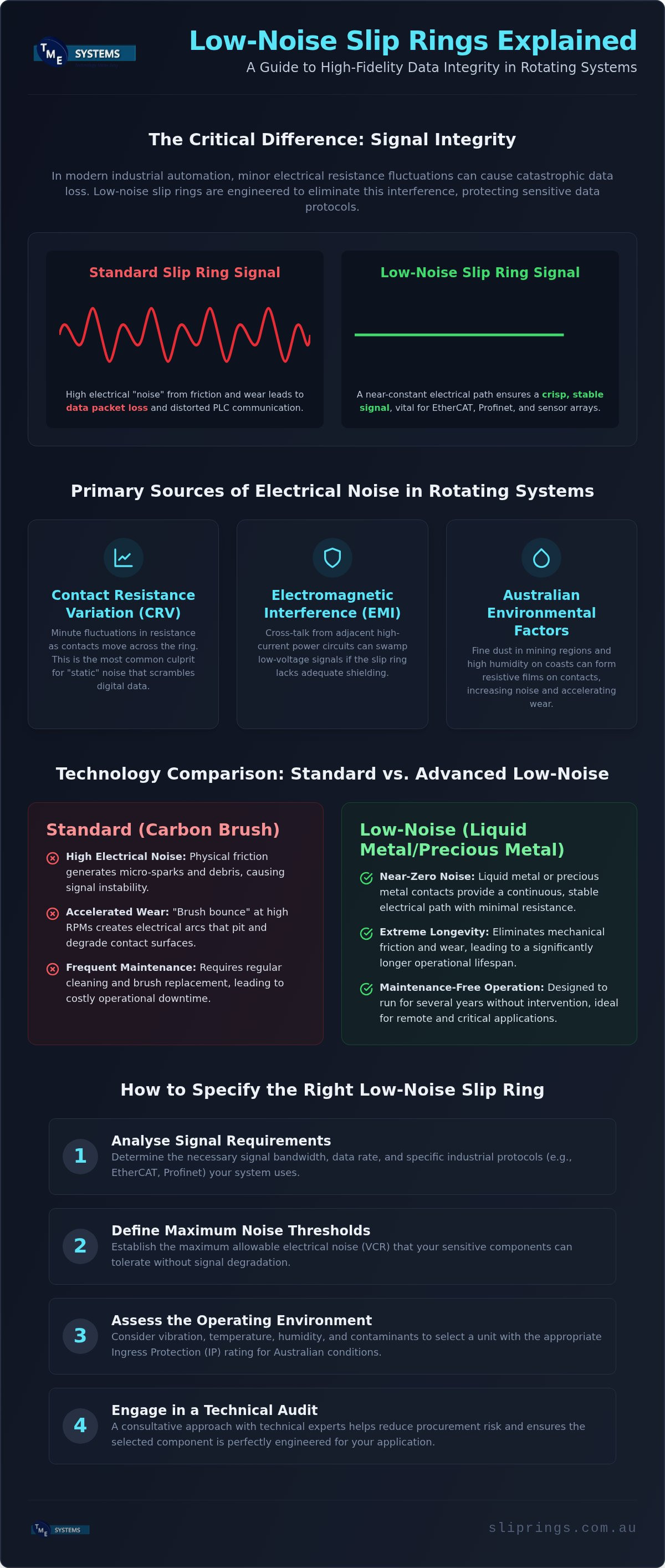
A slip ring is a specialised electromechanical device that enables the transmission of power and electrical signals from a stationary structure to a rotating one. In high-precision engineering, we define low-noise slip rings as rotary connectors specifically designed to minimise Voltage Contact Resistance (VCR). While a standard connector might handle basic power transfer, it often introduces electrical "noise" or fluctuations in resistance as the unit turns. For Australian industrial operators, this noise is the primary threat to the signal-to-noise ratio (SNR), a metric that is critical for modern protocols such as EtherCAT and Profinet.
Standard carbon brush rings rely on physical friction that inevitably generates micro-sparks and conductive debris. High-performance alternatives, such as those provided by Mercotac or Meridian Laboratory, utilise precious metal contacts or liquid metal interfaces to maintain a near-constant electrical path. This level of signal integrity is non-negotiable in sectors like advanced robotics, where positioning data must be millimetre-perfect, or subsea exploration, where sensor telemetry must travel through kilometres of cabling without degradation.
The Impact of Electrical Noise on Data Integrity
High electrical noise manifests in PLC systems as intermittent packet loss and communication timeouts. It's vital to distinguish between power circuit noise, which involves high-voltage spikes, and sensitive signal interference that masks low-voltage data. If the noise floor rises too high, the system cannot distinguish between a valid "1" and a "0" in a digital bitstream. Low-noise rings protect high-frequency data streams by maintaining a stable, low-resistance interface that prevents the introduction of parasitic signals.
Maintenance and Longevity Benefits
Beyond signal clarity, low-noise designs typically correlate with significantly reduced mechanical wear. Traditional brushes suffer from "brush bounce" at high RPMs, which creates physical gaps and electrical arcs that pit the contact surfaces. By eliminating these mechanical instabilities, premium solutions offer a clear cost-benefit advantage. This is especially valuable for remote Australian industrial sites, such as mining operations or offshore platforms, where the cost of a technician's site visit often exceeds the price of the component itself. Maintenance-free operation for several years ensures that data integrity remains consistent without the need for frequent cleaning or brush replacement.
Primary Sources of Electrical Noise in Rotating Systems
Identifying the root cause of signal degradation requires a forensic look at both the electrical interface and the mechanical environment. Contact Resistance Variation (CRV) is the most frequent culprit behind "static" noise. It refers to the minute fluctuations in resistance that occur as the contact point moves across the conductive ring. In high-precision low-noise slip rings, this variation is kept to a minimum, but in standard units, it can create significant voltage drops that scramble digital data.
Electromagnetic interference (EMI) is another major hurdle. In many Australian industrial setups, power and data lines are bundled together in tight enclosures. EMI from adjacent high-current power circuits causes cross-talk, which can swamp low-voltage signals if the slip ring lacks adequate shielding. Mechanical instability, such as shaft run-out or high-frequency vibration, further compounds this by causing inconsistent contact pressure. If you are struggling with intermittent signal loss, our technical application consulting can help identify whether the issue is electrical or mechanical in origin.
Australia’s unique environmental conditions also play a significant role. Fine silica dust in mining regions and high humidity in coastal areas can lead to the formation of a resistive film on contact surfaces. These contaminants increase electrical noise and accelerate physical wear. Choosing a connector with the appropriate Ingress Protection (IP) rating is essential to prevent these external variables from compromising your data integrity.
Rotational Speed (RPM) and Noise Correlation
At high rotational speeds, centrifugal forces can affect the contact pressure of traditional brushes. If the pressure is too low, the brush may "bounce," creating micro-arcs and massive noise spikes. Conversely, high pressure leads to excessive frictional heat, which alters the conductivity of the metal surfaces. High-speed applications typically require specialised architectures like the brushless ROTOCON series, which uses a liquid metal interface to maintain a perfectly stable connection regardless of RPM.
Material Science: Contact Surfaces and Plating
The choice of contact material defines the baseline noise floor of the system. Gold-on-gold interfaces are the industry standard for low-level signals due to their excellent conductivity and resistance to oxidation. While silver-on-silver is effective for higher currents, it is more prone to "tarnish" layers that increase resistance over time. Research into long duration space applications has demonstrated that material stability is the primary factor in maintaining low-noise performance over millions of revolutions. In harsh Australian environments, using liquid metal contacts can eliminate the need for lubricants, which often attract dust and eventually foul the assembly.
Comparison of Low-Noise Contact Technologies
Selecting the correct architecture for low-noise slip rings requires a technical evaluation of how the contact interface behaves under rotational load. Liquid metal connectors, such as those from Mercotac, represent the pinnacle of signal clarity. By replacing physical brushes with a liquid conductive path, these units eliminate the friction and micro-arcing that cause electrical "static". This results in near-zero Voltage Contact Resistance (VCR), making them the preferred choice for sensitive instrumentation where data integrity is the primary concern.
For applications involving high-current loads or extreme rotational speeds, Meridian Laboratory’s ROTOCON brushless technology provides a heavy-duty alternative. While liquid metal is ideal for compact signal paths, the ROTOCON design is engineered for high-bandwidth data transfer in demanding industrial environments. When your project requires a high circuit count or modular versatility, Prosper Rotation’s precious metal fibre brush designs offer an adaptable solution. Although the primary focus here is electrical interference, OSHA's guide to occupational noise highlights the broader industrial imperative to control all forms of environmental interference to maintain a safe and efficient workplace. Matching the right contact physics to your specific noise threshold (measured in milliohms) is the most effective way to reduce procurement risk.
Liquid Metal vs. Brushless ROTOCON
Mercotac units are highly regarded for their compact nature and are easily integrated into smaller assemblies like encoders or medical devices. However, the ROTOCON series is often better suited for larger-scale Australian industrial machinery that demands higher current capacity alongside signal transfer. Both technologies excel in environmental resilience, offering high IP ratings that protect the conductive interface from contaminants. Choosing between them usually comes down to a choice between the Mercotac’s small footprint and the ROTOCON’s superior capacity for high-speed, high-power throughput.
Conventional Precious Metal Fibre Brushes
Precious metal fibre brushes are often "quiet enough" for standard automation tasks where the noise threshold is around 10 milliohms. These designs utilise multi-point contact, where dozens of individual metal filaments touch the ring simultaneously. This redundancy significantly reduces resistive noise and ensures a stable connection even under vibration. Prosper Rotation specialises in these modular multi-circuit options, allowing you to combine power and data channels in a single, cost-effective assembly that doesn't require the extreme precision of liquid metal interfaces.
How to Specify Low-Noise Slip Rings for High-Data Applications
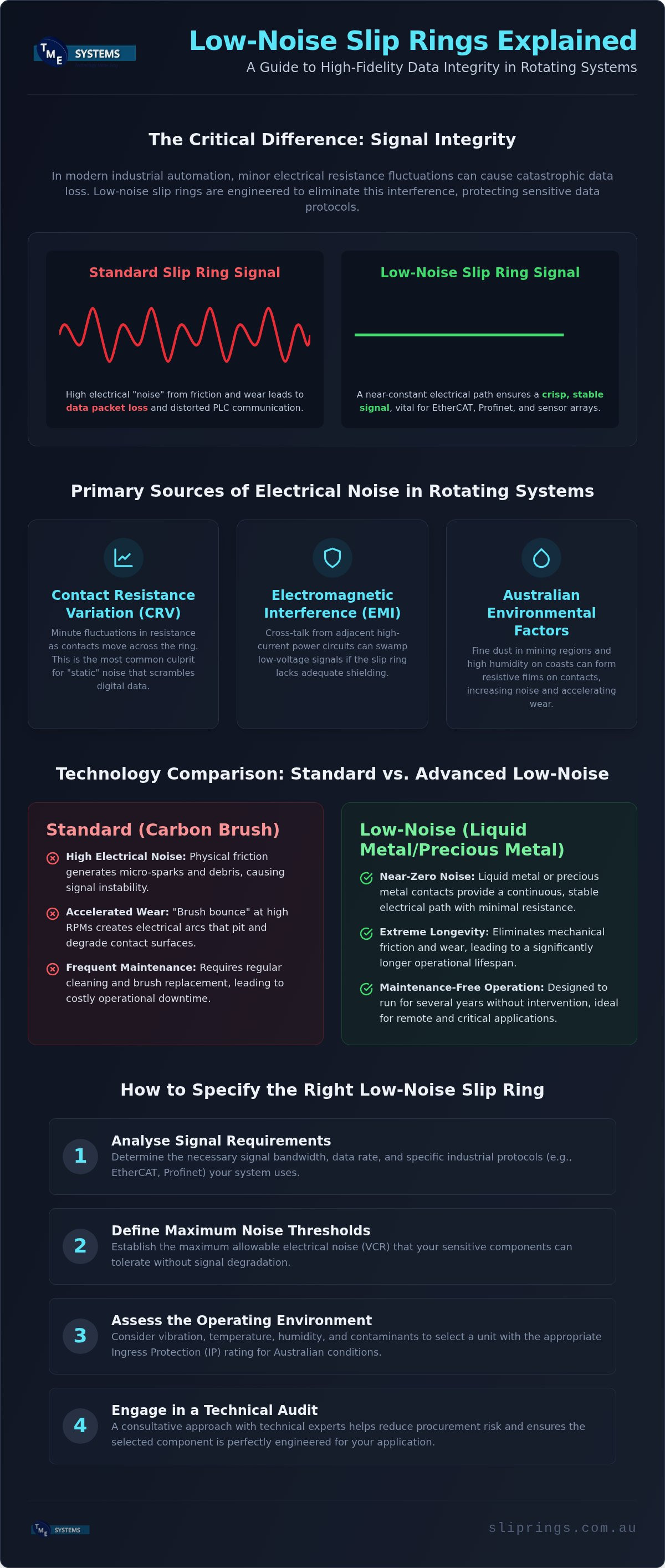
Specifying low-noise slip rings requires a methodical audit of your system's electrical and mechanical parameters to ensure long-term reliability. The first step involves identifying the exact frequency and bandwidth of the signal being transferred. For instance, a system running 1000Base-T Ethernet requires a connector that can handle high-speed data without introducing jitter or signal reflections. You must also determine the allowable noise threshold for your specific application; for many sensitive sensor arrays, this threshold is measured in single-digit milliohms to prevent data corruption.
Mechanical mounting constraints often dictate the final form factor. You will need to decide between a through-bore design, which allows for central shaft passage or the routing of pneumatic lines, and an end-of-shaft mounting style. Assessing environmental sealing is equally critical for Australian industrial sites. While an IP65 rating may suffice for indoor factory automation, an IP67 or higher rating is usually necessary for equipment exposed to heavy wash-downs, fine silica dust, or outdoor weather conditions. Consulting with a technical specialist early in the design phase allows you to match these parameters to the most suitable manufacturer, reducing procurement risk and ensuring system compatibility.
Specifying for Ethernet and Fieldbus Protocols
High-speed data protocols such as Profinet, EtherCAT, and standard Ethernet require rigorous shielding to prevent external electromagnetic interference from corrupting the bitstream. Impedance matching is just as vital as low resistance. An impedance mismatch at the rotary interface can cause signal reflections, which manifest as packet loss or communication timeouts in PLC systems. For a deeper technical reference on integrating these components into your infrastructure, refer to our guide on Slip Ring Application Engineering.
Environmental Protection in Australian Industry
Managing heat dissipation is a critical factor in high-ambient-temperature environments common across the Australian interior. When ambient temperatures exceed 40 degrees Celsius, the internal thermal dynamics of a slip ring change, which can impact the conductivity of contact materials. Selecting housing materials like 316 stainless steel is essential for corrosive sites, such as coastal processing facilities or offshore platforms. For heavy-duty sealing in the mining and wind power sectors, BGB Innovation provides robust assemblies designed to withstand these extreme conditions. To ensure your selection is fit for purpose, request a technical consultation to optimise your rotary system's data integrity.
Custom Low-Noise Solutions from TME Systems
TME Systems serves as a specialised value-added distributor, bridging the gap between sophisticated global manufacturing and the specific demands of Australian industry. By representing leading brands including Mercotac, Meridian Laboratory, BGB Innovation, and Prosper Rotation, we provide a centralised point of access for high-performance low-noise slip rings. Our approach is rooted in technical consulting rather than simple component sales. We understand that selecting the right rotary connector requires a deep dive into the electrical and environmental variables unique to your application. This consultative process begins with a thorough technical audit and continues through to component procurement, ensuring the final solution is engineered for long-term stability.
Having a single Australian point of contact for multiple global brands simplifies the procurement cycle for engineers and procurement officers alike. Instead of managing several international vendors, you can rely on a partner who understands the nuances of each manufacturer's technology. We encourage you to provide your specific data points, such as circuit count, peak RPM, and signal frequency, so we can facilitate a tailored recommendation. This methodical approach ensures that the "correct answer" is matched to your specific noise requirement, reducing the risk of signal degradation or mechanical failure once the system is in the field.
Technical Selection Assistance
Navigating the trade-offs between rotational speed, current capacity, and electrical noise is a complex task. We operate on a "no one-size-fits-all" philosophy for rotary connectors because every application presents a unique set of challenges. A solution that works for a slow-moving cable reel might fail in a high-speed sensor array. We help you evaluate these parameters to find the most efficient pathway to a solution. For those requiring the highest levels of precision and brushless performance for sensitive data streams, we often recommend Meridian Laboratory slip rings. Our team assists in navigating these technical trade-offs to ensure your system maintains its integrity over millions of revolutions.
Local Procurement and Support
Working with an Australian supplier offers significant advantages for project timelines and risk management. You gain access to a national supply chain and a technical partner who operates within your timezone, which is invaluable during the commissioning and troubleshooting phases. We take pride in the technical success of our clients' projects and remain committed to excellence from the initial consultation to final implementation. If you're ready to eliminate signal interference and maintain data integrity in your rotating systems, contact TME Systems for a technical consultation to discuss your specific requirements.
Optimising Signal Integrity for Future-Ready Rotating Systems
Maintaining signal integrity in rotating systems requires a precise alignment of contact physics and environmental resilience. We've explored how identifying the root causes of electrical noise, such as Contact Resistance Variation, is the first step toward system stability. Whether your application demands the near-zero noise of liquid metal or the modular versatility of precious metal fibre brushes, the "correct answer" depends on matching your specific milliohm threshold to the right technology. Addressing these variables early in the design phase prevents costly data packet loss and premature mechanical wear.
As an authorised distributor for Mercotac and Meridian Laboratory, TME Systems provides the technical expertise needed to navigate these complex trade-offs. Our team specialises in signal integrity for Ethernet and sensitive data protocols, offering Australian-based support to help you specify and implement low-noise slip rings that withstand harsh local conditions. We invite you to Request a Technical Consultation for Your Low-Noise Application to ensure your next project achieves long-term, maintenance-free operation. We look forward to helping you solve your most complex rotary engineering challenges and ensuring your systems operate with absolute precision.
Frequently Asked Questions
What is the maximum allowable noise for an Ethernet slip ring?
The maximum allowable noise for an Ethernet slip ring typically sits below 10 milliohms of Contact Resistance Variation (CRV). Modern industrial protocols like EtherCAT and Profinet are highly sensitive to electrical "static". If noise levels exceed this threshold, the system may experience jitter, signal reflections, or catastrophic data packet loss. High-speed 1000Base-T Ethernet applications require the lowest possible noise floor to ensure consistent communication across the rotating interface.
Can I use a low-noise slip ring for both power and signal?
You can certainly use a single assembly for both power and signal circuits, provided the unit is engineered with proper isolation. High-current power lines generate electromagnetic interference (EMI) that can easily swamp low-voltage data bitstreams. To prevent this "cross-talk", we recommend hybrid designs from manufacturers like Prosper Rotation or BGB Innovation. These units utilise internal shielding and specific circuit spacing to maintain high signal-to-noise ratios while simultaneously delivering electrical power.
How does liquid metal technology reduce electrical noise?
Liquid metal technology reduces noise by replacing traditional solid brushes with a liquid conductive interface. In a standard slip ring, physical friction between the brush and ring creates micro-sparks and debris that fluctuate in resistance. Liquid metal provides a perfectly continuous conductive path that remains stable even at high rotational speeds. This eliminates the mechanical "bounce" associated with traditional contacts, resulting in a near-zero noise floor that is ideal for sensitive telemetry.
What is the typical lifespan of a low-noise slip ring?
The lifespan of low-noise slip rings varies based on rotational speed, duty cycle, and environmental factors. Brushless models using liquid metal or wetted film contacts frequently achieve hundreds of millions of revolutions without degradation. Many industrial users report maintenance-free operation for several years in standard conditions. In contrast, fibre brush models have a finite wear life but offer multi-circuit versatility. We provide technical assistance to help you calculate the expected service life for your specific application.
Do low-noise slip rings require periodic maintenance?
Maintenance requirements depend entirely on the contact technology selected. Brushless designs, such as those from Mercotac or Meridian Laboratory, are effectively maintenance-free because they lack wearing parts that generate conductive dust. However, traditional precious metal fibre brush designs may require periodic cleaning to remove accumulated debris that can increase electrical noise over time. Choosing a high-IP-rated enclosure also helps minimise the need for intervention by preventing environmental contaminants from entering the assembly.
How do I measure the noise levels in my current slip ring assembly?
Measuring noise levels involves monitoring the Contact Resistance Variation (CRV) while the slip ring is in motion. This is typically achieved by passing a small, constant DC current through the ring and using an oscilloscope to observe the voltage fluctuations. Any "spikes" or deviations on the waveform represent electrical noise in milliohms. Regular monitoring helps identify when a unit is approaching the end of its service life or if environmental contamination is impacting performance.
Are there mercury-free low-noise slip ring options available?
Yes, there are numerous mercury-free options available that still deliver exceptional signal integrity. While some liquid metal designs use mercury for its high conductivity, many modern alternatives utilise precious metal fibre brushes or specialised brushless architectures to achieve low noise floors. Manufacturers like Meridian Laboratory and Prosper Rotation offer non-mercury solutions that are suitable for food processing, medical equipment, and other industries where hazardous materials are strictly prohibited.
What IP rating do I need for a low-noise ring in an outdoor Australian environment?
For outdoor Australian environments, we recommend a minimum of an IP65 rating to protect against fine silica dust. However, an IP67 rating is superior for sites exposed to heavy rain or high-pressure wash-downs. These ratings ensure that low-noise slip rings remain sealed against moisture and particulates that would otherwise increase resistance and cause signal distortion. Selecting the correct housing material, such as stainless steel, further enhances the unit's resilience in corrosive coastal or mining areas.