What if a connector suits the shaft but cannot handle the electrical load, speed or surrounding conditions? That mismatch can affect the whole rotating assembly. Choosing a Meridian Laboratory rotary connector supplier is about more than identifying a product. It means translating the application into clear selection requirements. TME Systems supplies Meridian Laboratory slip rings to industrial customers across Australia and provides technical assistance with selection.
Electrical, mechanical and environmental demands need to be considered together. Meridian Laboratory’s ROTOCON range includes brushless, liquid metal rotary connectors in categories such as high-current, high-speed, through-bore and harsh-environment configurations. The right category depends on how the connector will operate and fit into your machinery.
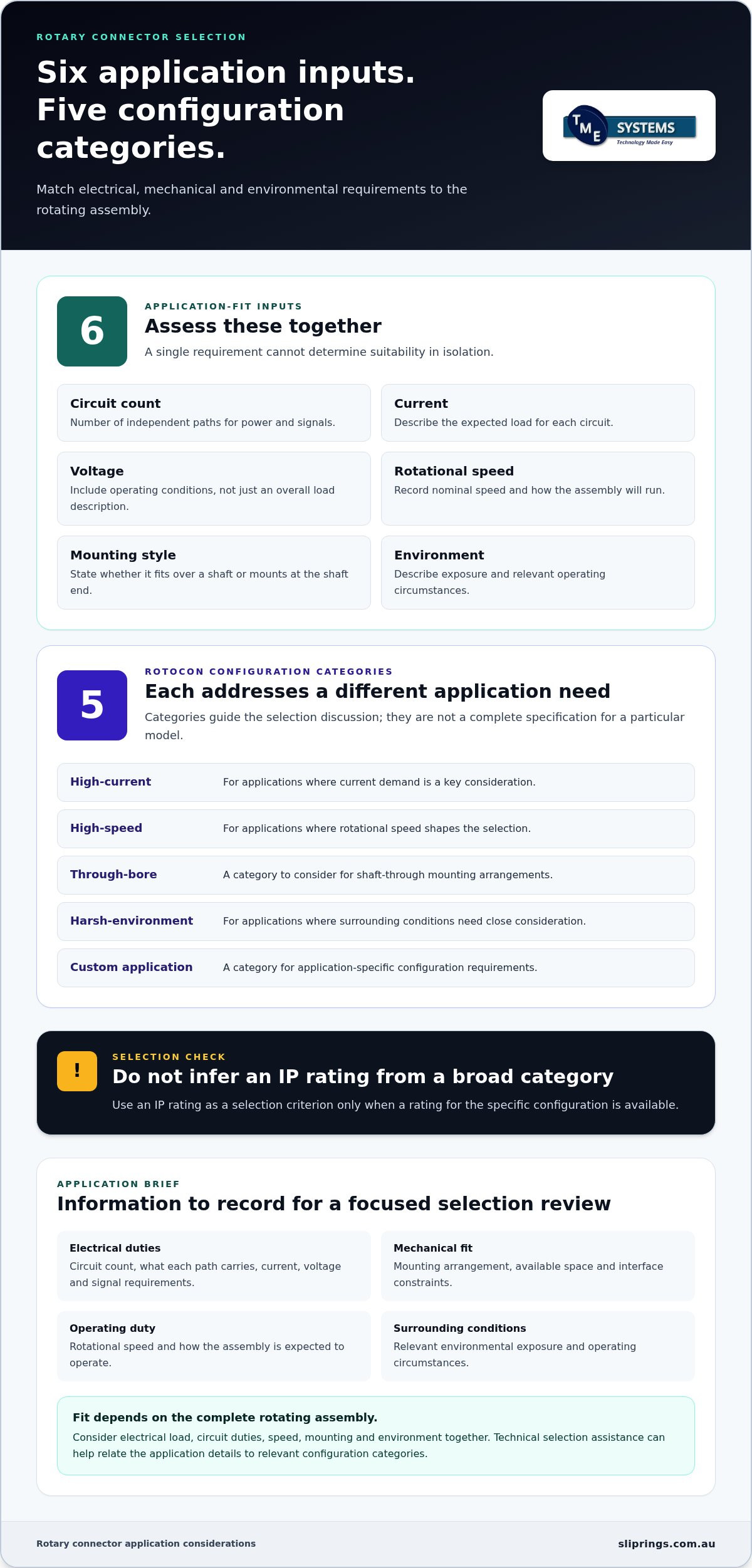
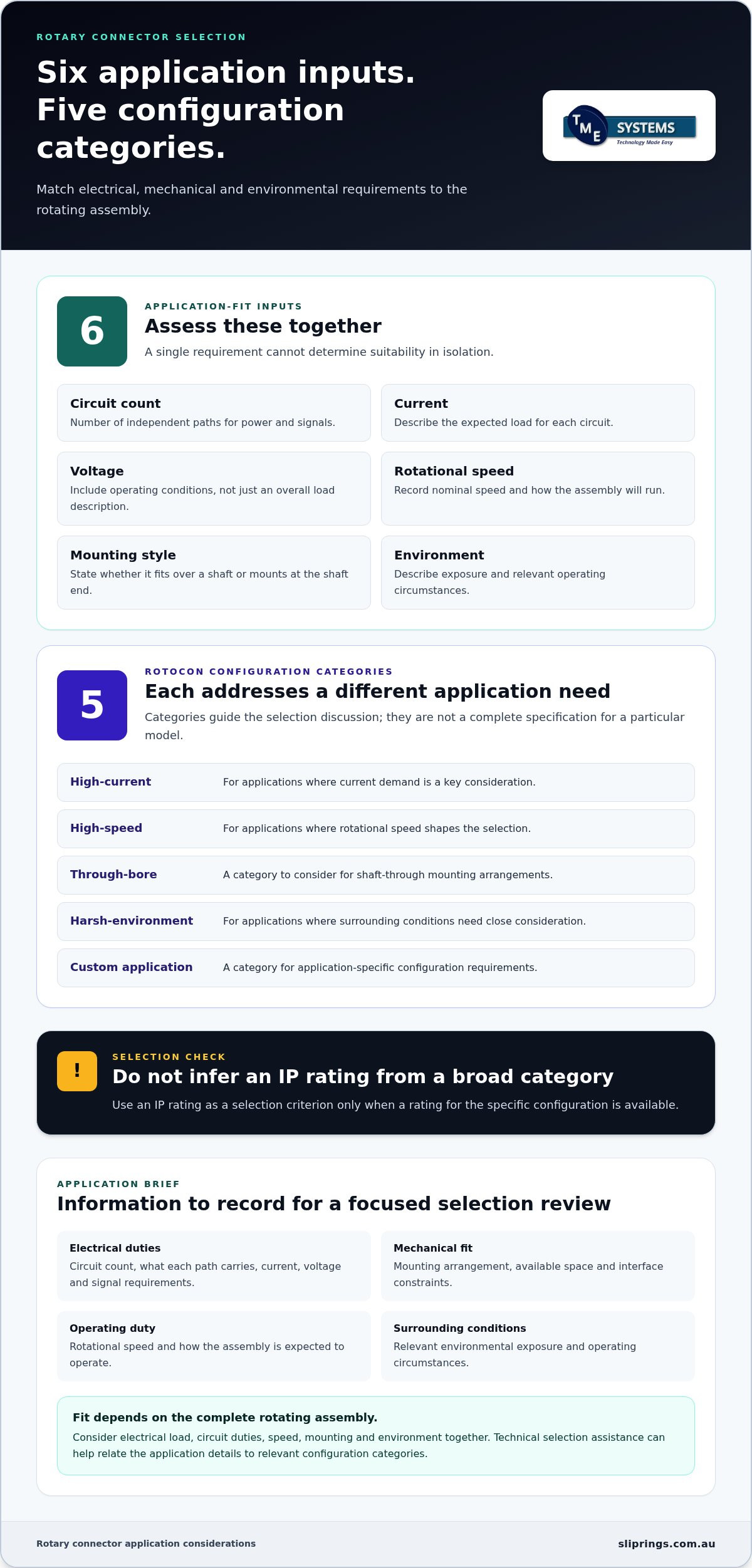
This guide outlines the requirements that shape suitability, including circuit count, current, voltage, rotational speed, mounting style and environment. It also explains relevant ROTOCON configuration categories and how to prepare a useful supply enquiry. A clear application brief gives TME Systems a practical starting point for discussing which configurations may fit your operating conditions.
Key Takeaways
- Assess electrical demands alongside the rotating assembly’s installation and operating environment to build a useful application brief.
- Compare ROTOCON configuration categories by the constraint they address, then identify the details needed to narrow the selection.
- Record operating duty and key application data before a selection review to make technical discussions more focused.
- A Meridian Laboratory rotary connector supplier can help connect application requirements with relevant product categories. TME Systems provides technical selection assistance across Australia.
- Use the preparation steps in this guide to turn project information into a clearer supply enquiry.
What to expect from a Meridian Laboratory rotary connector supplier in Australia
A rotary connector transfers power or signals between stationary and rotating parts while maintaining an electrical connection through rotation. It is one type of rotary electrical interface. A supplier helps relate an application’s requirements to relevant connector configurations and supports the supply process, rather than simply pointing to a product listing.
What does a rotary connector supplier help an engineering team resolve?
Selection involves connected electrical and mechanical requirements. Circuit count and electrical load describe what the connector must carry. Rotational speed and mounting style shape how it fits into the machinery. Considering these factors separately can leave gaps: a configuration that appears suitable electrically may not match the rotating assembly’s mounting arrangement or operating conditions.
Suitability depends on the complete assembly, not the connector in isolation. Available space, shaft arrangement, required electrical paths and operating environment all inform selection. For example, a through-bore installation has different mechanical considerations from an end-of-shaft arrangement. The connector’s intended operating duty also needs to be considered.
A Meridian Laboratory rotary connector supplier helps translate these requirements into a focused selection brief. TME Systems provides technical assistance with selection, using details such as circuit count, current, voltage, speed, mounting and environment to relate the application to relevant categories. This gives an engineering team a clearer basis for evaluating fit and preparing a supply enquiry.
Where Meridian Laboratory fits in the supplier decision
Meridian Laboratory manufactures the ROTOCON range of brushless rotary electrical connectors. Its product information describes the range and its configuration categories. The distributor’s role is to relate those categories to the customer’s application and support supply in Australia. Keeping these roles distinct helps make selection clearer: manufacturer information describes the product, while application details guide the discussion about fit.
ROTOCON categories include high-current, high-speed, through-bore, harsh-environment and custom application configurations. These categories indicate different operating or installation requirements, rather than providing a complete specification for any particular model. Suitability depends on the application requirements considered together.
TME Systems supplies Meridian Laboratory slip rings to Australian industrial customers and provides technical selection assistance. An engineering team can use that support to relate the rotating assembly’s needs to relevant ROTOCON categories, while keeping product information and application-fit assessment distinct.
Which Meridian Laboratory connector requirements shape application fit?
Start with a complete picture of the operating duty, rather than relying on one headline figure. A connector may need to carry power, control and signal paths while meeting particular speed, mounting and environmental requirements. Record each requirement separately, then consider how they interact within the rotating assembly.
Electrical requirements: circuit count, current, voltage and signals
Circuit count is the number of independent electrical paths available for power and signal transmission. Specify how many paths are needed and what each one carries. Separate power circuits from control and signal duties, and describe any data transmission requirements in practical terms.
Current and voltage describe the electrical load. Include the expected operating conditions for each circuit instead of relying on a single overall load description. For signals, note their function and any relevant transmission requirements. These details help frame selection, but they do not establish model suitability on their own. Current, voltage and data-rate limits must be assessed against documentation for the specific configuration. General information on the main components of a connector, including contacts and housing, can also help explain why construction and connection details matter when planning integration.
Mechanical and environmental requirements
Rotational speed, mounting arrangement and available installation space describe the mechanical demands. State whether the connector is intended to fit over a shaft or mount at its end. Include the space and interface constraints that could affect installation. Describe the operating duty as well as nominal speed so the selection discussion reflects how the assembly will run.
Describe the conditions around the connector. Environmental exposure and operating circumstances can influence configuration selection, so include relevant details in the application brief. Treat an IP rating as a selection criterion only when a rating for the specific configuration is available. Do not infer a protection level from a broad product category.
Connector fit depends on the combined application specification: electrical load, circuit duties, speed, mounting and environment must be considered together. A single requirement, such as circuit count or speed, cannot determine suitability in isolation. A Meridian Laboratory rotary connector supplier can use the complete set of inputs to support a focused technical selection review, without treating unverified figures as product ratings.
For a practical starting point, review the Meridian Laboratory slip rings information alongside your application requirements.
How do Meridian Laboratory ROTOCON configurations differ?
ROTOCON categories help narrow the options by form factor or operating demand. The table below links each category to the constraint it addresses and the information that helps frame selection. These are application categories, not guarantees that every configuration will suit every duty.
| Configuration category | Relevant installation or operating constraint | Information to prepare |
|---|---|---|
| Through-bore | A hollow centre can allow mounting over a rotating shaft or space for auxiliary components. | Shaft and mounting arrangement, available space, and any components that pass through the centre. |
| Capsule or compact | A compact, solid form can suit end-of-shaft mounting where the assembly has limited space. | Mounting position, installation envelope and connection requirements. |
| High-speed | For applications where operating speed is a key selection constraint. | Operating speed and duty, alongside electrical requirements. |
| High-current | For applications where the electrical load is the main consideration. | Current, voltage, circuit count and operating conditions. |
| Harsh-environment | For installations where surrounding conditions influence configuration choice. | Environmental exposure, mounting and electrical requirements. |
| Custom application | For requirements that need a configuration considered around the application. | Full operating and installation brief, including electrical, mechanical and environmental needs. |
Through-bore, capsule and compact configurations
A through-bore slip ring has a hollow centre for shaft integration or to accommodate auxiliary components. A capsule slip ring is a compact, solid unit intended for end-of-shaft mounting. The main distinction is how each form fits into the rotating assembly. Shaft layout, available space and mounting position help determine which form factor to assess. Dimensions and operating limits depend on the specific configuration.
High-speed, high-current and harsh-environment categories
These categories draw attention to the application demand that needs particular consideration. A high-speed option focuses selection on rotational speed. A high-current option focuses on electrical load, while a harsh-environment category draws attention to operating conditions. None is a blanket performance claim. Thermal management and environmental ratings need to be validated against the specific configuration and its operating conditions.
Specialist engineering contexts, including aerospace mission applications, illustrate how operating demands vary by system. That context does not establish connector suitability. Category comparisons help narrow the options, but selection still needs to account for the assembly’s electrical, mechanical and environmental requirements. A Meridian Laboratory rotary connector supplier can use the complete application brief to support that review.
What information should you prepare for a Meridian Laboratory selection review?
A structured brief turns machine requirements into a focused connector selection discussion. Separate confirmed design inputs from estimates or assumptions so unresolved points can be identified rather than treated as fixed specifications.
Build a concise application brief
Start with the machine’s function and describe what must pass across the rotating interface. Then gather the key operating and installation details:
- Operating duty: Describe how the assembly operates, including its expected cycle or use conditions.
- Circuit count: State the number of independent paths and identify their duties, such as power, control or signal.
- Current and voltage: Record the electrical requirements for the relevant circuits.
- Rotational speed: Provide the operating speed and any known variation during use.
- Mounting: Describe the shaft arrangement, mounting position and available installation space.
- Environment: Note the conditions around the connector that may affect configuration selection.
- Open items: Mark which values are confirmed and which still need engineering review.
A drawing or mounting description can help explain the mechanical arrangement when available. For more selection context, see slip ring application engineering.
Discuss your rotary connector application with TME Systems as you prepare a focused selection enquiry.
Use technical review to narrow the options
TME Systems uses the application parameters you provide to support Meridian Laboratory product selection. Reviewing electrical duties alongside speed, mounting and environmental conditions helps relate the brief to relevant ROTOCON categories. A final engineering review can also identify gaps, clarify assumptions and help resolve specification questions before procurement proceeds.
For a meaningful application-fit review, the brief should show how the connector will work within the complete rotating assembly. Separating known requirements from items that need review gives the selection discussion a sound technical basis.
How TME Systems supports Meridian Laboratory rotary connector supply
TME Systems supplies Meridian Laboratory slip rings to industrial customers across Australia and provides technical assistance with selection. The process connects the application brief with relevant ROTOCON configuration categories and supports a clear supply discussion. Product information describes the manufacturer’s range; application details help establish which categories are relevant to the rotating assembly.
From application data to a supply discussion
The process follows a practical sequence: share the operating requirements, review application fit, discuss relevant configurations and progress the supply enquiry. Circuit count, current, voltage, speed, mounting and environmental conditions give the selection discussion its technical basis. If details remain uncertain, identify them as open questions so confirmed design inputs are not confused with assumptions.
A technical review uses those parameters to relate the application to relevant Meridian Laboratory categories. For broader context on assessing suppliers and procurement requirements, read the industrial slip ring procurement guide. The focus here is matching the specific application to Meridian Laboratory products, rather than treating a category name as a complete specification.
AS/NZS 5368:2025 is titled Electrical equipment in mines and quarries and sets requirements for the design, installation and operation of electrical equipment in those settings. Its relevance depends on the project context. Mentioning the standard does not, by itself, establish that a particular connector or supply arrangement complies with it.
Next steps for Australian engineering and procurement teams
Before a selection discussion, assemble the circuit duties, electrical load, operating speed, mounting arrangement and environmental conditions. Include available installation information and mark any values that are estimates or still need engineering review. This gives TME Systems a structured starting point for technical assistance and a supply discussion with Australian engineering and procurement teams.
As a Meridian Laboratory rotary connector supplier, TME Systems supports Australian customers by connecting application requirements with relevant product categories. Share your application details to begin a focused technical discussion.
Discuss your Meridian Laboratory application
Move forward with a clear connector selection brief
Choosing a suitable ROTOCON configuration starts with the demands of the complete rotating assembly. Circuit count, current and voltage define key electrical requirements, while speed, mounting and environmental conditions shape mechanical fit. Considering these inputs together helps narrow the relevant categories and gives the selection review a sound technical basis.
TME Systems supplies Meridian Laboratory slip rings to industrial customers across Australia and provides technical selection assistance. As a Meridian Laboratory rotary connector supplier, TME Systems considers the application details you provide and helps relate them to relevant product categories. A concise brief, with confirmed values separated from assumptions, makes the next discussion more focused.
Have your application requirements ready? Discuss your Meridian Laboratory rotary connector application with TME Systems to start a focused selection discussion.
Frequently Asked Questions
What does a Meridian Laboratory rotary connector supplier do?
A Meridian Laboratory rotary connector supplier helps match an application’s requirements with relevant connector categories and supports product supply. For selection, TME Systems considers details such as circuit count, current, voltage, rotational speed, mounting arrangement and environmental conditions. These inputs frame a technical discussion, but a category name alone does not establish suitability. The connector needs to be assessed against the complete application specification and rotating assembly.
How do I select a Meridian Laboratory rotary connector?
Start by defining what needs to pass through the rotating interface, including power, control or signal circuits. Record circuit count, current, voltage, operating speed, mounting constraints and environmental conditions. Use these requirements to narrow the relevant configuration categories and identify any gaps for technical review. Do not select solely by a broad label such as high-speed or through-bore. The complete assembly and its operating conditions determine whether a configuration is suitable.
What is the difference between a through-bore and capsule slip ring?
A through-bore slip ring has a hollow centre and can fit over a rotating shaft or provide space for auxiliary components. A capsule slip ring is a compact, solid form intended for end-of-shaft mounting. The choice depends on the machine layout, available installation space and how the connector will integrate mechanically. Check dimensions and model-specific operating limits against current product documentation before finalising the design.
Can Meridian Laboratory ROTOCON slip rings support high-speed applications?
Yes, the ROTOCON range includes high-speed application categories. This does not mean every model has the same rotational speed rating or suits every duty. Assess the required speed alongside operating conditions, mounting and electrical requirements. Use current documentation for the specific configuration, supported by technical review, to evaluate suitability for the intended machine. A broad category is a starting point for selection, not a substitute for checking model-specific details.
What information should I provide when requesting rotary connector selection assistance?
Provide a description of the machine and what must cross the rotating interface. Include circuit count, current, voltage, rotational speed, mounting arrangement and environmental conditions. Identify whether circuits carry power, control signals or data. Drawings or interface details can help explain the installation when available. Separate confirmed design requirements from assumptions or open questions. This gives the technical discussion a clear basis and helps identify which configuration categories warrant further review.
Does TME Systems supply Meridian Laboratory slip rings in Australia?
Yes, TME Systems supplies Meridian Laboratory slip rings to industrial customers across Australia and provides technical assistance with selection. The discussion can consider circuit count, current, voltage, speed, mounting style and environmental requirements to relate application needs to relevant product categories. Share your application requirements to begin a focused technical discussion.