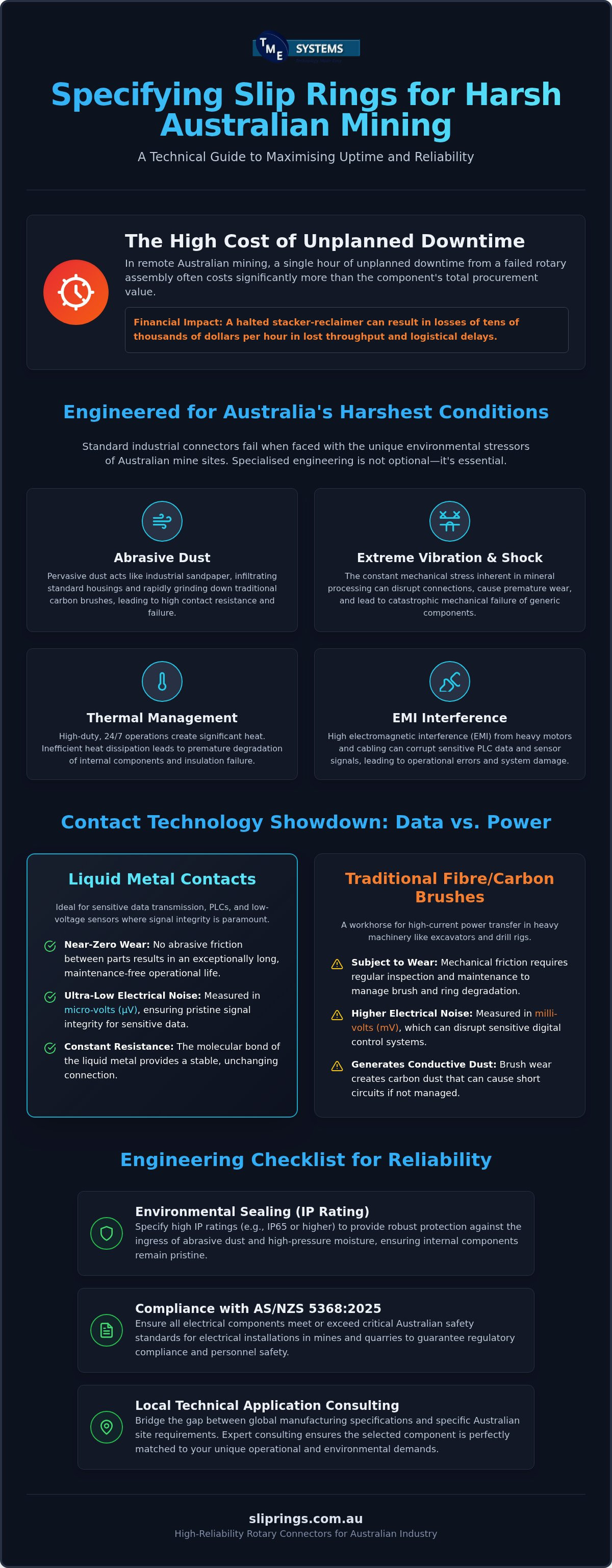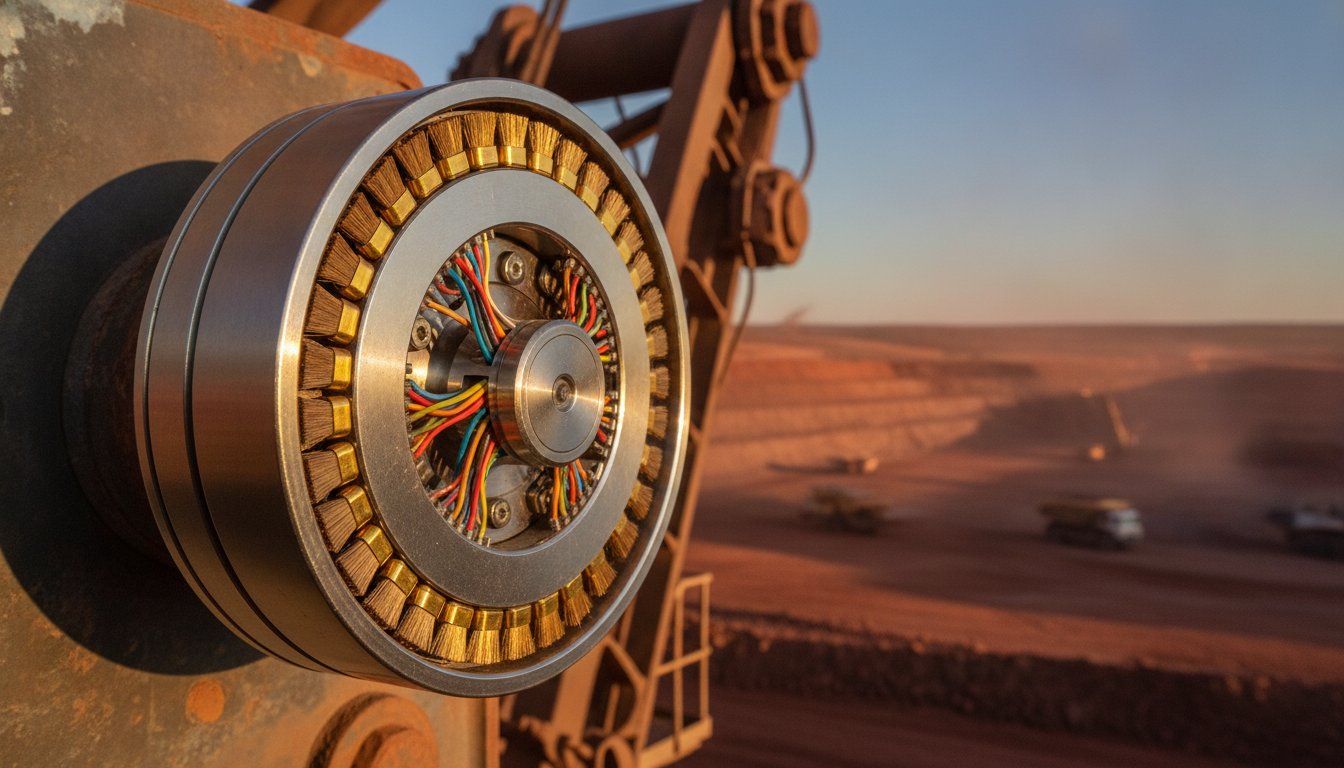
A single hour of unplanned downtime on a remote Australian mine site often costs significantly more than the total procurement value of the rotary assembly itself. When abrasive dust and extreme vibration are the daily reality, relying on generic specifications is a high-risk strategy that leads to premature brush wear and disrupted PLC signals. Selecting the right harsh environment slip rings Australia requires for these conditions isn't just about electrical capacity; it's about matching contact technology to the specific environmental stressors of the pit or processing plant.
You likely recognise that maintaining signal integrity across rotating interfaces is often the weakest link in your automated systems. This guide will help you master the technical parameters needed to specify high-reliability connectors that withstand Australia's unique conditions. We'll detail the requirements for AS/NZS 5368:2025 compliance, compare liquid metal versus fibre brush contacts for data stability, and outline the IP ratings necessary to achieve a low-maintenance or maintenance-free lifecycle in your most demanding applications.
Key Takeaways
- Understand how to select contact technologies, such as liquid metal or fibre brushes, to maintain signal integrity and eliminate electrical noise in sensitive PLC data.
- Learn how to specify harsh environment slip rings Australia requires by evaluating dynamic sealing and IP ratings that withstand abrasive dust and moisture.
- Ensure your equipment meets AS/NZS 5368:2025 standards and other critical mining safety regulations for electrical installations in mines and quarries.
- Identify mechanical and electrical constraints, including through-bore requirements and voltage peaks, to ensure a low-maintenance operational lifecycle.
- Discover the benefits of technical application consulting to bridge the gap between global manufacturing specifications and specific Australian site requirements.
The Critical Role of Slip Rings in Mining Operations
In the context of heavy-duty Australian mining, a slip ring isn't merely a commodity component; it's the primary electromechanical interface that allows for the continuous transfer of power and data between stationary and rotating structures. To understand the fundamentals, one might ask, What is a Slip Ring? Essentially, it's a rotary electrical joint that maintains a circuit connection while equipment revolves. In mining, where massive machinery like stacker-reclaimers and excavators must rotate 360 degrees without tangling cables, these devices are indispensable. However, standard industrial connectors frequently fail because they aren't engineered for the extreme vibration and physical shock inherent in mineral processing.
Specifying harsh environment slip rings Australia requires a focus on durability that exceeds factory-floor standards. For high-current applications or signal-sensitive data, selecting specialised hardware like Meridian Laboratory Slip Rings or Prosper Rotation Slip Rings provides the necessary resilience to keep operations moving.
Why Mining Environments Require Specialised Engineering
Abrasive dust, a pervasive challenge across Australia's mining operations, acts as an industrial sandpaper. It infiltrates standard housings and quickly grinds down traditional carbon brushes, leading to high contact resistance. High-duty cycle operations also create significant thermal management challenges. If a slip ring can't dissipate heat efficiently during 24/7 operation, the internal components degrade prematurely. Additionally, maintaining signal integrity is difficult because of the high electromagnetic interference (EMI) generated by surrounding heavy motors and high-voltage cabling.
The Cost of Unplanned Downtime
The financial consequences of a rotary connection failure are severe. The hourly loss of a halted stacker-reclaimer operation can reach tens of thousands of dollars in lost throughput and logistical bottlenecks. Beyond the immediate halt in production, there's a significant risk of secondary damage. A failing slip ring often generates electrical noise or voltage spikes that can corrupt sensor data or damage sensitive PLC modules. In this sector, we define "rotary reliability" as the ability of a component to exceed its predicted mean time between failures (MTBF) despite constant exposure to grit and mechanical stress. Using high-quality components from brands like BGB Innovation or Mercotac ensures that the connection remains a dependable part of your material handling chain.
Comparing Contact Technologies for Heavy-Duty Rotation
The operational success of a rotary interface depends almost entirely on the interaction between the stationary brush and the rotating ring. In the context of harsh environment slip rings Australia, selecting the wrong contact material leads to rapid degradation or corrupted data streams. Traditional carbon and brass brush systems remain the workhorse for high-current power transfer, especially in heavy-duty excavators and drill rigs. While these materials handle significant electrical loads, they generate conductive dust and require regular physical inspections to manage wear. This mechanical friction creates electrical noise in the milli-volt range, which often proves too disruptive for modern digital control systems.
For signal-sensitive applications, Mercotac slip rings utilise liquid metal technology to provide a vastly different performance profile. Rather than a sliding mechanical contact, these units use a pool of liquid metal that maintains a molecular bond between the rotating and stationary parts. This results in near-constant resistance and electrical noise measured in micro-volts. For low-voltage sensor data, gold-on-gold contacts are often the preferred choice; they provide superior resistance to oxidation, which is a critical factor in humid coastal mining regions or sites with high mineral salt content. Research into the performance of slip rings in harsh environments indicates that material synergy is the primary driver of component longevity when exposed to extreme thermal cycling.
Liquid Metal vs. Traditional Brushes
Liquid metal rotary connectors offer near-zero wear because there's no abrasive friction between moving parts. This eliminates the need for the periodic brush replacements required by carbon systems. However, liquid metal units have specific RPM limitations and must be mounted in specific orientations to prevent fluid migration. Traditional brushes are more versatile regarding mounting angles but struggle with signal integrity. If your system relies on high-speed Ethernet or sensitive PLC data, the micro-volt interference levels of liquid metal are a significant technical advantage over the milli-volt noise typical of dry brushes.
Contact Synergy and Heavy-Duty Performance
Heavy-duty mining loads require robust engineering that prevents contact oxidation and manages heat. BGB Innovation slip rings are designed to handle these extreme loads by using optimised contact geometries that maintain pressure even under heavy vibration. In humid or corrosive environments, the choice of plating is vital to prevent the "stick-slip" effect that causes erratic electrical behaviour. Ensuring that power transfer remains stable in large-scale machinery requires a precise match between the brush grade and the ring surface. If you're unsure which contact technology fits your specific site conditions, seeking technical application consulting can prevent costly specification errors before procurement.
Environmental Sealing and IP Ratings for Abrasive Dust
Standard IP65 ratings are frequently insufficient for the specific challenges of the Australian outback. While an IP65 rating suggests protection against dust and low-pressure water jets, it doesn't account for the micron-sized particulates found in iron ore or coal operations. These fine dust particles are often highly abrasive and conductive. If they bypass a basic seal, they quickly contaminate the contact surfaces, leading to signal degradation or catastrophic short circuits. Specifying harsh environment slip rings Australia requires a deeper look at dynamic sealing, which maintains a barrier while the internal shaft is in motion, rather than just static sealing that works only when the unit is stationary.
High-performance housings often utilise 316 stainless steel to resist both physical impact and the corrosive effects of mineral salts. In applications where weight or specific chemical resistance is a factor, specialised polymers provide a viable alternative. When selecting hardware for these conditions, Meridian Laboratory slip rings are often specified because of their superior dynamic sealing capabilities and ability to maintain a hermetic environment for the internal contacts. This level of protection is vital for the reliable operation of large-scale machinery, much like the advantages of slip-ring motors in mining that rely on consistent electrical paths to drive heavy mills and conveyors.
Managing Ingress Protection (IP) in Mining
For equipment subjected to high-pressure wash-downs or tropical moisture in Northern Australia, IP67 is the recommended minimum. Beyond the numerical rating, the mechanical design of the seal matters. Labyrinth seals create a tortuous path that prevents fine dust from reaching the contact chamber through centrifugal force. Additionally, temperature cycles during 24/7 operation can cause a "breathing" effect where moist air is sucked into the housing as it cools. Pressure compensation systems or specialised breathers prevent this moisture ingress, ensuring the internal atmosphere remains dry and stable.
Resilience Against Vibration and Shock
Mechanical stability is a primary concern in drilling and blasting zones where equipment is exposed to constant G-forces. High-reliability slip rings must be rated for specific vibration levels to ensure that the brushes don't bounce or lose contact with the rings. Mounting styles play a critical role here; using flange-mounted or torque-arm configurations helps isolate the slip ring from structural harmonics. For systems transmitting sensitive optical or high-speed data channels, internal dampening technologies are often integrated to protect the alignment of delicate components from the harsh realities of the mine site.
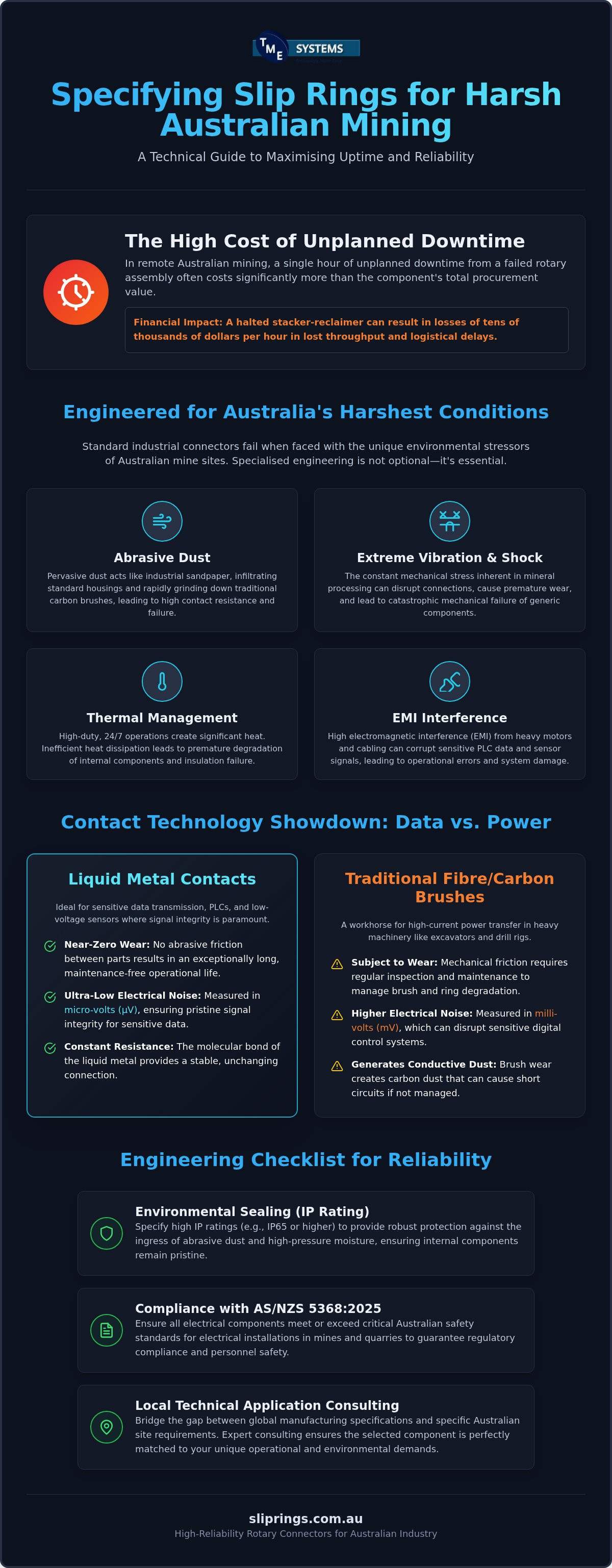
Engineering Checklist: Specifying for Load and Compliance
Specifying a rotary connector for a mine site requires more than just matching a part number; it is a technical audit of the entire rotating system. You must verify the exact circuit count, including dedicated paths for power, control, and data. Continuous current ratings must account for the highest expected load, while voltage peak ratings need to handle the transients often found in isolated mining grids. Determining mechanical constraints is equally vital. If the assembly must fit over an existing drive shaft, a through-bore design is mandatory. If space is at a premium, a compact capsule design might be the better fit. Selecting harsh environment slip rings Australia relies on these precise data points to avoid mechanical interference or electrical failure during peak production cycles.
Before procurement, assess the data protocol requirements of your control system. Whether you are running high-speed Ethernet, Profibus, or standard analogue signals, the slip ring must be capable of maintaining signal integrity without packet loss. For a detailed review of your specific load requirements, you can consult with our engineering team to ensure your selection is fit for purpose and built for longevity.
Navigating AS/NZS Compliance in Australia
Compliance with AS/NZS 5368:2025 is a critical requirement for electrical equipment used in Australian mines and quarries. This standard ensures that components can operate safely under the unique stresses of the local mining sector. For hazardous underground zones, explosion-proof (Ex) ratings are a non-negotiable necessity to prevent ignition sources in volatile atmospheres. You should also verify insulation resistance standards, especially for high-voltage equipment where dielectric breakdown can lead to significant safety risks. Proper documentation is essential for safety audits; ensure your supplier provides the necessary equipment certification to satisfy site-specific compliance frameworks.
Selecting Circuit Counts and Data Protocols
Future-proofing with spare circuits is standard practice in the mining industry. Adding 20% more circuits than currently required allows for future sensor integration without needing a complete hardware overhaul. Managing signal crosstalk is another priority; power and data lines must be sufficiently isolated within the assembly to prevent interference. Utilising Prosper Rotation slip rings is an effective strategy for modular configurations, as they allow for custom circuit counts and the mixing of signal types in a single, robust housing. This modularity ensures that as your site's data requirements evolve, your rotary interface remains a reliable link in the communication chain.
Technical Support and Procurement in Australia
Procurement for Australian mining operations is a high-stakes process where "close enough" is never sufficient. Relying on generic off-the-shelf components often leads to compatibility issues or premature failure when exposed to the specific heat and dust of regions like the Pilbara or the Bowen Basin. TME Systems Pty Ltd bridges the gap between global manufacturers and the practical realities of your site. By providing technical application consulting, we ensure that the harsh environment slip rings Australia demands are matched to the exact electrical and mechanical requirements of your rotating equipment. This proactive approach eliminates the guesswork often associated with sourcing specialised industrial hardware.
Transitioning from a selection phase to long-term operational uptime requires a precise understanding of site data. We assist in evaluating everything from peak voltage transients to the specific micron size of local dust particulates. This detailed approach prevents the high cost of unplanned downtime discussed in earlier sections. Beyond the technical specifications, managing lead times is a critical part of the procurement strategy. Given the geographical isolation of many Australian mining projects, establishing a critical spares inventory is essential. TME Systems Pty Ltd helps you determine which components, such as specific contact sets or seal kits, should be held on-site to mitigate the risk of logistical delays during a breakdown. This ensures that a minor wear issue doesn't escalate into a multi-day production halt.
The Value of Expert Application Consulting
Effective procurement moves beyond simply ordering a part number. It involves a comprehensive review of circuit counts, mounting styles, and environmental variables with a specialist who understands the failure modes of rotary interfaces. A specialist consultant can identify if a Mercotac slip ring with liquid metal contacts is the superior choice for your data integrity needs or if a modular Prosper Rotation slip rings assembly is required for high-circuit counts. This consultative process reduces the risk of specifying an undersized unit that will fail under the thermal stresses of continuous duty cycles. For a deeper look into this process, read our guide on Slip Ring Application Engineering.
Securing Your Supply Chain
Local distribution provides a level of technical support and troubleshooting that international vendors cannot match. Having a partner who understands AS/NZS compliance and local safety audits ensures your equipment remains compliant and operational. We also assist in establishing maintenance schedules based on manufacturer recommendations and actual site duty cycles. This methodical approach to harsh environment slip rings Australia ensures that your equipment achieves its full design life without the interference of abrasive contaminants. To ensure your rotating machinery is equipped for maximum reliability, consult with TME Systems Pty Ltd for your mining slip ring requirements.
Maximising Equipment Lifecycle Through Technical Precision
Securing long-term reliability in material handling requires a shift from basic part replacement to rigorous technical specification. Achieving stable signal integrity and power transfer depends on matching contact materials to your specific data protocols and ensuring sealing systems can withstand micron-sized abrasive dust. Adherence to AS/NZS 5368:2025 remains the essential benchmark for safety and performance in local operations.
When specifying harsh environment slip rings Australia projects require, the complexity of environmental variables makes expert consultation a vital step in the procurement process. TME Systems acts as a dedicated technical partner, providing Australian-based application support and distributing world-leading brands including Mercotac, BGB Innovation, and Meridian Laboratory. We've focused on high-reliability rotary connectors since our inception, ensuring your site data translates into the correct hardware selection.
Consult with TME Systems for specialised mining slip ring selection to protect your assets and reduce the risk of unplanned downtime. We look forward to assisting you with your next engineering challenge.
Frequently Asked Questions
How do I choose between a carbon brush and a liquid metal slip ring for mining?
Base your selection on the specific requirements of your signal sensitivity and power load. Carbon brushes are the standard for high-current power transfer but generate significant electrical noise and conductive dust. Liquid metal connectors, such as those from Mercotac, provide near-zero electrical noise and are superior for transmitting sensitive PLC data or high-speed Ethernet without signal degradation.
What IP rating is recommended for slip rings on open-cut mining equipment?
A minimum rating of IP67 is recommended to protect against high-pressure wash-downs and the fine particulates common on Australian sites. While IP65 is sufficient for standard industrial use, the superior sealing of IP67 ensures that harsh environment slip rings Australia operations rely on remain free from internal contamination and moisture ingress during extreme weather events.
Can slip rings transfer high-speed Ethernet data in high-vibration environments?
Yes, but this requires specialised contact technology to prevent packet loss. In high-vibration zones, traditional brushes can experience "bounce" that causes intermittent data drops. Using fibre brush or liquid metal interfaces maintains a constant molecular connection, ensuring signal integrity remains stable even when the machinery is subjected to heavy mechanical shock or structural harmonics.
What are the most common causes of slip ring failure in mining operations?
The primary causes of failure are abrasive dust ingress, mechanical vibration, and thermal overload. Fine dust acts as an abrasive that grinds down contact surfaces, while excessive vibration leads to erratic brush contact. Additionally, if the current load exceeds the unit's thermal dissipation capacity, the internal insulation can degrade, causing catastrophic short circuits and unplanned downtime.
Is AS/NZS 5368:2025 compliance mandatory for all rotary connectors in mines?
Compliance with AS/NZS 5368:2025 is the recognised standard for electrical equipment in Australian mines and quarries. This standard ensures that components are engineered for the specific physical and electrical stressors of the sector. Site safety audits generally require documentation proving that all rotary connectors meet these local regulatory frameworks to ensure operational safety and legal compliance.
How does ambient temperature in arid environments affect slip ring current ratings?
High ambient temperatures require a derating of the slip ring's continuous current capacity. As the external temperature increases, the unit's ability to dissipate heat generated by internal electrical resistance decreases. You must calculate the total temperature rise to ensure the internal components don't exceed their maximum operating limit, which often necessitates selecting a higher-rated unit for arid sites.
What maintenance is required for heavy-duty industrial slip rings?
Maintenance schedules vary significantly depending on the contact technology utilised. Traditional carbon brush systems require periodic inspections to check for wear and to remove conductive dust. In contrast, liquid metal and fibre brush designs offer virtually maintenance-free operation, though you should still perform regular visual checks on the housing and seals to ensure environmental protection remains intact.
Can I use a through-bore slip ring for hydraulic and electrical transfer?
You can use a through-bore design to integrate both hydraulic rotary unions and electrical circuits into a single rotating assembly. The hollow centre of the slip ring allows hydraulic or pneumatic lines to pass through the axis of rotation. This integrated approach is highly efficient for complex machinery where power, data, and fluids must be transferred across the same revolving interface.