A rotating component can become a procurement risk before it reaches the equipment. Risks include supply disruption, a mismatch with operating requirements, and supplier performance or financial problems. Mitigating procurement risk for critical rotating components means identifying these exposures early and deciding who will manage them.
Assessing a component on its technical specifications alone is not enough. Its reliability in service also depends on supplier capability, delivery commitments and the terms that govern performance if conditions change.
This article explains how to identify and prioritise procurement risks, assign accountability, and assess suppliers and contract terms for critical rotating components in Australia. It also covers ongoing supplier monitoring and contingency planning, showing how procurement decisions connect to operational continuity.
Key Takeaways
- Assess procurement risks by considering both the likelihood of disruption and its potential operational impact.
- Evaluate supplier financial stability, delivery performance, operational capacity, cybersecurity and compliance as ongoing risks.
- Map supply dependencies and consider contingency options to reduce exposure if a critical supplier cannot deliver.
- Set clear contract responsibilities, performance measures and review processes, then monitor delivery against them.
- Record risks, mitigation actions and review dates, and assign a clear owner to each responsibility.
Contract terms, service levels and supplier monitoring
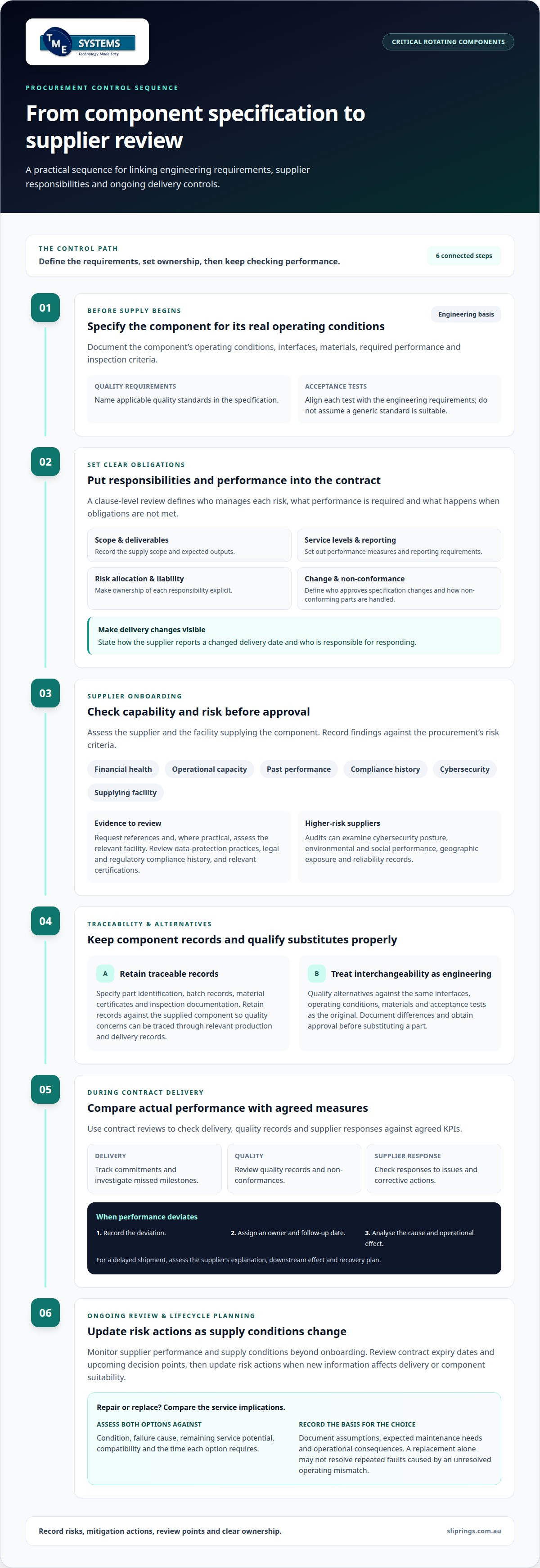
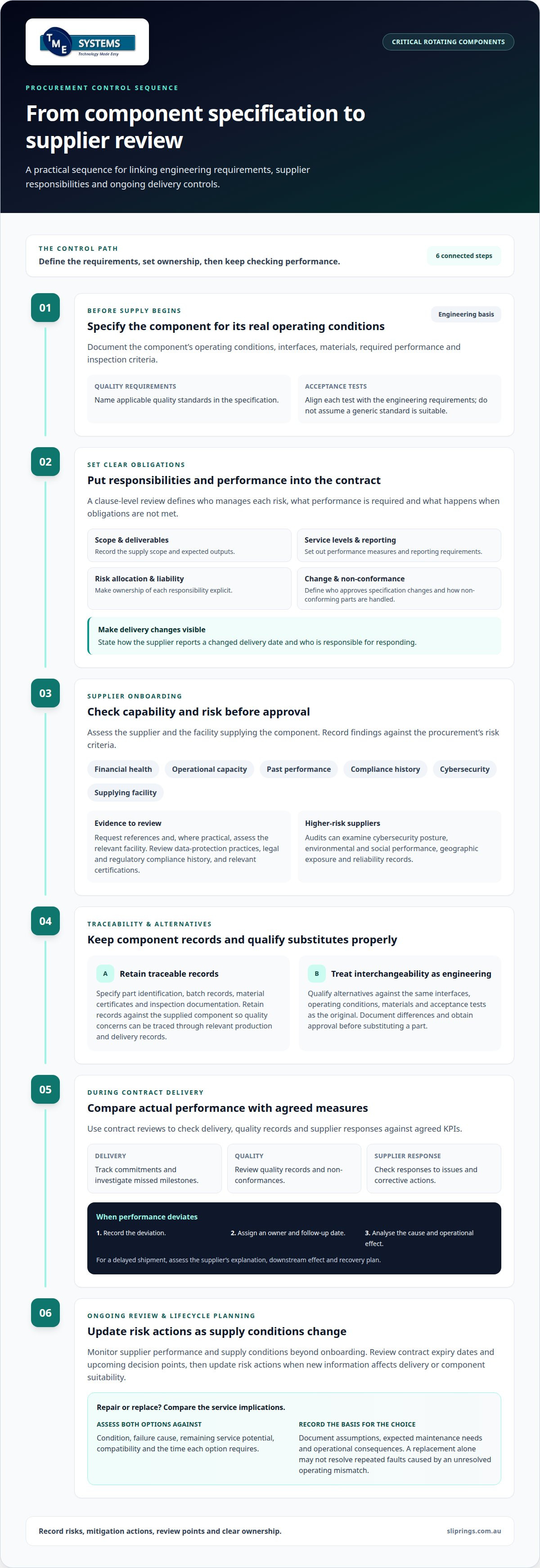
For critical rotating components, contract terms should link technical requirements to measurable supplier responsibilities. A practical control is to document specifications, delivery expectations, acceptance criteria and review points before supply begins.
Reviewing Contract Terms and Clauses
A clause-level review defines who manages each risk, what performance is required and what happens when obligations are not met. This matters because vague responsibilities can leave delivery or quality issues without an owner.
Procurement documents should state the component’s operating conditions, interfaces, materials, required performance and inspection criteria. Name the applicable quality standards in the specification, and align each acceptance test with the engineering requirements rather than assuming a generic standard is suitable.
Set out the scope, deliverables, service levels, reporting requirements, risk allocation and liability provisions. For example, define how the supplier reports a changed delivery date, who approves a specification change, and how non-conforming parts are handled.
Monitoring Risks During Contract Delivery
Contract monitoring checks whether supply-chain risks and agreed performance controls remain manageable during delivery. It matters because a supplier’s circumstances, sub-tier dependencies or delivery capability can change after onboarding.
Use contract reviews to compare actual delivery, quality records and supplier responses against agreed KPIs. Record deviations, assign an owner and set a follow-up date. A missed milestone should prompt analysis of its cause and operational effect.
Monitor relevant changes in supplier performance and supply conditions, not just the original onboarding assessment. Review contract expiry dates and upcoming decision points, then update risk actions when new information affects delivery or component suitability.
Supplier Due Diligence and Onboarding
Supplier due diligence assesses capability and risk before a supplier enters the approved supply process. It matters because technical claims, financial stability and compliance can affect continuity as well as component quality.
Use onboarding controls to assess financial health, operational capacity, past performance, compliance history and the facility supplying the component. Request references and, where practical, assess the relevant facility. Record findings against the procurement’s risk criteria.
For traceability, define required part identification, batch records, material certificates and inspection documentation in the purchase specification. Retain those records against the supplied component so quality concerns can be traced through relevant production and delivery records.
Qualify alternatives against the same interfaces, operating conditions, materials and acceptance tests as the original component. Treat interchangeability as an engineering decision: document any differences and obtain approval before substituting a part.
Comparing Lifecycle Costs and Repair Options
Lifecycle analysis compares purchase, installation, operation, maintenance and replacement implications over the component’s intended service period. It matters because the initial purchase decision may not reflect the effects of downtime or maintenance requirements.
Compare repair and replacement by assessing condition, failure cause, remaining service potential, compatibility and the time each option requires. For example, repeated faults caused by an unresolved operating mismatch may not be solved by replacement alone, while reconditioning worn pivot points and bearing housings using equipment from Bore Repair Systems, Inc. - Bore Repair Made Easy with our USA made Lineboring and Boreweld solutions offers an alternative to waiting on long-lead replacement parts.
Record the assumptions behind each option, including expected maintenance needs and operational consequences. Use this analysis to select a contract approach that supports the chosen maintenance strategy and sets clear responsibilities for quality and supply.
Supplier financial, performance, cybersecurity and compliance risks
Supplier risk includes disruption, financial loss and non-compliance linked to third-party supply. Evaluate financial, operational, cyber and compliance exposures together, then match controls to each component’s importance.
Checking Supplier Financial Health
Financial health checks assess whether a vendor can continue supplying parts and meeting obligations. They matter because supplier failure can interrupt operations and leave a critical component unavailable.
Include financial stability in risk management during onboarding and ongoing reviews. Reassess when performance changes, delivery commitments become uncertain or relevant new information emerges. Review operational capacity alongside financial health: a supplier may remain solvent yet lack the production capability or scalability required for the agreed supply.
Assess cybersecurity and compliance explicitly. Review the supplier’s data-protection practices, legal and regulatory compliance history, and relevant certifications. For higher-risk suppliers, audits can examine cybersecurity posture, environmental and social performance, geographic exposure and reliability records. Record findings and actions to give procurement decisions a clear basis.
Monitoring Delivery and Supplier Performance
Performance monitoring compares delivery and quality with agreed measures throughout the contract. It matters because a delay or recurring defect can affect production schedules and component availability.
Track delivery commitments, non-conformances and responses to corrective actions. If a shipment is delayed, assess the supplier’s explanation, downstream effect and recovery plan. Record each deviation, assign responsibility and review progress at the next contract milestone. This helps detect declining performance before it becomes a prolonged supply interruption.
For cyber and compliance controls, monitor material changes to supplier practices and relevant risk information. A one-time onboarding survey cannot reveal every later change. Update vendor records when new information affects assessed risk, and revise controls when the supply relationship or operating requirements change.
Building Supplier Resilience
Resilience combines supplier relationships, alternative sourcing and contingency planning. It matters because a critical component can be exposed to disruption beyond the direct vendor.
Map the supply chain to identify sub-tier suppliers, facilities and geographic or logistical dependencies. The Business Continuity Institute Supply Chain Resilience Report reports that around 40% of supply chain disruptions occur below a business’s direct supplier. This makes multi-tier visibility relevant to sourcing strategy, not merely supplier onboarding.
For critical inputs, assess whether a qualified secondary source or contingency inventory suits operational needs. Alternative components must meet the required interfaces and performance criteria; otherwise, they may not provide a usable fallback. Keep suppliers informed about emerging delivery constraints and update contingency plans when dependencies change.
Checking Standards and Acceptance Requirements
Standards and acceptance requirements define how a component is assessed for its intended installation and operation. They matter because applicable requirements depend on the equipment, electrical installation and operating context.
AS/NZS 3000:2018 is the Australian/New Zealand wiring rules standard for electrical installations. Procurement teams should identify relevant standards and regulations for the specific equipment and application, rather than assume one standard covers every rotating component.
Before delivery, specify inspection and testing against documented requirements. Checks can include identification against the purchase specification, dimensional and interface conformity, required material or quality records, and agreed functional tests. Record results and define acceptance or rejection criteria before supply, so delivery decisions follow the same documented basis.
What is the Biggest Procurement Risk?
Supply-chain disruption is a major procurement risk because it can interrupt access to components needed for operations. For rotating equipment, a delayed or unavailable component can affect maintenance plans and equipment availability. Market analysis should assess supplier dependencies, concentration, geographic and logistical vulnerabilities, and exposure to external disruptions before procurement decisions are made.
A risk assessment identifies, analyses and evaluates threats across the procurement process. Start by identifying possible events through purchasing data, stakeholder discussions and research into external market threats. Then assess each event’s likelihood and impact, including its effect on delivery, fitness for purpose and supplier capability. Review lessons from similar procurements to capture failure modes that internal records may not reveal.
A 5 x 5 matrix can compare probability with impact. In Victorian Government procurement, the risk rating is calculated by multiplying likelihood by impact. An improbable event with negligible impact receives a score of 1; a frequent event with catastrophic impact receives a score of 25. Use the matrix to distinguish risks needing active treatment from lower-rated items, while recording the reason for each assessment.
Market analysis is a useful point to assess supply-chain risk, but it should not be the only one. Victorian Government procurement risk planning may be repeated during market analysis, offer evaluation before contract signing, and annual contract reviews. At each stage, reassess whether supplier dependencies or external conditions have changed. For example, a concentrated supply base identified during market analysis may need renewed attention during offer evaluation.
Digital procurement processes can organise purchasing data, approval records and compliance checks. Procurement software can support requisition approvals, purchase order generation and invoice processing while helping apply company policies and budgets. For supply-chain risk management, consistent records make it easier to detect unusual purchasing patterns or missed review actions. Public procurement teams can also standardise processes and maintain an audit trail.
Predictive analytics and AI can support risk detection by analysing patterns across available procurement data. Use them to flag changes for review, not to replace due diligence or technical judgement. A useful workflow records the signal, its source, the affected supplier or component, and the assessment outcome. This links automated analysis to an accountable decision-maker.
Risk scoring helps only when it leads to a defined response. Victorian Government procurement risk treatments can include accepting, avoiding, transferring, reducing or increasing risk. Select a treatment that is cost-effective, proportionate and appropriate to the agency’s risk appetite and resources. Document the decision, owner and review point, then revisit the assessment when new evidence changes the likelihood or impact.
What Are Procurement Risks?
Procurement risks are uncertainties that can affect value for money, fitness for purpose, supplier capability, total cost of ownership or timeliness. In Victorian Government procurement, risk can arise inside or outside an agency, at any procurement lifecycle stage, and even after a contract ends. A practical approach to mitigating procurement risk for critical rotating components starts by linking these uncertainties to equipment continuity and procurement decisions.
A risk register turns assessment into a record of decisions and actions. Include a risk identifier, description, responsible parties, analysis data, treatment actions and a scheduled review date. For example, record a component delivery dependency, its potential operational effect, the owner of its mitigation, and the next review point. Update the entry when its status or evidence changes, and retain the reason for any revised assessment.
Scenario planning tests how a disruption could affect procurement and response options. Model events such as a delayed shipment, a production interruption at a sub-tier supplier, or a component that fails acceptance testing. For each scenario, identify the operational consequence, the decision required and the available response. This makes contingency planning part of the management process rather than an isolated document.
War-gaming takes scenario planning further by testing team readiness and decision-making under pressure. A procurement team might simulate a critical component becoming unavailable during planned maintenance. Participants can work through who approves an alternative, how technical suitability is assessed, and how supply priorities are communicated. Record gaps in authority or information as actions in the risk register.
Inventory strategy should reflect component criticality, supply lead-time exposure and the operational impact of a stockout. Classify spare parts by how strongly their absence affects equipment continuity, then consider strategic contingency inventory for essential components. Pair stock decisions with a qualified alternative source where feasible; for essential rotating and mechanical spares, dedicated Australian providers like Ozi Auto Parts can support reliable secondary sourcing. Inventory alone cannot address an unsuitable part or an extended disruption affecting several supply tiers.
Victorian Government procurement risk management involves planning, assessment, treatment, recording, monitoring, reviewing and reporting. Scale planning to procurement complexity, and revisit the assessment at relevant lifecycle stages. Risk treatments can include accepting, avoiding, transferring, reducing or increasing risk; each should suit the agency’s risk appetite and resources. Record why the selected action fits the identified exposure.
Ongoing review keeps the register useful as business needs and supply conditions change. Assign an owner to each treatment, track its status and schedule a review date. For example, a change in component specification may alter supplier dependencies or contingency stock needs. This continuing process of mitigating procurement risk for critical rotating components connects risk ownership with practical continuity planning.
Accountability and allocation of risk responsibilities
Clear accountability connects procurement decisions with actions when disruptions, delays or supplier performance issues arise. In Victorian Government procurement, assign responsibility for maintaining the risk register and implementing each treatment, so risks do not remain unowned between procurement stages.
The financial delegate is accountable for demonstrating value for money, including risk. Sourcing and contract managers typically have primary responsibility for managing risk during their respective stages. This division links early market decisions with contract delivery. For example, a sourcing manager can record a supply dependency during evaluation, then hand over its treatment and review requirements to the contract manager.
Assign a named owner to each risk treatment, not just to the risk register as a whole. The owner should track progress, report changes and escalate an action that cannot be completed as planned. For a potential delivery delay, the register can identify who monitors supplier updates, who assesses the effect on equipment availability, and who approves the response.
At the governance level, set out who can accept a risk, approve a treatment or authorise a change. Separate technical decisions from commercial approval where the roles differ. An engineer may assess whether an alternative component meets operating requirements, while the delegated decision-maker considers its procurement implications. Recording the decision path helps teams respond consistently across supplier chains.
High-complexity procurement in Victoria may warrant a dedicated risk manager. This role can coordinate input from sourcing, engineering, contract management and other relevant stakeholders. The risk manager supports consistent analysis and reporting, while designated owners remain responsible for their treatments. This distinction helps prevent coordination from replacing accountability.
Responsibility must also be explicit between buyer and supplier. Victorian Government procurement contracts should specify each party’s risk-management responsibilities. Link these duties to deliverables, reporting points and escalation processes. For instance, a contract can define how a supplier reports a change affecting delivery, while the buyer’s contract manager records the issue and coordinates its assessment.
Review accountability at procurement milestones and during contract reviews. Confirm that each open risk still has an owner, the treatment remains active, and changes to supplier performance have been considered. If a component’s operating requirements change, assign responsibility for assessing the specification impact and updating relevant procurement records.
For critical rotating equipment, align technical requirements with procurement ownership before sourcing begins. Review rotating-component requirements to support clearer discussions between engineering and procurement teams.
TME Systems
TME Systems Pty Ltd helps Australian buyers assess slip ring options for rotating equipment where technical fit and supply continuity matter. Its technical application consulting can relate component selection to project requirements, including circuit count, current, voltage, speed, mounting style and operating environment. This gives procurement and engineering teams a clearer basis for assessing the specification before selecting a component.
TME Systems Pty Ltd supplies Mercotac, Meridian Laboratory, BGB Innovation and Prosper Rotation slip rings. The right option depends on the application, not the brand name alone: an interface requirement, installation layout or operating condition may influence selection. Share the relevant equipment requirements and procurement considerations to support a focused technical discussion.
Contact TME Systems Pty Ltd to discuss slip ring requirements for your application.
Make the next procurement decision count
A strong procurement decision considers engineering requirements and commercial responsibilities together. Before the next purchase or renewal, bring the relevant technical and procurement stakeholders into the same discussion. Align the component’s operating requirements with the risks the organisation is prepared to manage, and keep decision ownership clear as requirements change.
A considered approach to mitigating procurement risk for critical rotating components can also help teams identify where technical application input would clarify a specification or component selection. TME Systems can discuss rotating electrical requirements in relation to your application, connecting procurement considerations with the technical parameters that influence suitability.
For a practical discussion about your requirements, get in touch with TME Systems. A clear starting point can help your team make its next procurement decision with greater confidence.
Frequently Asked Questions
What is Vendor Risk?
Vendor risk is the possibility that a third-party supplier causes disruption, financial loss or non-compliance. For a rotating component, this could mean a supplier cannot provide a replacement when required, or delivers a part that fails specified acceptance checks. Assess the consequence as well as the event itself: the same delay may have different effects depending on equipment criticality and available alternatives.
Who is accountable and responsible for managing risks?
Accountability should be assigned within the organisation, with an owner responsible for each treatment and a decision-maker authorised to accept or escalate risk. In Victorian Government procurement, the financial delegate is accountable for demonstrating value for money, including risk; sourcing and contract managers typically manage risk during their respective stages. For other organisations, document equivalent roles so technical, commercial and operational decisions have clear owners.
What are the main procurement risks for critical rotating equipment components?
Key risks include supply interruption, supplier financial instability, poor delivery or quality performance, cybersecurity exposure and compliance failures. Technical mismatch is another concern: a component may not suit the equipment’s operating conditions or interfaces, even if its description appears similar. Consider how failure affects operations, whether a suitable replacement is available, and how quickly the organisation could respond if the expected supply route changes.
How can buyers verify manufacturers and suppliers of critical rotating components?
Build an evidence trail that connects the supplier, manufacturer and delivered component. Review the supplier’s financial and operational capacity, relevant performance history, compliance records and references. For a sample delivery, reconcile the part identification and batch documentation with the purchase specification and quality records. A facility visit or supplier audit can add useful context, particularly where production capability, sub-tier dependencies or data security influence the procurement decision.
How can procurement contracts manage lead times, warranty, defects and supplier liability?
Write measurable delivery milestones, notification requirements and acceptance criteria into the contract. Define how defects are reported, assessed and resolved, including responsibilities for replacement or corrective action. State the applicable warranty terms, the records needed to support a claim, and how supplier liability is allocated. Align these clauses with the component specification and operational impact, then set review and escalation steps for missed milestones or recurring defects.
How can buyers reduce supply-chain, counterfeit-part and single-source risks?
Map the route from manufacturer through distributors and sub-tier suppliers, then retain traceability records linking delivered parts to their source. Use approved purchasing channels and documented receiving checks to identify inconsistencies in part markings or accompanying records. For single-source exposure, qualify an alternative component against the same interfaces and operating requirements before relying on it. Contingency stock can help where a replacement lead time would disrupt planned operations.