A rotary joint with similar dimensions can still be the wrong replacement. A Schleifring rotary joint cross-reference needs to match what passes through the interface, how it connects and the conditions it operates under, not just the housing dimensions or product label.
Product names and categories can make comparisons difficult. A unit may transfer electrical power or signals, fluid or gas, or a combination of these. This guide shows how to identify the existing unit’s function, document its interfaces and operating requirements, and compare alternatives without assuming that a similar-looking unit is a direct equivalent.
Record details such as circuit count, current, voltage, signal type, connection configuration, mounting style, rotational speed rating, pressure and operating environment. These specifications help identify the relevant product family and show where an alternative may suit. Where requirements need further assessment, TME Systems’ technical application consulting can help evaluate the match against industrial slip ring ranges, including Prosper Rotation.
Key Takeaways
- Identify whether the rotary joint transfers electrical power, signals, media or a combination before comparing alternatives.
- Build a Schleifring rotary joint cross-reference from documented functions, interfaces and operating limits, not product names alone.
- Record connection sizes and arrangements as shown on drawings or equipment documentation to avoid relying on a misleading fit.
- Mark each specification as a match, mismatch or unresolved, and distinguish documented facts from assumptions.
- Gather drawings, nameplate details and operating conditions to support a focused technical review of candidate rotary connections.
What a Schleifring rotary joint cross-reference must establish first
Start by identifying the task the existing assembly performs. “Rotary joint” can describe equipment that transfers media, electricity or both, so a shared category name does not establish that two units are functionally equivalent. Determine what crosses the rotating interface and what must remain continuous during operation.
A media rotary joint carries a substance such as hydraulic fluid, air or vacuum between stationary and rotating parts. A slip ring transfers electrical circuits, allowing power or signals to pass across that rotation. Both functions can appear in one assembly, but they use different transfer paths and interfaces. A media port and an electrical terminal are not interchangeable simply because they are fitted to the same housing.
A cross-reference is a documented comparison of function, interfaces and operating limits that establishes whether a candidate suits the application, not whether it resembles the original in a catalogue. Check the application and the evidence for each requirement before treating a candidate as a match.
Is the existing unit a media rotary joint or an electrical rotary connector?
Start with the connected equipment and trace what enters and leaves the rotating assembly. Note whether the connections carry fluid, air, vacuum, electrical power or signals. If the unit handles more than one function, record each separately. For example, a combined assembly may have a media path alongside electrical circuits, and each path needs its own compatibility checks.
The Slip ring overview explains electrical continuity across rotating interfaces. Use that distinction to classify the unit before narrowing down candidate product families. Electrical circuit requirements do not establish whether separate media connections suit their intended transfer path.
Why a similar product label does not prove interchangeability
Product names describe categories, not the complete application. Two products labelled as rotary joints may have different connection arrangements, transfer functions or operating limits. A slip ring with a similar housing may also differ in circuit configuration or electrical ratings. Treat the name as an identification clue, then use drawings, nameplate information and technical documentation to establish what the unit is designed to do.
A mechanical fit is only one part of the comparison. Matching dimensions do not prove that a media connection suits the required fluid or pressure, or that an electrical path supports the application’s current, voltage or signals. Check each requirement separately and record whether it is documented, mismatched or unresolved. Without evidence for the relevant interfaces and operating limits, describe a candidate as a possible alternative, not a direct replacement.
How to build a Schleifring rotary joint cross-reference specification
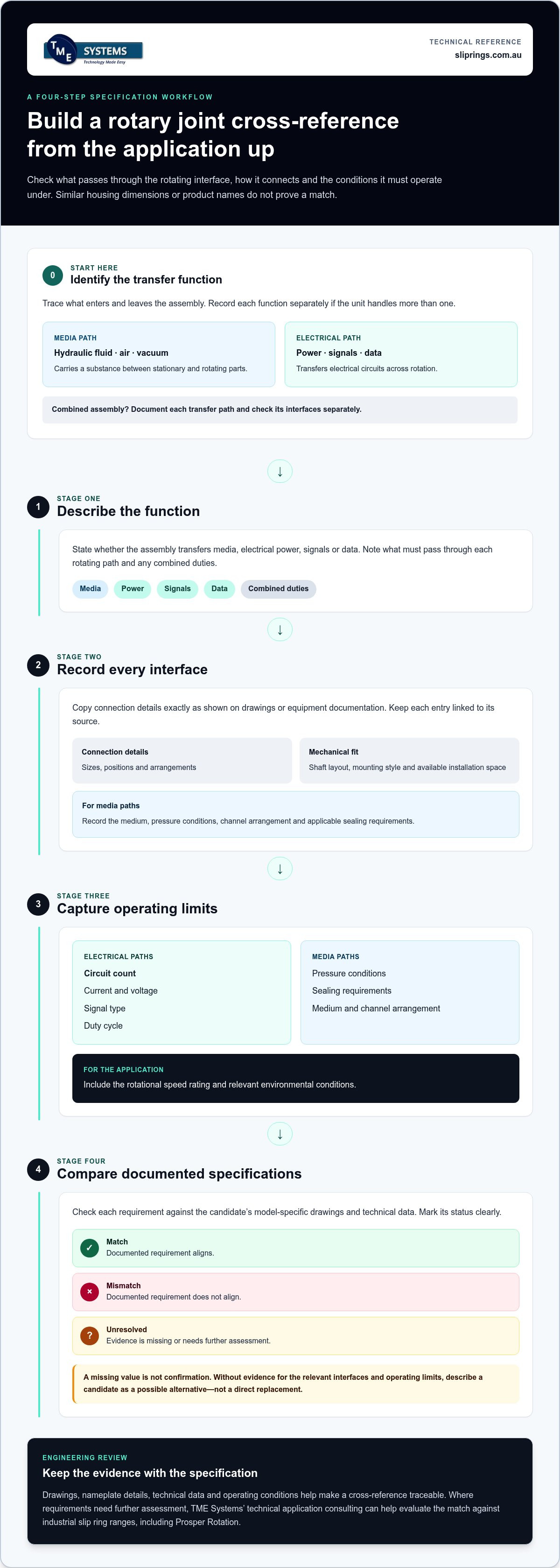
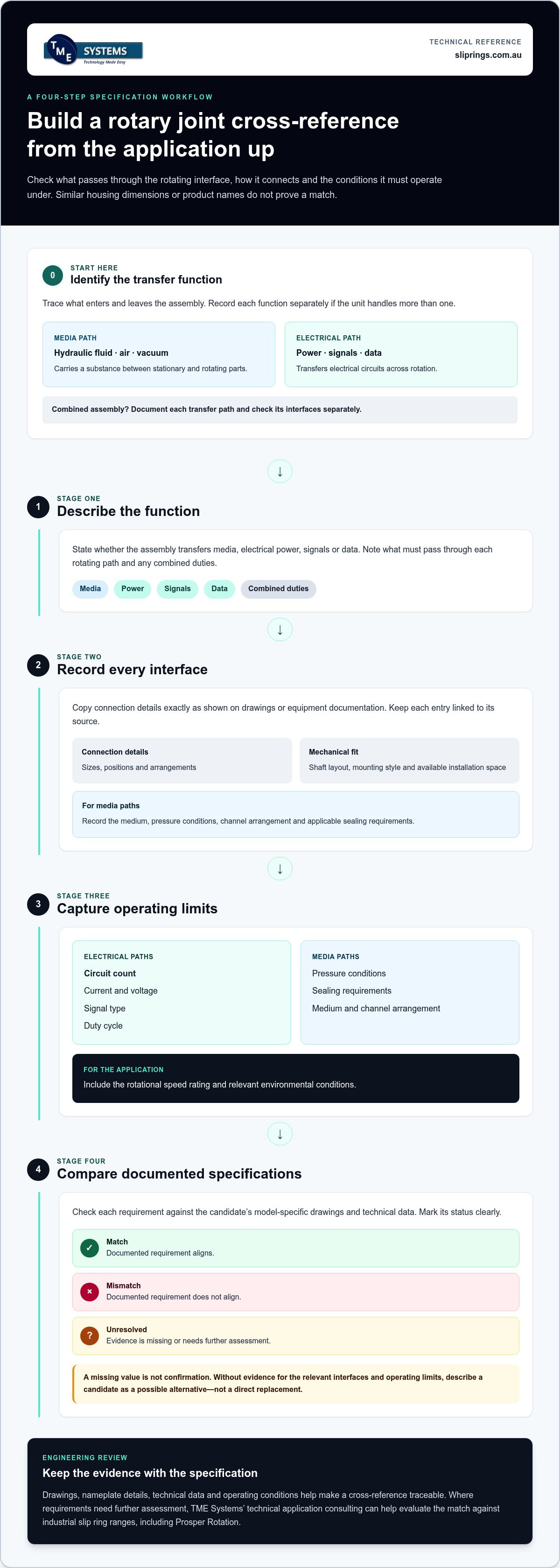
Once the assembly’s function is clear, turn the application requirements into a written specification. A Schleifring rotary joint cross-reference is easier to assess when every interface and operating limit is recorded in one place, rather than inferred from a product name or appearance. Follow the steps below and keep the source documents with each entry so the comparison can be traced.
- 1. Identify the function. State whether the assembly transfers media, electrical power, signals or data, and note any combined duties. Describe what must pass through each rotating path.
- 2. Record the interfaces. Copy connection sizes and arrangements exactly as marked on drawings or equipment documentation. Add the shaft layout, mounting style and available installation space.
- 3. Capture operating limits. For media paths, record applicable pressure and sealing requirements. For electrical paths, note circuit count, current, voltage and signal type. Include rotational speed rating and relevant environmental conditions.
- 4. Compare documented specifications. Check each requirement against the candidate’s model-specific drawings and technical data. Mark it as a match, mismatch or unresolved. A missing value is not confirmation.
Complete application information makes engineering review more useful. The Electrical rotary joint apparatus for large space structures report describes an electrical rotary joint in relation to its application and function. The same principle applies to industrial selection: define the duty and interfaces before comparing candidate specifications.
Record the mechanical and media interfaces
Document the rotating shaft arrangement, mounting style, connection positions and available installation space. Record connection dimensions and configurations exactly as stated in the source material, including the relevant drawing reference. For media transfer, identify the medium, pressure conditions and channel arrangement, along with applicable sealing requirements. Keep each detail tied to the specific model. Do not apply dimensions or ratings from one unit to another.
Capture electrical and operating requirements
For each electrical path, specify the circuit count, current and voltage, then identify whether it carries power, signals or data. Record the required rotational speed rating, duty cycle and environmental exposure from application documents. If the assembly combines electrical and media duties, keep separate entries for each path. This prevents an acceptable electrical match from obscuring an unresolved media requirement.
To prepare for technical application consulting, gather relevant drawings, nameplate details and operating conditions, and label assumptions clearly. This gives application engineering a sound basis for comparing documented requirements with candidate rotary connections without assuming a one-to-one equivalent.
Compare candidate rotary connections by compatibility, not catalogue resemblance
With the application data assembled, compare the existing unit and each candidate requirement by requirement. A familiar product label or similar housing may help narrow the search, but neither proves that a candidate will perform the same function. Use a comparison matrix to make gaps visible before selecting a product family.
Cross-reference confidence depends on matching every application-critical interface and operating limit against documented evidence. Mark each item as a match, mismatch or unresolved, and note the source. A drawing or product datasheet is evidence; an assumption based on appearance is not. If a critical rating remains unresolved, the Schleifring rotary joint cross-reference is incomplete.
| Parameter | What to compare | Assessment |
|---|---|---|
| Function | Media transfer, electrical continuity, or a combined assembly | Match / mismatch / unresolved |
| Interfaces | Connection type, size, arrangement and shaft interface | Match / mismatch / unresolved |
| Channels | Media paths and electrical circuit count, including signal type | Match / mismatch / unresolved |
| Ratings | Documented pressure, current, voltage and rotational speed rating, as relevant | Match / mismatch / unresolved |
| Mounting | Mounting style and available installation space | Match / mismatch / unresolved |
| Environment | Operating conditions and required environmental protection | Match / mismatch / unresolved |
Use the status column consistently. A mismatch against a required operating limit rules out a candidate for that application. An unresolved value needs further documentation or engineering review, not an assumed pass. Add notes beside each status so reviewers can distinguish a measured interface from a value copied from a model-specific datasheet.
When a media rotary joint and slip ring solve different problems
A media rotary joint transfers a medium; an electrical slip ring maintains electrical continuity across rotation. Neither substitutes for the other simply because both connect rotating and stationary equipment. Some assemblies combine these duties, but each media channel and electrical circuit needs its own interface and rating assessment. A match on one path does not establish a match on the others.
How to assess a possible slip ring alternative
For an electrical candidate, compare the required circuit count, current, voltage and signal type with documented ratings. Then assess mounting style, rotational speed rating and environmental conditions against the application. Base the decision on technical documentation for the specific candidate and application, not general industry information or an assumption drawn from catalogue categories.
Prosper Rotation slip rings provide one product-family reference for an electrical application review, not a guaranteed equivalent to an existing unit. TME Systems’ technical application consulting can help assess the collected requirements and identify where further engineering review is needed.
A practical engineering review checklist for uncertain cross-references
A structured review shows what is known, where each detail came from and what still needs resolution. Gather the source material before assessing a candidate. Keep measurements, manufacturer ratings and working assumptions separate so an unknown value cannot be mistaken for a confirmed match.
Assemble the following information where it applies:
- Drawings: Equipment and installation drawings showing the rotary assembly, shaft arrangement, mounting points, connection locations and available space.
- Nameplate details: Manufacturer, model identifier and any readable ratings or markings from the existing unit.
- Connection data: Connection size and arrangement as recorded in drawings or equipment documentation, plus electrical terminals or media channels.
- Application conditions: Operating function, speed, duty cycle and environmental exposure, along with pressure and sealing details for media transfer.
- Product documents: Available manufacturer datasheets, manuals and technical drawings for both the existing assembly and the candidate.
For an electrical unit, include circuit count, current, voltage and signal or data type. For a media unit, identify the medium, channel arrangement, pressure conditions and relevant sealing requirements. If the assembly combines these functions, keep the information for each transfer path distinct.
What technical information should the review include?
Label each entry as a confirmed measurement, a documented manufacturer rating or an assumption. Include its source, such as a drawing number, nameplate or datasheet reference. This makes discrepancies easier to trace and prevents a catalogue value for one model from being applied to another. If mining or quarry equipment is involved, AS/NZS 5368:2025 covers electrical equipment in mines and quarries. Its relevance depends on the application, so it is not a general cross-reference criterion.
How to handle missing or conflicting specifications
Mark missing information as unresolved, rather than estimating a value from appearance or a similar model. If a manufacturer document and an application drawing differ, record both references and flag the conflict for engineering review. Resolve uncertain interfaces or operating limits before treating candidates as equivalent.
A comparison record can be concise without inventing product values:
| Item | Existing unit evidence | Candidate evidence | Status |
|---|---|---|---|
| Function and channels | Recorded from application drawing | Candidate document required | Unresolved |
| Mounting and connections | Drawing reference recorded | Dimensions documented | Review against drawing |
| Operating ratings | Nameplate or application data recorded | Model-specific rating required | Unresolved |
Use this record to focus technical application consulting on open questions. For an electrical application, compare the documented requirements with the Prosper Rotation slip ring range as one product-family reference, without assuming a direct equivalent.
How TME Systems supports rotary joint cross-reference decisions
A cross-reference review turns application information into a clearer product-selection decision. TME Systems’ technical application consulting considers electrical and mechanical requirements together, including circuit count, current, voltage, speed, mounting style and environmental conditions. This helps identify which product family warrants closer comparison and which requirements still need engineering attention.
A candidate must perform the required function and meet the application’s documented interfaces and operating limits. Similarity to a product from another range does not establish a one-to-one replacement. If a critical rating or connection remains unresolved, keep that gap visible in the assessment rather than treating it as a match.
From application data to a suitable product family
Start with the assembled drawings, model markings and operating conditions. For an electrical application, TME Systems can assess the recorded circuit count, current and voltage alongside speed, mounting and environmental requirements. The same requirements-led approach to preparing industrial product information is covered in this rotary electrical connector procurement guide.
Once the function is established as electrical, TME Systems’ industrial slip ring ranges, including Prosper Rotation, Mercotac, Meridian Laboratory and BGB Innovation, can be compared against the documented application. The product family is a starting point, not evidence of compatibility. Suitability depends on the required function and verified, model-specific product documentation.
If the existing assembly also transfers media, assess that function separately. A slip ring range should only be considered for the electrical paths it is designed to serve; media channels require their own suitable rotary connection. For an assembly with combined functions, evaluate each path and interface, then assess how they fit together in the application.
The next step when you need a cross-reference
For a focused technical review, prepare the existing unit’s model markings, equipment and installation drawings, connection details, mounting arrangement and operating conditions. Include electrical requirements such as circuit count, current, voltage and signal type where applicable, plus speed and environmental information. Identify uncertain values so they remain distinct from confirmed data.
TME Systems uses this information in technical application consulting for product selection. It provides a practical basis for assessing possible alternatives across the industrial slip ring ranges without assuming that catalogue resemblance means interchangeability.
Share your application data with TME Systems to discuss the rotary connector requirements and support a technical selection review. Discuss your rotary connector application.
Take the next step with a documented application review
An unresolved specification is an engineering question to close before committing to a candidate. Keep the evidence gathered during the Schleifring rotary joint cross-reference with the project record. This gives your team a clear basis for design decisions, procurement discussions and future replacement planning.
TME Systems provides technical application consulting for industrial rotary connectors. Share the available application information to support a considered product-selection discussion. The review can assess requirements against relevant product documentation without assuming that a similar form factor or catalogue category guarantees interchangeability.
Discuss your rotary connector application with TME Systems and take the next step towards a technically supported selection. A clear application record gives the review a practical starting point and keeps unresolved requirements in view.
Frequently Asked Questions
Is a rotary joint the same as a slip ring?
No. “Rotary joint” is a broad term for an assembly that transfers something across rotating parts, while a slip ring transfers electrical power or signals. A media rotary joint carries substances such as fluid or air. Some assemblies combine electrical and media paths, so identify the function of each connection rather than relying on the overall product name.
Can a Schleifring media rotary joint replace an electrical slip ring?
Not simply because both assemblies operate across a rotating interface. A media rotary joint transfers a medium, while an electrical slip ring maintains electrical continuity. If the application needs electrical circuits, a media-only unit will not perform that task. For a combined assembly, assess the electrical and media paths separately and compare each with the candidate’s documented function and ratings.
What information do I need to cross-reference a rotary joint?
Record the unit’s model markings, intended function, connection arrangement, mounting and installation constraints. For electrical duties, note circuit count, current, voltage and signal type. For media duties, record the medium, channel arrangement, pressure conditions and sealing needs. Add operating speed and environmental conditions from application records. A Schleifring rotary joint cross-reference is more useful when each entry has a source, such as a drawing or manufacturer document.
How do I tell whether a rotary joint transfers media or electrical signals?
Start with equipment drawings, labels and the connected system, then trace what each port, cable or terminal serves. Tubed connections may indicate a media path, while electrical conductors connect to circuits, but appearance alone is not conclusive. Check the unit’s documentation and equipment schematic. If the assembly has both types of connection, list each transfer path separately before comparing alternatives.
Can a cross-reference be based on connection size alone?
No. Connection size helps establish whether parts may physically interface, but it does not show that they perform the same function or meet operating requirements. Matching media connections, for example, do not establish suitable pressure or sealing performance. In an electrical application, matching terminal or housing dimensions do not confirm circuit configuration, current, voltage or speed suitability. Treat size as one comparison point, not a selection decision.
What should I do if the existing rotary joint has incomplete specifications?
Gather readable model markings, equipment drawings, installation details and operating records, then note which values are confirmed and which remain unknown. Compare available documents for inconsistencies, and do not fill gaps with ratings from a similar-looking model. If a critical interface or operating limit cannot be established, keep the candidate status unresolved until the information is assessed through technical review or suitable application records.