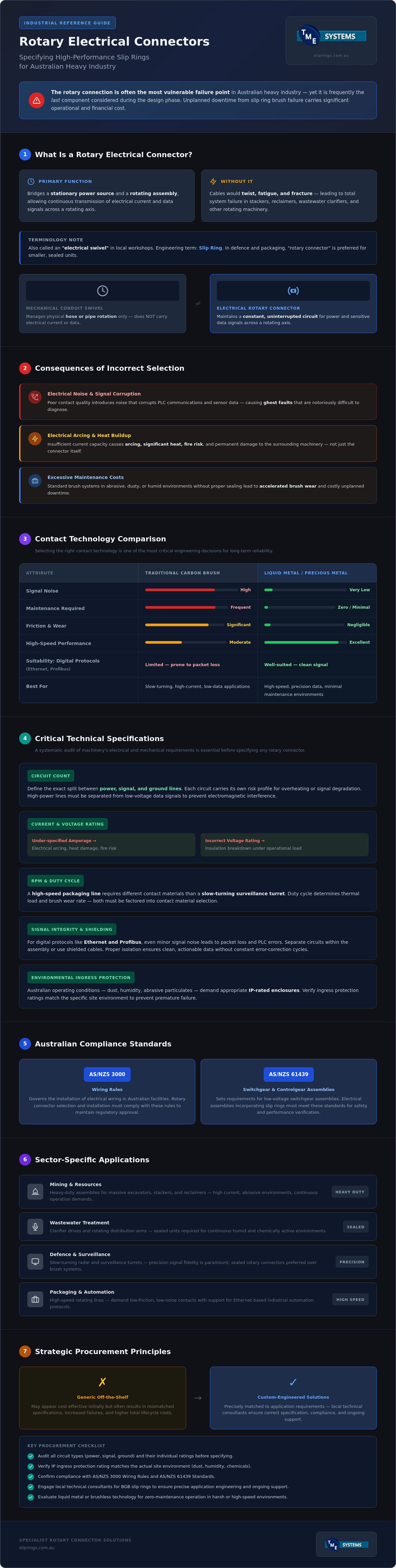
How much is a single hour of unplanned downtime costing your facility when a traditional slip ring brush fails? In Australian heavy industry, the rotary connection is often the most vulnerable failure point, yet it's frequently the last component considered during the design phase. You likely understand the frustration of signal interference in sensitive sensors or the constant maintenance required to manage brush wear in dusty, humid environments. This guide provides the technical framework necessary to specify and source high-performance rotary connectors, including BGB slip rings Australia, to ensure your operations remain compliant with AS/NZS 3000 wiring rules and AS/NZS 61439 standards. We'll examine the critical shift toward brushless technology and liquid metal alternatives that offer zero-maintenance operation. You'll also learn how to select hardware that guarantees clean Ethernet transmission for modern industrial automation. By following this reference, you can move away from reactive repairs and toward a strategy of long-term reliability for your rotating machinery.
Key Insights
- Understand the fundamental mechanics of electrical swivel connectors and how they eliminate cable fatigue in rotating industrial structures.
- Identify critical specifications for circuit counts and voltage to prevent overheating and ensure compliance with Australian electrical standards.
- Evaluate the performance of liquid metal contacts for low signal noise against traditional brush systems used in heavy machinery.
- Learn how to source BGB slip rings Australia through local technical consultants to ensure precise application engineering and support.
- Navigate the procurement process by prioritising custom-engineered solutions over generic off-the-shelf components for high-reliability industrial sectors.
Defining Rotary Electrical Connectors in the Australian Industrial Context
In the context of Australian heavy industry, a rotary electrical connector acts as a specialised interface designed to bridge the gap between a stationary power source and a rotating assembly. While many technicians in local workshops might simply refer to it as an "electrical swivel," the engineering term for this component is a slip ring. Its primary function is to facilitate the continuous transmission of electrical current and data signals across a rotating axis. Without this interface, cables would eventually twist, fatigue, and fracture, leading to total system failure in equipment like stackers, reclaimers, or wastewater treatment clarifiers.
Engineers must distinguish these from mechanical conduit swivels. While mechanical swivels manage physical hose or pipe rotation, an electrical rotary connector maintains a constant, uninterrupted circuit for power or sensitive data. Specifying the correct hardware, such as BGB slip rings Australia, ensures that these rotational movements don't compromise electrical integrity. The goal is to provide a path of low resistance that remains stable even at high RPMs or under extreme environmental stress. When sourcing BGB slip rings Australia, procurement officers must consider the specific environmental ingress protections required for our local conditions.
Slip Rings vs. Rotary Connectors: Technical Nuances
Terminology often shifts depending on the specific sector. In the Australian mining industry, you'll hear engineers discuss heavy-duty slip ring assemblies for massive excavators. In the defence or packaging sectors, the term "rotary connector" is more common, often referring to smaller, sealed units. Traditional slip rings typically rely on carbon brushes that slide against a conductive ring. Modern rotary connectors might use precious metal contacts or liquid metal to reduce friction. Selecting between them requires a clear understanding of your duty cycle. A high-speed packaging line needs different contact materials than a slow-turning turret on a surveillance system.
The Consequences of Incorrect Selection
Choosing an unsuitable connector leads to immediate operational headaches. Poor contact quality introduces electrical noise, which can corrupt PLC communications and sensor data, causing ghost faults that are notoriously difficult to diagnose. If you specify a unit with insufficient current capacity for a high-load application, you risk electrical arcing and significant heat buildup. This doesn't just damage the connector; it can lead to fire risks or permanent damage to the surrounding machinery. Using a standard brush system in a highly abrasive environment without proper sealing increases maintenance costs. Technicians will need to replace worn brushes much more frequently than planned, leading to expensive downtime.
Critical Technical Specifications for Industrial Specification
Specifying an industrial rotary connector requires a systematic audit of your machinery's electrical and mechanical requirements. It isn't enough to match the physical dimensions; you must account for every circuit's specific duty. When sourcing BGB slip rings Australia, engineers must define the exact split between power, signal, and ground lines. Each circuit carries its own risk profile for overheating or signal degradation. For instance, a high-current power line requires different contact materials and surface areas compared to a sensitive thermocouple signal. Failing to specify the correct Amperage can lead to electrical arcing, while incorrect voltage ratings may result in insulation breakdown under load.
Circuit Count and Signal Integrity
Organising your circuit layout is vital for maintaining data accuracy. High-power lines generate electromagnetic interference that can easily corrupt low-voltage data signals. To prevent this, you should separate these circuits within the assembly or use shielded cables. This is especially critical for digital protocols like Ethernet or Profibus, where even minor signal noise leads to packet loss. For a deeper look at managing these complexities, read our Signal Slip Ring: A Guide to Reliable Rotary Data Transmission. Proper isolation ensures your PLC receives clean, actionable data without the need for constant error-correction.
RPM and Mechanical Mounting Styles
Rotational speed directly influences the lifespan of your connector. Standard carbon brush systems often struggle at speeds exceeding 3000 RPM due to increased friction and heat. In these high-speed scenarios, you might need to consider brushless designs or specialised contact alloys. Mechanical compatibility is the next hurdle. You must select a mounting style that fits your machine's architecture. Through-bore designs allow for a central shaft or hydraulic line to pass through the middle. Pancake slip rings solve height restrictions in tight vertical spaces, while capsule designs offer a compact, fully sealed solution for smaller equipment. If you are unsure which configuration suits your existing housing, requesting a technical consultation can prevent costly mounting errors during installation.
Environmental resilience is the final pillar of industrial specification. Australian industrial sites often face extreme dust in mining regions or high humidity in coastal processing plants. You must verify the IP (Ingress Protection) rating of any connector to ensure it can withstand these variables. An IP65 rating might suffice for general dust protection, but environments with high-pressure washdowns or heavy particulate matter often require IP66 or higher. BGB slip rings Australia are frequently selected for these harsh conditions because their enclosures are designed to maintain internal contact integrity despite external contaminants.
Comparing Contact Technologies: Liquid Metal vs. Conventional Systems
Selecting the right contact technology is a balance between signal precision and raw power handling. Liquid metal contacts, often referred to as mercury-wetted, provide a pool of conductive liquid that maintains a constant connection. This eliminates the "bounce" or electrical noise common in mechanical systems. In technical terms, liquid metal connectors maintain a resistance change of less than one milliohm during rotation. This stability is mandatory for Gigabit Ethernet and sensitive sensor feeds where data corruption is not an option. Because the connection is fluid, there is no mechanical wear on the contact surfaces, which drastically extends the unit's operational life.
Conventional systems use carbon or precious metal brushes that physically slide against conductive rings. While they introduce slightly higher electrical noise, they remain the standard for high-current applications. Large-scale machinery in the Australian mining sector relies on these systems because they can be serviced on-site. Unlike sealed units, you can replace individual brush blocks without discarding the entire assembly. This provides a different kind of ROI; the upfront cost is lower, and the hardware is serviceable, though it requires a scheduled maintenance programme to manage brush wear and dust accumulation.
Mercotac Technology: Precision for Low Noise
For Australian packaging and high-speed automation lines, Mercotac slip rings are the preferred choice. Their design ensures a maintenance-free lifecycle with exceptionally low signal distortion. In environments where mercury is restricted, such as food-grade processing or pharmaceutical manufacturing, mercury-free alternatives are available. These specialised models provide the same performance benefits while meeting strict Australian environmental and safety regulations. They are particularly effective in high-speed data applications where maintaining signal integrity is a primary requirement.
Heavy-Duty Solutions: BGB Innovation and Prosper Rotation
When an application demands massive current or modularity, BGB Innovation slip rings offer the necessary robustness. These units are frequently specified for wind energy projects and large industrial carousels across Australia. For a detailed analysis of these heavy-duty applications, refer to our guide on BGB Innovation Slip Rings Australia: Heavy Duty Solutions for Industrial Rotation. If your project requires a specific combination of power and signal circuits in a single assembly, Prosper Rotation provides modular configurations. This versatility allows engineers to specify custom circuit counts without the lead times typically associated with bespoke manufacturing. Sourcing BGB slip rings Australia through a technical consultant ensures that these heavy-duty components are correctly matched to your machinery's duty cycle and environmental conditions.
Sector-Specific Applications Across Australian Industry
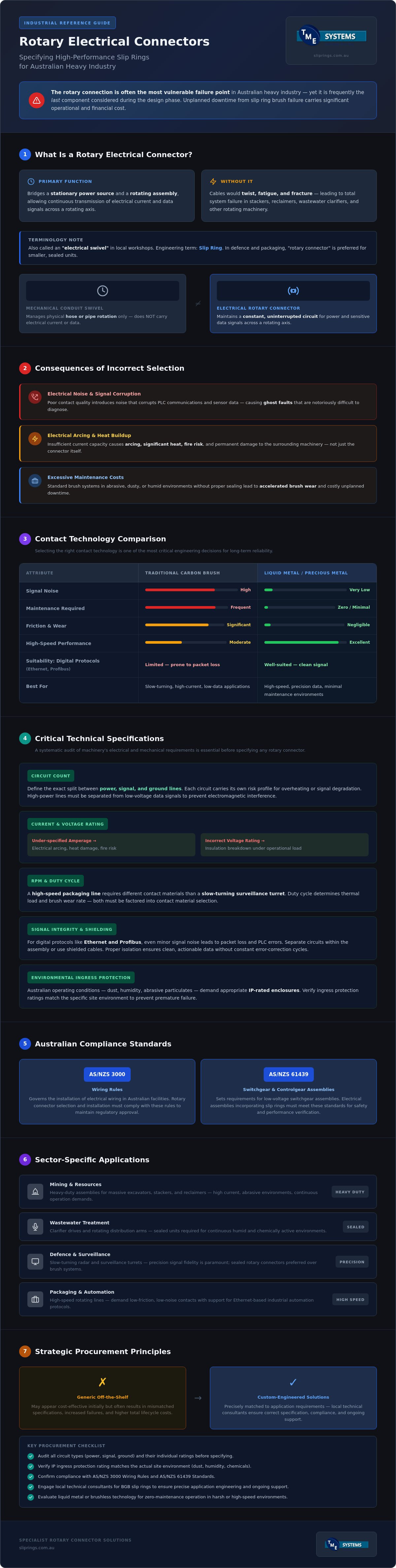
Rotary connectors must be engineered to withstand the specific stressors of their operating environment. In the Australian mining and minerals sector, equipment like stackers, reclaimers, and massive conveyor systems requires heavy-duty assemblies capable of handling high-current loads while exposed to abrasive ore dust. For these demanding roles, BGB slip rings Australia are frequently specified due to their proven track record in extreme conditions. These units ensure that power for drive motors and control signals for positioning sensors remain uninterrupted despite the constant vibration and heavy particulate matter found on-site.
The defence and surveillance sectors demand a different set of performance criteria, prioritising signal reliability and precision. High-reliability swivels are essential for radar systems, CCTV installations, and armoured vehicle turrets. These applications often require hybrid configurations that combine electrical circuits with fibre optic rotary joints. Similarly, the renewable energy sector relies on specialised slip ring assemblies for wind turbine pitch control. These components allow the turbine blades to adjust their angle relative to the wind while maintaining a constant electrical connection to the hub's control electronics.
In the food and beverage industry, the primary challenge is maintaining hygiene during frequent high-pressure washdowns. Rotary fillers and labelling machines require sealed, stainless steel connectors that prevent water ingress and bacterial growth. These units must be compatible with caustic cleaning agents used in Australian processing plants. Choosing a connector with the correct sealing ensures that production lines don't suffer from electrical shorts or corrosion during routine maintenance cycles.
Robotics and Automation
Modern industrial robotics requires compact swivel connectors that can be integrated directly into arm joints. These components provide 360-degree freedom of movement without the risk of cable snagging. Maintaining signal purity is the top priority here, especially for high-definition vision systems and feedback sensors that dictate the robot's precision. You must select connectors designed for high-frequency repetitive motion. Standard units often fail prematurely under the stress of constant oscillation, making specialised automation-grade swivels a necessity for long-term reliability.
Water Treatment and Marine Environments
Facilities such as wastewater treatment plants and offshore marine platforms face constant threats from moisture and corrosion. Specifying IP67-rated connectors for clarifiers and marine winches is a standard requirement to prevent internal ingress. Stainless steel housings are essential in coastal or chemical-heavy environments to resist salt spray and corrosive vapours. You also need to account for internal moisture buildup. Australian humidity can cause condensation within a sealed unit if it isn't designed with proper internal venting or desiccant features. If you are designing for these harsh conditions, contact our technical team to ensure your specifications meet the necessary environmental standards.
Strategic Procurement: Sourcing Reliable Rotary Solutions in Australia
Procurement for Australian industrial projects requires more than just a part number. You need a partner who understands the nuances of local site conditions and electrical standards. Sourcing BGB slip rings Australia through local channels ensures you have access to application engineering support that bridges the gap between a technical requirement and a physical solution. This local presence is vital for verifying lead times and ensuring that critical spares are held in-country to minimise the impact of unplanned downtime. When a component fails in a remote mining site or a busy processing plant, having a technical contact in the same time zone is a significant operational advantage.
TME Systems Pty Ltd, with an established operational base in Australia, serves as the primary technical contact for BGB Innovation products in Australia. They assist in navigating the complexities of technical selection, ensuring that every specified unit matches the machine's actual duty cycle. Procurement officers often fall into the trap of ordering "off-the-shelf" components to save time. However, for complex machinery, a generic solution often lacks the precise electrical sizing or environmental sealing required. This oversight results in higher long-term costs due to frequent replacements and the potential for catastrophic equipment damage. Selecting the right partner means choosing a consultant who provides a pathway to a solution rather than just a vendor.
Technical Consulting and Selection
Working with an Australian distributor allows for a detailed technical audit before purchase. You can consult on specific mounting configurations to avoid mechanical misalignment, which is a leading cause of premature failure in rotary interfaces. If you're dealing with legacy machinery where original parts are no longer available, custom-engineered solutions become the only viable path to maintaining operational integrity. This consultative approach ensures that the chosen contact technology is compatible with both your power requirements and your modern data protocols. It also allows for the integration of specific features, such as specialised connectors or custom housing materials, that off-the-shelf units simply don't offer.
Quality Assurance and Standards
All rotary solutions must meet the safety and performance expectations of Australian industry. This includes adhering to the AS/NZS 3000 wiring rules and ensuring that assemblies are fit for their intended environment. For applications requiring extreme precision, such as high-speed testing or laboratory environments, brands like Meridian Laboratory provide the necessary technical benchmarks for low-noise performance. For a comprehensive look at selecting a partner for your next project, refer to our Industrial Slip Ring Supplier Australia: A Professional Procurement Guide. These resources help you build a procurement strategy focused on long-term reliability and technical excellence rather than just the initial purchase price.
Optimising Your Industrial Rotary Connections
Optimising the performance of your rotating machinery requires a deliberate approach to electrical interface selection. You've seen how the distinction between liquid metal precision and heavy-duty brush systems is fundamental to preventing signal corruption and mechanical wear. By prioritising technical specifications like IP ratings and circuit isolation, you protect your facility from the hidden costs of unplanned downtime. When sourcing BGB slip rings Australia, the value of local technical support can't be overstated. Local expertise ensures your hardware is correctly sized for its specific duty cycle and environmental conditions.
TME Systems Pty Ltd serves as your dependable partner in this process, offering national supply and application engineering support from our Australian base. As the authorised distributor for Mercotac, Meridian Laboratory, and BGB Innovation, we specialise in solving the complexities of high-speed and low-noise rotary applications. We invite you to consult with TME Systems Pty Ltd for technical selection support to secure a high-performance solution tailored to your specific industrial needs. Don't settle for off-the-shelf compromises that lead to premature wear. Specifying the correct connector today prevents costly failure tomorrow.
Frequently Asked Questions
Can a rotary electrical connector handle both power and high-speed data simultaneously?
Yes, hybrid rotary connectors are designed to manage both high-current power and sensitive data circuits within a single assembly. Success depends on internal shielding and physical isolation to prevent electromagnetic interference from corrupting data packets. You must specify a unit engineered for this purpose to ensure that high-speed protocols like Gigabit Ethernet remain stable while the machine is under full electrical load.
What is the difference between a mercury-wetted and a mercury-free rotary connector?
Mercury-wetted connectors use a pool of liquid metal to maintain a constant, low-resistance connection with near-zero signal noise. Mercury-free alternatives use precious metal alloys or specialised brushes to achieve electrical conduction without the environmental risks associated with liquid mercury. While mercury-wetted units offer superior stability for high-definition vision systems, mercury-free models are mandatory for food-grade processing or sensitive Australian environmental zones.
How do I determine the IP rating needed for an outdoor electrical swivel in Australia?
Your choice of IP rating should reflect the specific environmental stressors of your site. For general outdoor use in dusty Australian conditions, an IP65 rating is typically the minimum requirement. If your equipment faces high-pressure washdowns or heavy tropical rain, you should specify IP66 or IP67. This prevents moisture ingress that can lead to internal arcing and catastrophic failure in rotating machinery.
How often do industrial slip rings require maintenance or replacement in heavy-duty use?
Maintenance intervals vary significantly based on the contact technology and the duty cycle of the equipment. Traditional carbon brush systems often need inspection every few months to clear conductive dust and check brush length. Sealed liquid metal units are designed for maintenance-free operation over millions of revolutions. Sourcing BGB slip rings Australia through a technical consultant ensures you select a model that aligns with your site's maintenance schedule.
Are there rotary connectors available for high-speed applications exceeding 5000 RPM?
Yes, specialised brushless and liquid metal connectors are engineered to operate at speeds well above 5000 RPM. Traditional brush systems usually fail at these speeds because friction generates excessive heat and causes the brushes to bounce. Precision models from brands like Meridian Laboratory maintain a stable connection at high velocities, making them suitable for high-speed testing rigs and advanced centrifugal machinery used in Australian laboratories.
What causes electrical noise in a swivel connector and how can it be reduced?
Electrical noise is primarily caused by inconsistent contact between the stationary and rotating components, often due to mechanical vibration or brush wear. You can reduce this noise by specifying liquid metal contacts or gold-on-gold alloy systems that provide a more stable conductive path. Ensuring the connector is perfectly aligned during installation also reduces mechanical "bounce," which is a common source of signal distortion in sensitive sensors.
Can I use a standard electrical swivel for Ethernet or Profinet transmission?
You shouldn't use a standard power swivel for high-speed data protocols. Ethernet and Profinet require controlled impedance and specialised shielding to prevent packet loss and signal degradation. You need to specify a data-rated rotary connector that uses twisted-pair wiring and high-frequency contacts. This ensures your PLC receives clean, real-time data without the lag or ghost faults associated with unshielded power-grade swivels.
Is it possible to customise the circuit count on a standard industrial slip ring?
Customisation is a standard feature for modular industrial slip rings. While compact capsule designs are often fixed, many heavy-duty assemblies allow you to stack modules to reach the exact circuit count your machine requires. When you specify BGB slip rings Australia, you can work with an application engineer to define a custom mix of power, signal, and ground lines that fits within your existing mechanical housing.