What if the most sophisticated 4K surveillance system in your facility is only as reliable as a single rotating contact point? It's a frustrating reality for many systems integrators when high-resolution optics are undermined by signal "noise" or frame drops the moment a PTZ unit begins its rotation. Selecting the correct slip ring for CCTV camera systems is no longer just about maintaining a basic power connection; it's about ensuring the absolute integrity of high-speed data streams in compact, often harsh environments.
You likely recognise that mechanical failure in 24/7 surveillance units often stems from poor contact quality or insufficient environmental protection against Australian conditions. This article provides the technical framework to select components that ensure your installations deliver crystal clear 4K video without the risk of premature wear. We will analyse critical selection parameters including circuit counts for IP cameras, signal-to-noise ratios for UHD transmission, and the mechanical requirements for fitting IP-rated components into the restricted housing of modern dome units.
Key Takeaways
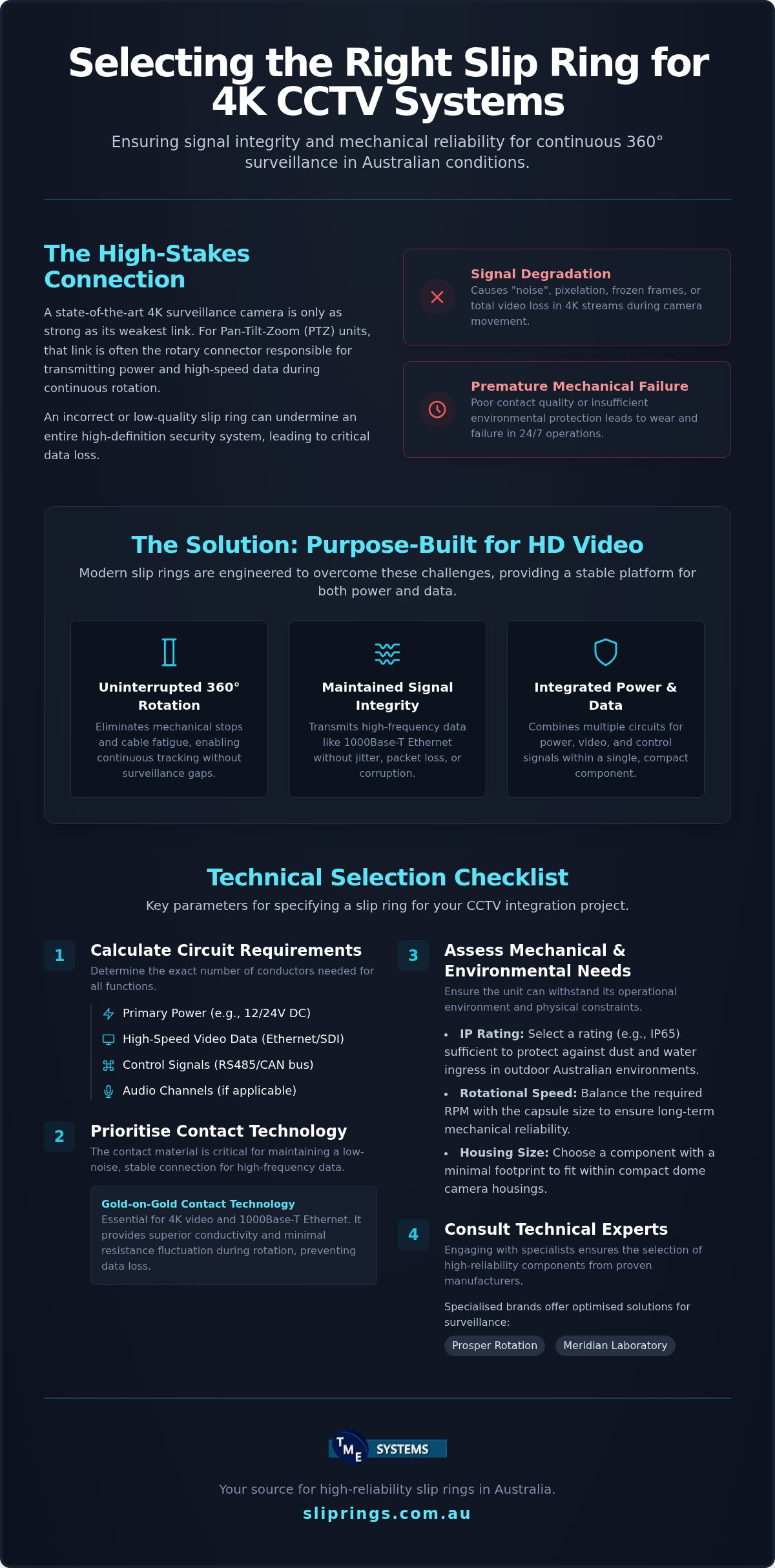
- Learn why gold-on-gold contact technology is essential for maintaining 1000Base-T Ethernet and 4K video signals without data loss during continuous rotation.
- Master the step-by-step process for specifying a slip ring for CCTV camera systems, including how to calculate the precise circuit count for power, control, and grounding.
- Understand the critical trade-offs between rotational speed and capsule size to ensure long-term mechanical reliability in compact dome camera housings.
- Identify the necessary IP ratings and material specifications required to prevent mechanical fatigue in 24/7 outdoor surveillance applications across Australian environments.
- Discover how professional technical consulting can help you select high-reliability components from specialised brands like Prosper Rotation and Meridian Laboratory.
The Role of Slip Rings in Modern CCTV and Surveillance Systems
In the engineering of modern surveillance, the ability to maintain a constant visual on a target is paramount. A Slip ring serves as the vital electromechanical interface that makes this possible, enabling the continuous 360-degree rotation of a camera head without the physical constraints of fixed cabling. While early security systems often relied on hard-wired connections that limited panning range, these setups inevitably led to mechanical fatigue. Cables subjected to repetitive twisting eventually suffer from internal conductor breakage, resulting in intermittent video loss or total system failure. Using a dedicated slip ring for CCTV camera installations eliminates these failure points by providing a reliable, sliding electrical contact.
The industry's transition from legacy analogue PAL/NTSC formats to high-bandwidth IP and HD-SDI digital video has fundamentally changed the requirements for rotary connectors. Modern 4K surveillance requires a connection capable of handling high-frequency data streams while maintaining a low electrical noise floor. It's no longer sufficient to simply provide electrical continuity. The component must ensure signal integrity across every degree of rotation to prevent the data packets from dropping, which would otherwise result in "frozen" or pixelated frames during critical monitoring periods.
Continuous Rotation vs. Limited Tilt
Standard PTZ cameras require "endless" 360-degree panning to track subjects across a wide perimeter. Without a rotary connector, the camera would reach a mechanical stop and be forced to rotate back in the opposite direction. This creates a critical window where surveillance is lost. Beyond traditional dome cameras, this technology is essential in robotic surveillance and unmanned ground vehicles (UGVs). For these compact applications, specialised solutions like Prosper Rotation slip rings provide the necessary circuit density within a minimal footprint, ensuring the mechanical assembly remains agile and responsive.
Integrated Power and Signal Transmission
Modern surveillance units are complex electromechanical assemblies that require the simultaneous transmission of low-voltage power and sensitive data signals. A typical circuit configuration for a high-end PTZ camera includes:
- Primary power supply: Typically 12V or 24V DC to drive the camera and internal heaters.
- High-speed video data: Ethernet for IP cameras or SDI for broadcast-quality units.
- Control signals: RS485 or CAN bus for precise motor positioning and zoom control.
- Audio channels: Bi-directional signals for intercom or environmental monitoring.
Managing these disparate signals within a single housing requires meticulous circuit isolation. If the power circuits aren't properly shielded from the data lines, electrical noise can corrupt the video feed. This is why professional-grade connectors prioritise shielding and contact material choice to maintain a clean signal path, even in environments with high electromagnetic interference.
Maintaining Signal Integrity for High-Definition Video Data
Transmitting 1000Base-T Gigabit Ethernet or HD-SDI through a mechanical rotating interface presents a unique electrical challenge. Unlike legacy analogue signals that might only show visual "noise" under interference, digital 4K feeds suffer from packet loss, latency, and total signal dropouts. This is particularly critical for maintaining signal integrity in advanced imaging systems where data rates are high and constant. Any fluctuation in contact resistance during rotation creates electrical jitter. This jitter disrupts the timing of high-frequency pulses, causing the digital decoder to lose lock and resulting in frozen frames at critical moments.
The primary enemy of high-definition video in a slip ring for CCTV camera is contact resistance fluctuation, often denoted as dynamic resistance. If the sliding contact is not perfectly stable, the resulting "noise" interferes with the sensitive data packets. Shielding and circuit isolation are mandatory to prevent motor electromagnetic interference (EMI) from degrading the video feed. High-power circuits for pan-tilt motors must be physically separated from data circuits within the capsule to prevent crosstalk.
Ethernet and IP Camera Compatibility
Modern IP cameras require performance levels equivalent to Cat5e or Cat6 cabling. A rotary connector must maintain a stable 100-ohm impedance for twisted-pair Ethernet to avoid signal reflections. For coaxial-based HD-SDI systems, 75-ohm impedance matching is essential to prevent signal degradation over the rotating interface. If these specifications aren't met, the surveillance network will experience increased bit error rates, regardless of the camera's native resolution.
Contact Materials and Signal Noise
Gold-on-gold contact technology is the industry standard for low-voltage signal clarity in surveillance. Unlike silver or copper, gold does not oxidise; this ensures that contact resistance remains low and stable over millions of revolutions. In the context of rotary connectors, the signal-to-noise ratio is the ratio of the desired signal power to the power of the background electrical noise generated by the sliding contact. Stable contact materials are the only way to keep this ratio high enough for 4K video.
For applications requiring the absolute lowest noise floor, Mercotac slip rings utilise a liquid metal pool to create a near-perfect electrical connection. This design eliminates the "brush bounce" and wear debris found in traditional mechanical brushes. If you're designing a high-bandwidth surveillance network for a sensitive environment, consulting with a technical specialist can help you identify the optimal shielding and contact configuration for your specific data requirements.
Mechanical Specifications: Durability in Continuous Rotation
Mechanical reliability determines the operational lifespan of a PTZ unit. While high-speed tracking cameras might require rotational speeds of 300 RPM or higher for rapid repositioning, the primary concern for most integrators is the trade-off between compact size and circuit capacity. As camera housings become increasingly miniaturised, the slip ring for CCTV camera must accommodate power, video, and control signals within a footprint often no larger than a standard postage stamp. Balancing this density with long-term mechanical wear requires precision-engineered bearings and low-friction contact materials to ensure 24/7 operation without maintenance intervals.
Vibration and shock resistance are equally critical, especially for cameras mounted on mobile platforms, heavy machinery, or near high-vibration equipment like industrial crushers. These environments demand a slip ring with reinforced internal supports to prevent "contact bounce". If the sliding contact is interrupted even for a millisecond by a physical shock, the digital video stream may lose synchronisation. Choosing a component with high structural integrity ensures that the camera remains functional despite constant mechanical movement and external stressors.
Capsule vs. Through-Bore Designs
Capsule slip rings are the default choice for compact dome and gimbal assemblies due to their integrated housing and pre-terminated lead wires. These units provide a plug-and-play solution for manufacturers. Conversely, through-bore options feature a hollow centre, allowing for the passage of a central drive shaft or even pneumatic lines if the camera is part of a larger sensor suite. While through-bore units offer greater mounting flexibility, they typically occupy more space. For those prioritising a minimal footprint in standard ceiling-mounted domes, Prosper Rotation slip rings offer specialised capsule designs that maintain high circuit counts in restricted spaces.
Environmental Protection and Sealing
Outdoor surveillance in Australia faces extreme environmental stressors. From the scorching heat of arid regions to the corrosive salt spray of coastal environments, the internal contacts must remain isolated from the atmosphere. An IP65 rating is generally sufficient for most weather-protected outdoor cameras, providing protection against dust and low-pressure water jets. For installations in high-exposure areas or marine environments, an IP67 rating ensures the device can withstand temporary immersion and finer particulate ingress. Corrosion resistance is vital; stainless steel or high-grade polymer housings prevent the structural degradation that can occur in coastal deployments. Selecting the correct sealing level is the most effective way to prevent premature electrical failure in the field.
Technical Selection Criteria for Security System Integrators
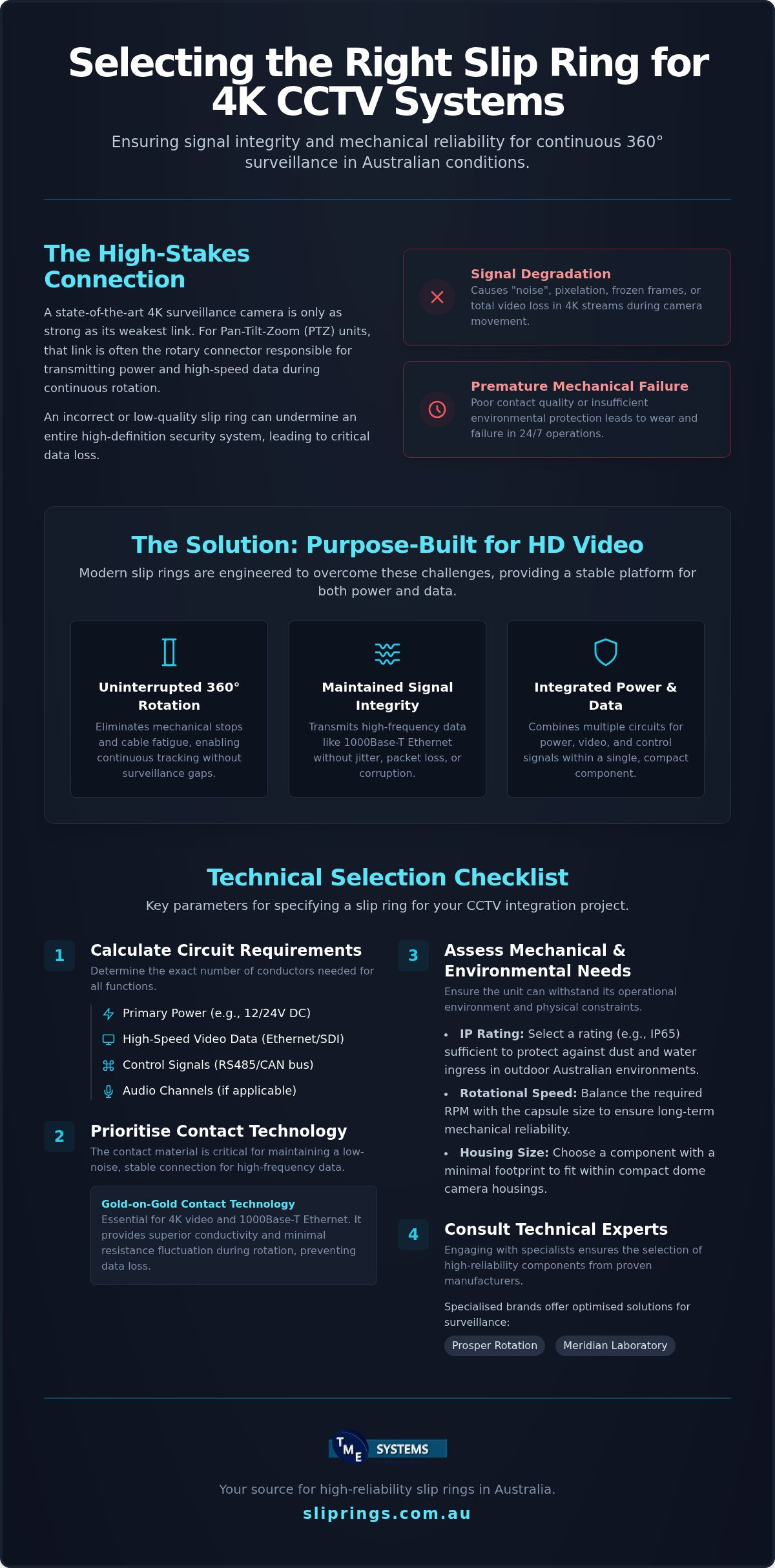
Specifying a slip ring for CCTV camera systems requires a methodical audit of both electrical and mechanical constraints. It's not merely a matter of finding a component that fits the physical housing; the selection must ensure compatibility with the entire hardware stack. Integrators should begin by calculating the total circuit count, which typically includes dedicated paths for primary DC power, video data, PTZ control signals, and a protective earth grounding circuit. For modern IP-based systems, this often involves specifying a unit with four to eight dedicated circuits for high-speed Ethernet alongside standard power lines.
Determining voltage and current requirements is the next critical step. While the camera sensor itself has a low draw, high-intensity IR illuminators and internal heaters, which are essential in Australian environments to prevent condensation, can significantly increase the total current load. Selecting a slip ring with insufficient current capacity leads to overheating and eventual contact failure. Integrators must also account for peak power draws during motor start-up when the camera initiates a rapid pan or tilt movement. Ensuring a 20 to 30 percent overhead in the current rating is a pragmatic way to guarantee long-term stability.
Circuit Configuration and Current Ratings
Effective circuit configuration involves physically separating high-current power lines from sensitive RS-485 or Ethernet data streams within the slip ring assembly. This separation is vital to minimise electromagnetic interference that can corrupt data packets. Standard circuit counts for common PTZ camera brands usually range from 6 to 24 circuits. When selecting a replacement unit, verify that the lead wire gauge is sufficient for the intended current load; thin wires can cause voltage drops that trigger camera reboots during high-load periods, such as when the IR array activates at dusk.
Physical Integration and Mounting
The physical envelope of the slip ring must align with the camera gimbal's internal geometry. Integrators must choose between flange mounting, which provides a secure external attachment point, or end-of-shaft mounting for more restricted spaces. Wire lead lengths and connector types, such as RJ45 for network cameras or BNC for analogue units, should be specified to match the existing loom to avoid unnecessary splicing. For custom surveillance housings or specialised industrial mounts, slip ring application engineering provides the necessary data to ensure the component meets both the mechanical and electrical demands of the project. If you require assistance in matching a slip ring to your specific camera model, contact TME Systems Pty Ltd for a technical consultation.
Professional Procurement and Technical Support in Australia
The procurement of a slip ring for CCTV camera system within the Australian market involves more than just a transaction. It requires a partner who understands the local regulatory environment, including the Electrical Equipment Safety System (EESS) and ACMA technical standards for electromagnetic compatibility. TME Systems Pty Ltd operates as an established distributor, ensuring that all imported components meet these rigorous safety and performance benchmarks. This local presence is critical for critical surveillance infrastructure where downtime isn't an option. Relying on overseas vendors can lead to delays in customs clearance or difficulties in managing the 10% GST and import processing charges required for formal declarations.
Partnering with a specialist distributor also guarantees long-term component availability. In the security industry, systems are designed to operate for a decade or more. If a specific capsule design becomes obsolete, a local technical partner can provide a drop-in replacement or a compatible upgrade path. This continuity prevents the need for costly full-system overhauls when a single rotating component reaches the end of its service life. Using an Australian partner ensures you have access to technical documentation and support that aligns with local engineering standards.
Specialist Brands for High-End Surveillance
For projects where zero-maintenance and extreme longevity are the primary metrics, Meridian Laboratory slip rings offer a superior solution. Their brushless designs eliminate the wear debris that can eventually cloud optical sensors or cause electrical noise in high-definition feeds. For large-scale outdoor perimeter cameras, BGB Innovation provides heavy-duty solutions that are engineered to withstand the mechanical stressors of high-torque motors and constant environmental exposure. These brands are selected for their proven performance in demanding industrial and security applications where failure is not an acceptable outcome.
Consultative Selection Process
Selecting the correct slip ring for CCTV camera units requires a thorough technical audit. TME Systems Pty Ltd assists integrators by analysing specific data points, such as peak current draws for IR heaters and the required signal-to-noise ratio for 4K video. This consultative approach reduces operational risks by selecting components with a high Mean Time Between Failures (MTBF). By providing national supply and engineering expertise, we ensure that every rotary connection is optimised for its specific environment. This methodical process moves beyond simple parts-picking and into professional application engineering, ensuring that your surveillance infrastructure remains reliable, clear, and compliant.
Optimising Rotary Performance for Australian Surveillance Infrastructure
The transition to high-resolution 4K surveillance has redefined the requirements for camera rotation. Maintaining signal integrity over millions of cycles requires a precise balance of contact materials, mechanical sealing, and electrical shielding. Selecting the correct slip ring for CCTV camera systems is no longer a simple hardware choice; it's an engineering decision that safeguards the long-term reliability of your security infrastructure.
TME Systems Pty Ltd serves as the authorised distributor for high-performance brands such as Mercotac and Prosper Rotation. Our team provides specialised technical support for Australian surveillance integrators, ensuring every rotary connection meets the rigorous demands of defence and critical infrastructure projects. By matching your specific circuit counts and environmental variables with proven hardware, we help eliminate the risk of signal dropouts and mechanical fatigue.
Contact our technical team for a CCTV slip ring consultation to ensure your next installation delivers the interference-free performance your clients expect. We look forward to supporting your technical requirements.
Frequently Asked Questions
What is the best slip ring for a 4K IP camera?
The best slip ring for a 4K IP camera utilises gold-on-gold contact technology or liquid metal to ensure a low electrical noise floor. These materials maintain the signal integrity required for high-bandwidth data streams without causing packet loss. It's essential to select a unit with specific impedance matching for Ethernet to prevent signal reflections. For compact installations, a high-quality capsule slip ring for CCTV camera systems provides the necessary performance within a restricted physical footprint.
Can a slip ring transmit Power over Ethernet (PoE)?
Slip rings can transmit Power over Ethernet (PoE) provided they are engineered to meet the necessary impedance and current specifications. The component must handle the DC voltage and current required by PoE standards while maintaining a stable 100-ohm connection for data. It's vital to verify that the internal wiring and contact resistance won't cause excessive voltage drops that could trigger camera reboots during high-load IR operation at night.
How long do CCTV slip rings typically last in 24/7 operation?
In 24/7 surveillance applications, a high-quality slip ring for CCTV camera units typically lasts between 10 million and 50 million revolutions before requiring maintenance. This lifespan depends heavily on the rotational speed and the contact materials used. Units featuring gold-on-gold contacts generally offer superior longevity compared to silver or copper alternatives. Regular mechanical audits help identify wear before it impacts video quality or the precision of camera movement.
Do slip rings cause signal interference in security cameras?
Signal interference only occurs if the slip ring lacks adequate internal shielding or exhibits high dynamic resistance. Professional-grade units isolate high-current power circuits from sensitive data lines to prevent electromagnetic interference. If you experience "noise" or frame drops during rotation, it often indicates poor contact quality or insufficient circuit separation. Choosing a component designed for high-frequency digital signals ensures a clean, interference-free video feed across all degrees of movement.
What IP rating is required for an outdoor PTZ camera slip ring?
An outdoor PTZ camera slip ring generally requires a minimum rating of IP65 to protect against dust and water ingress. In coastal Australian environments or areas prone to high-pressure washdowns, upgrading to an IP66 or IP67 rating is recommended. These higher ratings ensure that the internal electrical contacts remain isolated from salt spray and moisture. This prevents corrosion and maintains the reliability of the surveillance system over several years of exposure.
Can I replace a slip ring in an existing dome camera?
Replacing a slip ring in an existing dome camera is possible provided the new component matches the original's physical envelope and circuit configuration. Capsule slip rings are often used as drop-in replacements due to their integrated housing and pre-terminated lead wires. It's critical to confirm that the lead wire gauge and connector types are compatible with the existing camera loom to avoid complex soldering or mechanical modifications during the repair process.
How do I reduce electrical noise in my camera rotation?
Reducing electrical noise in camera rotation requires selecting components with stable contact resistance and superior shielding. Gold-on-gold contact technology significantly reduces "brush bounce" and electrical jitter compared to standard alloys. For the absolute lowest noise levels, liquid metal interfaces provide a near-perfect electrical connection. Ensuring that the camera's grounding circuit is correctly terminated through the slip ring also helps dissipate stray electromagnetic interference that can degrade sensitive digital signals.
Are there mercury-free slip rings suitable for security applications?
Mercury-free slip rings are widely available and are the standard choice for most security applications. While liquid metal units offer high performance, gold-on-gold capsule designs from brands like Prosper Rotation provide a reliable alternative for dome and PTZ cameras. These units are easier to transport and dispose of while still delivering the low contact resistance and long service life required for 24/7 surveillance in demanding commercial and industrial settings.