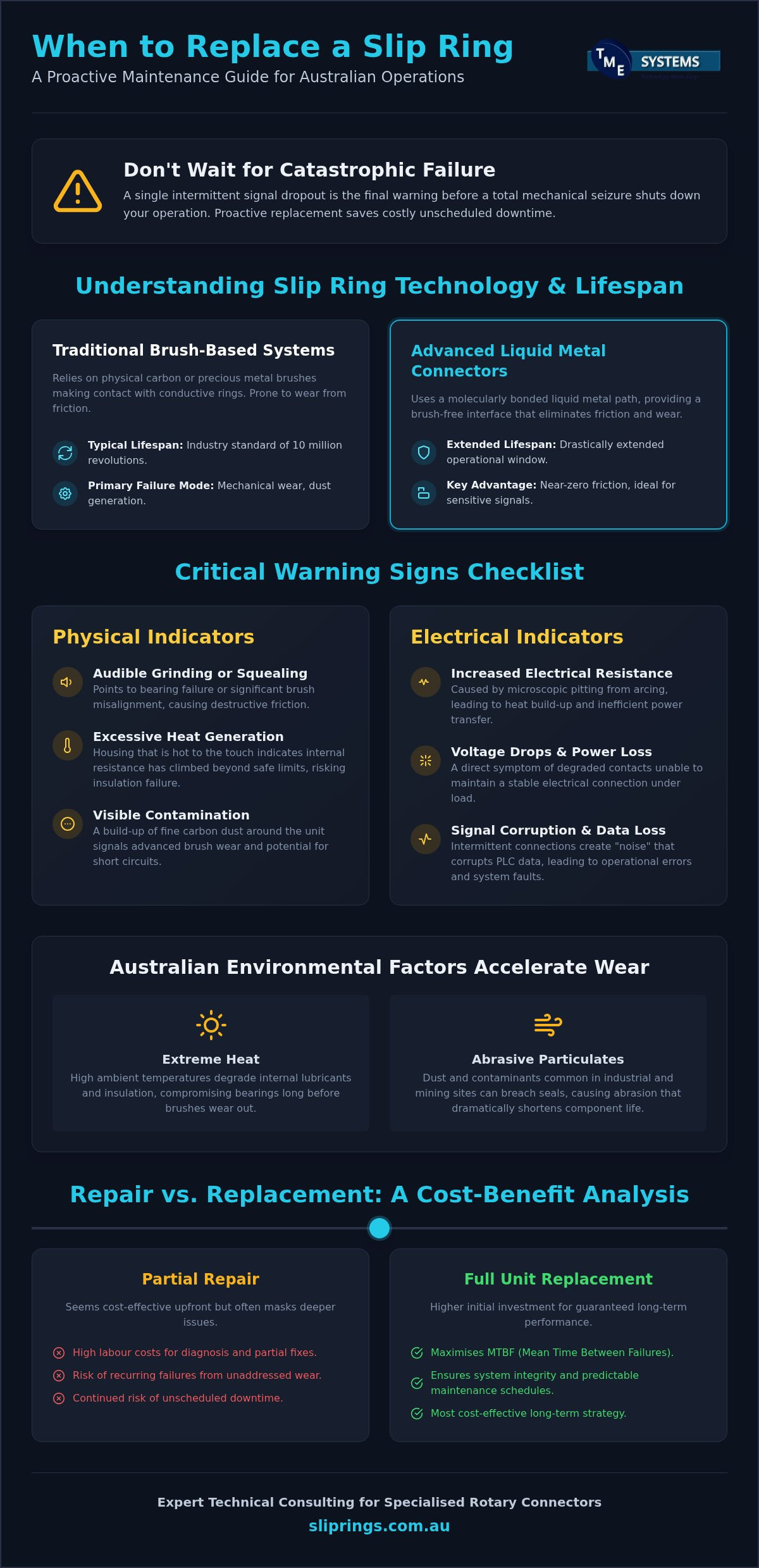
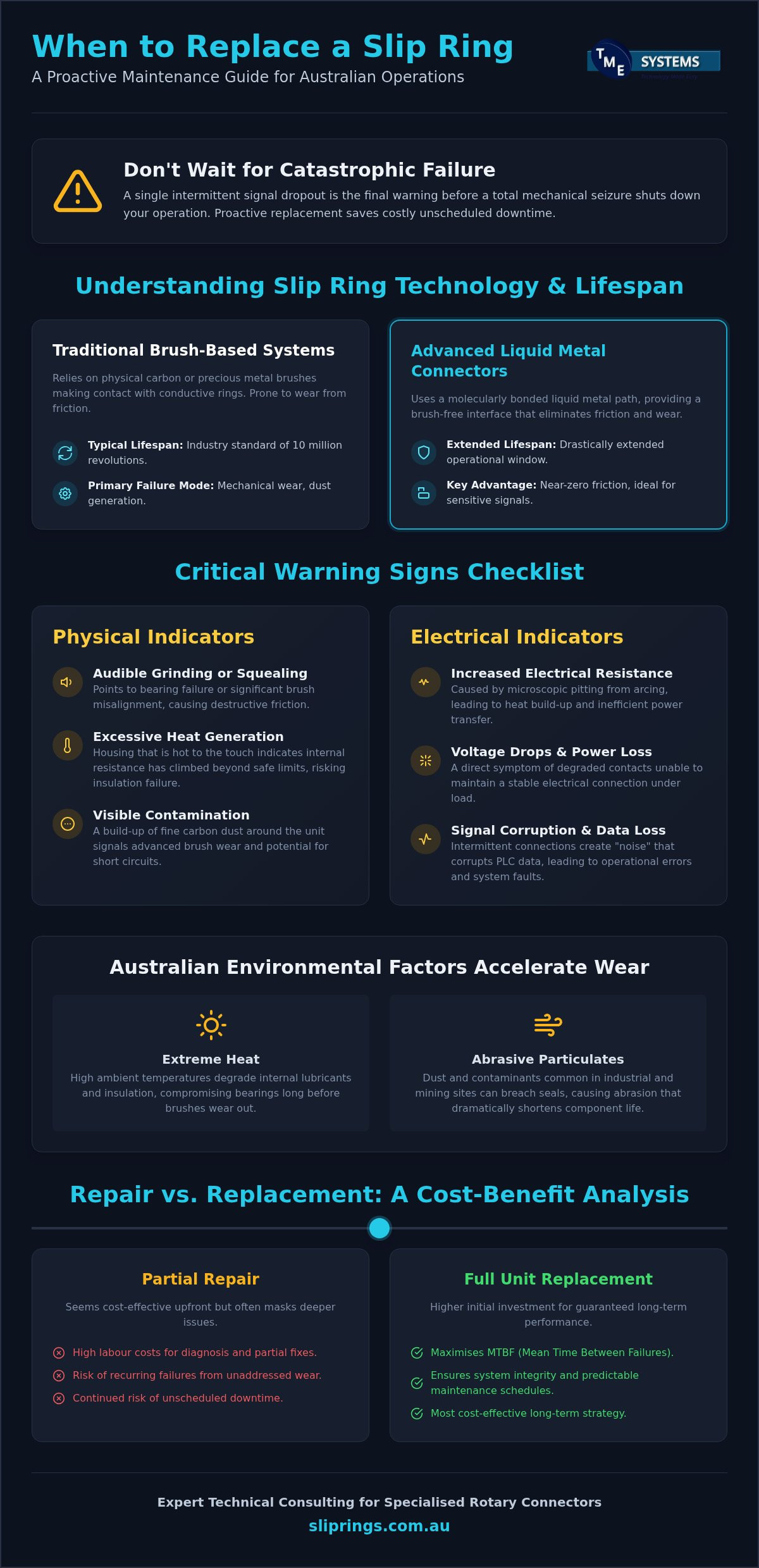
A single intermittent signal dropout in your PLC data isn't just a minor glitch; it's often the final warning before a total mechanical seizure shuts down your entire operation. For Australian maintenance managers, the pressure to maximise equipment uptime often leads to a "run to fail" mentality that ignores the subtle indicators of component fatigue. You likely recognise that every hour of unscheduled downtime costs your facility far more than the price of a proactive maintenance window. This guide identifies the critical electrical and mechanical triggers to help you decide exactly when to replace a slip ring before it compromises your system's integrity.
We'll examine the technical signs of degradation, such as increased electrical resistance and physical brush wear, acknowledging that even high-quality modular systems are generally benchmarked to an industry standard of 10 million revolutions. By understanding these failure modes, you can gain the confidence to select superior replacements from brands like Mercotac or BGB Innovation. We will outline a methodical approach to identifying failure signs, helping you minimise the risk of catastrophic failure and navigate the complexities of sourcing specialised rotary connectors within the Australian market.
Key Takeaways
- Evaluate Mean Time Between Failures (MTBF) by analysing RPM, duty cycles, and current loads to establish a proactive maintenance schedule.
- Recognise the critical electrical warning signs, such as voltage drops and signal corruption, that indicate when to replace a slip ring to avoid unscheduled downtime.
- Account for the impact of the Australian environment, where extreme heat and abrasive particulates can significantly reduce the lifespan of standard rotary connectors.
- Determine the most cost-effective path by comparing the labour costs of partial repairs against the long-term reliability of a full unit replacement.
- Optimise your system's performance through technical consulting that ensures your replacement hardware meets precise circuit and speed requirements.
Understanding Slip Ring Service Life and MTBF
A slip ring is an electromechanical component that enables the transfer of power and data across a rotating interface. For Australian maintenance managers, Mean Time Between Failures (MTBF) is the most reliable metric for predicting maintenance intervals. It represents a statistical average of how long a unit should operate before an inherent failure occurs. While this provides a baseline, actual service life depends heavily on the specific technology used and the operational environment. It's a common mistake to assume that a unit will reach its full rated life without accounting for local site variables.
Design choices significantly dictate longevity. Traditional brush-based systems, such as those provided by BGB Innovation, rely on physical contact and are typically rated for an industry standard of 10 million revolutions. In contrast, liquid metal connectors from Mercotac provide a brush-free interface. This drastically reduces internal friction and extends the operational window for sensitive signals. Understanding these technological differences is vital when deciding when to replace a slip ring in a high-speed or high-duty-cycle application.
Mechanical Wear vs. Electrical Degradation
Physical friction is the primary driver of mechanical wear. Every rotation causes the brushes to wear down against the conductive rings, eventually depleting the contact material. High-speed rotation also places significant stress on internal bearings and seals. If a seal fails, contaminants enter the housing, accelerating wear through abrasion. This physical depletion is often visible during routine inspections as carbon dust accumulation or reduced brush spring tension.
Electrical degradation often happens simultaneously but is harder to spot. Electrical arcing, caused by minor contact bounces or high current loads, creates microscopic pitting on the ring surfaces. This damage increases electrical resistance and generates thermal energy. Over time, this heat can degrade the surrounding insulation or lubricants. This leads to a total system failure that could've been avoided with earlier intervention. Identifying these electrical anomalies is a primary indicator of when to replace a slip ring.
Manufacturer Specifications vs. Real-World Usage
Datasheets usually provide a "design life" based on controlled laboratory conditions. These figures assume optimal mounting, stable temperatures, and clean air. In Australian industrial settings, factors like 24/7 duty cycles and high ambient temperatures often shorten these windows. If you're running a unit at its maximum rated RPM continuously, the heat build-up will likely compromise the bearings long before the brushes wear out.
Proper integration is essential for reaching the manufacturer's stated lifespan. Misalignment during installation creates side-loading on the shaft, which forces the internal components to work against uneven friction. This doesn't just reduce efficiency; it creates a "hot spot" that accelerates the degradation of both the electrical contacts and the mechanical housing. Monitoring these variables helps you accurately predict when to replace a slip ring before it reaches a point of catastrophic failure.
Technical Warning Signs: When to Replace a Slip Ring
Determining exactly when to replace a slip ring requires a shift from basic visual checks to measurable technical assessments. While a unit might still be rotating, internal arcing and contact pitting can compromise the electrical path long before the housing shows signs of distress. A technical analysis of slip ring failure indicates that surface irregularities often lead to a "snowball effect" where increased resistance generates more heat, further damaging the conductive rings. For Australian maintenance managers, catching these signs early is the difference between a planned swap-out and an expensive emergency repair.
Physical indicators are often the most immediate red flags. Audible grinding or high-pitched squealing usually points to bearing failure or significant brush misalignment. Excessive heat generation, where the housing feels noticeably hot to the touch, suggests that internal resistance has climbed beyond safe limits. You should also look for visible contamination; a build-up of fine carbon dust around the vents or evidence of oil leakage from seals are clear signs that the unit's internal integrity is failing. If you observe these symptoms, a technical application consultation can help determine if a different technology, such as liquid metal, is required for your specific environment.
Measuring Electrical Signal Integrity
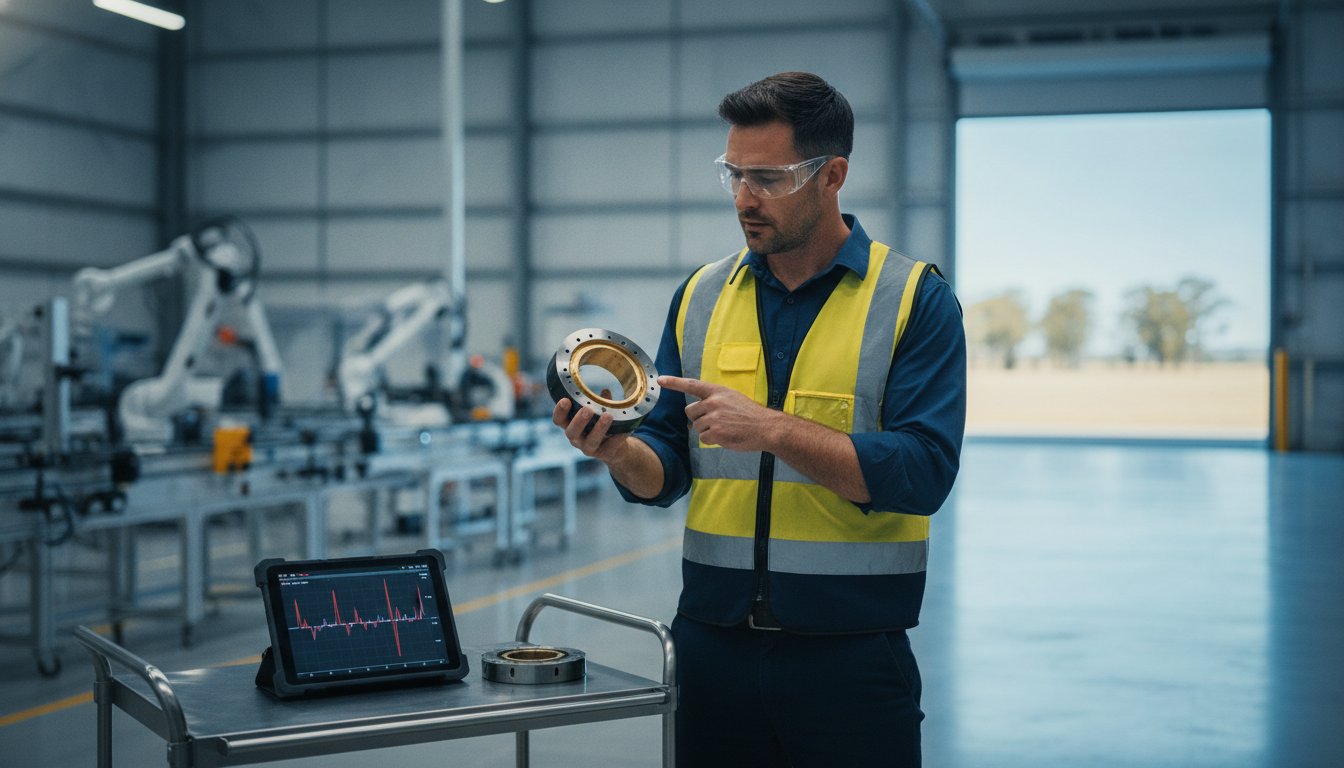
Signal noise and data corruption in PLC or sensitive sensor lines are primary triggers for replacement. You can use an oscilloscope to detect "noise" or voltage spikes in high-speed data transmission that a standard multimeter might miss. If the contact resistance fluctuates wildly during rotation or exceeds the baseline by more than 10%, the conductive path is no longer reliable. Intermittent connectivity, often described as "dead spots" at certain points of the rotation, confirms that the ring surface has significant pitting or accumulated debris that prevents consistent contact.
Mechanical Inspection Protocols
A thorough mechanical audit should focus on shaft run-out and bearing play. Any perceptible movement in the shaft indicates that the internal bearings are worn, which will eventually lead to catastrophic mechanical seizure. For traditional brush-based systems, such as those from BGB Innovation, inspecting the brush length is mandatory. If the brushes have reached their minimum wear line, the spring tension will be insufficient to maintain a stable connection. In IP-rated or liquid metal connectors, evaluate the seal condition; any brittleness or cracking in the elastomer seals justifies an immediate replacement to prevent ingress of abrasive Australian dust.
Environmental Factors Accelerating Wear in Australia
Australia's industrial landscape presents unique challenges that standard datasheets often fail to account for. For maintenance managers in the Pilbara or tropical Queensland, environmental stressors are the primary drivers of premature component failure. Identifying these local variables is essential for determining when to replace a slip ring before it causes a site-wide outage. High ambient temperatures, abrasive iron ore dust, and coastal salt spray all work to degrade mechanical seals and electrical contact surfaces far faster than in temperate climates.
High-vibration environments, common in heavy machinery and screening plants, also compromise contact stability. Constant oscillation can lead to "fretting corrosion" where minute movements at the contact interface create oxidised debris. This debris increases electrical resistance and can eventually lead to signal loss. Monitoring the vibration profiles of your rotating equipment is a proactive way to predict wear patterns that don't appear in standard service life tables.
Managing Dust and Contaminants
In Australian mining and quarrying operations, fine particulates are a constant threat. Even with high-quality housings, micron-sized dust can bypass standard seals through capillary action or pressure differentials during thermal cycling. Once inside, these contaminants act as an abrasive paste, grinding down the conductive rings and brushes. For outdoor plant equipment, an IP65 or IP67 rating is often the bare minimum required for survival.
In bulk material handling applications, such as ship loaders or conveyor pivots, units often fail in less than half their rated lifespan due to heavy ingress. This accelerated wear makes regular physical inspection of the internal housing a non-negotiable trigger for replacement. If you find evidence of grit inside the unit, the internal contact surfaces are likely already compromised beyond the point of reliable operation.
Heat Dissipation and Thermal Stress
High ambient temperatures across much of Australia significantly impact the current-carrying capacity of rotary connectors. As external heat rises, the ability of the slip ring to dissipate the thermal energy generated by electrical resistance decreases. This leads to increased lubricant viscosity in bearings and potential dielectric breakdown in insulation materials. In high-RPM precision applications, thermal expansion can cause minute shifts in contact alignment, leading to signal jitter.
Selecting components with high-temperature resilience is vital. For example, Mercotac slip rings utilise liquid metal technology that remains stable across a wide thermal range, offering superior signal integrity compared to traditional grease-filled units. Likewise, BGB Innovation slip rings are often specified for heavy-duty wind and mining applications because their brush grades are engineered to withstand the thermal loads of continuous operation. Thermal degradation of internal seals is a clear indicator of when to replace a slip ring to prevent lubricant leak-out and subsequent bearing seizure.
Replacement vs. Repair: A Professional Cost Analysis
Maintenance managers often face the dilemma of whether to refurbish an existing unit or invest in a new one. While a repair might seem cheaper on a procurement spreadsheet, the labour costs associated with a complex teardown and component-level refurbishment can quickly eclipse the cost of a brand-new, factory-tested unit. There's also the significant risk of "secondary failure". Replacing only the brushes while leaving aged bearings or brittle seals in place creates a weak link in the system. Deciding when to replace a slip ring should involve a risk assessment of the entire assembly, not just the most obviously worn part.
Time is the most critical variable in the Australian industrial sector. A standard replacement can often be completed in under two hours, whereas a comprehensive repair might take two days once sourcing individual components and testing are factored in. In high-stakes environments, the production loss from an extended outage far outweighs the capital expenditure of a new unit. If your current hardware requires frequent "patching" to maintain signal integrity, it's a clear indicator that the unit has reached the end of its reliable service life.
The True Cost of Reactive Maintenance
Calculating the cost of lost production is essential for justifying a replacement strategy. In critical rotary equipment, an unscheduled stop doesn't just affect one machine; it disrupts upstream and downstream processes, leading to a cascade of idle labour and missed deadlines. Holding critical spares is a standard requirement for Australian facilities to mitigate this risk. By swapping out a degrading unit during a planned maintenance window, you eliminate the unpredictability of reactive repairs and ensure the facility remains operational during peak demand.
Strategic Upgrading During Replacement
A replacement cycle is the ideal time to evaluate if the original OEM slip ring was under-specified for the task. Many factory-fitted units are selected for cost rather than long-term durability in harsh environments. You might find that moving to Mercotac liquid metal technology provides the noise-free signal your PLC requires, or that BGB Innovation heavy-duty designs offer the robustness needed for high-vibration mining applications. This is also an opportunity to future-proof your equipment for higher data speeds or increased current requirements. Before you commit to a like-for-like swap, consult with a technical specialist to ensure your replacement hardware is optimised for your specific site conditions.
Organising Your Slip Ring Replacement with TME Systems
Once you've determined when to replace a slip ring based on the electrical and mechanical triggers discussed, the next step is ensuring the new component is perfectly matched to your application. TME Systems operates as a specialised Australian distributor, providing the technical bridge between leading global manufacturers and local industrial requirements. We don't just supply hardware; we provide the technical application consulting necessary to ensure that circuit counts, current capacities, and rotational speeds are precisely aligned with your machinery's demands.
For applications requiring extreme precision and high-speed data transmission, we facilitate the selection of Meridian Laboratory slip rings. These units are engineered for near-zero electrical noise, making them ideal for sensitive laboratory and high-speed industrial environments. Conversely, for more versatile industrial needs, Prosper Rotation offers a range of robust solutions that balance performance with cost-effectiveness. By sourcing through a local specialist, you eliminate the risks associated with generic overseas procurement and ensure compliance with Australian standards.
Technical Data Required for Accurate Sourcing
To provide an accurate specification, several data points are essential. You'll need to define the exact circuit count, including dedicated lines for power and signal. Voltage requirements and maximum current per circuit must be specified to prevent overheating. Mechanical compatibility is equally critical; ensure you've verified the shaft diameter, housing dimensions, and mounting style, such as through-bore or flange mount. Finally, identify the required IP rating for environmental protection and the maximum operating RPM to ensure the internal bearings and seals can withstand the duty cycle.
Streamlining Procurement in Australia
Procuring specialised rotary connectors in Australia can be complex due to long lead times and a lack of local technical support. TME Systems streamlines this process by offering deep expertise in slip ring application engineering. This ensures that you aren't just buying a part number, but a verified solution for your specific engineering challenge. If you're uncertain about when to replace a slip ring or which technology best suits your environment, contacting TME Systems for professional procurement and specification advice is the most reliable way to maintain your facility's uptime.
Optimising Reliability Through Proactive Component Management
Accurately identifying when to replace a slip ring is a technical necessity that protects your facility from the compounding costs of unscheduled downtime. By monitoring measurable degradation, such as increased electrical resistance or physical seal failure, you can transition from risky reactive repairs to a strategic, planned replacement cycle. This methodical approach is particularly vital in harsh Australian industrial environments where extreme heat and abrasive dust frequently shorten the standard service life of even the most robust rotary connectors.
TME Systems has operated as a specialised Australian distributor since its inception, providing deep technical support for world-leading brands like Mercotac and BGB Innovation. Our national supply chain ensures that critical industrial components are available for your facility, backed by application engineering to ensure perfect compatibility with your existing machinery. We take pride in helping our clients bridge the gap between complex hardware specifications and real-world operational success.
Contact TME Systems for Expert Slip Ring Selection Advice to secure the long-term performance and signal integrity of your rotating equipment. We look forward to supporting your next maintenance project with precision and expertise.
Frequently Asked Questions
How can I tell if my slip ring noise is electrical or mechanical?
Electrical noise typically manifests as signal jitter, data packet loss, or intermittent PLC errors visible on an oscilloscope. Mechanical noise is usually audible, presenting as grinding, squealing, or high-pitched humming from the housing. While electrical noise indicates contact degradation or surface pitting, mechanical noise points to bearing failure or seal compromise. You should use vibration analysis to confirm mechanical issues before they lead to a total seizure.
Can a slip ring be cleaned instead of replaced?
Cleaning is often a temporary measure for open-style brush units, but it cannot restore worn contact plating or pitted ring surfaces. For sealed capsule or liquid metal units, cleaning the internal contacts is not possible. While removing carbon dust might briefly improve conductivity, it doesn't address the underlying mechanical wear. Most Australian maintenance managers find that the labour cost of repeated cleaning exceeds the price of a full replacement.
What is the typical lifespan of a liquid metal slip ring compared to a brush type?
Liquid metal slip rings, such as those from Mercotac, can often exceed 100 million revolutions because they eliminate physical brush friction. In contrast, high-quality modular brush systems are typically benchmarked to an industry standard of 10 million revolutions. This significant difference in longevity is a primary factor for engineers to consider when determining when to replace a slip ring in high-speed or continuous-duty applications.
How do I measure slip ring contact resistance accurately?
You should use a micro-ohmmeter to measure the voltage drop across the rotating interface while the unit is in motion. A standard multimeter often lacks the resolution required to detect the milliohm fluctuations that signal internal degradation. By monitoring these values during a slow rotation, you can identify "dead spots" or resistance spikes that indicate the conductive path is no longer reliable for sensitive data or power transmission.
What happens if a slip ring fails completely during operation?
A complete failure can result in a mechanical seizure, potentially shearing mounting brackets or damaging the primary drive motor. Electrically, a total loss of contact causes immediate system shutdowns and can trigger complex logic errors in connected PLC systems. This risk of secondary equipment damage is why identifying when to replace a slip ring through proactive monitoring is essential for maintaining safe and cost-effective facility operations.
Are there mercury-free alternatives for food-grade or sensitive environments?
Yes, gold-on-gold or silver-on-silver contact designs from manufacturers like Meridian Laboratory provide high-performance, mercury-free alternatives. These units are specifically engineered for food processing or pharmaceutical environments where the risk of liquid metal contamination must be eliminated. They offer excellent signal integrity and low electrical noise without the environmental constraints or regulatory requirements associated with mercury-based connectors, ensuring compliance with Australian safety standards.
Does high RPM always mean a shorter slip ring life?
High RPM increases friction-generated heat and centrifugal forces, which can accelerate the degradation of internal lubricants and seals. While high speed doesn't strictly guarantee a shorter life, it necessitates the use of units specifically engineered for those velocities. If a standard slip ring is operated beyond its rated RPM limits, the bearings will fail prematurely, and contact bounce will compromise the electrical signal long before the brushes are worn.
How do I choose between a through-bore and a capsule slip ring for replacement?
The choice depends on your machinery's mechanical configuration and mounting constraints. A through-bore slip ring is designed to slide over a central drive shaft or allow for the passage of pneumatic or hydraulic lines through the centre. A capsule slip ring is a compact, fully enclosed unit typically mounted at the end of a shaft. You must verify the available spatial envelope and mounting style before selecting a replacement unit.