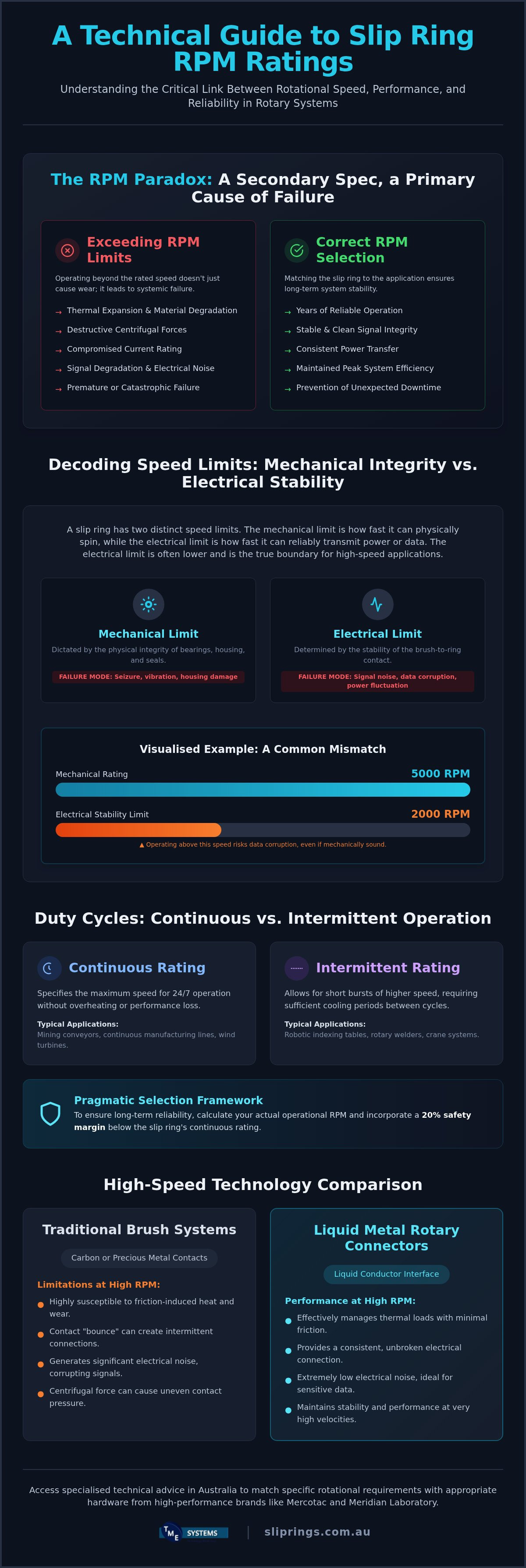
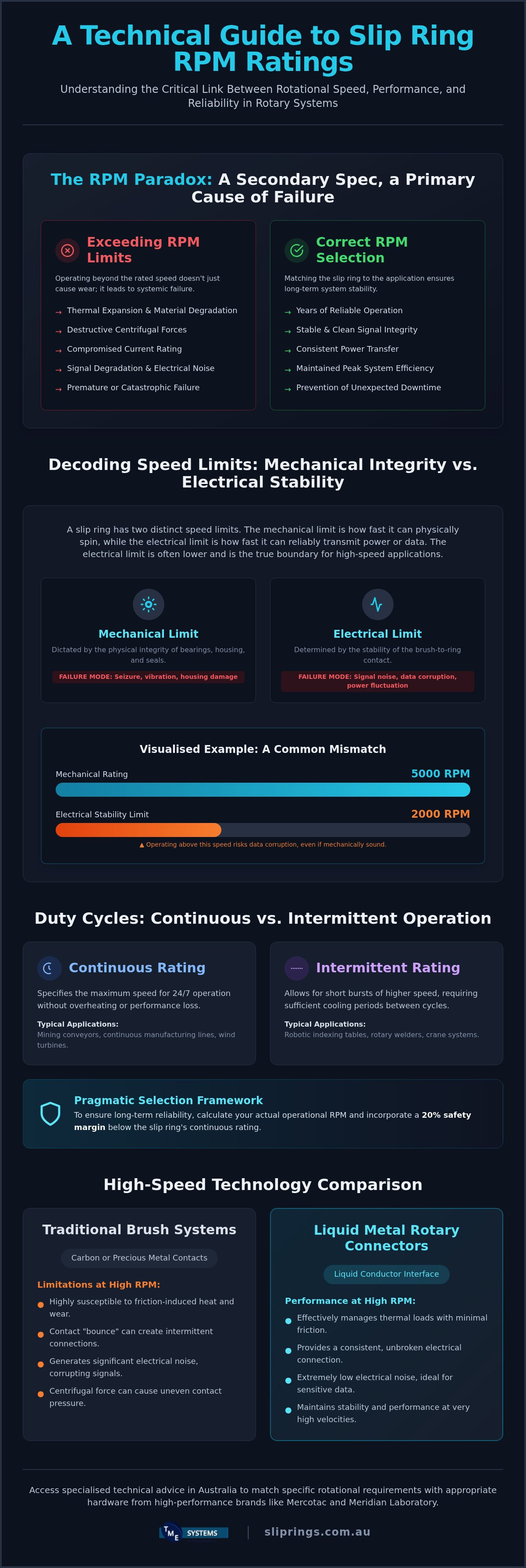
A slip ring's RPM rating is frequently treated as a secondary specification, yet it is the primary factor that determines whether your rotary system operates for years or fails within weeks. When rotational speeds exceed design limits, the resulting thermal expansion and centrifugal force don't just wear down components; they fundamentally compromise the slip ring current rating and signal integrity. You've likely dealt with the frustration of premature contact failure or intermittent electrical noise that seems impossible to stabilise during high speed operation.
We recognise that selecting hardware requires balancing mechanical velocity with electrical demands to ensure reliable power transfer. This technical guide provides a clear framework for evaluating how speed ratings impact longevity and performance in demanding industrial environments. We will explore the critical differences between mechanical and electrical speed limits, provide a selection methodology that accounts for environmental factors, and identify high performance procurement sources such as Mercotac and Meridian Laboratory available within the Australian market. By understanding these technical boundaries, you can ensure your rotary applications maintain peak efficiency without the risk of unexpected downtime.
Key Takeaways
- Distinguish between mechanical bearing limits and electrical contact stability to avoid catastrophic failure in high-speed machinery.
- Evaluate how friction-induced heat at high velocities can compromise your slip ring current rating and lead to signal degradation.
- Compare the performance of traditional brush systems against liquid metal rotary connectors for applications requiring high RPM and low electrical noise.
- Apply a pragmatic selection framework that incorporates duty cycles and safety margins to ensure long-term equipment reliability.
- Access specialised technical advice to match specific rotational requirements with the appropriate hardware from brands like Mercotac and Meridian Laboratory.
Defining the Slip Ring RPM Speed Rating
The RPM speed rating is the definitive boundary of a rotary connector's operational safety. It represents the maximum revolutions per minute that a device can sustain while maintaining its specified mechanical and electrical performance. Manufacturers establish these limits through rigorous testing, ensuring that the internal components can withstand the centrifugal forces and thermal loads generated at high velocities. Before moving into complex selection criteria, it's useful to revisit the fundamentals of What is a Slip Ring? and how its core function as a bridge for power and data is challenged by rotation.
Exceeding the rated RPM doesn't just cause gradual wear; it often leads to immediate catastrophic failure or significant signal jitter. When a unit rotates too quickly, the physical contact between the brush and the ring can become unstable. This instability creates electrical noise that corrupts data and causes power fluctuations. Furthermore, the heat generated by excessive friction can compromise the slip ring current rating, as the elevated temperature increases resistance and reduces the efficiency of the conductive path. Professional-grade hardware from brands like Mercotac Slip Rings or Meridian Laboratory Slip Rings is certified to ensure these boundaries are clearly defined for industrial use.
Mechanical vs. Electrical Speed Limits
There's a critical distinction between how fast a slip ring can physically spin and how fast it can reliably conduct electricity. Mechanical limits are dictated by the physical integrity of the housing, the precision of the bearings, and the durability of the seals. If you exceed the mechanical limit, the bearings may seize or the housing could vibrate apart.
Electrical limits concern the stability of the connection. At high speeds, traditional brushes may begin to "aquaplane" on a microscopic layer of air or bounce off the ring surface. This creates an intermittent connection that is technically a failure even if the device is still spinning. You might encounter a slip ring that is mechanically rated for 5000 RPM but is only electrically stable up to 2000 RPM. Always verify which limit is being quoted in a technical datasheet to avoid signal degradation.
Continuous vs. Intermittent RPM Ratings
Duty cycles play a massive role in how RPM ratings are applied on Australian production lines. A continuous rating indicates the speed at which a unit can run 24 hours a day without overheating. This is the standard requirement for mining conveyors or continuous manufacturing processes where downtime is not an option.
Intermittent ratings allow for short bursts of higher speed, provided there's a sufficient cooling period between cycles. These are common in indexing tables or crane rotations. If you apply an intermittent rating to a continuous application, the internal temperature will climb until the lubricants fail or the conductive surfaces warp. When designing your system, calculate your actual operational RPM including a 20% safety margin to ensure long-term reliability.
The Physics of Rotation: Heat, Friction, and Contact Wear
Every rotation converts mechanical energy into thermal energy at the contact interface. This heat generation is directly proportional to the rotational velocity and the coefficient of friction between the brush and the ring. Excessive heat doesn't just degrade materials; it directly impacts the slip ring current rating by increasing electrical resistance. If the temperature exceeds the design parameters, the conductive surfaces can oxidise or soften, leading to a rapid decline in performance. High-speed applications often require specialised contact materials, such as silver-graphite or liquid metal, to manage these thermal loads effectively.
Traditional carbon or precious metal brushes are particularly susceptible to speed-induced wear. As the RPM increases, the rate of material transfer from the brush to the ring accelerates. For a deeper look into these mechanics, engineers can reference this technical analysis of slip ring friction and wear. Centrifugal forces also complicate the internal environment. At high speeds, these forces can displace internal lubricants or cause uneven contact pressure. This displacement leaves the contact interface dry, spiking friction levels and causing the brush to wear down prematurely. If you are unsure how these physical forces affect your specific setup, consulting with a technical specialist can help identify the correct hardware for your environment.
Thermal Dissipation in Rotary Connections
Heat generation is determined by surface speed, measured in metres per second, rather than just RPM. This means the diameter of the slip ring is a critical factor. A large-diameter slip ring rotating at 1000 RPM has a much higher surface velocity than a smaller unit at the same speed. This increased velocity generates more friction and heat over a larger area. In enclosed industrial environments, such as Australian manufacturing plants with high ambient temperatures, effective heat dissipation is essential. Designers must often choose between ventilated housings or integrated cooling systems to maintain a stable slip ring current rating during continuous operation.
Signal Integrity and Electrical Noise
High rotational velocities introduce 'micro-bouncing,' where the brush momentarily loses contact with the ring due to microscopic surface irregularities. This phenomenon, combined with RPM-induced vibration, creates electrical noise or interference. For sensitive instrumentation and high-speed monitoring systems, even minor signal jitter can lead to data corruption. Low-noise connectors are required in these scenarios to ensure that the electrical path remains stable despite the mechanical stress of rotation. Maintaining a consistent contact pressure is the only way to prevent this noise from compromising your control signals or sensor data.
Comparing High-Speed Technologies: Brushes vs. Liquid Metal
Selecting the right rotary technology requires a pragmatic assessment of your operational speed and maintenance expectations. Traditional brush slip rings are a staple in the Australian market due to their initial cost-effectiveness. These systems use solid carbon or precious metal brushes that slide against a conductive ring. While they're suitable for many standard applications, the physical wear and friction inherent in this design create a natural speed ceiling. As speeds increase, the brushes wear faster and the risk of contact instability grows, which can negatively impact the slip ring current rating and overall reliability.
Liquid metal rotary connectors offer a robust alternative for high-speed environments. Instead of a solid brush, these units use a pool of conductive liquid to maintain the electrical path. This design removes the primary source of friction and wear, allowing for significantly higher RPM ratings. Because the contact is fluid, it remains stable even under vibration, resulting in near-zero electrical noise. The choice between these technologies often comes down to the required operational lifespan; while brushes are cheaper upfront, liquid metal units often provide a lower total cost of ownership by eliminating frequent maintenance cycles.
The Mercotac Advantage for High-Speed Rotation
Liquid metal contacts provide a distinct advantage by eliminating the mechanical friction found in traditional brush systems. This lack of friction means that heat generation is kept to a minimum, allowing the unit to achieve consistent low resistance even at thousands of RPM. The liquid interface also provides natural cooling properties, as the fluid can dissipate thermal energy across the contact surface more efficiently than a solid point. This makes Mercotac Slip Rings a preferred choice for high-speed packaging machinery and rotary sensors where long-term stability is a priority.
Precision Engineering with Meridian Laboratory
When an application demands precision engineering for high-performance data acquisition, the limitations of standard hardware become apparent. High-RPM testing environments, such as those involving thermocouples or strain gauges, require absolute signal purity. Standard brushes often introduce signal jitter that corrupts sensitive data. Meridian Laboratory Slip Rings are engineered to meet these high-speed technical requirements, providing a stable electrical path that preserves signal integrity. These units can be configured for unique Australian engineering projects that involve experimental testing or high-velocity industrial monitoring where standard off-the-shelf solutions fail to perform.
Selection Criteria for High-RPM Applications in Australian Industry
Selecting a slip ring for high-speed operation requires a pragmatic assessment of the actual environment rather than just the peak values on a datasheet. In many Australian industrial sheds, ambient temperatures frequently exceed 40°C during summer, which significantly reduces the thermal overhead available for the hardware. This environmental heat, combined with the friction of high-speed rotation, can force a de-rating of the slip ring current rating to prevent internal components from melting or warping. Engineers must also consider the circuit count; as rotational speed increases, the heat generated by multiple circuits in a compact housing becomes harder to dissipate, often necessitating a reduction in the number of channels per unit.
Duty cycles are equally critical for long-term reliability. A machine that runs continuously at high RPM requires a different grade of hardware than one used for intermittent indexing. Continuous operation allows no time for thermal dissipation, meaning the bearings and contact surfaces are under constant stress. For these demanding applications, contacting a technical specialist is the most reliable way to ensure your selection accounts for both the mechanical velocity and the electrical load of your specific project.
Calculating Required Speed and Safety Margins
Specifying a slip ring that is rated at least 20% higher than your machine's maximum operational speed is a standard engineering precaution. This margin accounts for potential motor surges, future process optimisations, and the inevitable degradation of lubricants over time. While it's tempting to over-spec for maximum safety, choosing a unit rated for 10,000 RPM when your application only reaches 500 RPM is an unnecessary expense that can sometimes lead to poor electrical contact due to insufficient centrifugal force or brush pressure. The surface speed of a rotary contact is calculated by multiplying the contact diameter by pi and the rotational speed, then dividing by sixty thousand to determine the velocity in metres per second.
Environmental Factors and Mounting Styles
Vibration and shock loads are common in Australian mining and heavy manufacturing, and these forces can significantly degrade RPM performance. If a slip ring is not perfectly aligned, high rotational speeds will amplify any eccentricity, leading to rapid bearing failure and signal jitter. The mounting style plays a vital role in maintaining this stability. Flange mounting provides a secure, rigid connection for smaller units, whereas through-bore mounting is often preferred for larger systems where the slip ring must sit directly on a drive shaft. Ensuring precise alignment during installation is the only way to prevent eccentric rotation from compromising the slip ring current rating and the mechanical integrity of the entire assembly.
Sourcing High-Performance Slip Rings for Demanding Speeds
Procuring hardware for high-speed rotation is a high-stakes decision that requires more than a cursory glance at a datasheet. While many overseas vendors offer off-the-shelf components, they often lack the technical depth required to support complex Australian engineering projects. Selecting a slip ring based solely on a catalogue number ignores the nuances of heat dissipation and the preservation of a stable slip ring current rating under mechanical stress. TME Systems Pty Ltd operates as a national technical consultant, bridging the gap between global manufacturing standards and local operational realities. This ensures the hardware you procure is not just compatible, but optimised for the specific RPM and duty cycle of your machinery.
The Australian operational landscape presents unique challenges, from remote, dusty sites to high ambient temperatures prevalent across various industrial settings. These environmental factors can drastically alter the performance of a rotary connector once it's in the field. Working with a national technical consultant allows you to verify that your chosen technology can handle the thermal load of continuous high-speed operation without compromising electrical performance. This level of oversight is the only way to avoid the hidden costs of premature wear and signal degradation.
Application Engineering and Technical Support
The transition from a technical specification to a functional installation requires a detailed audit of your system's torque and speed requirements. Specialists at TME Systems Pty Ltd work closely with clients to verify these parameters before any procurement occurs. This consultative approach is essential for slip ring application engineering, where non-standard environmental factors or unique RPM profiles must be addressed. By organising custom solutions at the design phase, you significantly reduce the risk of premature failure and costly downtime. Reliable Australian supply chains further ensure that replacement components or technical assistance are available when they're needed most.
Reliable Brands for Australian Industry
For heavy-duty industrial rotation, BGB Innovation Slip Rings are the benchmark. These units are engineered for the extreme environments found in mining and renewable energy, where high speeds must be maintained alongside significant power loads. If your project requires a more compact or modular approach, Prosper Rotation Slip Rings provide the versatility needed for robotics and precision manufacturing. These brands offer different strengths:
- BGB Innovation: Built for durability and high-power transmission in harsh, heavy-industry conditions.
- Prosper Rotation: Ideal for high-speed data and signal transfer in space-constrained, modular assemblies.
Choosing between these technologies requires a firm grasp of how rotational velocity impacts your slip ring current rating and overall system longevity. If you're ready to move from technical specification to procurement with confidence, contact TME Systems Pty Ltd for expert technical assistance tailored to the Australian industrial sector.
Optimising Rotary Performance for Australian Industry
Selecting the correct RPM rating is a fundamental requirement for maintaining the mechanical integrity and electrical stability of your rotary systems. We've explored how rotational velocity generates thermal loads that can compromise your slip ring current rating, leading to signal jitter or hardware failure. By distinguishing between mechanical bearing limits and electrical contact stability, you can select hardware that withstands the rigours of continuous operation. Correct specification, including a 20% safety margin, ensures that your equipment remains reliable even under the high ambient temperatures common in Australian industrial environments.
As an authorised Australian distributor for Mercotac and Meridian Laboratory, TME Systems Pty Ltd provides the specialist application engineering required for high-RPM industrial systems. Whether you're managing heavy-duty rotation with BGB Innovation or seeking the low-noise precision of liquid metal connectors, our team ensures your specifications align with real-world operational demands. Moving from a technical specification to a reliable installation requires a partner who understands the complexities of high-speed hardware.
Consult with our technical team for high-speed slip ring selection to ensure your next project achieves peak performance and long-term reliability. We look forward to helping you solve your most demanding rotary challenges.
Frequently Asked Questions
What happens if I run a slip ring faster than its rated RPM?
Running a slip ring beyond its rated RPM leads to excessive friction and thermal expansion at the contact point. This heat can cause the conductive surfaces to warp or oxidise, which fundamentally compromises the slip ring current rating. Mechanically, you risk bearing seizure or centrifugal displacement of internal lubricants. In data applications, you'll likely observe significant signal jitter as the brushes begin to bounce off the rings at high velocities.
Does the number of circuits affect the maximum RPM speed rating?
Yes, a higher circuit count typically reduces the maximum safe RPM. Each additional circuit increases the total surface area of contact, which generates more friction and heat within the housing. In a compact assembly, this cumulative thermal energy is difficult to dissipate. When designing high-speed systems, it's often more reliable to use multiple low-circuit units or specialised liquid metal connectors to maintain performance without overheating the internal components.
Why do high-speed slip rings generate more electrical noise?
Electrical noise at high speeds is primarily caused by 'micro-bouncing' and mechanical vibration. As the ring rotates faster, microscopic surface irregularities cause the brush to momentarily lose contact. This interruption creates high-frequency interference that corrupts data signals. Maintaining signal purity at high RPM requires high-precision bearings and specific contact pressures to ensure the brushes remain seated. High-speed monitoring systems often require liquid metal interfaces to eliminate this noise entirely.
Can I use a liquid metal slip ring for high-speed data transfer?
Liquid metal slip rings are highly effective for high-speed data transfer due to their near-zero electrical noise. Because the conductive path is maintained through a fluid interface rather than a solid brush, there's no mechanical bouncing or friction-induced signal jitter. This makes them ideal for transmitting sensitive sensor data or high-bandwidth video from rotating platforms. These units provide a stable connection that preserves signal integrity even at several thousand revolutions per minute.
How does ambient temperature affect the RPM rating of a slip ring?
High ambient temperatures reduce the thermal overhead of the device, often requiring a de-rating of the slip ring current rating and maximum RPM. In Australian industrial sheds where temperatures can exceed 40°C, the heat generated by rotation adds to the environmental load. If the internal temperature exceeds the design limit, lubricants may fail and materials can soften. You must account for these environmental variables to ensure the unit doesn't reach its thermal ceiling.
Is maintenance required more frequently for high-speed slip rings?
Maintenance requirements increase significantly as rotational speeds rise. Traditional brushes wear down faster at high RPM due to the increased distance travelled and the higher friction temperatures. You'll need to monitor brush length and clean conductive dust from the rings more frequently to prevent short circuits. For applications where frequent maintenance isn't possible, liquid metal connectors from brands like Mercotac are often preferred as they're virtually maintenance-free throughout their operational life.
What mounting style is best for high-speed rotational stability?
Through-bore mounting is generally superior for high-speed stability as it allows the slip ring to be centred directly on the drive shaft. This reduces the risk of eccentric rotation and vibration that can occur with flange-mounted units if they're slightly misaligned. Ensuring precise mechanical alignment is essential; even minor offsets are amplified at high speeds, leading to rapid bearing wear and signal degradation. Rigid mounting is the key to maintaining long-term reliability.
Are there specific slip rings designed for 10,000+ RPM?
There are specialised slip rings designed for 10,000+ RPM, but they usually require precision engineering from brands like Meridian Laboratory. These units use high-grade bearings and specific contact geometries to handle extreme velocities. At these speeds, traditional carbon brushes are rarely suitable due to rapid wear and heat generation. Liquid metal interfaces or precious metal wire brushes are typically used to maintain a stable electrical path while surviving the intense mechanical forces.