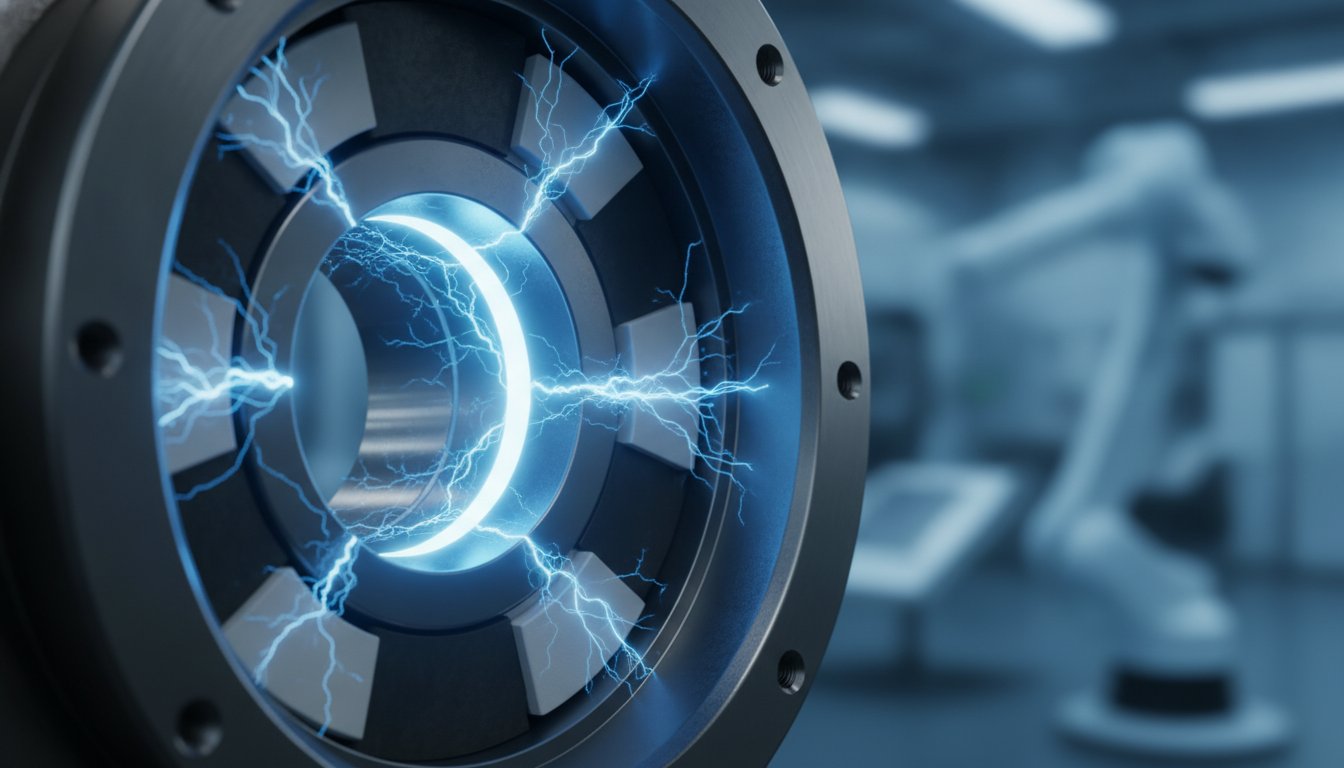
A slip ring voltage rating is not a flexible suggestion; it's a structural safety limit that, when ignored in harsh Australian environments, leads directly to catastrophic insulation breakdown. You likely recognise that a single electrical flashover can destroy sensitive equipment and halt a production line for days. Despite this, many engineers find themselves frustrated by the lack of clarity between peak AC values and continuous DC limits when specifying rotary components. It's a technical gap that often results in "off-the-shelf" components failing prematurely under local operating conditions.
We'll help you master the technical nuances of voltage selection to prevent arcing and ensure your installations remain compliant with AS/NZS 3000:2018 standards. By understanding how humidity and dust de-rate your hardware, you can effectively eliminate flashover risks and protect your assets. This guide examines critical specification factors, from dielectric strength to the reliability of Mercotac liquid metal connectors. You'll learn how to interpret manufacturer data correctly and select the right Meridian Laboratory or BGB Innovation solutions to optimise equipment service life across any industrial application.
Key Takeaways
- Understand why a slip ring voltage rating is a fixed structural constraint of the insulation material rather than a flexible operating suggestion.
- Learn how to maintain critical isolation between 415V power circuits and 5V data signals to eliminate cross-talk and electromagnetic interference.
- Discover how to de-rate hardware for harsh Australian conditions where humidity and conductive dust can compromise internal spacing and dielectric strength.
- Ensure all rotary electrical interfaces comply with AS/NZS 3000:2018 requirements to prevent catastrophic flashovers and equipment failure.
- Follow a structured specification framework that accounts for peak operating voltages and mechanical duty cycles to maximise equipment service life.
Understanding Slip Ring Voltage Rating: Beyond the Nominal Value
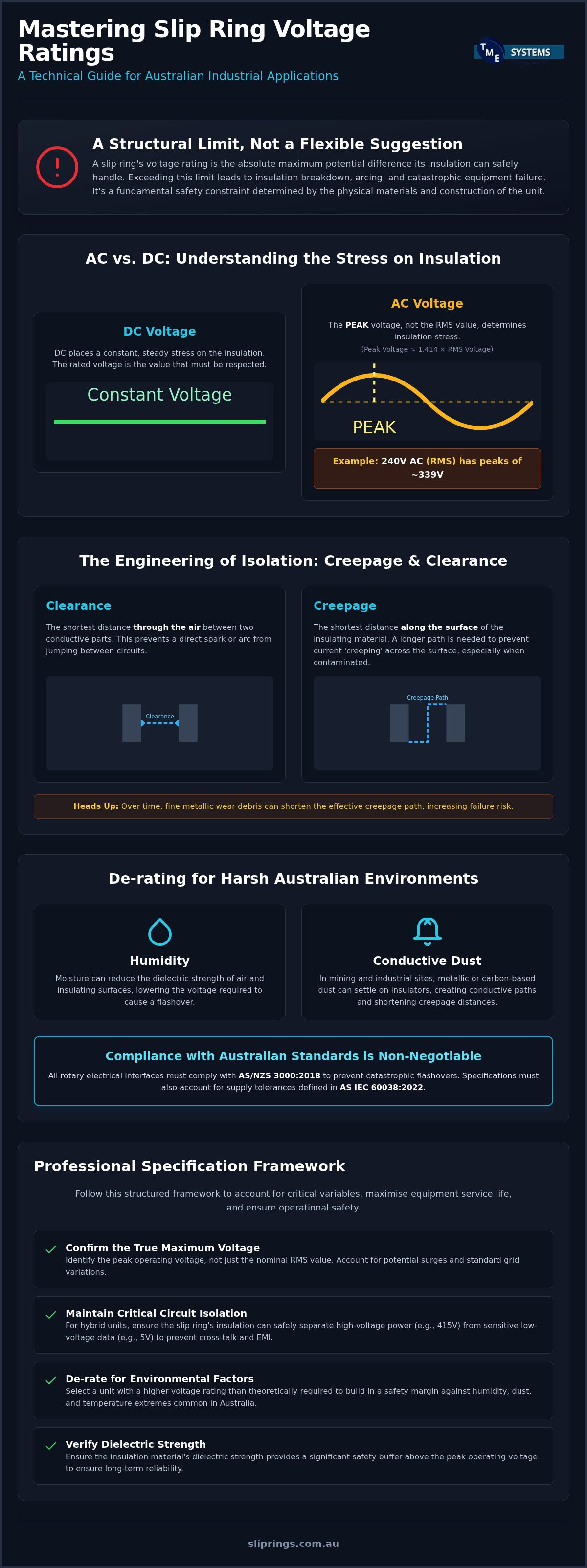
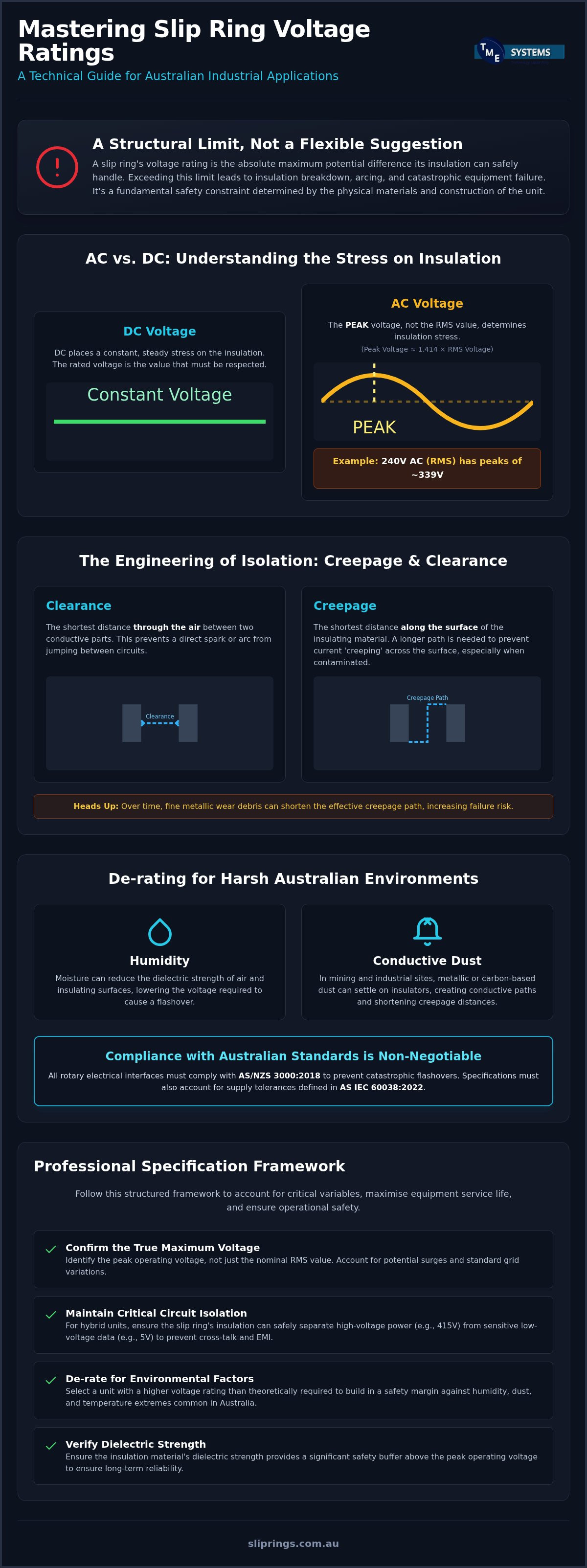
A slip ring voltage rating represents the maximum continuous potential difference that can safely exist between independent circuits or between a circuit and the grounded housing. It's a structural safety limit, not a performance recommendation. This rating is determined by the physical properties and thickness of the insulation material used to separate conductive paths. If you exceed this limit, the insulation fails. This results in short circuits, electrical arcing, and permanent hardware damage.
Specifying the correct rating requires a clear distinction between continuous operating voltage and peak voltage. While your system might run at a steady Root Mean Square (RMS) value, transient surges or spikes can momentarily exceed this. In Australia, engineers must also consider the supply tolerances outlined in AS IEC 60038:2022. This standard defines the nominal voltages for Australian electricity grids and the allowable variations. A slip ring specified too close to the nominal voltage may fail during a standard utility over-voltage event, making a conservative specification strategy essential for industrial reliability.
Operating Voltage vs. Dielectric Strength
Dielectric strength refers to the specific point where an insulating material fails and becomes conductive. It's the absolute breakdown threshold. To ensure long-term industrial reliability, a significant safety buffer must exist between the operating voltage and this failure point. TME Systems Pty Ltd evaluates these margins by analysing the specific dielectric properties of the polymers or ceramics within the unit. We ensure that the insulation remains robust even as materials age or face thermal stress. This prevents the common specification errors that lead to costly downtime in heavy industry.
AC vs. DC Voltage Considerations
AC and DC current place different stresses on insulation. AC voltages are particularly demanding because the peak voltage is significantly higher than the nominal RMS value. For instance, a standard 240V AC supply actually reaches peaks of approximately 339V. This peak value is what determines the stress on the insulation barrier. In high-voltage AC applications, you must also account for the corona effect, where the air surrounding the conductor ionises and begins to break down. When using Meridian Laboratory slip rings or Mercotac liquid metal connectors, it's vital to ensure the AC peak does not exceed the component's maximum DC rating to maintain circuit integrity.
The Engineering Behind Voltage Limits: Insulation and Dielectric Strength
The physical architecture of a rotary connector is the primary determinant of its slip ring voltage rating. Engineers must balance the need for high circuit density with the physical realities of electrical isolation. As internal spacing between rings decreases, the potential for arcing increases. This is why compact capsule slip rings often have lower voltage ceilings compared to larger industrial units. To maintain safety at higher voltages, manufacturers utilise specialised high-performance polymers or technical ceramics that provide superior dielectric strength within limited dimensions.
Mercotac liquid metal connectors represent a unique approach to internal isolation. By using liquid metal rather than sliding brushes, these units maintain exceptionally low noise and high integrity. However, their internal seals and fluid chambers must be engineered with precise tolerances to prevent voltage leakages between channels. If the internal spacing is compromised by poor design or wear, the insulation will fail, leading to equipment damage.
Creepage and Clearance Distances in Rotary Units
Effective voltage isolation relies on two distinct spatial measurements: clearance and creepage. Clearance is the shortest distance through air between two conductive parts. It prevents direct spark-over between rings. Creepage is the distance measured along the surface of the insulation material. In rotary units, this is more complex than in static connectors. Continuous movement can distribute fine metallic wear debris across the insulating surface, effectively shortening the creepage path over time. If the design doesn't account for this accumulation, the unit will eventually experience a surface tracking failure.
Insulation Resistance and Material Integrity
Insulation resistance (IR) is a critical metric for assessing the health of a slip ring. While a new unit should exhibit IR values in the giga-ohm range, these values naturally fluctuate based on environmental factors. Temperature is a major variable; as internal plastics heat up, their dielectric constant can shift, potentially lowering the insulation's effectiveness. Dielectric breakdown is a permanent failure of the insulating medium, occurring when the voltage stress exceeds the material's ability to resist current flow. Once a breakdown occurs, the insulation is physically carbonised and cannot be repaired. To avoid these failures, we recommend regular IR testing as part of a predictive maintenance schedule.
If you are unsure about the isolation requirements for your specific rotary application, our team can provide technical application consulting to ensure your hardware is correctly specified.
Managing Hybrid Units: Isolation Between Power and Signal Circuits
Combining high-power and low-voltage signal lines in a single assembly presents significant engineering hurdles. In Australian industrial plants, it's common to see 415V three-phase power circuits sharing a housing with 5V or 24V data lines. This proximity creates a risk of electromagnetic interference (EMI) and cross-talk, where the high-voltage field induces noise in the sensitive signal lines. The slip ring voltage rating of the internal insulation must be robust enough to prevent any potential for the high-voltage circuit to breach the isolation barrier and destroy downstream PLC or sensor equipment.
Meridian Laboratory high-speed units address this by using advanced shielding techniques. These designs ensure that high-frequency data, such as Ethernet or Profinet, remains clean even when adjacent to high-current power rings. A dedicated ground or earth circuit is also essential in these assemblies. It provides a low-impedance path for fault currents and helps drain away induced noise that could otherwise compromise data integrity.
Preventing Flashovers in Mixed-Circuit Assemblies
A failure in a high-voltage ring can cause a flashover that "jumps" to a signal ring, effectively sending 415V directly into a control system. To mitigate this, hybrid slip rings use a combination of physical barriers and increased air gaps. These barriers act as secondary insulation, ensuring that even if surface tracking occurs on one ring, it cannot easily bridge to the next. While traditional brush-type units require significant space for these gaps, liquid metal connectors offer superior signal integrity in compact spaces. They use isolated fluid chambers that naturally dampen electrical noise and provide high dielectric resistance.
Specifying Safety Margins for Industrial Safety
When determining the required isolation for sensor lines, you must look beyond the nominal operating voltage. Surge protection is vital to prevent transient spikes from breaching the insulation. If a spike exceeds the slip ring voltage rating, the resulting arc can permanently carbonise the insulation path. For complex builds involving multiple protocols and power levels, consulting on slip ring application engineering is the most effective way to ensure every circuit is protected. This methodical approach ensures that your signal lines remain isolated from power transients, preserving the life of your control hardware.
Environmental De-rating: How Australian Conditions Impact Voltage Safety
Australian environmental variables are often the primary cause of insulation failure in rotary connections. While a manufacturer might specify a slip ring voltage rating based on a clean, temperature-controlled laboratory, real-world industrial sites in Australia, particularly those exposed to extreme conditions, are rarely so accommodating. High humidity, salt-laden air, and conductive dust all work to shorten the effective creepage distances we established earlier. If you don't account for these factors during the specification phase, you risk a premature dielectric breakdown that could have been avoided through proper de-rating.
De-rating is the pragmatic engineering practice of operating a component below its maximum theoretical limit to compensate for environmental stress. A unit that safely manages 600V in a climate-controlled factory might only be suitable for 400V when mounted on a ship loader or a mining excavator. IP ratings, such as IP65 or IP67, provide a critical secondary defence by preventing the ingress of moisture and particulates. However, an IP rating alone doesn't change the internal physics of the insulation; it simply protects the environment in which that insulation operates.
Humidity and Condensation Risks
High humidity levels facilitate a phenomenon known as "tracking," where moisture creates a conductive path across insulating surfaces. This is particularly dangerous in environments with high salinity, where salt-laden air increases the conductivity of any condensation. Over time, these small leakage currents can carbonise the insulation material, creating permanent "carbon tracks" that eventually lead to a full flashover. In large enclosures, using internal heaters or desiccant packs helps maintain a dry internal environment, preserving the integrity of the dielectric barriers even during seasonal temperature swings.
Contamination and Dielectric Breakdown
Conductive dust, such as iron ore or coal fines, poses a severe threat to voltage safety by settling on insulating spacers and bridging the air gaps between rings. Even the wear from carbon brushes themselves creates a fine conductive film inside the housing over time. Using sealed BGB Innovation slip rings is an effective strategy for these environments, as their robust enclosures are specifically designed to keep contaminants away from the electrical interfaces. Maintenance protocols must include the regular removal of this internal debris to restore the unit's safety margins and prevent the accumulation of conductive paths.
To ensure your equipment is correctly specified for your local environment, contact the TME Systems Pty Ltd technical team for a comprehensive application audit.
A Professional Framework for Specifying Voltage Ratings in Australia
Selecting the correct rotary connector requires a structured evaluation of both electrical requirements and physical operating conditions. A generic approach often leads to over-specification, which is costly, or under-specification, which is dangerous. By following a professional framework, you can ensure your slip ring voltage rating provides the necessary safety margin without compromising system efficiency.
- Step 1: Identify nominal and maximum peak operating voltages. You must account for the highest possible transient peaks your system might encounter, including motor start-up surges.
- Step 2: Assess the duty cycle and rotation speed (RPM). High-speed applications generate more internal heat and wear debris, which can degrade insulation over long periods.
- Step 3: Evaluate the installation environment. Use the "Pollution Degree" classification (typically 1 to 4) to determine how much dust or moisture will impact the internal dielectric spacing.
- Step 4: Consult with a specialist. A technical audit ensures that the safety factor matches the criticality of the application.
Data Required for an Accurate Technical Quote
Providing a simple "240V" requirement is insufficient for a professional specification. To deliver an accurate quote, we require the full context of the application. This includes the total circuit count, the required current for each channel, and the expected rotational speed. Using Prosper Rotation data sheets can provide a baseline for selection, but these should always be reviewed against your specific environmental variables. Knowing the current and voltage simultaneously allows us to calculate the total power density and ensure the internal insulation can manage the resulting thermal load.
Partnering with TME Systems for National Support
Technical application consulting is the most effective way to reduce project risk and prevent electrical failure. TME Systems acts as a knowledgeable intermediary, bridging the gap between global manufacturing standards and local Australian requirements. We provide access to premium brands like Mercotac and Meridian Laboratory, ensuring that your facility uses components designed for long-term reliability. Our team, based in Ingleburn, supports clients nationally with precise circuit selection and voltage validation. Contact TME Systems for expert slip ring specification to ensure your next project meets the highest safety standards.
Securing Your Rotary Electrical Infrastructure
Mastering the technical requirements of a slip ring voltage rating is essential for maintaining the safety and longevity of industrial equipment. These ratings are rigid structural constraints dictated by insulation properties and physical spacing. Whether you're managing hybrid units with mixed power and signal lines or operating in the high-humidity environments common across Australia, precise specification is your primary defence against electrical failure. Ignoring the need for environmental de-rating often leads to costly downtime that could've been avoided through a methodical engineering audit.
TME Systems provides the technical expertise needed to bridge the gap between manufacturer data sheets and your specific application realities. As an authorised distributor for Mercotac and Meridian Laboratory, we offer specialist technical support to ensure your rotary connections meet Australian requirements. Our team in Ingleburn, NSW, provides national supply and consultative assistance for complex circuit counts and high-voltage isolation. Consult with our technical team for precise slip ring specification and ensure your next project operates with absolute integrity. We look forward to helping you optimise your equipment's service life.
Frequently Asked Questions
What happens if I exceed the slip ring voltage rating?
Exceeding the rating causes immediate dielectric breakdown, where the insulation material fails and becomes conductive. This often manifests as an internal arc that carbonises the plastic or ceramic barriers, creating a permanent short circuit. Once this path is established, the unit cannot be repaired and must be replaced. In high-power applications, this failure can lead to equipment fires or catastrophic damage to downstream control systems.
Can I use a signal-grade slip ring for low-voltage power transfer?
You shouldn't use signal-grade units for power unless the current and voltage specifications precisely match the load. Signal rings are designed with minimal spacing to reduce noise, which often results in a lower slip ring voltage rating. Even low-voltage power can generate enough heat to degrade signal-grade contacts. It's safer to specify a hybrid unit that provides dedicated, isolated channels for both power and data.
How does rotation speed (RPM) affect the voltage rating?
Increased rotation speed generates mechanical heat and metallic wear debris, both of which can compromise electrical isolation. As debris accumulates, it settles on insulating surfaces and effectively shortens the creepage distance between rings. This increases the risk of surface tracking and eventual flashover. High-RPM applications often require more frequent cleaning or the use of sealed liquid metal units to maintain their original safety margins.
Is there a difference between AC and DC voltage ratings for slip rings?
Yes, there's a significant difference because insulation must withstand the peak voltage, not just the average. For a 240V AC circuit, the peak voltage reaches approximately 339V, which places much higher stress on the dielectric material than a steady 240V DC supply. Always check if a manufacturer's rating is specified in AC RMS or DC, as using a DC-rated unit for an equivalent AC load can lead to insulation failure.
Do I need to de-rate my slip ring for high-altitude or high-temperature use?
De-rating is mandatory for these conditions because air density and temperature directly impact dielectric strength. At high altitudes, the thinner air provides less resistance to arcing, requiring greater clearance distances. Similarly, high temperatures can alter the dielectric constant of internal polymers, making them less effective insulators. If your installation is above 1,000 metres or in a high-heat environment, you must consult a specialist to determine the appropriate safety factor.
What Australian standards govern slip ring voltage safety?
The primary standard is AS/NZS 3000:2018, commonly known as the Australian Wiring Rules. This standard dictates the requirements for isolation and protection of electrical installations, including rotary connections. Additionally, AS IEC 60038:2022 provides the framework for nominal supply voltages and tolerances. Compliance ensures that your slip ring voltage rating is sufficient to handle standard grid fluctuations and safety requirements in industrial settings.
How do I test the insulation resistance of my slip ring?
You can test insulation resistance using a dedicated megohmmeter to measure the leakage current between independent circuits. Before testing, ensure the unit is disconnected from all power sources. Apply the manufacturer's recommended test voltage between rings and between each ring and the housing. A new industrial unit should typically show resistance in the giga-ohm range. Any significant drop over time indicates contamination or moisture ingress that requires maintenance.
Can a slip ring handle high-voltage surges from lightning or grid faults?
Standard slip rings aren't designed to absorb high-voltage surges from lightning or significant grid faults. Without external surge protection, these transients will likely exceed the unit's dielectric strength and cause an internal flashover. To protect your hardware, you should install primary surge arrestors upstream of the rotary connection. This is especially important in Australian regions prone to lightning or where the local grid is known for frequent switching transients.