In high-cycle pick and place robotics, the choice of contact technology dictates the boundary between automated efficiency and constant maintenance. Selecting the right slip rings for pick and place robots is critical to avoiding the frustration of unscheduled downtime caused by brush wear or the erratic signal interference that plagues data lines. It's often assumed that cable fatigue and restricted rotation are simply unavoidable costs of high-speed automation in a demanding industrial environment.
This guide demonstrates how to identify high-performance rotary connectors that solve these specific engineering hurdles. By prioritising signal integrity and mechanical longevity, you can achieve a truly maintenance-free operation even at high RPM. We'll explore the technical parameters for compact integration and stable data transmission, providing a clear pathway to optimise your robotic arms for long-term reliability. We will also compare contact materials and housing configurations to ensure your hardware survives the rigours of continuous, high-speed duty cycles without performance degradation.
Key Takeaways
- Understand how continuous 360-degree rotation eliminates the mechanical strain and cable twisting that typically leads to robotic system failure.
- Learn to calculate precise circuit counts and high-speed RPM ratings to ensure your hardware maintains signal integrity during rapid duty cycles.
- Compare the performance of conventional brush contacts against liquid metal technology to achieve near-zero electrical noise in sensitive data lines.
- Identify the correct IP ratings for slip rings for pick and place robots to protect against dust and moisture ingress in Australian industrial environments.
- Recognise why expert technical consulting is essential for matching complex electrical requirements with the physical constraints of existing robotic arms.
The Critical Role of Slip Rings in High-Speed Robotic Automation
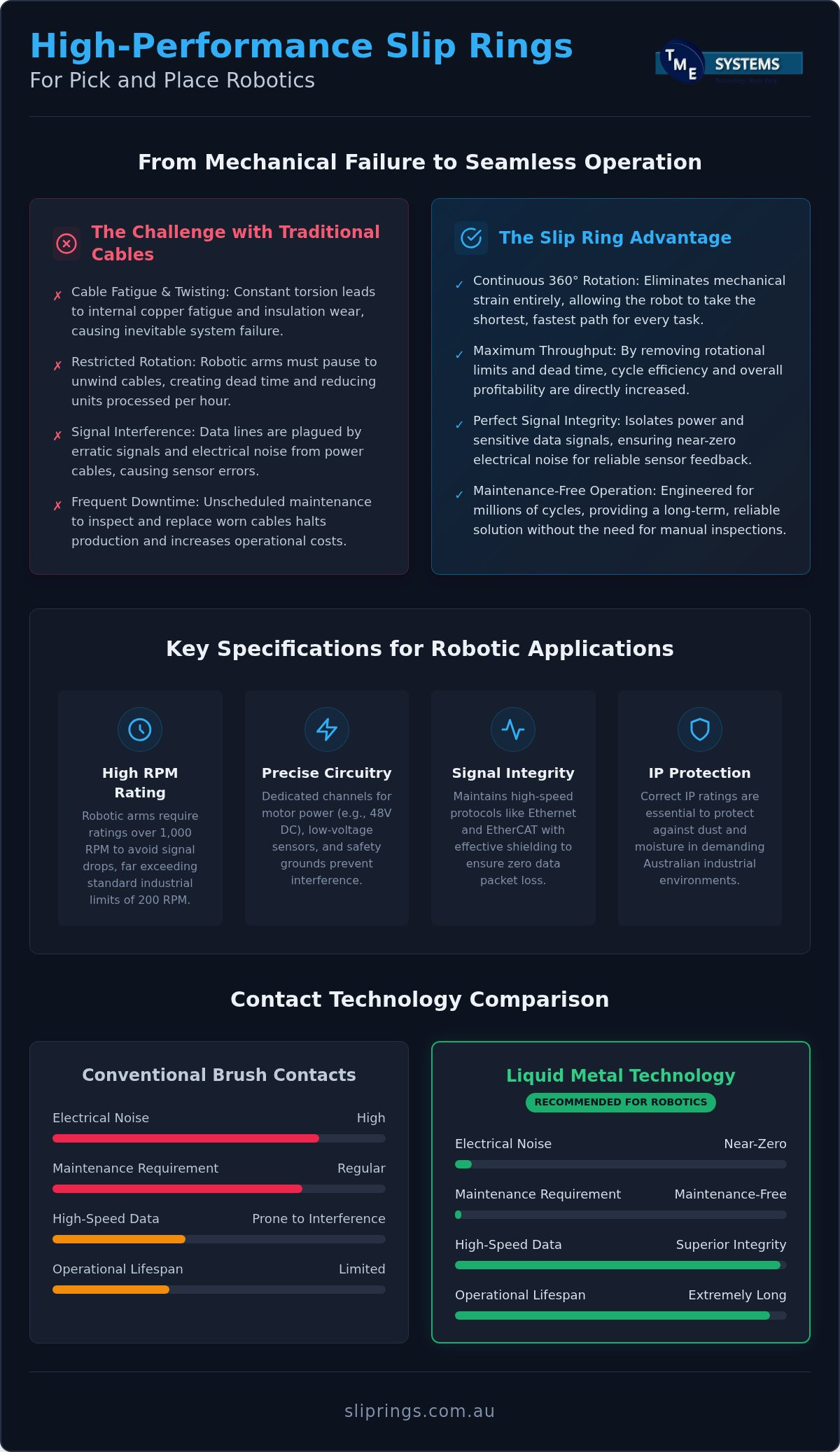
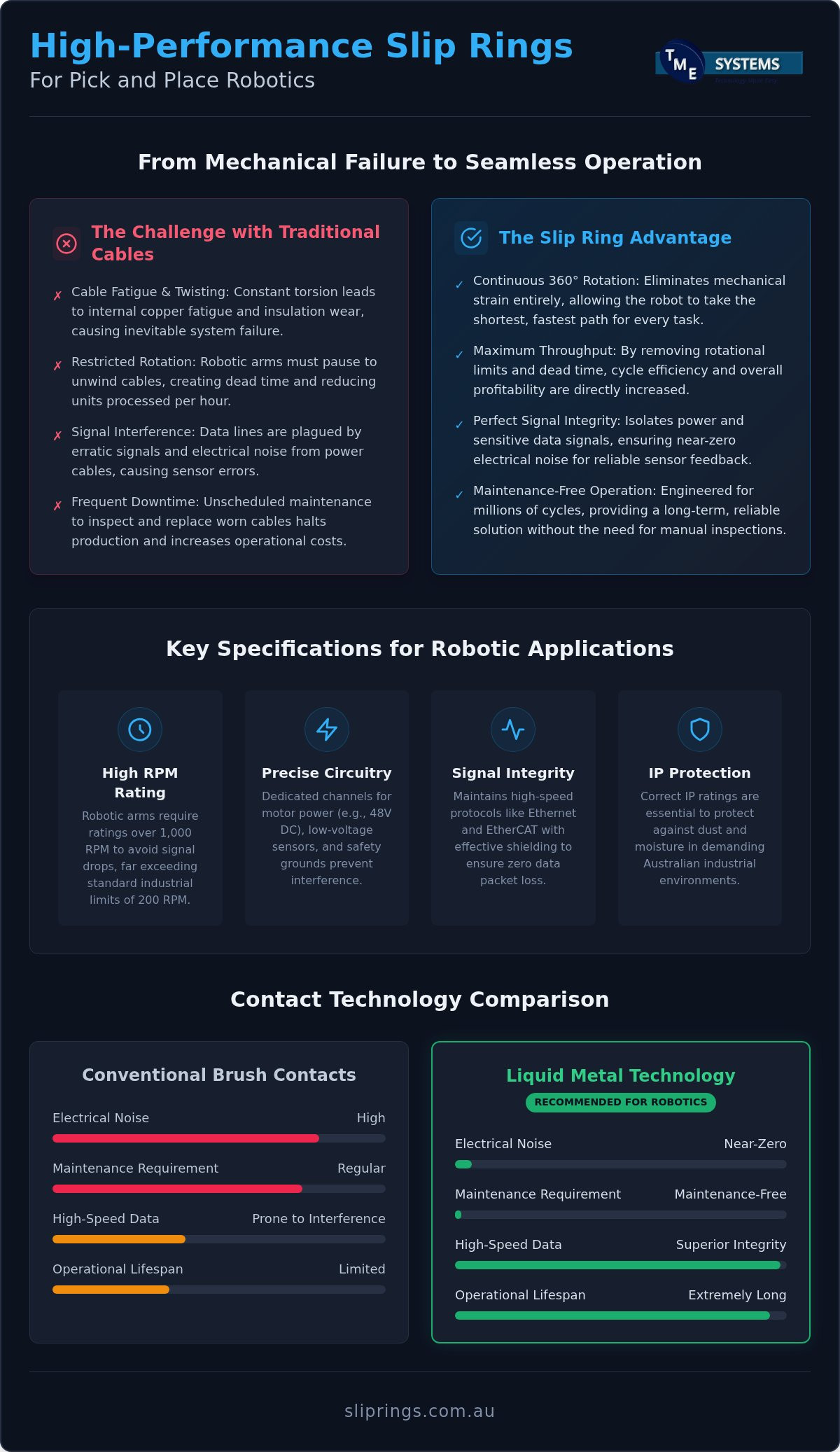
High-speed pick and place systems rely on rapid, repetitive movements to maintain high throughput. A slip ring acts as a rotary electrical interface, allowing for continuous 360-degree rotation while maintaining a constant electrical connection between a stationary base and a rotating arm. Without this component, slip rings for pick and place robots would be replaced by traditional wiring that inevitably twists and degrades. In high-frequency environments, rotational freedom isn't just a convenience; it's the primary driver of cycle time efficiency.
Traditional cables have a finite twist limit. Once a robotic joint reaches the end of its cable slack, the system must pause and rotate in the opposite direction to unwind. This creates dead time in the production cycle and introduces unnecessary mechanical stress. In contrast, integrating specialised hardware ensures that the robot can take the shortest path to its next coordinate, directly increasing total units processed per hour. This efficiency is vital in Australian manufacturing sectors where labour costs and production speed dictate overall profitability.
Eliminating Cable Fatigue and Tangling
Flex-cables are designed for movement, but they aren't immune to the mechanical stress of constant torsion. In a 24/7 manufacturing facility, standard cabling often fails due to internal copper fatigue or insulation wear. Slip rings allow for infinite rotation, which removes the need for complex cable management systems that add bulk and weight to the robotic arm. By simplifying the wiring, engineers can achieve:
- Reduced physical footprints: Smaller cable looms allow for more compact robotic cells.
- Lowered mechanical resistance: Removing cable tension enables faster pivots and higher RPM.
- Simplified maintenance: Eliminating sacrificial cable loops reduces the frequency of manual inspections.
Enabling Multi-Axis Transmission
Modern 4-axis and 6-axis robotic systems require a simultaneous transfer of high-voltage power for drive motors and sensitive low-voltage signals for end-of-arm tooling, such as vacuum sensors or grippers. High-quality components, such as those from Mercotac or Meridian Laboratory, ensure these signals remain isolated and interference-free. This multi-channel capability is what allows a robot to perform complex, multi-dimensional movements without losing signal integrity. A rotary union serves as the mechanical counterpart to a slip ring, facilitating the transfer of fluids or gases for pneumatic and hydraulic end-effectors. Ensuring these systems work in tandem is a core focus of technical application consulting, where the goal is to match electrical circuit requirements with the physical constraints of the robotic arm.
Key Technical Specifications for Pick and Place Performance
Selecting slip rings for pick and place robots requires a precise audit of your electrical and mechanical loads. Start by defining the circuit count. You'll typically need dedicated channels for high-current motor power, low-voltage sensor signals, and a reliable safety ground. Mixing these in a single housing requires careful engineering to prevent electromagnetic interference. High-speed robotic actuators often operate at 24V or 48V DC, while sensors might require millivolt-level sensitivity. If the voltage drop across the rotating interface is too high, it'll trigger system errors or inconsistent gripper performance.
Pick and place applications are defined by speed. While a standard industrial slip ring might handle 200 RPM, robotic arms often demand ratings exceeding 1000 RPM. At these velocities, contact friction becomes a significant source of electrical noise. This noise can distort the square waves of digital signals, leading to packet loss in high-speed data streams. Ensuring your hardware is rated for your maximum operational velocity is the only way to avoid intermittent signal drops during rapid pivots.
Signal Integrity and Data Rates
Maintaining high-speed protocols like Ethernet, EtherCAT, or Profibus through a rotating joint is a common bottleneck. Effective shielding is mandatory to prevent high-frequency power pulses from bleeding into data lines. A poor signal-to-noise ratio doesn't just slow down communication; it directly impacts the precision of pick and place sensors. If a sensor's feedback is delayed by even a few milliseconds due to signal re-transmission, the robot's placement accuracy will drift. For mission-critical precision, technical application consulting can help determine the optimal contact technology for your specific data rates.
Mechanical Mounting and Compact Design
The physical configuration of the slip ring must align with the robot's architecture. Through-bore designs allow the slip ring to slide over a central shaft or accommodate pneumatic lines, while capsule designs offer a compact, self-contained solution for tight spaces. Weight is another critical factor. Adding excessive mass to the end-of-arm tooling increases the inertia that the robotic motors must overcome. This can lead to slower acceleration times and increased motor heat. Minimising this load is essential for maintaining the high-cycle throughput that defines pick and place automation. Customising mounting flanges ensures a seamless fit without the need for bulky adapters that could interfere with the robot's range of motion.
Comparing Contact Technologies: Liquid Metal vs. Conventional Brushes
The internal architecture of slip rings for pick and place robots determines how long the system operates before requiring manual intervention. Conventional brush contacts rely on physical friction between a stationary brush and a rotating ring. Typically made from carbon or precious metal alloys, these brushes must press firmly against the ring to maintain conductivity. This mechanical contact creates wear debris and increases electrical resistance as the surfaces degrade. In high-cycle robotic environments, the true cost of a component is measured by its "cost per million revolutions". This figure includes the initial hardware price plus the cumulative expense of cleaning, maintenance, and the downtime required for replacement.
Liquid metal connectors offer a fundamentally different approach. By replacing the sliding brush with a pool of conductive liquid metal, these units provide a near-perfect electrical path with negligible resistance. There's no physical rubbing of solid parts, which means electrical noise is virtually eliminated. For high-speed pick and place robots that rely on millisecond-perfect data feedback, this lack of interference is the difference between a fluid production line and one plagued by intermittent sensor errors.
The Mercotac Advantage for Signal Quality
The primary benefit of Mercotac slip rings is their ability to maintain a constant, low-resistance connection regardless of rotational speed. Traditional brushes often suffer from "contact bounce" at high RPM, where micro-vibrations momentarily break the circuit. Liquid metal technology inherently absorbs these vibrations, ensuring a stable signal. Because there's no debris from brush wear, the risk of internal shorts or signal degradation over millions of cycles is removed. This makes them a maintenance-free solution for the duration of their service life, significantly reducing the total cost of ownership in high-output facilities.
When to Use Traditional Brush Systems
While liquid metal is superior for noise reduction, traditional brush systems are still the preferred choice for specific configurations. If your robotic application requires an exceptionally high circuit count in a single compact housing, brush-based systems often provide greater configuration flexibility. Beyond this, certain environmental restrictions or industry-specific safety standards may require mercury-free alternatives. In these scenarios, high-performance units from Meridian Laboratory are highly effective. These systems utilise advanced precious metal alloys to minimise electrical noise and extend the service interval far beyond what's possible with standard carbon brushes. Choosing between these technologies requires a careful audit of your circuit requirements and environmental constraints.
Addressing Environmental Challenges in Australian Industry
Australian industrial environments present unique challenges for slip rings for pick and place robots. Unlike climate-controlled facilities in other regions, local manufacturing sheds often endure extreme temperature fluctuations and high levels of airborne particulates. When a robotic arm operates at high RPM, internal friction generates heat that must be effectively dissipated to prevent component failure. If the ambient temperature in a shed reaches 45°C during a summer heatwave, the internal temperature of a poorly specified rotary connector can quickly exceed its safe operating limit.
Vibration and mechanical shock are equally critical factors. The rapid acceleration and deceleration inherent in high-cycle pick and place tasks put immense strain on internal bearings and contact surfaces. If the slip ring isn't designed to withstand these forces, you'll see premature wear or intermittent signal loss. For corrosive environments or facilities requiring frequent wash-downs, specifying 316 stainless steel housings is essential to prevent oxidation and ensure long-term structural integrity.
Heat and Thermal Management
High-speed rotation naturally creates thermal energy within the housing. Aluminium housings are often preferred for their superior thermal conductivity, allowing heat to move away from the sensitive internal contacts more efficiently than plastic or steel alternatives. Stainless steel, while more durable in corrosive settings, has lower thermal efficiency and may require a larger surface area or specific ventilation in extreme cases. It's vital to check that your hardware's operating range accounts for both the heat generated by the duty cycle and the ambient conditions of the Australian workshop.
Sealing and Ingress Protection
The choice between IP65 and IP67 ratings depends on your cleaning protocols and environmental exposure. IP65 is generally sufficient for protecting against dust and low-pressure water jets, whereas IP67 is required if the unit might be temporarily submerged during deep-clean cycles. In food and pharmaceutical packaging, seals must also prevent internal lubricants from contaminating the production line. Labyrinth seals provide a non-contact, tortuous path that prevents dust and moisture from reaching the internal components without adding the friction associated with traditional lip seals. To ensure your hardware meets these rigorous standards, you can request a technical consultation for your specific site requirements.
Expert Consultation and Procurement for Australian Robotics
Selecting slip rings for pick and place robots is a specialised engineering task that extends beyond matching physical dimensions. A successful installation requires a thorough audit of the robot's operational duty cycle to ensure the hardware can withstand the specific mechanical and electrical stresses of your facility. To facilitate a professional review, you'll need to provide several critical data points: the maximum operational RPM, the required amperage per circuit, the peak voltage, and the specific nature of the data signals, such as EtherCAT or high-speed analogue sensor feeds. These parameters allow for a precise calculation of thermal loads and potential signal interference.
Streamlining the procurement process for both new builds and replacement parts involves moving from a simple vendor relationship to a technical partnership. By engaging with a consultant early in the design or maintenance phase, you can verify that your chosen rotary connectors are fit for purpose. This proactive approach prevents the common pitfalls of underspecified hardware, such as premature contact wear or intermittent data loss, which can halt a production line for days. Expert review ensures that every component is optimised for the high-cycle rigours of modern robotic automation.
Technical Support and Specification Audits
Collaborating with application engineers allows you to match slip ring specifications to the exact acceleration curves and deceleration forces of your robotic joints. This process is vital for reducing the risk of incorrect part selection, which often leads to expensive rework or system instability. A professional audit considers the cumulative effect of electrical noise and mechanical vibration on your specific toolpath. For a deeper dive into these technical requirements, our reference on slip ring application engineering provides a comprehensive framework for Australian industry standards.
Reliable Supply Chains for Australian Industry
Sourcing components through a specialist Australian distributor provides a level of security that international vendors cannot match. We maintain a consistent national supply of Mercotac and Prosper Rotation components, ensuring that critical spares are available without the lead times associated with global shipping. Local technical documentation and support are also essential for troubleshooting and seamless system integration on-site. The next step in optimising your robotic efficiency is to contact TME Systems for a formal technical consultation, where we can verify your hardware specifications against your current operational demands.
Optimising High-Cycle Robotic Throughput
Selecting the correct slip rings for pick and place robots ensures that your automation remains a driver of efficiency rather than a source of maintenance downtime. By prioritising low-resistance contact technologies like liquid metal and specifying IP-rated housings for Australian conditions, you can eliminate signal interference and cable fatigue. Matching these components to your specific RPM and circuit requirements is the most effective way to secure long-term reliability in high-speed applications.
As an authorised distributor for Mercotac and Meridian Laboratory, TME Systems provides specialised expertise in high-speed rotary connections. Our technical support is based entirely in Australia, ensuring you have access to professional audits and reliable local supply chains. We invite you to consult with TME Systems for expert slip ring selection to verify your hardware requirements before your next installation. Taking a proactive approach to specification will ensure your robotic systems achieve the throughput and precision your facility demands.
Frequently Asked Questions
How do I choose between a capsule and a through-bore slip ring for my robot?
Choose a capsule design when space is limited and you need a compact, self-contained unit for end-of-arm tooling. A through-bore slip ring is necessary if you need to pass a mechanical shaft, pneumatic lines, or hydraulic hoses through the centre of the rotation. Technical consulting helps determine if the bore diameter matches your robotic arm's internal clearance requirements while maintaining the required circuit count and electrical integrity.
Can slip rings transmit high-speed data like Ethernet without errors?
High-speed data transmission is achievable provided the slip ring is engineered for signal integrity. Slip rings for pick and place robots often use specialised shielding and low-resistance contacts to support Ethernet, EtherCAT, and Profibus protocols. This prevents packet loss and maintains the real-time feedback required for precise robotic movements. Liquid metal connectors are particularly effective here as they provide a constant connection without the signal noise associated with traditional brushes.
What is the typical lifespan of a slip ring in a 24/7 pick and place operation?
The lifespan depends heavily on the contact technology and operational RPM. Traditional brush-based systems may require maintenance or replacement after 50 to 100 million revolutions due to physical wear. In contrast, liquid metal units often last the entire life of the robotic arm without requiring internal maintenance. Factors like ambient temperature and duty cycle frequency will also influence the total service interval in a high-cycle Australian production environment.
Are there mercury-free alternatives for food-grade robotic applications?
Yes, mercury-free alternatives are essential for food-grade and pharmaceutical applications where contamination risks must be eliminated. Meridian Laboratory slip rings utilise advanced precious metal alloy contacts to provide high-performance rotation without the use of liquid mercury. These units maintain low electrical noise and high reliability, making them suitable for wash-down environments and strict hygiene standards found in Australian packaging facilities. They offer a dependable solution where environmental regulations prohibit mercury.
How does electrical noise in a slip ring affect robotic precision?
Electrical noise creates "jitter" or interference in the feedback signals sent from the robot's sensors to its controller. If the signal-to-noise ratio is poor, the robot may experience positioning errors or delayed responses during high-speed tasks. High-quality slip rings for pick and place robots minimise this noise, ensuring that the control system receives clean data for sub-millimetre placement accuracy and consistent gripper timing throughout millions of operational cycles.
What maintenance is required for high-speed rotary connectors?
Maintenance requirements vary by design. Conventional brush slip rings require periodic inspection for dust accumulation and brush wear to prevent signal degradation. You'll need to clean the contact surfaces and eventually replace the brushes to maintain conductivity. Conversely, liquid metal connectors are hermetically sealed and maintenance-free. They don't generate wear debris, which eliminates the need for scheduled internal servicing during their operational life in a high-speed robotic cell.
Can a single slip ring handle both high-current power and sensitive signals?
A single slip ring can handle both high-current power and sensitive data signals if the internal circuits are properly isolated. Engineers use physical spacing and electromagnetic shielding to prevent power lines from interfering with low-voltage sensor data. Specifying the correct number of power and signal channels during a technical audit ensures the unit can drive robotic actuators while simultaneously transmitting high-frequency control protocols without any cross-talk or signal degradation.
Do I need a special IP rating for a slip ring used in a wash-down environment?
Wash-down environments require a higher level of ingress protection to prevent moisture and cleaning agents from entering the housing. An IP65 rating protects against low-pressure water jets, while IP67 is necessary if the unit is subject to heavy splashing or temporary submersion. For food processing applications, you should also ensure the housing material, such as stainless steel, is resistant to the corrosive chemicals used in Australian industrial cleaning protocols.